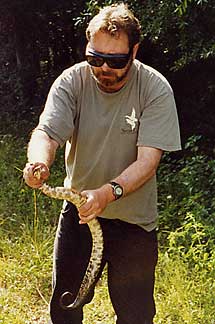
Kris, you said it perfectly and I really can't add anything to it. Upscale got bent out of shape over remarks I made that were taken far out of context. I should just bite my lip but for the sake of beginners who may be reading this thread, I'll respond. Upscale did indeed showed photos of venomous snakes being "handled" either for the purpose of milking, showing off, or, T.V. (and not all showed proper technique). Is the average hobbyist going to be starting his/her own venom extraction lab or making appearances on T.V.? Doubtful. Is it necessary to physically touch a venomous herp? In all honesty, you could potentially keep a vneomous snake w/out ever touching it (even to administer meds); but that may be difficult depending on the application or situation. So, yes, there are times when contact is necessary but should never be done by someone keeping a venomous herp for the first time. Do I make contact with my venomous herps? Yes, but we have over 100 and having worked with them for many years with a perfect safety record, I would never have considered hooking/tailing or pinning (which really should never be done unless it's absolutely required) when I first started. Sure, hook and tailing of fast moving and agile elapids is most likely an important technique to master but not necessarily a requirement of keeping one. Most folks (99.9% in my opinion - that's a bit of an exageration so hold the comments) wishing to own a venomous snake, particularly an elapid, probably shouldn't. Most folks don't have the proper facilities, access to A/V, experience, skills or emergency protocols in place to responsibly keep them. The key to keeping venomous herps successfully is to not get bit; it's really that simple. You get bit when you expose yourself by using poor judgement (immaturity, showing off, drugs/alcohol, etc.), underestimating the snake (strike distance, speed, not being able to read the snake, etc.), or playing the Darwinian odds (the more you physically touch the snake, the more chance you have of getting bitten). You reduce the Darwinian odds by using proper tools (and mastering their usage) when working with venomous snakes. There is still an inherent risk and although I am not a big fan of most folks keeping them, there are enough responsible people, like Kris and others, where I support their rights to own them as private individuals; but they are few and far between.
>>it was never necessary to have actual contact with a venomous snake? And for that matter, who is stating that all one needs to maintain these animals safely and successfully is sturdy caging, a few hooks, tongs and some goggles? I don't read the responses here to imply that at all...
>>
>>The fact of the matter is that sometimes (rarely) it IS necessary to come into contact with your venomous snakes...administering meds and other necessary husbandry practices do necessitate exposure to the business end of the snake...I don't think anyone is arguing this...Is keeping these animals inherently dangerous? Certainly....but the MOST IMPORTANT ingredients in order to avoid looking at daisy roots from the bottom are sound handling techniques, sound safety protocols in the event of a bite and some good ole' fashioned common sense...Sound handling techniques include the proficient use of hooks and other handling equipment in an effort to do what you have to do with minimal contact with the snake.
>>
>>The pics posted of various snakes being milked give an unrealistic picture of what a "newbie" can expect when entering the foray of ven keeping...virtually all of the photos depict an animal being milked...There is no reason a private keeper should ever do this...Medical facilities wouldn't accept milkings from private parties (too much risk of contamination) and it puts both the keeper and the kept at grave risk of injury or death...
>>
>>Appropriate use of tubes, hooks, tongs, etc. is the safest way to manipulate these animals...Anyone that argues that it's "better" to have alot of personal contact with their cobra or rattlesnake is beggin' for a Darwin award IMO...Whether or not consistent handling influences the behavior of these animals is irrelevant...even the "tamest" snake will have its bad days, and with alot of these animals all it takes is one.
>>
>>Upscale, if you want to "keep it real" this is as real as I can keep it...Yes, it is necessary at times to handle a venomous snake...However, those instances are few and far between thanks to tubes, hooks, etc. Yes, one does have to have confidence and knowledge when dealing with these animals. Purporting the idea that it is necessary or safe to handle animals in the manner depicted in the photos you posted is misdirected and erroneous...Milking snakes is never necessary for the private hobbyist and crouching over a C. adamanteus, preparing to grab it behind the head certainly does NOT fall into the "good sense" category required for responsible husbandry, regardless of who does it.
>>
>>Stepping off my soap box now....
>>
>>-AzAtrox
>>
-----
Rob Carmichael, Curator
The Wildlife Discovery Center at Elawa Farm
Lake Forest, IL


 I am 23 and a veterinary student with an interest in exotics and infectious disease. Thanks for the notes, guys, I really appreciate your knowledge and advice.