Reptile & Amphibian Forums

Welcome to kingsnake.com's message board system. Here you may share and discuss information with others about your favorite reptile and amphibian related topics such as care and feeding, caging requirements, permits and licenses, and more. Launched in 1997, the kingsnake.com message board system is one of the oldest and largest systems on the internet.

Click here for Dragon Serpents
Click for 65% off Shipping with Reptiles 2 You

New to Rainbows - Hi!

Liann Jun 11, 2007 03:49 PM

Just wanted to say hello! I've been wanting to add a BRB to my collection for a long time and finally brought home a baby female this past weekend. I'm not new to snakes (have Boas, Bp's, Milks, & Corns), but this is my first BRB.

So far she is really tame. I've been waiting for her to snap out of it and become a normal nippy hatchling, but she hasn't "yet". She's not jumpy at all and is surprisingly calm when being held although I've been careful not to hold her much since bringing her home Sat. morning. I fed her a frozen thawed fuzzy this morning and half expected her to grab it and coil, but instead she just crawled over to it, opened her mouth, gently took it off the hemostats and started to swallow it. :? Did I just get really lucky, or is she just waiting for me to lapse into a false sense of security?

I've read a lot about their biting and getting scared easily, so I was kind of prepared for that type of behavior. For those of you who have owned them for a while, do you find that their "personalities" vary - some being calm and some always uptight? I'm keeping my fingers crossed that she is always this easy to deal with.
-----
-----
Amber

Replies (36)

TimOsborne Jun 11, 2007 04:01 PM

Welcome Amber..
BRB's certainly do vary a bit from individual to individual - you will also find different feeding "attitudes" sometimes when you feed your pet. Usually, they have a pretty strong feeding response, but I have occassionally had one of mine take the rodent gently and start to munch it like your did.

They are great pets.. handle it some (give a day or two since you just fed it.. ) and it should calm down and be fine. You may get bit a time a two in the process, but a young brb's bite is not bad at all.

Since your new to rainbows.. make sure you have a good care sheet and follow it. Young brb's require milder temps and a lot more humidity then most of the other boids.

If you ask real nice, I am sure Dave will post his care sheet for you - it is one of the best pieces of information available on captive husbandry for brbs..

Hang around the forums too.. we have a lot of fun and get way off topic.. but there is a lot of experience and a lot of great people.

BTW - You owe us pics now (of the brb.. )

>>Just wanted to say hello! I've been wanting to add a BRB to my collection for a long time and finally brought home a baby female this past weekend. I'm not new to snakes (have Boas, Bp's, Milks, & Corns), but this is my first BRB.
>>
>>So far she is really tame. I've been waiting for her to snap out of it and become a normal nippy hatchling, but she hasn't "yet". She's not jumpy at all and is surprisingly calm when being held although I've been careful not to hold her much since bringing her home Sat. morning. I fed her a frozen thawed fuzzy this morning and half expected her to grab it and coil, but instead she just crawled over to it, opened her mouth, gently took it off the hemostats and started to swallow it. :? Did I just get really lucky, or is she just waiting for me to lapse into a false sense of security?
>>
>>I've read a lot about their biting and getting scared easily, so I was kind of prepared for that type of behavior. For those of you who have owned them for a while, do you find that their "personalities" vary - some being calm and some always uptight? I'm keeping my fingers crossed that she is always this easy to deal with.
>>-----
>>-----
>>Amber
-----
photos.xtremecombatsports.com

rainbowsrus Jun 11, 2007 04:14 PM

Brazilian Rainbow Boa Care Sheet

Description

Brazilian Rainbow boas (BRB) are a subspecies of Epicrates cenchria, commonly known as Rainbow Boas. The range of BRBs is quite large. It includes northern Peru and Brazil, southern Venezuela and Guyana and much of Surinam and French Guiana. Although not endangered, due to habitat destruction they are not common in their range. They are a semi-arboreal, slender-bodied snake with an adult size of 5-7 feet, females being slightly larger than males. They have beautiful coloration ranging from a deep red to orange, sometimes brown, with dark rings down their back, and several rows of dark spots along their sides, the first row that is highlighted by bright, light-colored crescents.

They get their name from their incredible iridescence caused by microscopic ridges on their scales that act like prisms to turn light into rainbows.

Housing

Neonates and sub-adults do very well housed in Rubbermaid containers or similar. Adults need a minimum of somewhere around 4 to 6 square feet of caging. Substrates that BRBs do well on include sphagnum/peat moss, Care fresh, newspaper, and cypress mulch. I keep mine on a layer of dimpled craft paper with a couple of layers of newspaper underneath for added absorbency. Neonates require a much higher humidity level than adults and can be housed successfully on paper towels. With such high humidity comes mold, therefore attention must be kept to maintaining very clean cages. They should have free access to a large bowl of fresh water at all times (large enough to soak in). As adults they will usually drink large amounts of water and will not require nearly as high relative humidity in their cages. Unless they are on several inches of loose substrate that they can burrow in, they should also be provided with adequate hiding spots. Though not an absolute necessity, perches and shelves can be added to the enclosure.

Common mistake - using a fish tank with a screen top, This will lose most of the humidity and dry out your BRB. If not corrected will lead to Upper respiratory problems and death.

Temperature and Humidity

They are more tolerant of lower ambient temperatures than many other boids, though they cannot tolerate excessive heat well. They should have a temperature gradient of 75 - 83 degrees. Temperatures exceeding 85 degrees can be fatal.

Common mistake - measuring temps at mid cage. BRBs will spend most of their time on the cage floor, this is where the temps should be measured.

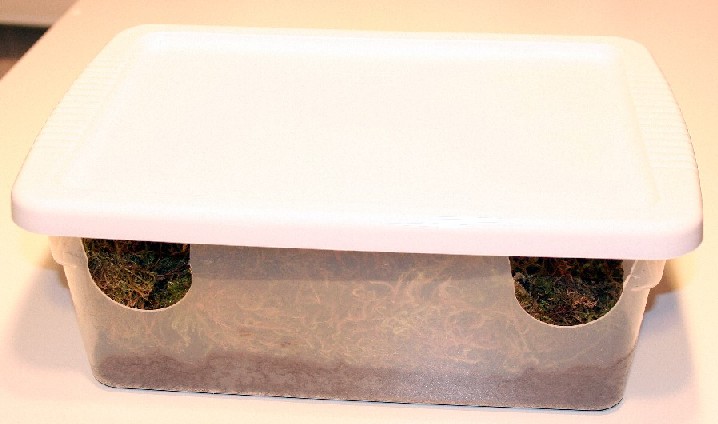
Adult BRBs require a minimum humidity level of 75%+. Should humidity drop into the 60’s or 50’s for an extended period of time the results can be respiratory infections, regurgitation, and death by dehydration. For my adults I make a “damp hide” from a sweaterbox size tub with two access holes in one side. I put 1 inch of peat moss and one inch of green moss. Both nice and damp. They love to hang out in there and come out to explore at night.

Neonates should be kept at or near 95%+ humidity. I accomplish this with a fairly tight fitting shoebox rack. There’s always condensation at the front. Temps for babies should be right around 77 degrees.

Humidity is affected by two factors, evaporation and dissipation. The larger surface area water dishes will evaporate more into the air. By minimizing ventilation, you will keep that humidity in the enclosure.

Common mistake - thinking daily spritzing will make up for lack of natural humidity. If your enclosure is set up properly with adequate water sources and minimal ventilation, spritzing is not required.

Handling

BRBs can be somewhat nervous snakes. Babies are born striking at anything, but with regular, gentle handling they can tame down quite nicely to become acceptable pets. As babies, let them strike at you, bite you and even chew on you. This will show them you will not be chased away by those actions and they will soon learn the big bad hand is nothing to be afraid of. Pick up the baby with a steady non-tentative action. The baby will typically be coiled or piled in one spot. Aim for the side away from the mouth and just do it! If you are bit, there will be minimal pain and quite likely several pinholes in your skin. Resist the urge to pull back, that will only make it worse. BRB’s have teeth that curve backwards to hold onto their prey. If you pull away, you will tear your skin and could easily damage some of their teeth.

They are typically a more active snake when being held than your average boa, seemingly always on the move. This is not to say that they will not grip on to you tightly, these boas keep a good hold. Be careful when holding not to startle them, as rainbows can nip when scared.

Feeding

BRBs are voracious feeders that feed primarily on rodents, birds, lizards, and possibly aquatic life forms as well. In captivity they eat mice and rats approximately the same size as the largest part of the snakes girth. Neonates are born large enough to take hopper mice and rat pinkies. If these boas refuse food, their husbandry should be carefully examined. Stress, poor husbandry, or illness is the likely causes of a BRB that refuses to eat.

Babies should be fed on a schedule of from once every four days to once a week. Most of them will continue to feed even when they are opaque prior to shedding. These snakes are born large enough to take hopper mice as their first meal. Many of mine have done well starting out on rat pinkies. A reluctant snake may be induced to feed by placing it in a small tub or even a paper bag along with the food item. Place the smaller container back in the secure cage in case the baby escapes and leave it for an hour, if still not eating, can be left overnight.

Common mistake - feeding pinky mice to baby BRBs. If you have an unlimited source of pinky mice then go ahead but be prepared to feed several to each baby at each feeding.
A mouse pinky will make a very small lump in a baby BRB and be digested down so that the lump is no longer externally visible within 24 hours.

BRBs will grow rapidly on one appropriately sized mice/rats a week. Yearlings often grow to 48 inches in length though 36 to 40 inches is more typical. Many two-year-olds are four and a half to five feet long. Females and males are not significantly different in size. Adult males can do well on 20 medium sized rats per year. A breeding female will require two to three times as much to eat.

BRBs are often overfed to obesity in captivity as adults. At 2', the snake is large enough for pinkie rats and jumper mice. At 3', it is capable of consuming adult mice and young rats. Feed at least once every 10 days, when the snake begins feeding on large meals such as rats feeding can occur less frequently. Avoid handling after a sizable meal; it is stressful and may cause regurgitation. Many animals may be conditioned to accept pre-killed or thawed warmed rodents at feed time. This technique is safer, than feeding live rodents since this prevents the snake from being bitten by a rodent. Live feeders should be avoided except for the few (very few) snakes that will not eat anything else. Never leave a live rodent in the with a snake unattended. A rodent can cause serious damage to your pet!

Never handle rodents and then handle a snake; you may be mistaken as food. Develop proper feeding habits. As the snake grows it may be wise to feed the snake only dead rodents and move it to a feeding container prior to food offering. If moved to a feeding container for all feedings it may become conditioned not to expect food while in its' cage. This may reduce the possibility of being mistaken as a food item by an over zealous feeder. Best method is to place dead rodent in container and let snake discover it, encourages gentle food acquisition. Maintain accurate feeding and health records.

Shedding

Shedding is dependent on the animal's growth rate and condition and may occur every 3 - 6 weeks. They may refuse feeding attempts while shedding. Increase the humidity as a rainbow approaches a shed, this helps to avoid dry shed. With proper humidity, the shed should come off without shredding. Can easily get torn but should not be tattered. If the snake is having a bad shed where parts are stuck on, wet a pillowcase, put snake in pillowcase and tie knot in pillowcase to prevent snake from getting out. Place pillowcase back in enclosure at a neutral temp location and leave for a couple of hours. If still not fully shed, you can continue pillow case treatment overnight.

Breeding

BRB breeding practice is similar to that of the common boa. They can produce litters with up to 35 young. They can be bred as early as 2.5 years providing they are meet minimum size and weight requirements of 5+ feet and weighing more than 3.5 pounds for females. Another six inches of length and pound of weight is more appropriate and should produce a larger first litter with less strain on the snake. Males should be 5 feet and 2.75 pounds, though many are this size at 30 months, they usually won’t breed until 42 months. They should not be bred unless they are extremely healthy, as breeding takes a lot out of them.

Cooling is necessary for successful production of egg and sperm cells. Breeding may be induced by night time temperature drops down to 68 - 72F and daytime temperatures in the low 80's. Reduction of light cycle from 12 - 14 hours to 8 hours and misting the animals with warm water prove beneficial. BRBs will usually begin breeding within a few weeks of being warmed back up after the cooling period. Females will show a very marked mid body ovulatory lump for several hours. This lump is usually not seen because it lasts for such a short time. Most gravid females will refuse to feed. They will sometimes take a very small prey animal while they are gravid. Many females will become enormously large in the back half of their body and look very emaciated in the front half late in the gestation. Reproduction takes an extreme amount of energy and should only be attempted with very healthy adults. Gestation lasts approximately five months.

The female will often appear restless and cruise around the cage as if looking for something for a day or two before laying. Laying often occurs during weather changes. Female snakes should not be disturbed while they are laying as this may cause them to interrupt oviposition which can lead to incidences of stillborn babies.

Females often eat recently laid infertile slugs. I have never witnessed a female eating babies but recognize that the possibility exists for a snake which is picking through a pile of live babies and slugs to possible devour a newborn baby accidentally. For this reason I try to remove the babies from the mother soon after they are born.

Baby BRBs are born in litters of two to thirty five. A typical litter contains twelve to twenty five babies. Babies are born 15-20 inches, and show pale, washed out coloration. The babies will color up significantly over the first few sheds. Ultimate coloring can take 18 months to show.

Most babies start out striking at anything that moves, it’s either food or needs to be chased away. They can be readily tamed with direct, calm handling gently and regularly over the first few weeks. They will often eat before they have shed. The first shed usually occurs after 10 to 14 days from birth.

They need to be kept at temperatures near 77 degrees and in high humidity. Temperatures above 85 degrees can cause fatalities in Brazilian Rainbows. Baby Brazilian Rainbows require humidity above 70 percent. They will do well kept individually in plastic shoeboxes until they are about 24 inches long and can then be moved into larger plastic storage containers or box type cages.

BRBs are difficult to sex based on visible external differences until they are about three years old. Young ones can be sexed by probing. Females will probe a distance of two to four subcaudal scales and males will probe to a depth of eight to twelve subcaudal scales. They can also be sexed by palpitation or popping. All three methods require someone experienced in sexing snakes. Adult males have substantially larger spurs along the side of the vent and also have noticeably thicker bases of their tails due to the invaginated hemipenes. After about eight years of age the heads of both sexes are noticeably larger than on nearly similar sized young adults. This phenomenon of the enlarged head on older animals seems to be more pronounced on red and orange animals than on brownish specimens. This phenomenon also occurs with older Peruvian Rainbows.

Morphs

There are an increasing number of BRB morphs being discovered. Though many of them are still unproven, current BRB morphs include but not limited to:

Anerythristic - lack or red pigmentation, results in a brown or taupe with white crescents.
Hypomelanistic - reduction of melanin resulting in a snake with brown orange and yellow patterning and significantly lighter markings.
Bullseye - Side crescents where some degree of full circling occurs with dark center.
Eclipse - Side blotches (oceli) where there is little to no crescents.
Blush - Side oceli where the crescent color is speckled through the pattern.
Striped (dorsal) - striping down the back.
Striped (lateral) - merging of individual oceli to make lateral stripes on the sides.
Clown - large oversized oceli
Calico - white scales typically outlining the dorsal patterns
Albino - Lack of melanin (or lack of expressing melanin) resulting in a white snake with orange markings. Very secretive and not many exist.

-----
Thanks,

Dave Colling

www.rainbows-r-us-reptiles.com

0.1 Wife (WC and still very fiesty)
0.2 kids (CBB, a big part of our selective breeding program)

LOL, to many snakes to list, last count:
21.29 BRB
19.19 BCI
And those are only the breeders

lots.lots.lots feeder mice and rats

TimOsborne Jun 11, 2007 04:15 PM

I really wish that could be made into a sticky..

>>Brazilian Rainbow Boa Care Sheet
>>
>>
>>Description
>>
>>Brazilian Rainbow boas (BRB) are a subspecies of Epicrates cenchria, commonly known as Rainbow Boas. The range of BRBs is quite large. It includes northern Peru and Brazil, southern Venezuela and Guyana and much of Surinam and French Guiana. Although not endangered, due to habitat destruction they are not common in their range. They are a semi-arboreal, slender-bodied snake with an adult size of 5-7 feet, females being slightly larger than males. They have beautiful coloration ranging from a deep red to orange, sometimes brown, with dark rings down their back, and several rows of dark spots along their sides, the first row that is highlighted by bright, light-colored crescents.
>>
>>They get their name from their incredible iridescence caused by microscopic ridges on their scales that act like prisms to turn light into rainbows.
>>
>>
>>Housing
>>
>>Neonates and sub-adults do very well housed in Rubbermaid containers or similar. Adults need a minimum of somewhere around 4 to 6 square feet of caging. Substrates that BRBs do well on include sphagnum/peat moss, Care fresh, newspaper, and cypress mulch. I keep mine on a layer of dimpled craft paper with a couple of layers of newspaper underneath for added absorbency. Neonates require a much higher humidity level than adults and can be housed successfully on paper towels. With such high humidity comes mold, therefore attention must be kept to maintaining very clean cages. They should have free access to a large bowl of fresh water at all times (large enough to soak in). As adults they will usually drink large amounts of water and will not require nearly as high relative humidity in their cages. Unless they are on several inches of loose substrate that they can burrow in, they should also be provided with adequate hiding spots. Though not an absolute necessity, perches and shelves can be added to the enclosure.
>>
>>Common mistake - using a fish tank with a screen top, This will lose most of the humidity and dry out your BRB. If not corrected will lead to Upper respiratory problems and death.
>>
>>Temperature and Humidity
>>
>>They are more tolerant of lower ambient temperatures than many other boids, though they cannot tolerate excessive heat well. They should have a temperature gradient of 75 - 83 degrees. Temperatures exceeding 85 degrees can be fatal.
>>
>>Common mistake - measuring temps at mid cage. BRBs will spend most of their time on the cage floor, this is where the temps should be measured.
>>
>>Adult BRBs require a minimum humidity level of 75% . Should humidity drop into the 60’s or 50’s for an extended period of time the results can be respiratory infections, regurgitation, and death by dehydration. For my adults I make a “damp hide” from a sweaterbox size tub with two access holes in one side. I put 1 inch of peat moss and one inch of green moss. Both nice and damp. They love to hang out in there and come out to explore at night.
>>
>>Neonates should be kept at or near 95% humidity. I accomplish this with a fairly tight fitting shoebox rack. There’s always condensation at the front. Temps for babies should be right around 77 degrees.
>>
>>Humidity is affected by two factors, evaporation and dissipation. The larger surface area water dishes will evaporate more into the air. By minimizing ventilation, you will keep that humidity in the enclosure.
>>
>>Common mistake - thinking daily spritzing will make up for lack of natural humidity. If your enclosure is set up properly with adequate water sources and minimal ventilation, spritzing is not required.
>>
>>
>>Handling
>>
>>BRBs can be somewhat nervous snakes. Babies are born striking at anything, but with regular, gentle handling they can tame down quite nicely to become acceptable pets. As babies, let them strike at you, bite you and even chew on you. This will show them you will not be chased away by those actions and they will soon learn the big bad hand is nothing to be afraid of. Pick up the baby with a steady non-tentative action. The baby will typically be coiled or piled in one spot. Aim for the side away from the mouth and just do it! If you are bit, there will be minimal pain and quite likely several pinholes in your skin. Resist the urge to pull back, that will only make it worse. BRB’s have teeth that curve backwards to hold onto their prey. If you pull away, you will tear your skin and could easily damage some of their teeth.
>>
>>They are typically a more active snake when being held than your average boa, seemingly always on the move. This is not to say that they will not grip on to you tightly, these boas keep a good hold. Be careful when holding not to startle them, as rainbows can nip when scared.
>>
>>
>>Feeding
>>
>>BRBs are voracious feeders that feed primarily on rodents, birds, lizards, and possibly aquatic life forms as well. In captivity they eat mice and rats approximately the same size as the largest part of the snakes girth. Neonates are born large enough to take hopper mice and rat pinkies. If these boas refuse food, their husbandry should be carefully examined. Stress, poor husbandry, or illness is the likely causes of a BRB that refuses to eat.
>>
>>Babies should be fed on a schedule of from once every four days to once a week. Most of them will continue to feed even when they are opaque prior to shedding. These snakes are born large enough to take hopper mice as their first meal. Many of mine have done well starting out on rat pinkies. A reluctant snake may be induced to feed by placing it in a small tub or even a paper bag along with the food item. Place the smaller container back in the secure cage in case the baby escapes and leave it for an hour, if still not eating, can be left overnight.
>>
>>Common mistake - feeding pinky mice to baby BRBs. If you have an unlimited source of pinky mice then go ahead but be prepared to feed several to each baby at each feeding.
>>A mouse pinky will make a very small lump in a baby BRB and be digested down so that the lump is no longer externally visible within 24 hours.
>>
>>BRBs will grow rapidly on one appropriately sized mice/rats a week. Yearlings often grow to 48 inches in length though 36 to 40 inches is more typical. Many two-year-olds are four and a half to five feet long. Females and males are not significantly different in size. Adult males can do well on 20 medium sized rats per year. A breeding female will require two to three times as much to eat.
>>
>>BRBs are often overfed to obesity in captivity as adults. At 2', the snake is large enough for pinkie rats and jumper mice. At 3', it is capable of consuming adult mice and young rats. Feed at least once every 10 days, when the snake begins feeding on large meals such as rats feeding can occur less frequently. Avoid handling after a sizable meal; it is stressful and may cause regurgitation. Many animals may be conditioned to accept pre-killed or thawed warmed rodents at feed time. This technique is safer, than feeding live rodents since this prevents the snake from being bitten by a rodent. Live feeders should be avoided except for the few (very few) snakes that will not eat anything else. Never leave a live rodent in the with a snake unattended. A rodent can cause serious damage to your pet!
>>
>>Never handle rodents and then handle a snake; you may be mistaken as food. Develop proper feeding habits. As the snake grows it may be wise to feed the snake only dead rodents and move it to a feeding container prior to food offering. If moved to a feeding container for all feedings it may become conditioned not to expect food while in its' cage. This may reduce the possibility of being mistaken as a food item by an over zealous feeder. Best method is to place dead rodent in container and let snake discover it, encourages gentle food acquisition. Maintain accurate feeding and health records.
>>
>>
>>Shedding
>>
>>Shedding is dependent on the animal's growth rate and condition and may occur every 3 - 6 weeks. They may refuse feeding attempts while shedding. Increase the humidity as a rainbow approaches a shed, this helps to avoid dry shed. With proper humidity, the shed should come off without shredding. Can easily get torn but should not be tattered. If the snake is having a bad shed where parts are stuck on, wet a pillowcase, put snake in pillowcase and tie knot in pillowcase to prevent snake from getting out. Place pillowcase back in enclosure at a neutral temp location and leave for a couple of hours. If still not fully shed, you can continue pillow case treatment overnight.
>>
>>
>>
>>Breeding
>>
>>BRB breeding practice is similar to that of the common boa. They can produce litters with up to 35 young. They can be bred as early as 2.5 years providing they are meet minimum size and weight requirements of 5 feet and weighing more than 3.5 pounds for females. Another six inches of length and pound of weight is more appropriate and should produce a larger first litter with less strain on the snake. Males should be 5 feet and 2.75 pounds, though many are this size at 30 months, they usually won’t breed until 42 months. They should not be bred unless they are extremely healthy, as breeding takes a lot out of them.
>>
>>Cooling is necessary for successful production of egg and sperm cells. Breeding may be induced by night time temperature drops down to 68 - 72F and daytime temperatures in the low 80's. Reduction of light cycle from 12 - 14 hours to 8 hours and misting the animals with warm water prove beneficial. BRBs will usually begin breeding within a few weeks of being warmed back up after the cooling period. Females will show a very marked mid body ovulatory lump for several hours. This lump is usually not seen because it lasts for such a short time. Most gravid females will refuse to feed. They will sometimes take a very small prey animal while they are gravid. Many females will become enormously large in the back half of their body and look very emaciated in the front half late in the gestation. Reproduction takes an extreme amount of energy and should only be attempted with very healthy adults. Gestation lasts approximately five months.
>>
>>
>>The female will often appear restless and cruise around the cage as if looking for something for a day or two before laying. Laying often occurs during weather changes. Female snakes should not be disturbed while they are laying as this may cause them to interrupt oviposition which can lead to incidences of stillborn babies.
>>
>>Females often eat recently laid infertile slugs. I have never witnessed a female eating babies but recognize that the possibility exists for a snake which is picking through a pile of live babies and slugs to possible devour a newborn baby accidentally. For this reason I try to remove the babies from the mother soon after they are born.
>>
>>Baby BRBs are born in litters of two to thirty five. A typical litter contains twelve to twenty five babies. Babies are born 15-20 inches, and show pale, washed out coloration. The babies will color up significantly over the first few sheds. Ultimate coloring can take 18 months to show.
>>
>>Most babies start out striking at anything that moves, it’s either food or needs to be chased away. They can be readily tamed with direct, calm handling gently and regularly over the first few weeks. They will often eat before they have shed. The first shed usually occurs after 10 to 14 days from birth.
>>
>>
>>
>>They need to be kept at temperatures near 77 degrees and in high humidity. Temperatures above 85 degrees can cause fatalities in Brazilian Rainbows. Baby Brazilian Rainbows require humidity above 70 percent. They will do well kept individually in plastic shoeboxes until they are about 24 inches long and can then be moved into larger plastic storage containers or box type cages.
>>
>>BRBs are difficult to sex based on visible external differences until they are about three years old. Young ones can be sexed by probing. Females will probe a distance of two to four subcaudal scales and males will probe to a depth of eight to twelve subcaudal scales. They can also be sexed by palpitation or popping. All three methods require someone experienced in sexing snakes. Adult males have substantially larger spurs along the side of the vent and also have noticeably thicker bases of their tails due to the invaginated hemipenes. After about eight years of age the heads of both sexes are noticeably larger than on nearly similar sized young adults. This phenomenon of the enlarged head on older animals seems to be more pronounced on red and orange animals than on brownish specimens. This phenomenon also occurs with older Peruvian Rainbows.
>>
>>
>>
>>Morphs
>>
>>There are an increasing number of BRB morphs being discovered. Though many of them are still unproven, current BRB morphs include but not limited to:
>>
>>Anerythristic - lack or red pigmentation, results in a brown or taupe with white crescents.
>>Hypomelanistic - reduction of melanin resulting in a snake with brown orange and yellow patterning and significantly lighter markings.
>>Bullseye - Side crescents where some degree of full circling occurs with dark center.
>>Eclipse - Side blotches (oceli) where there is little to no crescents.
>>Blush - Side oceli where the crescent color is speckled through the pattern.
>>Striped (dorsal) - striping down the back.
>>Striped (lateral) - merging of individual oceli to make lateral stripes on the sides.
>>Clown - large oversized oceli
>>Calico - white scales typically outlining the dorsal patterns
>>Albino - Lack of melanin (or lack of expressing melanin) resulting in a white snake with orange markings. Very secretive and not many exist.
>>
>>-----
>>Thanks,
>>
>>
>>Dave Colling
>>
>>www.rainbows-r-us-reptiles.com
>>
>>
>>
>>0.1 Wife (WC and still very fiesty)
>>0.2 kids (CBB, a big part of our selective breeding program)
>>
>>LOL, to many snakes to list, last count:
>>21.29 BRB
>>19.19 BCI
>>And those are only the breeders
>>
>>lots.lots.lots feeder mice and rats
-----
photos.xtremecombatsports.com

rainbowsrus Jun 11, 2007 04:15 PM

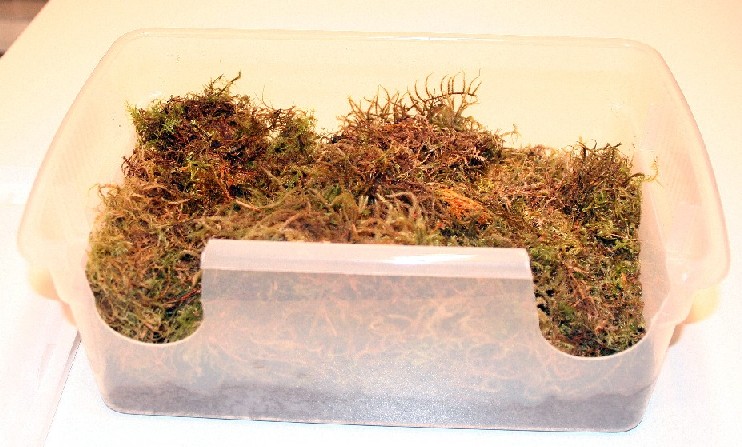
I use a sterilite 1754 sweaterbox for my damp moss boxes. I cut two access holes. Note the holes are "U"
shaped so if multiple sections of snake are going through at same time, it can lift the lid if necessary.
I had two kinda stuck one time with a round hole. One had it's body going both in and out while a second also
was going in one direction for a total of three body widths at the same time. They probably woulda been fine
and worked it out on their own but I didn't like it so I opened the top of the holes to the current "U" shape.

With the top removed you can see the green moss and the "U" shaped holes in the sides. I only use an inch of
green moss but it does expand to about two inches when damp.

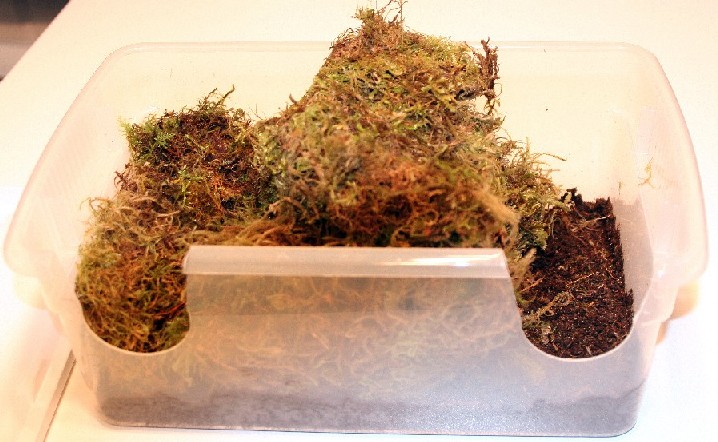
Pulled up the corner of the moss to show the layer of peat moss
underneath. This serves two purposes, adds mass for water and heat retention and provides a bit of drainage
for when they urinate. They will urinate and deficate in the box. I pull the solids and replace the entire
contents about monthly give or take depending on circumstances. For example, they will go longer between
changes right now with no food intake.

-----
Thanks,

Dave Colling

www.rainbows-r-us-reptiles.com

0.1 Wife (WC and still very fiesty)
0.2 kids (CBB, a big part of our selective breeding program)

LOL, to many snakes to list, last count:
21.29 BRB
19.19 BCI
And those are only the breeders

lots.lots.lots feeder mice and rats

FRoberts Jun 11, 2007 04:37 PM

I do not think jeff will mind me posting this link, since he is a sponsor of this forum....
Rainbow Boas

-----
Thanks,

Frank Roberts
Roberts' Realm Of Reptile Research

Liann Jun 11, 2007 05:00 PM

Really awesome care sheet Dave! This is one of the ones I read over before bringing her home. Yes, I have "lurked" here on occasion.

>>Brazilian Rainbow Boa Care Sheet
>>
>>
>>Description
>>
>>Brazilian Rainbow boas (BRB) are a subspecies of Epicrates cenchria, commonly known as Rainbow Boas. The range of BRBs is quite large. It includes northern Peru and Brazil, southern Venezuela and Guyana and much of Surinam and French Guiana. Although not endangered, due to habitat destruction they are not common in their range. They are a semi-arboreal, slender-bodied snake with an adult size of 5-7 feet, females being slightly larger than males. They have beautiful coloration ranging from a deep red to orange, sometimes brown, with dark rings down their back, and several rows of dark spots along their sides, the first row that is highlighted by bright, light-colored crescents.
>>
>>They get their name from their incredible iridescence caused by microscopic ridges on their scales that act like prisms to turn light into rainbows.
>>
>>
>>Housing
>>
>>Neonates and sub-adults do very well housed in Rubbermaid containers or similar. Adults need a minimum of somewhere around 4 to 6 square feet of caging. Substrates that BRBs do well on include sphagnum/peat moss, Care fresh, newspaper, and cypress mulch. I keep mine on a layer of dimpled craft paper with a couple of layers of newspaper underneath for added absorbency. Neonates require a much higher humidity level than adults and can be housed successfully on paper towels. With such high humidity comes mold, therefore attention must be kept to maintaining very clean cages. They should have free access to a large bowl of fresh water at all times (large enough to soak in). As adults they will usually drink large amounts of water and will not require nearly as high relative humidity in their cages. Unless they are on several inches of loose substrate that they can burrow in, they should also be provided with adequate hiding spots. Though not an absolute necessity, perches and shelves can be added to the enclosure.
>>
>>Common mistake - using a fish tank with a screen top, This will lose most of the humidity and dry out your BRB. If not corrected will lead to Upper respiratory problems and death.
>>
>>Temperature and Humidity
>>
>>They are more tolerant of lower ambient temperatures than many other boids, though they cannot tolerate excessive heat well. They should have a temperature gradient of 75 - 83 degrees. Temperatures exceeding 85 degrees can be fatal.
>>
>>Common mistake - measuring temps at mid cage. BRBs will spend most of their time on the cage floor, this is where the temps should be measured.
>>
>>Adult BRBs require a minimum humidity level of 75% . Should humidity drop into the 60’s or 50’s for an extended period of time the results can be respiratory infections, regurgitation, and death by dehydration. For my adults I make a “damp hide” from a sweaterbox size tub with two access holes in one side. I put 1 inch of peat moss and one inch of green moss. Both nice and damp. They love to hang out in there and come out to explore at night.
>>
>>Neonates should be kept at or near 95% humidity. I accomplish this with a fairly tight fitting shoebox rack. There’s always condensation at the front. Temps for babies should be right around 77 degrees.
>>
>>Humidity is affected by two factors, evaporation and dissipation. The larger surface area water dishes will evaporate more into the air. By minimizing ventilation, you will keep that humidity in the enclosure.
>>
>>Common mistake - thinking daily spritzing will make up for lack of natural humidity. If your enclosure is set up properly with adequate water sources and minimal ventilation, spritzing is not required.
>>
>>
>>Handling
>>
>>BRBs can be somewhat nervous snakes. Babies are born striking at anything, but with regular, gentle handling they can tame down quite nicely to become acceptable pets. As babies, let them strike at you, bite you and even chew on you. This will show them you will not be chased away by those actions and they will soon learn the big bad hand is nothing to be afraid of. Pick up the baby with a steady non-tentative action. The baby will typically be coiled or piled in one spot. Aim for the side away from the mouth and just do it! If you are bit, there will be minimal pain and quite likely several pinholes in your skin. Resist the urge to pull back, that will only make it worse. BRB’s have teeth that curve backwards to hold onto their prey. If you pull away, you will tear your skin and could easily damage some of their teeth.
>>
>>They are typically a more active snake when being held than your average boa, seemingly always on the move. This is not to say that they will not grip on to you tightly, these boas keep a good hold. Be careful when holding not to startle them, as rainbows can nip when scared.
>>
>>
>>Feeding
>>
>>BRBs are voracious feeders that feed primarily on rodents, birds, lizards, and possibly aquatic life forms as well. In captivity they eat mice and rats approximately the same size as the largest part of the snakes girth. Neonates are born large enough to take hopper mice and rat pinkies. If these boas refuse food, their husbandry should be carefully examined. Stress, poor husbandry, or illness is the likely causes of a BRB that refuses to eat.
>>
>>Babies should be fed on a schedule of from once every four days to once a week. Most of them will continue to feed even when they are opaque prior to shedding. These snakes are born large enough to take hopper mice as their first meal. Many of mine have done well starting out on rat pinkies. A reluctant snake may be induced to feed by placing it in a small tub or even a paper bag along with the food item. Place the smaller container back in the secure cage in case the baby escapes and leave it for an hour, if still not eating, can be left overnight.
>>
>>Common mistake - feeding pinky mice to baby BRBs. If you have an unlimited source of pinky mice then go ahead but be prepared to feed several to each baby at each feeding.
>>A mouse pinky will make a very small lump in a baby BRB and be digested down so that the lump is no longer externally visible within 24 hours.
>>
>>BRBs will grow rapidly on one appropriately sized mice/rats a week. Yearlings often grow to 48 inches in length though 36 to 40 inches is more typical. Many two-year-olds are four and a half to five feet long. Females and males are not significantly different in size. Adult males can do well on 20 medium sized rats per year. A breeding female will require two to three times as much to eat.
>>
>>BRBs are often overfed to obesity in captivity as adults. At 2', the snake is large enough for pinkie rats and jumper mice. At 3', it is capable of consuming adult mice and young rats. Feed at least once every 10 days, when the snake begins feeding on large meals such as rats feeding can occur less frequently. Avoid handling after a sizable meal; it is stressful and may cause regurgitation. Many animals may be conditioned to accept pre-killed or thawed warmed rodents at feed time. This technique is safer, than feeding live rodents since this prevents the snake from being bitten by a rodent. Live feeders should be avoided except for the few (very few) snakes that will not eat anything else. Never leave a live rodent in the with a snake unattended. A rodent can cause serious damage to your pet!
>>
>>Never handle rodents and then handle a snake; you may be mistaken as food. Develop proper feeding habits. As the snake grows it may be wise to feed the snake only dead rodents and move it to a feeding container prior to food offering. If moved to a feeding container for all feedings it may become conditioned not to expect food while in its' cage. This may reduce the possibility of being mistaken as a food item by an over zealous feeder. Best method is to place dead rodent in container and let snake discover it, encourages gentle food acquisition. Maintain accurate feeding and health records.
>>
>>
>>Shedding
>>
>>Shedding is dependent on the animal's growth rate and condition and may occur every 3 - 6 weeks. They may refuse feeding attempts while shedding. Increase the humidity as a rainbow approaches a shed, this helps to avoid dry shed. With proper humidity, the shed should come off without shredding. Can easily get torn but should not be tattered. If the snake is having a bad shed where parts are stuck on, wet a pillowcase, put snake in pillowcase and tie knot in pillowcase to prevent snake from getting out. Place pillowcase back in enclosure at a neutral temp location and leave for a couple of hours. If still not fully shed, you can continue pillow case treatment overnight.
>>
>>
>>
>>Breeding
>>
>>BRB breeding practice is similar to that of the common boa. They can produce litters with up to 35 young. They can be bred as early as 2.5 years providing they are meet minimum size and weight requirements of 5 feet and weighing more than 3.5 pounds for females. Another six inches of length and pound of weight is more appropriate and should produce a larger first litter with less strain on the snake. Males should be 5 feet and 2.75 pounds, though many are this size at 30 months, they usually won’t breed until 42 months. They should not be bred unless they are extremely healthy, as breeding takes a lot out of them.
>>
>>Cooling is necessary for successful production of egg and sperm cells. Breeding may be induced by night time temperature drops down to 68 - 72F and daytime temperatures in the low 80's. Reduction of light cycle from 12 - 14 hours to 8 hours and misting the animals with warm water prove beneficial. BRBs will usually begin breeding within a few weeks of being warmed back up after the cooling period. Females will show a very marked mid body ovulatory lump for several hours. This lump is usually not seen because it lasts for such a short time. Most gravid females will refuse to feed. They will sometimes take a very small prey animal while they are gravid. Many females will become enormously large in the back half of their body and look very emaciated in the front half late in the gestation. Reproduction takes an extreme amount of energy and should only be attempted with very healthy adults. Gestation lasts approximately five months.
>>
>>
>>The female will often appear restless and cruise around the cage as if looking for something for a day or two before laying. Laying often occurs during weather changes. Female snakes should not be disturbed while they are laying as this may cause them to interrupt oviposition which can lead to incidences of stillborn babies.
>>
>>Females often eat recently laid infertile slugs. I have never witnessed a female eating babies but recognize that the possibility exists for a snake which is picking through a pile of live babies and slugs to possible devour a newborn baby accidentally. For this reason I try to remove the babies from the mother soon after they are born.
>>
>>Baby BRBs are born in litters of two to thirty five. A typical litter contains twelve to twenty five babies. Babies are born 15-20 inches, and show pale, washed out coloration. The babies will color up significantly over the first few sheds. Ultimate coloring can take 18 months to show.
>>
>>Most babies start out striking at anything that moves, it’s either food or needs to be chased away. They can be readily tamed with direct, calm handling gently and regularly over the first few weeks. They will often eat before they have shed. The first shed usually occurs after 10 to 14 days from birth.
>>
>>
>>
>>They need to be kept at temperatures near 77 degrees and in high humidity. Temperatures above 85 degrees can cause fatalities in Brazilian Rainbows. Baby Brazilian Rainbows require humidity above 70 percent. They will do well kept individually in plastic shoeboxes until they are about 24 inches long and can then be moved into larger plastic storage containers or box type cages.
>>
>>BRBs are difficult to sex based on visible external differences until they are about three years old. Young ones can be sexed by probing. Females will probe a distance of two to four subcaudal scales and males will probe to a depth of eight to twelve subcaudal scales. They can also be sexed by palpitation or popping. All three methods require someone experienced in sexing snakes. Adult males have substantially larger spurs along the side of the vent and also have noticeably thicker bases of their tails due to the invaginated hemipenes. After about eight years of age the heads of both sexes are noticeably larger than on nearly similar sized young adults. This phenomenon of the enlarged head on older animals seems to be more pronounced on red and orange animals than on brownish specimens. This phenomenon also occurs with older Peruvian Rainbows.
>>
>>
>>
>>Morphs
>>
>>There are an increasing number of BRB morphs being discovered. Though many of them are still unproven, current BRB morphs include but not limited to:
>>
>>Anerythristic - lack or red pigmentation, results in a brown or taupe with white crescents.
>>Hypomelanistic - reduction of melanin resulting in a snake with brown orange and yellow patterning and significantly lighter markings.
>>Bullseye - Side crescents where some degree of full circling occurs with dark center.
>>Eclipse - Side blotches (oceli) where there is little to no crescents.
>>Blush - Side oceli where the crescent color is speckled through the pattern.
>>Striped (dorsal) - striping down the back.
>>Striped (lateral) - merging of individual oceli to make lateral stripes on the sides.
>>Clown - large oversized oceli
>>Calico - white scales typically outlining the dorsal patterns
>>Albino - Lack of melanin (or lack of expressing melanin) resulting in a white snake with orange markings. Very secretive and not many exist.
>>
>>-----
>>Thanks,
>>
>>
>>Dave Colling
>>
>>www.rainbows-r-us-reptiles.com
>>
>>
>>
>>0.1 Wife (WC and still very fiesty)
>>0.2 kids (CBB, a big part of our selective breeding program)
>>
>>LOL, to many snakes to list, last count:
>>21.29 BRB
>>19.19 BCI
>>And those are only the breeders
>>
>>lots.lots.lots feeder mice and rats
-----
-----
Amber

rainbowsrus Jun 11, 2007 05:04 PM

Glad it helped!! Don't hesitate to ask any questions you may have. Sounds like you did it right and researched it FIRST, then got one.
-----
Thanks,

Dave Colling

www.rainbows-r-us-reptiles.com

0.1 Wife (WC and still very fiesty)
0.2 kids (CBB, a big part of our selective breeding program)

LOL, to many snakes to list, last count:
21.29 BRB
19.19 BCI
And those are only the breeders

lots.lots.lots feeder mice and rats

FRoberts Jun 11, 2007 04:07 PM

All snakes are individualistic. Not all neonates are aggressive. Almost all aggression ( in snakes ) is directly related to the fear of predation and a survival of the fittest mentality. Some captive neonatal snakes will eat without utilizing constriction, taking the prey gently off the hemostats, be glad you have a zealous feeder. I have had some that where like you describe and others that where the EXACT opposite in behavior.

Most aggression( most if not all ) in snakes subsides after a period of time in the captive environment. As long as the snake becomes used to your presence and no longer considers you a threat to their continued existence. If such interactions fails to occur, the snake will continue to feel threatened by your presence and will try to defend itself by any means they have, up to and including biting, constricting, and voiding bodily fluids upon you.

Most snakes that have notorious reputations for aggression have become tame in the captive environment. Also, aggression appears to be hereditary in reptiles.

Once again, Welcome!!!!!!!!!
-----
Thanks,

Frank Roberts
Roberts' Realm Of Reptile Research

rainbowsrus Jun 11, 2007 04:19 PM

"As long as the snake becomes used to your presence and no longer considers you a threat to their continued existence."

I have had babies completely tame to me and never give me any crap (other than the real crap stuff)

When shipped to new homes, were stressed and reverted back to lil nippers. Point is changes can induce unwanted responses, just be unafraid and handle her anyways, even if she does bite you not a big deal.
-----
Thanks,

Dave Colling

www.rainbows-r-us-reptiles.com

0.1 Wife (WC and still very fiesty)
0.2 kids (CBB, a big part of our selective breeding program)

LOL, to many snakes to list, last count:
21.29 BRB
19.19 BCI
And those are only the breeders

lots.lots.lots feeder mice and rats

rainbowsrus Jun 11, 2007 04:10 PM

Always glad to have a new member.

Sounds like you have a nice one. How old? If she's a 2006 baby that could explain the used to being handled and fed.

Just like any animal, they are all different. My babies are pretty much nippy at birth and settle down within a month or so from the cleaning and feeding necessary in that time. I have some I can always just reach in and grab tehm, Others I need to be more careful. None, not a one, are downright mean. Just have some that do better at handling than others.

Show us some pix when you have them, always like to see them!!

For you....Lon:


He's one of my "blush" phase from 2006.

And for a little color, Daisey (gravid):

-----
Thanks,

Dave Colling

www.rainbows-r-us-reptiles.com

0.1 Wife (WC and still very fiesty)
0.2 kids (CBB, a big part of our selective breeding program)

LOL, to many snakes to list, last count:
21.29 BRB
19.19 BCI
And those are only the breeders

lots.lots.lots feeder mice and rats

Liann Jun 11, 2007 04:54 PM

Thank you for all of the great info. and the welcome! She is a 2007 and tiny. I was expecting a little monster from the way the guy I bought her talked. I picked her up at Hamburg on Saturday and these two guys behind the table were teasing me about how nippy she was and they just watched me with these smirks as I picked her up and let her crawl around my hand. She was as calm as could be and they were left scratching their heads. I figured once I got home, she would start giving me a little 'tude, but the next day, she was still as calm as could be when I picked her up and checked her out. I took some pictures, so I am going to get those uploaded here in a second. I have to say, I've been perusing the forum and you guys have some gorgeous snakes! The ones in Dave's post above are really beautiful!
-----
-----
Amber

rainbowsrus Jun 11, 2007 05:02 PM

a females touch!!!
-----
Thanks,

Dave Colling

www.rainbows-r-us-reptiles.com

0.1 Wife (WC and still very fiesty)
0.2 kids (CBB, a big part of our selective breeding program)

LOL, to many snakes to list, last count:
21.29 BRB
19.19 BCI
And those are only the breeders

lots.lots.lots feeder mice and rats
FRoberts Jun 11, 2007 08:54 PM

...
-----
Thanks,

Frank Roberts
Roberts' Realm Of Reptile Research

FRoberts Jun 11, 2007 08:53 PM

show off!!! lol
-----
Thanks,

Frank Roberts
Roberts' Realm Of Reptile Research

Liann Jun 11, 2007 09:22 PM

Lol, you guys are too much!

>>show off!!! lol
>>-----
>>Thanks,
>>
>>Frank Roberts
>>Roberts' Realm Of Reptile Research
>>
-----
-----
Amber

FRoberts Jun 11, 2007 09:38 PM

I called him "smartie pants", cause he said something rather intelligent.

my most recent amusing post, to me anyways lol....

last two comments made me smile

Bob asked me for an opinion....

long winded answer full of my opinions..

-----
Thanks,

Frank Roberts
Roberts' Realm Of Reptile Research

rainbowsrus Jun 11, 2007 11:09 PM

we have a lot of fun here. By far my favorite forum just to hang out in.

So, your mom thinks your a dish? Oouu lah lah
-----
Thanks,

Dave Colling

www.rainbows-r-us-reptiles.com

0.1 Wife (WC and still very fiesty)
0.2 kids (CBB, a big part of our selective breeding program)

LOL, to many snakes to list, last count:
21.29 BRB
19.19 BCI
And those are only the breeders

lots.lots.lots feeder mice and rats
run26neys Jun 11, 2007 05:13 PM

Welcome to the forum.

You will always get great information when you ask questions here, and we feel that adding a brb into your collection is great (except Scott who has a columbian rainbow and no brazilian's).
-----
Mike

2.4 BRB
1.2 Spotted Python
1.0 Cal. King

Liann Jun 11, 2007 05:14 PM

A photographer I am not! But you can get an idea what she looks at. Sorry the first one looks like a promotional add for "Zales". I didn't realize I was flashing my rings better than the snake!


-----
-----
Amber

rainbowsrus Jun 11, 2007 05:20 PM

Still, nice pics of a nice typical BRB.

BTW, typical BRB's are gorgeous!!
-----
Thanks,

Dave Colling

www.rainbows-r-us-reptiles.com

0.1 Wife (WC and still very fiesty)
0.2 kids (CBB, a big part of our selective breeding program)

LOL, to many snakes to list, last count:
21.29 BRB
19.19 BCI
And those are only the breeders

lots.lots.lots feeder mice and rats
run26neys Jun 11, 2007 05:40 PM

Wonderful pics, and she reminds me of my first brb Minnie. It is the nice side cresents they both have is where they look similar.

Also, it looks like you know how to care for her - large water bowl and she looks to be on damp paper towels - perfect for her.
-----
Mike

2.4 BRB
1.2 Spotted Python
1.0 Cal. King

FRoberts Jun 11, 2007 06:05 PM

only best friend. Nice BRB!!
-----
Thanks,

Frank Roberts
Roberts' Realm Of Reptile Research

Liann Jun 11, 2007 05:44 PM

Since we like OT discussions here too, here are a few pics of the other inhabitants in my home:


-----
-----
Amber

rainbowsrus Jun 11, 2007 05:49 PM

Beardie, my daughter has one, fun to play with!
-----
Thanks,

Dave Colling

www.rainbows-r-us-reptiles.com

0.1 Wife (WC and still very fiesty)
0.2 kids (CBB, a big part of our selective breeding program)

LOL, to many snakes to list, last count:
21.29 BRB
19.19 BCI
And those are only the breeders

lots.lots.lots feeder mice and rats

FRoberts Jun 11, 2007 06:23 PM

I like all of them, that Beardie pic is just hummm, majestic looking.

Ball Pythons are not the most appreciated snake on this forum, I have 7 of them in my collection.

I keep quite a variety of animals, here are a few....


-----
Thanks,

Frank Roberts
Roberts' Realm Of Reptile Research

Liann Jun 11, 2007 07:17 PM

Frank - You have some awesome looking animals there! Lol on the bp's under appreciation here. I think the same thing goes for the boa forum! I'll limit those pics. Here's a few more of my zoo.


-----
-----
Amber

FRoberts Jun 11, 2007 07:35 PM

you can post those BP pics, I like them, everyone can kiss my A$$ if they don't like it. lol

You are like me in regards to the varied assortment of critters you keep.

I love all those animals you posted, awesome boa, also what type of tri colored king/milk snake is that, so many of them.

I love the geckos as well...been thinking of getting a few crested, but keep holding off, once I get one, it will turn into a "colony" in a short period of time.

I must keep my addiction in check!!!!

Also, although, I do not think these names are related.

I wanted to name my son (if I ever had one, being single add's certain obstacles) Liam. close to, but unrelated to Liann ( I think anyway )

-----
Thanks,

Frank Roberts
Roberts' Realm Of Reptile Research

Liann Jun 11, 2007 07:49 PM

Lol, if anyone gives me crap about the bp's, I'll tell them that!

The tri-colored snake is a Sinaloan Milk Snake. I love those - have a male and female. They are one of my favorite snakes. The boa is a Suriname and he is my baby. I used to have more boas, but my husband recently made me sell a few of them. They make him "nervous", lol. He doesn't like being stalked in the laundry room and I'll admit they did have a certain gleam in their eye when he walked by their cages... The Suri I refused to part with though.

I try hard to keep the addiction in check as well, but then I go and bring home a BRB!

Liam is close to Liann. Liann is my middle name. My mom had a set of dishes that the print was called "Liann". She liked it so much that that's what she named me. So I'm named after a dish...

>>you can post those BP pics, I like them, everyone can kiss my A$$ if they don't like it. lol
>>
>>You are like me in regards to the varied assortment of critters you keep.
>>
>>I love all those animals you posted, awesome boa, also what type of tri colored king/milk snake is that, so many of them.
>>
>>I love the geckos as well...been thinking of getting a few crested, but keep holding off, once I get one, it will turn into a "colony" in a short period of time.
>>
>>I must keep my addiction in check!!!!
>>
>>Also, although, I do not think these names are related.
>>
>>I wanted to name my son (if I ever had one, being single add's certain obstacles) Liam. close to, but unrelated to Liann ( I think anyway )
>>
>>
>>-----
>>Thanks,
>>
>>Frank Roberts
>>Roberts' Realm Of Reptile Research
>>

-----
-----
Amber

FRoberts Jun 11, 2007 07:57 PM

tell your husband to be glad you are not into the larger species, I keep reticulated pythons, burmese pythons, african rock pythons, and anacondas. He would probably crap himself if he where to walk into my snakeroom lol.
-----
Thanks,

Frank Roberts
Roberts' Realm Of Reptile Research

WolfenWarrior Jun 12, 2007 03:26 PM

OH! What kind of uro is that? Mali? It's so cute!

Liann Jun 12, 2007 03:55 PM

Yes, he is a mali. That's Keegan, He's just a little squirt at the moment.

>>OH! What kind of uro is that? Mali? It's so cute!

-----
-----
Amber

WolfenWarrior Jun 13, 2007 12:22 AM

He's gorgeous! I'm getting my first mali tomorrow. So excited!

IkeLightner Jun 11, 2007 08:55 PM

Hey Liann,

Welcome to the forum its great to have you here.

I thought it was interesting when reading about your snakes feeding behavior. I am fairly new to BRBs as well. I currently have 1 female BRB. She is a 2006 baby from Dave Colling.

Anyway...the way you described her not really striking and coiling the prey item but just grabbing it with her mouth and swallowing it, my snake has been doing the same thing lately. The first few meals I fed her live prey and she of course did the normal constriction but for the last 4 meals I have fed her f/t rat pups and she has done the exact same thing you described. She won't even strike at it, it's like she can somehow recognize that it's already dead and she will just go up to it and precede in swallowing it. It makes me think they're a little smarter than we may think, intersting though for whatever reason.

Anyway welcome to the forum!

ROXY 06' FEMALE

Liann Jun 11, 2007 09:28 PM

Thanks for the welcome! I'll be interested to see how she takes her next meal. I have several corns that eat like this as well. I just hand them the rat head first and they open up real wide and start swallowing. It's a nice change. My boa Aloysius has such a strong feeding response that I practically have to hide behind a chair when I open his door because he always comes flying out. It's amazing how "short" 3 foot hemostats seem when you are feeding a hungry Suri.

>>Hey Liann,
>>
>>Welcome to the forum its great to have you here.
>>
>>I thought it was interesting when reading about your snakes feeding behavior. I am fairly new to BRBs as well. I currently have 1 female BRB. She is a 2006 baby from Dave Colling.
>>
>>Anyway...the way you described her not really striking and coiling the prey item but just grabbing it with her mouth and swallowing it, my snake has been doing the same thing lately. The first few meals I fed her live prey and she of course did the normal constriction but for the last 4 meals I have fed her f/t rat pups and she has done the exact same thing you described. She won't even strike at it, it's like she can somehow recognize that it's already dead and she will just go up to it and precede in swallowing it. It makes me think they're a little smarter than we may think, intersting though for whatever reason.
>>
>>Anyway welcome to the forum!
>>
>>ROXY 06' FEMALE
>>

-----
-----
Amber

BRB_russ Jun 12, 2007 09:03 AM

its funny thats how my rainbow was, i got it VERY young and it is and allways has been my calmest snake, its never bit nor has even tried or looked like it was going to!

Goodluck with your BRB and welcome
-----
Russ
1.0 Brazilian Rainbow Boa (Apollo)
1.0 Columbian Rainbow Boa (Odin)
1.0 Guyana Red-Tail Boa (Ares)
0.1 Pastel Salmon Boa (Minerva)
0.1 Rosy Boa (Athena)

Melbourne, Fl

Liann Jun 12, 2007 03:51 PM

Thanks Russ! I'm keeping my fingers crossed that she stays calm like yours!

>>its funny thats how my rainbow was, i got it VERY young and it is and allways has been my calmest snake, its never bit nor has even tried or looked like it was going to!
>>
>>Goodluck with your BRB and welcome
>>-----
>>Russ
>>1.0 Brazilian Rainbow Boa (Apollo)
>>1.0 Columbian Rainbow Boa (Odin)
>>1.0 Guyana Red-Tail Boa (Ares)
>>0.1 Pastel Salmon Boa (Minerva)
>>0.1 Rosy Boa (Athena)
>>
>>Melbourne, Fl
-----
-----
Amber

Site Tools
