Reptile & Amphibian Forums

Welcome to kingsnake.com's message board system. Here you may share and discuss information with others about your favorite reptile and amphibian related topics such as care and feeding, caging requirements, permits and licenses, and more. Launched in 1997, the kingsnake.com message board system is one of the oldest and largest systems on the internet.

Click here to visit Classifieds
Click for ZooMed
Click for 65% off Shipping with Reptiles 2 You

Bad year here, how about you?

Mike Meade Jun 17, 2007 01:11 PM

After having real good luck last year this year had been nearly a bust. All of my eastern eggs seem to have been infertile.

Worse yet, my Texan eggs were fertile and doing great up until a couple of weeks before they were due to hatch. Then they began to collapse quickly. One actually hatched (for which I am thankful) but is very small (weighing just 20 grams at hatching). The rest contained normal looking embryos which died in the egg for some reason with some yolk left to absorb.

I started a new job this year which has kept me extremely busy and I went several days without checking on the eggs. When I did it seemed like an unusual amount of condensation had built up on the lid of the box they were in. I used perlite:water at a dryer than 1:1 by weight mix, but my guess is still they were too moist or didn't get enough air exchange.

How about the rest of you? I hope some of you have done better by these guys than I did this year. Cheer me up with some success stories!

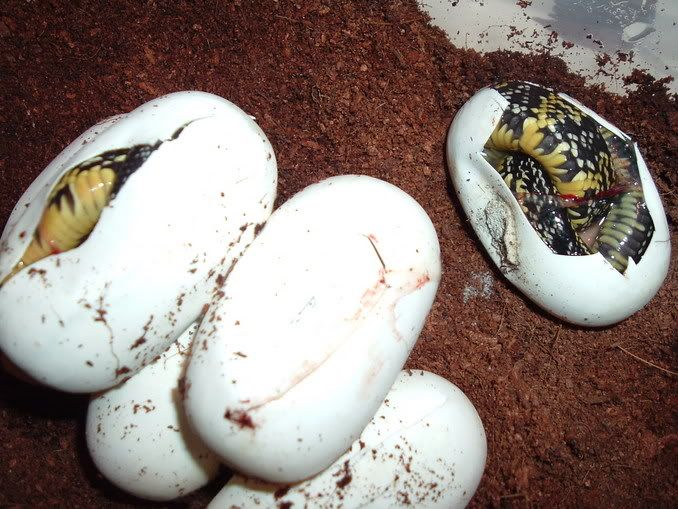
Here's a pic of happier times...

Replies (7)

Dann Jun 17, 2007 04:21 PM

Talk about bad news.

I didn’t breed any snakes this year. The girls and I took the year off. Just now selling off the last of my 06 stock for cage room. Keeping only one 06 female hold back.
Hope next year works out better for you Mike. Hang in there…Indigo Breeder.

Dan

robertbruce Jun 21, 2007 04:45 AM

Sorry about the eggs Mike. I agree that both inadequate air exchange and overly wet substrate can cause death of eggs. A third common cause is too high an incubation temperature.

In the last third of the incubation period, Eastern Indigo eggs produce so much heat from their own metabolism that they supersaturate the air around them, and this causes a large increase in water condensation on the inside of the egg containers. This is actually a sign that the eggs are alive, as dead eggs won't do this. If the eggs are in a closed insulated incubator, they could overheat from their own metabolism.

Over the years, I have known many people who have had eggs die very close to the time they were supposed to hatch. Fortunately, this hasn't happened to me, so far anyways. I have for a long time thought that this may commonly be due to substrate that is too wet. There is an air pocket at the top inside each egg. If the substrate is too wet, this air pocket can be displaced by liquid (according to my own theory). This kills the egg as the air pocket is necessary for proper gaseous exchange.

Mike, I would like to know how much gaseous exchange the eggs were getting. Could you tell me exactly how the eggs were getting air exchange? Certainly if there was no air exchange for a several day period, the eggs would die. Most people's egg boxes are not airtight though, and many people have holes drilled into them. There is a perfect amount of air exchange (dependent on how far the eggs have developed) where the eggs are kept in humid air but still there is adequate fresh air exchange. For me, if each egg gets two and a half liters of fresh air per day (close to hatching) there won't be a problem. Younger eggs require less. If there is suboptimal air exchange, the eggs will frequently be fine, but just take longer to hatch. Things would have to be sealed up pretty well to kill the eggs in my opinion.

Robert Bruce.

Sighthunter Jun 21, 2007 09:31 AM

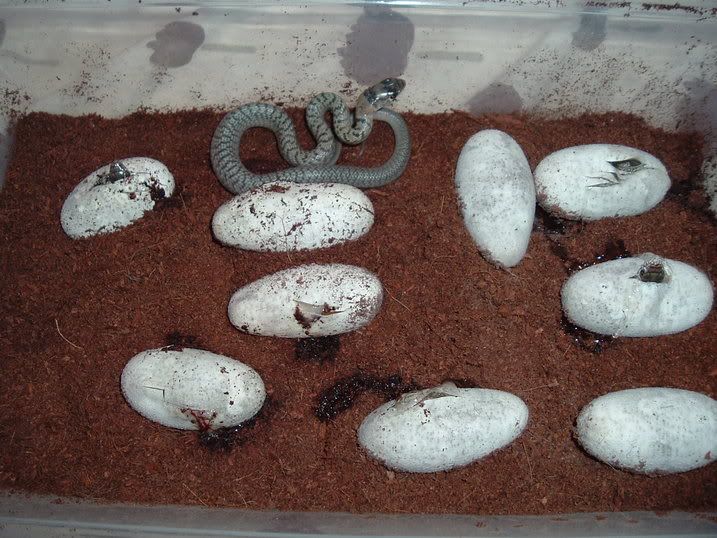
Yes I agree with Robert. I use at first an airtight container and open it every day checking condensation on lid. If I get no condensation over a three day period I know my substrate is to dry and if I get droplets I know my substrate is too wet. As the eggs grow I have four ¼ inch holes taped off. If I start noticing condensation developing I start opening up the tape allowing a small air exchange. I have noticed that a light fog on lid of container is the best moisture. Near the end I usually have two to three holes opened up. I can run a dryer substrate since my heat source is under a water source inside the incubator. I have the water in an airtight container with one ¼ inch hole. Contrary to most my eggs usually do not dimple and as I recall Robert’s eggs do not dimple much either. Here is a picture how most of my eggs look just before hatching.


-----
"Life without risk is to merely exist."

Mike Meade Jun 21, 2007 06:24 PM

Robert,
Thanks for sharing your experience. The eggs were in a sweater box with a typical lid (snap on, but not tupperware tight). The box had two 1/4" holes on all four sides.

I opened the box daily (or very nearly so) for the first 2 months. I did not see any condensation during these inspections and the eggs appeared to be perfect in all regards.

At about 70 days incubation I went 5 or 6 days without checking them as I figured they were home free and I was busy tending to work and my other snakes. When I opened them to check I had that sick feeling you get when you know you've screwed up. The eggs looked fine but the condensation poured off of the lid when I took it off. After this I checked them daily again, but I think the damage was done.

It certainly seems like the air holes were insufficient to ventilate the eggs properly. About 90 days into incubation several of the eggs began to collapse on top. Several still looked good, but had collapsed from the bottom up leaving a well rounded top.

The egg that hatched was in the center of the group, and that hatchling is small but looks normal. It should shed tonight or tomorrow and we'll see if it eats.

The one thing that would make this experience more tolerable would be if other learn from my mistake, so thanks for the discussion.

And good luck with your eggs!

Mike

robertbruce Jun 22, 2007 03:40 AM

Mike,

I believe that I know why your eggs died.

Firstly, like I mentioned before, condensation inside the egg containers is normal in the last one-third of the incubation period. It is actually a good sign, a sign that the eggs are alive. If I don't see the condensation, then I worry.

Secondly, your egg-containers were plenty well ventilated. The closure on a sweater box is so non-tight that no extra ventilation holes are necessary, at any stage of incubation. You were probably getting ten complete air exchanges per day. The extra vent holes you drilled were superfluous. Unless the sweater box was enclosed in another airtight container like a cooler or ice chest with a tight seal, the eggs were getting more than enough air.

It is almost impossible to provide enough air circulation to prevent condensation in the last third of the incubation period. The only important issue here is to make sure that water drops don't fall onto the eggs. It may be necessary to dry the underside of the lid from time to time to prevent this.

What killed your eggs was too dry of a substrate, not too wet. Again, like I mentioned in another post, Indigo eggs must be in contact with a moist substrate in the second half of the incubation period. Since they are warmer than the air around them during this time, they can't absorb enough water from the humid air and end up losing water. In the first half of the incubation, Indigo eggs will be fine on a foam substrate in moist air. They can absorb water from the air. In the second half of the incubation, they become too warm to do this, and they must then be in contact with a moist substrate.

From the added information you just mentioned, your eggs had the classical symptoms of dehydrated eggs. The condensation in the container indicated that they were alive. They were collapsing due to loss of water. Dehydrating eggs frequently collapse from underneath and go unnoticed as a result. Indigo eggs can tolerate a small degree of dehydration/collapse and still hatch. Too much and they will die.

Perlite is a poor choice for incubation substrate in my opinion. Even if it is moist, eggs don't make enough physical contact with it to be able to absorb water. Vermiculite is a much better choice. Its soft nature allows a better contact area with eggs. Eggs can absorb water readily from it.

I would speculate that the perlite you used became more dry around the outsides of the container. The egg in the middle survived because it was able to get a little more water from the moister perlite in the center. I would also suspect that this egg collapsed too, due to dehydration, just not as much as the others. Tell me if I am right.

I will try to post a fail-safe method for Indigo egg incubation soon. Remind me if I forget. Next year will be better.

Robert Bruce
robert.bruce@sbcglobal.net (310) 502-6311

Sighthunter Jun 22, 2007 10:58 AM

I would tend to agree with a side note. I know that chickens will pip and die or die in the egg if there was an imbalance in vitamins in the hens diet prior to laying her eggs. I have had eggs with very weak hatchlings before, diet? Air flow?, moisture? My other theory is a ever changing temprature as in a 100% hatch from my green racers eggs left under an upsidedown flowerpot outside. Too much time not enough research......LOL


-----
"Life without risk is to merely exist."

Mike Meade Jun 22, 2007 06:05 PM

Robert: You are correct, the egg that hatched had collapsed as well.

I look forward to your incubation recipe. Don't forget...

Mike

Site Tools