Reptile & Amphibian Forums

Welcome to kingsnake.com's message board system. Here you may share and discuss information with others about your favorite reptile and amphibian related topics such as care and feeding, caging requirements, permits and licenses, and more. Launched in 1997, the kingsnake.com message board system is one of the oldest and largest systems on the internet.

Click here for Dragon Serpents
Click for ZooMed
Click here for Dragon Serpents

New rainbow enthusiast

Bladespark Jul 15, 2007 06:58 PM

Hello! I thought I'd sign up here, so I can have somebody other than my boyfriend to babble at about how beautiful rainbow boas are! (I think he's getting sick of hearing about them, and I don't even have the snake yet!)

Anyhow, I figured I should say hello. I'm Stephanie, I go by spark or bladespark. I love animals of all sorts. I currently own two cats, and have had various cats,dogs, guinea pigs, gerbils, hamsters, fish, etc. growing up. I always wanted to have a snake, I used to catch king snakes a lot as a child. But my mom didn't like pets, and drew the line at snakes. No snakes in her house! Well, I'm 29 and well moved out of her house, and seeing some ball pythons at a (sadly dubious) pet store got me thinking about snakes again. I was considering getting a ball python for quite a while. Most people tell me they're easy starters (though of course people being people, some disagree.) And I think they're rather cute.

But then I saw a rainbow boa. Which is beyond "rather cute" and into "holy crap that is the most beautiful snake I've ever seen!" The base markings are attractive to begin with, but then you add that amazing rainbow sheen, and wow! I thought they were the most amazing things ever just from seeing photos. But the one place I encountered them on line at the time was only selling morphs, for BIG BUCKS, and as I wasn't familiar enough with them to realize these were morphs, and that normals might actually be within my price range, I wrote them off, with a mental "Well, if I'm ever rich I'll buy one."

Then I had a stroke of amazing good luck! Just a few blocks from where I live a new reptile-oriented pet store opened up. A pet store that sells only captive bred, and where the owner breeds his own turtles and tortises, and buys all his lizards and snakes from reliable breeders. Given that all the other local pet stores are either big box, (Petsmart, Petco,) or somewhat dubious (the place that had crickets in a ball python cage, the other place that had ball pythons and redtails in together, that kind of thing,) I was very pleased to find a sparkly-clean place with only one or two snakes per cage, where everybody seems to actually know what they're talking about.

I went in to see what they had, planning on asking them about ball pythons, as that was what I thought I wanted at the time.

But then I saw them... they had two baby Columbian Rainbow Boas! They were GORGEOUS! They were adorable! They were only $120! Wow, actually within my limited budget! The gal who works there fished one out for me to hold. It was a little nippy, I got my first snakebite right then. A very gentle introduction to the ranks of the bitten, given that its teeth are almost too small to see. None of those childhood king snakes had ever managed to tag me. I had loved seeing the photos, but I was totally enchanted by them in person I think I spent twenty minutes just letting her crawl all over me.

I'm still slightly torn on the issue of which snake to get. Over and over and over I've been told that rainbows are intermediate snakes, and that a beginner just can't handle them. But I've read EVERYTHING I can find on the internet about them, including pages and pages and pages of this forum, and a dozen care sheets, and all kinds of other random stuff. I know it will be a lot of work, and I'll need to pay very close attention to what's going on, especially right at first, but I am totally dedicated to getting the best information and putting in as much effort as it takes. I plan on getting the whole setup, tank and heater and light and hides and water and substrate and everything, and getting it running and the correct temps and humidity before I even buy the snake.

I've had several people tell me that I should start with the ball, and get the rainbow once I'm used to the ball. But I don't want two snakes! I live in a tiny apartment, I am not going to breed or collect or anything, I just want one display pet, that I can handle and have fun with now and then, that I can watch and enjoy the rest of the time. Two snakes are going to take more space than I care to give them, and it's not fair to the 'starter' snake, to get another snake that will take my attention away. I'd end up neglecting the first snake, I just know it. It's not like the cats, where I can't neglect my first cat, she jumps up into my lap and demands petting. Snakes can't tell you they need something.

So I'm trying to decide, but I'm really leaning towards getting the Columbian Rainbow. Everything I've read about them suggests they're what I want, as far as size, temperment, etc. goes, and they really are by FAR my favorites when it comes to appearance.

Anyhow, that's my rather rambling story. I'm taking a vacation next week, and when I get back and have money again (vacation is eating everything I've got this month) I'll be starting to buy the tank and other supplies, and then when that's all laid in, it'll be time to get my new baby! So I have until I start buying stuff to decide, as the two options do have slightly different housing requirements. Any advice for me?

(Wow, I wrote a novel! Sorry about that. But I'm really enthused just now about all this. I so can't wait to have a snake!)

Replies (21)

waspinator421 Jul 15, 2007 07:18 PM

Welcome Stephanie! I'm glad to hear you've discovered the awesomeness (is that a word?) of Rainbow Boas.

I would say as long as you follow your care sheets, and advice from the great members of this forum, I'd say GO FOR IT! I don't find my Rainbows to be that much harder than my other snakes. They do need a little more attention, but not much.

I'm sure Dave will post his Rainbow Care 101, which has some really good information on it. You can also click on Jeff Clark's link above the posts in the forum, he also has some good info there.

We are a pretty nice bunch of people here, though sarcastic at times. Feel free to ask any questions you have.

One condition though.... post pictures when you get him/her!


-----
Aubrey Ross

©
www.SlipstreamSerpents.com

TimOsborne Jul 15, 2007 07:20 PM

"We are a pretty nice bunch of people here, though sarcastic at times."

Only that Aubrey person.. you really have to watch out for her.. a trouble maker for sure.
-----
photos.xtremecombatsports.com

waspinator421 Jul 15, 2007 07:34 PM

Point proven!!
-----
Aubrey Ross

©
www.SlipstreamSerpents.com

TimOsborne Jul 15, 2007 07:18 PM

Hi Stephanie!! Welcome to the forum!! You are certainly among friends that love to babble endlessly about reptiles in general.. and LOVE to talk rainbows!

Two bits of advice - First, if the boyfriend is sick of hearing about rainbows.. dump him!! (j/k of course.. well, maybe.. )
and second, and of course, a bit more serious - don't let the intermediate tag on rainbows scare you.

I think a large part of the reason that they are tagged intermediate is simply because they are different then most of the common species in terms of care. They need a cooler temp then most of the common "starter" snakes.. and a lot higher humidity then would be healthy for those "starter animals". SO - If rainbows are your choice, do some home work up front, gather advice from reliable and experienced people! Then make sure you have a cage set up that will be suitable for a rainbow - then enjoy your new pet! I am sure many people here will be more then willing to help you along the way (Just don't ask Dave for pics.. it will tie up your dsl lines for hours.. )

There is a great deal of bad or incorrect information on rainbows out there.. but you can trust the information on this site www.corallus.com/cenchria/index.html and if you ask nicely, I am sure Dave will be happy to post his caresheet for you.

Fair warning though.. they are addictive!! You can't stop with just one!

>>Hello! I thought I'd sign up here, so I can have somebody other than my boyfriend to babble at about how beautiful rainbow boas are! (I think he's getting sick of hearing about them, and I don't even have the snake yet!)
>>
>>Anyhow, I figured I should say hello. I'm Stephanie, I go by spark or bladespark. I love animals of all sorts. I currently own two cats, and have had various cats,dogs, guinea pigs, gerbils, hamsters, fish, etc. growing up. I always wanted to have a snake, I used to catch king snakes a lot as a child. But my mom didn't like pets, and drew the line at snakes. No snakes in her house! Well, I'm 29 and well moved out of her house, and seeing some ball pythons at a (sadly dubious) pet store got me thinking about snakes again. I was considering getting a ball python for quite a while. Most people tell me they're easy starters (though of course people being people, some disagree.) And I think they're rather cute.
>>
>>But then I saw a rainbow boa. Which is beyond "rather cute" and into "holy crap that is the most beautiful snake I've ever seen!" The base markings are attractive to begin with, but then you add that amazing rainbow sheen, and wow! I thought they were the most amazing things ever just from seeing photos. But the one place I encountered them on line at the time was only selling morphs, for BIG BUCKS, and as I wasn't familiar enough with them to realize these were morphs, and that normals might actually be within my price range, I wrote them off, with a mental "Well, if I'm ever rich I'll buy one."
>>
>>Then I had a stroke of amazing good luck! Just a few blocks from where I live a new reptile-oriented pet store opened up. A pet store that sells only captive bred, and where the owner breeds his own turtles and tortises, and buys all his lizards and snakes from reliable breeders. Given that all the other local pet stores are either big box, (Petsmart, Petco,) or somewhat dubious (the place that had crickets in a ball python cage, the other place that had ball pythons and redtails in together, that kind of thing,) I was very pleased to find a sparkly-clean place with only one or two snakes per cage, where everybody seems to actually know what they're talking about.
>>
>>I went in to see what they had, planning on asking them about ball pythons, as that was what I thought I wanted at the time.
>>
>>But then I saw them... they had two baby Columbian Rainbow Boas! They were GORGEOUS! They were adorable! They were only $120! Wow, actually within my limited budget! The gal who works there fished one out for me to hold. It was a little nippy, I got my first snakebite right then. A very gentle introduction to the ranks of the bitten, given that its teeth are almost too small to see. None of those childhood king snakes had ever managed to tag me. I had loved seeing the photos, but I was totally enchanted by them in person I think I spent twenty minutes just letting her crawl all over me.
>>
>>I'm still slightly torn on the issue of which snake to get. Over and over and over I've been told that rainbows are intermediate snakes, and that a beginner just can't handle them. But I've read EVERYTHING I can find on the internet about them, including pages and pages and pages of this forum, and a dozen care sheets, and all kinds of other random stuff. I know it will be a lot of work, and I'll need to pay very close attention to what's going on, especially right at first, but I am totally dedicated to getting the best information and putting in as much effort as it takes. I plan on getting the whole setup, tank and heater and light and hides and water and substrate and everything, and getting it running and the correct temps and humidity before I even buy the snake.
>>
>>I've had several people tell me that I should start with the ball, and get the rainbow once I'm used to the ball. But I don't want two snakes! I live in a tiny apartment, I am not going to breed or collect or anything, I just want one display pet, that I can handle and have fun with now and then, that I can watch and enjoy the rest of the time. Two snakes are going to take more space than I care to give them, and it's not fair to the 'starter' snake, to get another snake that will take my attention away. I'd end up neglecting the first snake, I just know it. It's not like the cats, where I can't neglect my first cat, she jumps up into my lap and demands petting. Snakes can't tell you they need something.
>>
>>So I'm trying to decide, but I'm really leaning towards getting the Columbian Rainbow. Everything I've read about them suggests they're what I want, as far as size, temperment, etc. goes, and they really are by FAR my favorites when it comes to appearance.
>>
>>Anyhow, that's my rather rambling story. I'm taking a vacation next week, and when I get back and have money again (vacation is eating everything I've got this month) I'll be starting to buy the tank and other supplies, and then when that's all laid in, it'll be time to get my new baby! So I have until I start buying stuff to decide, as the two options do have slightly different housing requirements. Any advice for me?
>>
>>(Wow, I wrote a novel! Sorry about that. But I'm really enthused just now about all this. I so can't wait to have a snake!)
-----
photos.xtremecombatsports.com

Bladespark Jul 15, 2007 08:00 PM

Well, thankfully the boyfriend likes snakes! Just not as much as I do. And he thinks redtails are neat, whereas I actually think they look kind of creepy.

Thanks for the advice, anyhow. I'd been to the corallus.com site (about ten times now, everybody links to it, it seems.) Good to know it's trustworthy. I've run into some conflicting information, and it's occasionally a little confusing.

I'll definitely post lots of photos when I do get my new snake, no worries about that!

flavor Jul 15, 2007 07:37 PM

Hey Stephanie,

Welcome to the forum. You know, there's no reason why a person's first snake can't be a rainbow boa. Talk to people, read up on them and get an eclosure prepared before you buy and you should be O.K. As stated, you'll find a lot of good care info here. In fact, I have a pretty good care page on my site if I do say so myself. It is based on over 15 years of experience keeping these fantastic snakes.

Columbians are nice and there's a certain someone on this forum who will be very happy that someone else is considering owning one (calm down Scott, she hasn't made her purchase yet). Just be forwarned that the adults look nothing like the babies. In Columbian rainbows, the bold pattern of the babies fades to a uniform brown coloration. Brazilians, on the other hand reatin bold colors and patterns throughout their lives.

Good luck with your research. Let us know what you decide and like Aubrey said, post pics when you got 'em.
-----
Mike Lockwood
www.tooscaley.com

Bladespark Jul 15, 2007 08:02 PM

Ah, that's very interesting to know about the colors. I'd wondered why I'd seen a few pictures of solid brown snakes labeled as Columbians, when most pictures quite clearly show them with markings. I'm mostly fond of the rainbow sheen, though I do find the spotted markings very attractive. But the rainbow effect is something else. I've only ever seen things like it in butterflies and beetles, before encountering rainbow boas.

flavor Jul 15, 2007 08:35 PM

Yeah, the Columbians do have nice irridescence. But so do the Brazilians (poke poke, nudge nudge)

-----
Mike Lockwood
www.tooscaley.com

IkeLightner Jul 15, 2007 08:30 PM

Hello Stephanie,

Welcome to the forum, It's great to have you here. It is awesome everytime someone new decides to get into rainbow boas. I have only had mine for about 4 or 5 months now and I absolutely love them. I currently keep two BRB, one I bought from Dave Colling (she's the female) and one I bought from Will Bird (he's the male). I noticed you said you like the pattern of the CRB more, I just wanted to make sure and warn you, although judging by the fact you said you've researched them quite a bit you probably already know this but,their cute baby pattern you saw at the pet store will fade out into a pure brownish redish color though they will retain their irridescence. Either way regardless of which you choose both snakes, BRB or CRB are awesome. Welcome to the forum!

Thanks,
Ike Lightner

1.1 BRB (Dugo & Roxy)
P.S. If you for some reason happen to decide you'd rather buy a BRB it is currently baby season and will be for a while longer and I know that Dave will be having multiple litters any day now and that Will Bird already has had 3 or 4 litters this summer and has babies for sell on his site right now. Anyway, enough rambling...

The pics attached are of my 06' female (Roxy) first and my 06' male(Dugo)second....

Jeff Clark Jul 15, 2007 11:28 PM

Stephanie,
...Welcome to our forum. I really do like Colombian Rainbow Boas but because they are plain colored as adults I think as an only snake the Brazilian Rainbow Boa is a better choice. This is one of my adult Colombian Rainbow Boas.

Whether a Rainbow Boa is the right first snake for someone is more dependent on the person than the snake. For someone who is willing to do the research and pay attention to the small details a Rainbow Boa is an ideal first snake. Brazilain Rainbow Boa Caresheet to follow in next post.
Jeff

Jeff Clark Jul 15, 2007 11:38 PM

Stephanie,
..I am attaching my caresheet for baby BRBs. Care of baby Colombian Rainbow Boas is exactly like the care of baby BRBs. As Rainbow Boas get larger they do not require such high humidity and can tolerate more extreme temperatures. Adult Brazilians do require slightly higher humidity than Colombians.

CARE OF NEWBORN BRAZILIAN RAINBOW BOAS
Epicrates cenchria cenchria
By Jeff Clark

Brazilian Rainbow Boas (BRBs) make great pets. They are very hardy and typically grow to around 6 feet in length. Many BRBs have been kept in captivity for over 20 years. Their size is much more manageable and practical than many of the other Boas and Pythons. They do require high humidity. This is especially important when they are small. If kept too dry they will dehydrate. Minor dehydration will cause feeding and shedding problems. Major dehydration will kill them. Baby BRBs should be maintained with close to 100% humidity in their cages. This can be accomplished by using damp substrate and limiting the ventilation. They do require some ventilation but in cages with large screen sides or screen tops the humidity will rapidly escape from the cage. Ideal substrate material for little BRBs is paper-towels or newspaper. The advantage of paper-towels and newsprint is that it can be easily changed. Damp substrate will quickly grow mold. It should be changed often. BRBs drink more water and pass more liquid urine than most other snakes. Substrate that is kept in the cage too long will become contaminated with urates which are very acidic and this will harm the snake’s skin. Many people use mulch and chipped bark substrates. Some of these substrates are excellent but you should be careful not to use one that is too acidic or one from a garden center that may have parasites in it. I especially like the cocoanut husk chunks and chips substrates for BRBs. It is vitally important to not use cedar substrate. The oils in cedar and similar woods are toxic to snakes. Pine shavings and aspen shavings are also not suitable for BRBs. Did I mention that you should change the substrate often? BRBs require cages with a cool end in the low 70s and the warm end in the high 70s to very low 80s. If you keep them in cages that are too small to maintain a temperature gradient in the cage they should be kept with the entire cage in the mid 70s. Temperatures higher than this can quickly cause dehydration and death. Most reptile heating products are too hot for Rainbow Boas. These snakes are nocturnal and secretive. Using overhead lights to heat their cages will create too much stress for a BRB. Cage temperatures must be controlled with a proportional thermostat or a carefully set and monitored rheostat. Don’t guess what the temperature is down in the cage where the snake spends most of it’s time. Invest in good temperature measuring equipment and use it often to make sure you do not overheat your BRB. BRB temperature requirements are 10 to 15 degrees cooler than what is required for many other boids including Ball Pythons, Boa Constrictors and Burmese and Reticulated Pythons. People who try to keep BRBs hot like they keep their other boids often kill them. Extra care should be taken when transporting BRBs. If left in a closed car in the sun the temperature will rapidly rise and kill them. BRBs should be provided with caging with hiding spots so that they can avoid light and activity. Small plastic containers like margarine is packaged in with a small entry hole cut into the side of the container work well. Place substrate material such as damp moss or damp papertowels in the hiding container. BRBs need a waterbowl in their cage that is large enough for them to submerge. They will often soak in the water for several days before shedding. However, when they do not have a good hiding spot they may have to use the waterbowl for a hiding spot and spend too much time in the water. Adult BRBs can be set up in elaborate naturalistic caging. They look especially nice in large cages with exotic plants. However they will spend much of the daylight hours hiding in or under the plants. It is best with a new little BRB to keep the caging simple to make sure the snake is doing okay before adding too many variables that may cause problems. After the snake is acclimated and doing well you can make small changes in the caging and try different substrates and plants making one change at a time. Little BRBs should be fed small live mice at first. Many will also take live pinky rats for their first meals. They will feed much more readily on a live meal than a dead meal. They also like mice that are large enough to run around much more than they like pinky or small fuzzy mice. I have actually fed full-grown adult mice to BRBs for their first meal. They can handle very large prey but are more likely to regurgitate if fed extremely large meals When they have become accustomed to eating live prey they will easily switch to eating fresh killed and then frozen and thawed prey. Thawed prey will work best if it is heated to around 105 degrees for the first feeding attempts with it. BRBs are always more likely to eat undisturbed in the dark than when being closely watched in bright daylight. Do not force-feed a BRB. Force feeding is very stressful and stress is often the reason that one will not eat. These snakes are eating machines. If your BRB does not eat it is because of stress or improper husbandry. Eliminate the stress and correct the husbandry and they will eat readily. The most common husbandry problems are keeping the snake too hot or too dry or subjecting it to too much light or activity. Little BRBs have a very simple outlook on other living things. Anything it sees moving is either a predator or prey. When first born they will often strike and bite. The bite of a little BRB is not painful and usually does not bleed. If you handle the snake for several minutes everyday it will quickly become tame. If it bites or strikes it is because it is afraid of you or it thinks it can eat you. Just let it bite and hold on and chew if it wants. By doing this it will learn that you are too big to eat and that you are not harming it and that striking and biting will not make you go away. If you do retreat when it strikes you will reinforce the striking and biting behavior. Little BRBs can be handled for as much as an hour per day. Too much handling can cause stress and stress may cause them to not feed. It is okay to have them out of their cages in humidity much lower than 100% for short handling periods.

If you have any problems with your BRB email me at jclarksnakes@comcast.net
Visit the Rainbow Boa forum on kingsnake.com to get answers to any questions you may have about Rainbow Boas. The archives of posts there are full of information. My Rainbow Boa website has information on breeding Rainbow Boas and also has information about and photographs of the other subspecies of Rainbow Boas. The website is located at www.corallus.com/cenchria/index.html

rainbowsrus Jul 16, 2007 02:19 AM

I read all the nice responses and thought to myself, Wow, we really do welcome new members very well. You'll find this place to be a great place to hang out and discuss not only our passion for rainbows but quite a bit of off topic (OT) stuff. We seem to get side tracked quite a bit. And we also like to poke quite a bit of fun at each other, none of it is mean or spitefull, more like family.

I'd agree with the others about Columbians turning solid brown as they mature. If that's what you want, then by all means go for it but as I remember your post included comments about pattern. IMO, BRB's are pinnacle of rainbow boas. I have 60 of them (Yes, sixty or 24.36) with two more (1.1) already commited to but not ready to ship to me yet. While the morphs are still very expensive, A nice normal BRB can be had for a similar price to the one you indicated for a CRB and if you were willing to spend a little bit more, you could have a stunningly beautiful BRB. Either way, there will normally be more cost in setting up the enclosure(s) than the initial cost of the animal. I'll post my caresheet in a minute, first though are some pictures of some of mine, OK, Most of mine (I love the opportunity to show them off)

Porky

Lefty

Fred

High Red Rusty

Tommy

High Red SA-PO-06 "Phoenix"

High Red PE-M5-03 "Diablo"

BO-M5-08 Bullseye Male 'hook'

Hypo Mickey

Hypo Dumbo

Bullseye male from Will Bird "Rhett"

Blush BO-PO-18 "Lon"

Dusty

Pos het hypo male "Gomez"

Pos het hypo male "Fester"

Pos het hypo male "Pugsley"

Pos het hypo male "Lurch"

Pos het hypo male "Thing"

Ziggy

Petunia

Boo

Bullseye

Normal Clover

High Red Savannah

Wilma

Betty

High Orange Daisey

Ann

Molly

Milla

High Red SA-PO-01"Amber"

Bullseye PE-M5-19 "Lucy"

Rose

Tink

High red SA-PO-02 "Wendy"

Cate

Nikki

Crystal

Het Hypo Minnie

Hypo Dottie

Bullseye female from Will Bird "Scarlett"

Bullseye female from Will Bird "Vivian"

Lily

Anery from Brian Sharp "Tawney"

Originator of the new hypo line "Eve"

New Hypo female "Genevieve"

Zoe

-----
Thanks,

Dave Colling

www.rainbows-r-us-reptiles.com

0.1 Wife (WC and still very fiesty)
0.2 kids (CBB, a big part of our selective breeding program)

LOL, to many snakes to list, last count:
24.36 BRB
19.19 BCI
And those are only the breeders

lots.lots.lots feeder mice and rats

rainbowsrus Jul 16, 2007 02:20 AM

Description

Brazilian Rainbow boas (BRB) are a subspecies of Epicrates cenchria, commonly known as Rainbow Boas. The range of BRBs is quite large. It includes northern Peru and Brazil, southern Venezuela and Guyana and much of Surinam and French Guiana. Although not endangered, due to habitat destruction they are not common in their range. They are a semi-arboreal, slender-bodied snake with an adult size of 5-7 feet, females being slightly larger than males. They have beautiful coloration ranging from a deep red to orange, sometimes brown, with dark rings down their back, and several rows of dark spots along their sides, the first row that is highlighted by bright, light-colored crescents.

They get their name from their incredible iridescence caused by microscopic ridges on their scales that act like prisms to turn light into rainbows.

Housing

Neonates and sub-adults do very well housed in Rubbermaid containers or similar. Adults need a minimum of somewhere around 4 to 6 square feet of caging. Substrates that BRBs do well on include sphagnum/peat moss, Care fresh, newspaper, and cypress mulch. I keep mine on a layer of dimpled craft paper with a couple of layers of newspaper underneath for added absorbency. Neonates require a much higher humidity level than adults and can be housed successfully on paper towels. With such high humidity comes mold, therefore attention must be kept to maintaining very clean cages. They should have free access to a large bowl of fresh water at all times (large enough to soak in). As adults they will usually drink large amounts of water and will not require nearly as high relative humidity in their cages. Unless they are on several inches of loose substrate that they can burrow in, they should also be provided with adequate hiding spots. Though not an absolute necessity, perches and shelves can be added to the enclosure.

Common mistake - using a fish tank with a screen top, This will lose most of the humidity and dry out your BRB. If not corrected will lead to Upper respiratory problems and death.

Temperature and Humidity

They are more tolerant of lower ambient temperatures than many other boids, though they cannot tolerate excessive heat well. They should have a temperature gradient of 75 - 83 degrees. Temperatures exceeding 85 degrees can be fatal.

Common mistake - measuring temps at mid cage. BRBs will spend most of their time on the cage floor, this is where the temps should be measured.

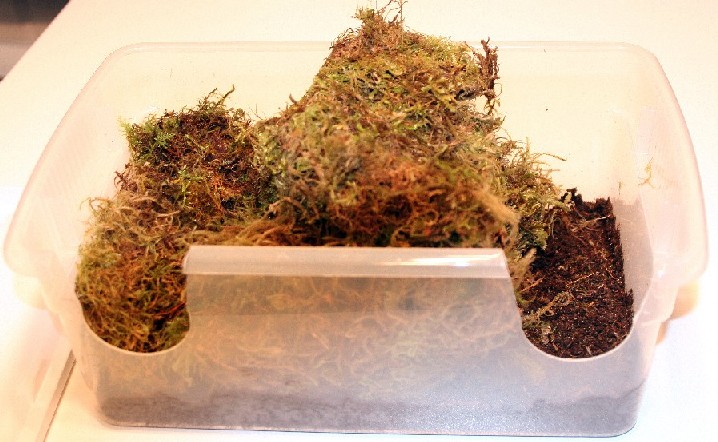
Adult BRBs require a minimum humidity level of 75% . Should humidity drop into the 60’s or 50’s for an extended period of time the results can be respiratory infections, regurgitation, and death by dehydration. For my adults I make a “damp hide” from a sweaterbox size tub with two access holes in one side. I put 1 inch of peat moss and one inch of green moss. Both nice and damp. They love to hang out in there and come out to explore at night.

Neonates should be kept at or near 95% humidity. I accomplish this with a fairly tight fitting shoebox rack. There’s always condensation at the front. Temps for babies should be right around 77 degrees.

Humidity is affected by two factors, evaporation and dissipation. The larger surface area water dishes will evaporate more into the air. By minimizing ventilation, you will keep that humidity in the enclosure.

Common mistake - thinking daily spritzing will make up for lack of natural humidity. If your enclosure is set up properly with adequate water sources and minimal ventilation, spritzing is not required.

Handling

BRBs can be somewhat nervous snakes. Babies are born striking at anything, but with regular, gentle handling they can tame down quite nicely to become acceptable pets. As babies, let them strike at you, bite you and even chew on you. This will show them you will not be chased away by those actions and they will soon learn the big bad hand is nothing to be afraid of. Pick up the baby with a steady non-tentative action. The baby will typically be coiled or piled in one spot. Aim for the side away from the mouth and just do it! If you are bit, there will be minimal pain and quite likely several pinholes in your skin. Resist the urge to pull back, that will only make it worse. BRB’s have teeth that curve backwards to hold onto their prey. If you pull away, you will tear your skin and could easily damage some of their teeth.

They are typically a more active snake when being held than your average boa, seemingly always on the move. This is not to say that they will not grip on to you tightly, these boas keep a good hold. Be careful when holding not to startle them, as rainbows can nip when scared.

Feeding

BRBs are voracious feeders that feed primarily on rodents, birds, lizards, and possibly aquatic life forms as well. In captivity they eat mice and rats approximately the same size as the largest part of the snakes girth. Neonates are born large enough to take hopper mice and rat pinkies. If these boas refuse food, their husbandry should be carefully examined. Stress, poor husbandry, or illness is the likely causes of a BRB that refuses to eat.

Babies should be fed on a schedule of from once every four days to once a week. Most of them will continue to feed even when they are opaque prior to shedding. These snakes are born large enough to take hopper mice as their first meal. Many of mine have done well starting out on rat pinkies. A reluctant snake may be induced to feed by placing it in a small tub or even a paper bag along with the food item. Place the smaller container back in the secure cage in case the baby escapes and leave it for an hour, if still not eating, can be left overnight.

Common mistake - feeding pinky mice to baby BRBs. If you have an unlimited source of pinky mice then go ahead but be prepared to feed several to each baby at each feeding.
A mouse pinky will make a very small lump in a baby BRB and be digested down so that the lump is no longer externally visible within 24 hours.

BRBs will grow rapidly on one appropriately sized mice/rats a week. Yearlings often grow to 48 inches in length though 36 to 40 inches is more typical. Many two-year-olds are four and a half to five feet long. Females and males are not significantly different in size. Adult males can do well on 20 medium sized rats per year. A breeding female will require two to three times as much to eat.

BRBs are often overfed to obesity in captivity as adults. At 2', the snake is large enough for pinkie rats and jumper mice. At 3', it is capable of consuming adult mice and young rats. Feed at least once every 10 days, when the snake begins feeding on large meals such as rats feeding can occur less frequently. Avoid handling after a sizable meal; it is stressful and may cause regurgitation. Many animals may be conditioned to accept pre-killed or thawed warmed rodents at feed time. This technique is safer, than feeding live rodents since this prevents the snake from being bitten by a rodent. Live feeders should be avoided except for the few (very few) snakes that will not eat anything else. Never leave a live rodent in the with a snake unattended. A rodent can cause serious damage to your pet!

Never handle rodents and then handle a snake; you may be mistaken as food. Develop proper feeding habits. As the snake grows it may be wise to feed the snake only dead rodents and move it to a feeding container prior to food offering. If moved to a feeding container for all feedings it may become conditioned not to expect food while in its' cage. This may reduce the possibility of being mistaken as a food item by an over zealous feeder. Best method is to place dead rodent in container and let snake discover it, encourages gentle food acquisition. Maintain accurate feeding and health records.

Shedding

Shedding is dependent on the animal's growth rate and condition and may occur every 3 - 6 weeks. They may refuse feeding attempts while shedding. Increase the humidity as a rainbow approaches a shed, this helps to avoid dry shed. With proper humidity, the shed should come off without shredding. Can easily get torn but should not be tattered. If the snake is having a bad shed where parts are stuck on, wet a pillowcase, put snake in pillowcase and tie knot in pillowcase to prevent snake from getting out. Place pillowcase back in enclosure at a neutral temp location and leave for a couple of hours. If still not fully shed, you can continue pillow case treatment overnight.

Breeding

BRB breeding practice is similar to that of the common boa. They can produce litters with up to 35 young. They can be bred as early as 2.5 years providing they are meet minimum size and weight requirements of 5 feet and weighing more than 3.5 pounds for females. Another six inches of length and pound of weight is more appropriate and should produce a larger first litter with less strain on the snake. Males should be 5 feet and 2.75 pounds, though many are this size at 30 months, they usually won’t breed until 42 months. They should not be bred unless they are extremely healthy, as breeding takes a lot out of them.

Cooling is necessary for successful production of egg and sperm cells. Breeding may be induced by night time temperature drops down to 68 - 72F and daytime temperatures in the low 80's. Reduction of light cycle from 12 - 14 hours to 8 hours and misting the animals with warm water prove beneficial. BRBs will usually begin breeding within a few weeks of being warmed back up after the cooling period. Females will show a very marked mid body ovulatory lump for several hours. This lump is usually not seen because it lasts for such a short time. Most gravid females will refuse to feed. They will sometimes take a very small prey animal while they are gravid. Many females will become enormously large in the back half of their body and look very emaciated in the front half late in the gestation. Reproduction takes an extreme amount of energy and should only be attempted with very healthy adults. Gestation lasts approximately five months.

The female will often appear restless and cruise around the cage as if looking for something for a day or two before laying. Laying often occurs during weather changes. Female snakes should not be disturbed while they are laying as this may cause them to interrupt oviposition which can lead to incidences of stillborn babies.

Females often eat recently laid infertile slugs. I have never witnessed a female eating babies but recognize that the possibility exists for a snake which is picking through a pile of live babies and slugs to possible devour a newborn baby accidentally. For this reason I try to remove the babies from the mother soon after they are born.

Baby BRBs are born in litters of two to thirty five. A typical litter contains twelve to twenty five babies. Babies are born 15-20 inches, and show pale, washed out coloration. The babies will color up significantly over the first few sheds. Ultimate coloring can take 18 months to show.

Most babies start out striking at anything that moves, it’s either food or needs to be chased away. They can be readily tamed with direct, calm handling gently and regularly over the first few weeks. They will often eat before they have shed. The first shed usually occurs after 10 to 14 days from birth.

They need to be kept at temperatures near 77 degrees and in high humidity. Temperatures above 85 degrees can cause fatalities in Brazilian Rainbows. Baby Brazilian Rainbows require humidity above 70 percent. They will do well kept individually in plastic shoeboxes until they are about 24 inches long and can then be moved into larger plastic storage containers or box type cages.

BRBs are difficult to sex based on visible external differences until they are about three years old. Young ones can be sexed by probing. Females will probe a distance of two to four subcaudal scales and males will probe to a depth of eight to twelve subcaudal scales. They can also be sexed by palpitation or popping. All three methods require someone experienced in sexing snakes. Adult males have substantially larger spurs along the side of the vent and also have noticeably thicker bases of their tails due to the invaginated hemipenes. After about eight years of age the heads of both sexes are noticeably larger than on nearly similar sized young adults. This phenomenon of the enlarged head on older animals seems to be more pronounced on red and orange animals than on brownish specimens. This phenomenon also occurs with older Peruvian Rainbows.

Morphs

There are an increasing number of BRB morphs being discovered. Though many of them are still unproven, current BRB morphs include but not limited to:

Anerythristic - lack or red pigmentation, results in a brown or taupe with white crescents.
Hypomelanistic - reduction of melanin resulting in a snake with brown orange and yellow patterning and significantly lighter markings.
Bullseye - Side crescents where some degree of full circling occurs with dark center.
Eclipse - Side blotches (oceli) where there is little to no crescents.
Blush - Side oceli where the crescent color is speckled through the pattern.
Striped (dorsal) - striping down the back.
Striped (lateral) - merging of individual oceli to make lateral stripes on the sides.
Clown - large oversized oceli
Calico - white scales typically outlining the dorsal patterns
Albino - Lack of melanin (or lack of expressing melanin) resulting in a white snake with orange markings. Very secretive and not many exist.
-----
Thanks,

Dave Colling

www.rainbows-r-us-reptiles.com

0.1 Wife (WC and still very fiesty)
0.2 kids (CBB, a big part of our selective breeding program)

LOL, to many snakes to list, last count:
24.36 BRB
19.19 BCI
And those are only the breeders

lots.lots.lots feeder mice and rats

rainbowsrus Jul 16, 2007 02:21 AM

Rainbow humidity 101

Since this topic comes up from time to time, I've created a document with all my answers. Not steadfast rules and/or guidelines, just what works for me.

Being from tropical rain forests, Rainbow Boas require high humidity. There are three basic factors to humidity:

Evaporation - is the process of water molecules becoming airborne.

Dissipation - The natural tendency of airborne water particles is to spread out as far apart as possible.

Condensation - warm moist air contacting a cooler surface will cause the water molecules to condense into droplets on the cool surface.

The number one mistake made with rainbow boas is to give them lots of ventilation. They really do not require much oxygen. They've even been reported to submerge under water for up to 30 minutes at a time. That ventilation will allow all those precious airborne water molecules to dissipate into your house. Unless your house is humid, many more will leave than enter. This will result in the enclosure drying out.

Many keepers use misting regimens to keep humidity levels up. IMO, you need to set up the environment so it will automatically be humid. Here are the steps I take to provide that environment.

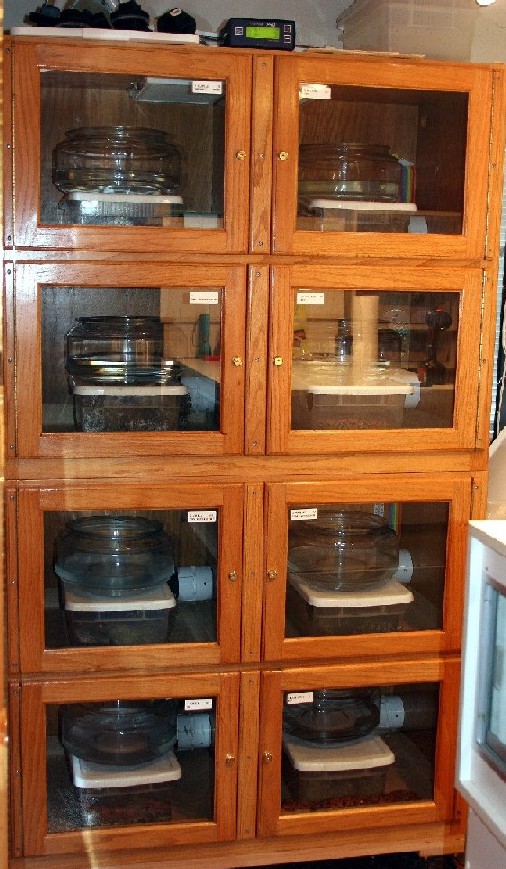
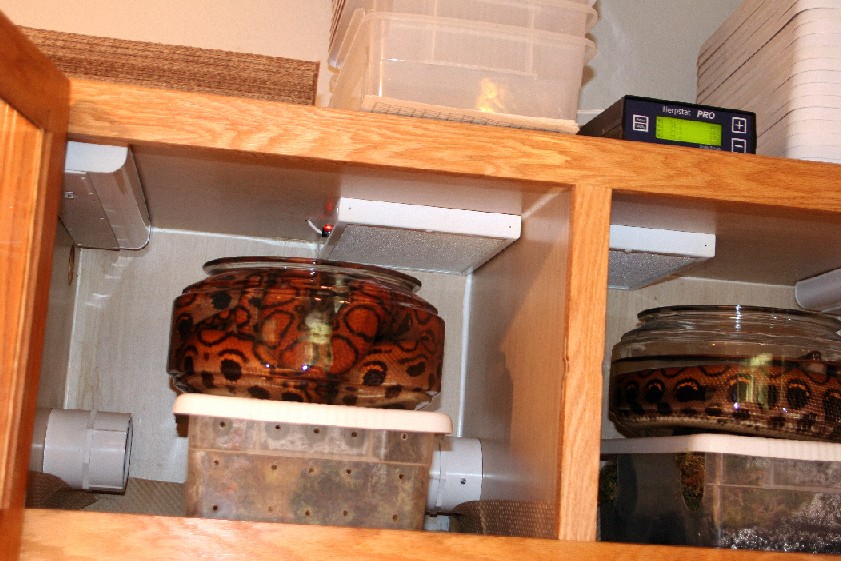
1) LIMIT VENTILATION - my cages at around 6 cubic feet only have one two inch round vent each. More than enough for air exchange.

2) Provide LARGE surface area water bowls. Remember, the larger the surface area, the more water will evaporate.

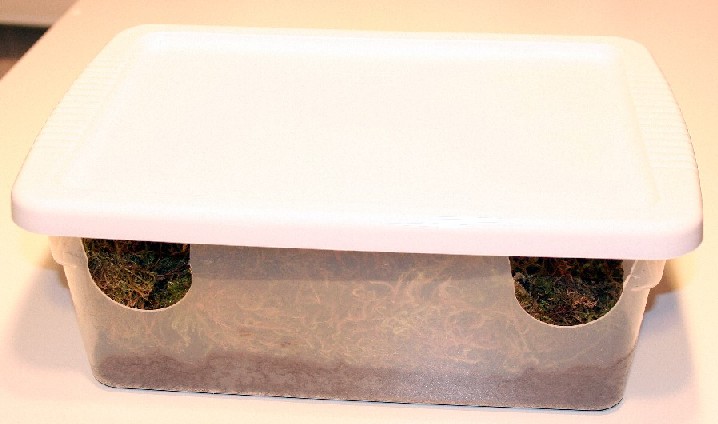
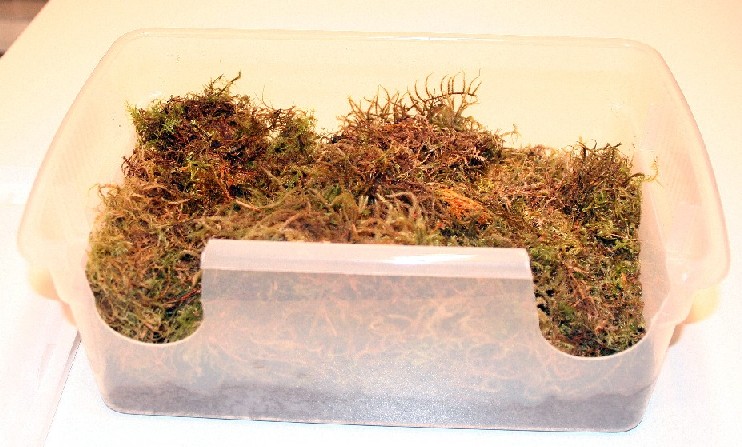
3) I provide damp hide boxes. A sweater box size for adults with holes in the sides. An inch of peat moss and another inch of green moss. All kept damp

4) Depending on your enclosure you can fine tune your system by moving the water bowl around. Closer to the warm end and more evaporation, closer to the cool end and less.

My cages:


A moss box:


Thanks for reading and I hope this helps.
-----
Thanks,

Dave Colling

www.rainbows-r-us-reptiles.com

0.1 Wife (WC and still very fiesty)
0.2 kids (CBB, a big part of our selective breeding program)

LOL, to many snakes to list, last count:
24.36 BRB
19.19 BCI
And those are only the breeders

lots.lots.lots feeder mice and rats

Bladespark Jul 16, 2007 02:50 AM

I'd actually encountered your care sheet already. (I ran into most of the care sheets I've been given while searching the net, in fact. Google is a wonderful tool.) But the extra info on humidity is very useful. I'll be starting out with a small screen top tank, but I intend to saran wrap most of the screen, to keep the moisture in. Although I do live in a relatively damp climate (Western Oregon) it's still not quite damp enough here.

Bladespark Jul 16, 2007 02:46 AM

Wow, there are lot of gorgeous snakes there!

I'll admit the Brazilians are lovely. But I'm quite fond of the Columbians too, and ease and reliability of acquisition is a big factor for me. I know that most snake dealers are honest folks, and that shipping is pretty safe, but I've still heard an awful lot of scare stories, and buying from a reputable source close to home seems like the way to go, really. Maybe I should ask the pet gal if her breeder has Brazilians as well as Columbians.

rainbowsrus Jul 16, 2007 11:27 AM

There is a lot to be said for picking it out in person, No pic can substitute actual eyes on selection. That said, shipping is really quite safe (with responsible breeders) There are limits to safe temps for shipping. There are three critical temp locations, departure and arrival cities and also the main sort hub for the carrier being used. Between shipping out and receiving in I've been involved in the shipping of hundreds of snakes. So far I've not had a loss. Have sweated a few that got delayed but all has turned out well in the end.

A couple of ideas for you.

1) Check for local or semi local shows, that way you can still have that "hands on" selection and may find more available.

2) Check out reputable dealers and talk with them, see how they ship. IMO, you can get a pretty good feeling just from talking with dealers. If all they're interested in is payment and getting it shipped out in a hurry, IMO run!! The dealer you would do best with is one that will work with you on selection, habitat set-up and any other questions you have both before and after the sale. Lastly, avoid resellers, you want your baby to come directly from the breeder who produced it.
-----
Thanks,

Dave Colling

www.rainbows-r-us-reptiles.com

0.1 Wife (WC and still very fiesty)
0.2 kids (CBB, a big part of our selective breeding program)

LOL, to many snakes to list, last count:
24.36 BRB
19.19 BCI
And those are only the breeders

lots.lots.lots feeder mice and rats

strictly4fun Jul 16, 2007 03:58 AM

rainbows are just about the prettiest snakes you can imagine Steph and if you are taking count of the people voting for you to get either a Columbian or a Brazilian, the BRB's will outweigh like 27 to 1 or something along those lines Shipping WILL not be an issue if you buy from a reputable breeder. You may have heard of horror stories but believe me none include the best guys we have on this forum. Since you only plan to buy one snake might as well do it right and get a BRB seriously. I would highly recommend the guys right here
Mike Lockwood
Jeff Clark
Dave Colling
Will Bird
Bryan Hummel
and if you go with one of these fellas then you will be aok and last but not least welcome to the most friendliest, most off-topic and maybe the most knowledgeable forum that ks has to offer
Bob

coluberking25 Jul 16, 2007 01:31 PM

GO WITH THE CRBs! Not only will that give me someone to discuss CRBs with, besides Jeff, but they are very good for a first time rainbow boa keeper, as they are more tolerant of mistakes with humidity(ie. keep it too low) than their Brazilian counterparts.

And when they grow up, they become very pretty snakes. Just check out my CRB, Rocky.

-----
Scott

Reptiles
--------
1 Colombian Rainbow Boa (Rocky)
1.0 Ball Python (Sultan)
0.1 California Kingsnake (Leota)
1.0 Eastern Painted Turtle (Yugi)
0.1 Red/Gold Bearded Dragon* (Irwin, R.I.P.)

Other
-----
1.0 Betta Fish (Tyrone)
1.0 Hooded Rat* (Clubber, R.I.P.)
0.1 Albino Rat (Isis)

atherisquamigera Jul 16, 2007 05:59 PM

hey awesome! that sounds like my reaction when i first saw a rainbow! (although the only difference is that i have kept snakes for a few years prior to my first rainbow, so i did my research and then immediatly went and spent every penny i had buying a baby brb from jeff clark. (i diet consisted of ramen for a few weeks cuz of that one.) =) and now i am addicted, and i can't seem to stop buying rainbows! my only hope is to breed them and then when I have like 15 babies maybe i will feel satisfied for a LITTLE while.
-----
-Jasmine

1.1 Brazilian Rainbow Boas
(Mercutio and Kajika)

rdude110 Jul 17, 2007 08:42 AM

I am getting a GTP as my first snake and then a Brazilian rainbow, i know what im doing, crickets are for camels
-----
Theres no need to ask directions if you ever lose you mind...

Site Tools