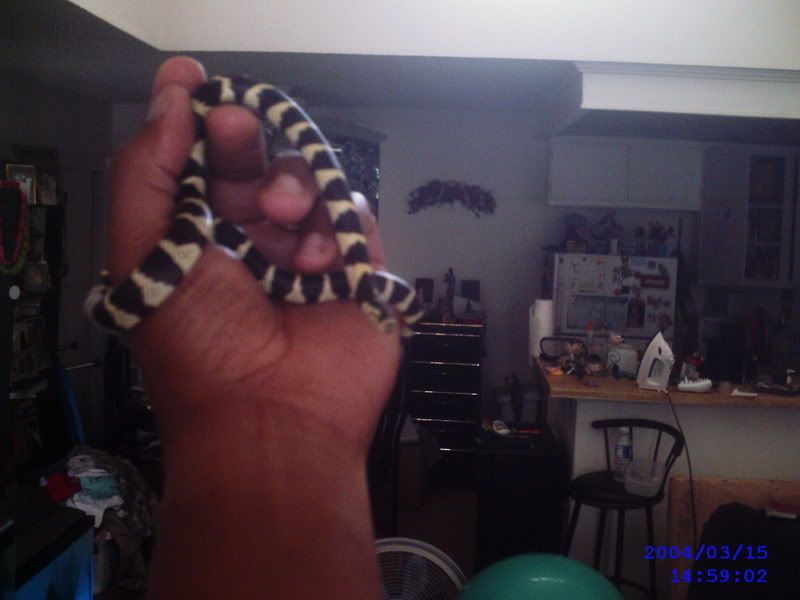
What I call webbing (what I use to call dirty bands) are bands where the dark base color exists on the edges of the scales of the light band scales, making a web.
The Cal Kings in East Contra Costa County exhibit this type of banding (as well as other locales).
Here is my male:

You can see his brown color around the edges of the cream scales.
I breed him to a banded amel female with vibrant yellow bands (best after shed - and it has been awhile). Here's her bands:

Because she's amel, it may be hard to notice any webbing if it did exist, but it looks to me like it does not.
-=-
Out of their 5 young last year, I held back two females.
The first to hatch and the fifth to hatch.
Here is the first - and I find this exciting:

Her bands are definitely yellow like her mothers bands though not quite as vivid, but they are also webbed like daddy's bands. Webbing to me anyway looks a lot better on yellow than it does on cream.
Her sister -

I'll try to replace that with a better pic.
Anyway - her bands are much more like fathers in colour, but very little webbing if any.
-=-
Anyway - from that pairing, I'm holding back a male this year.
I have no idea how yellow he will end up or how much webbing he will have - but if he isn't like big sister, I'll hold back another male in '08 etc. until I get a male to match her.
Unfortunate byproduct is that some of the F2s will be amel, but only a quarter of them.
Anyway - I really like the effect of webbing on yellow bands, and I think it would be kind of neat to try to line breed some that have a really vivid yellow with very distinct webbing.
Not something I intended to produce with the pairing, just kind of neat that it happened. I find it really attractive.
-----
11.14 L. getula californiae (Cal. King)
2.3 L. getula nigrita (MBK)
1.0 L. getula floridana (Brooksi)
1.0 Pantherophis guttatus guttatus (Corn)
0.1 Pituophis catenifer catenifer (Pacific gopher)
4.2 Elgaria multicarinata multicarinata - 14 eggs (Cal. Alligator Lizard)