Hi everyone. I just picked up a Brazilian Ranbow boa today. He is my first rainbow (I also keep rosys and breed kenyan sand boas). I was just looking for a little advice from those of you with more experience. The snake is a male that is 3 months old. I bought him at my local reptile shop who got him from a reputable local breeder. His cage is 24x12x12 inches. I am using cypress mulch as a substrate and also have a humidity hide box, some branches, and a water dish that he can easily soak in if he wants to. I set the cage up a few days ago and the humidity has maintained in the 70% range with the cool side being about 75 degrees and the warm side about 85 degrees F. Does this seem about right for a rainbow? I'll try to put some pics up when I get a chance. Thanks in advance for all the input. - Jeremy
Reptile & Amphibian Forums
Welcome to kingsnake.com's message board system. Here you may share and discuss information with others about your favorite reptile and amphibian related topics such as care and feeding, caging requirements, permits and licenses, and more. Launched in 1997, the kingsnake.com message board system is one of the oldest and largest systems on the internet.



New to rainbows
Replies (12)
and the temps sound like a good range but make sure it is not 85 or so in the hide itself trapping the heat and cuz that may make it very stuffy for him. If you can set it up in the 80 degree range he will love and the humidity is a little low so rather than spraying a lot just try and keep the moisture in as well as you can by covering the top with something non-porous or if you have to use towels in the meantime just dampen the bottom side of them and you will be fine temporarily. For a better fix I use 3/8 thick plexi (not cheap though) but some people use glass, cling wrap or you try putting the water bowl over the heat source to create that extra little humidity by controlling the air flow with the top covered is key to not allowing his environment to dry out though. Hope this helps and best of luck to you and your rainbow. Any more ?'s just post them and welcome to the forum btw
Bob
Bob, thanks for the advice. I checked the temp of the hide box with my temp gun and it was right at 79 degrees during the mid afternoon. As far as the humidity goes, I have about 2/3 of the water bowl over the UTH and I am going over to my parent’s house tomorrow to pick up some plexiglass that I have left over from other projects, thanks for the heads up on that.
All sounds good, except I'd drop the temps a few degrees. Also by moving the water dish closer to the warm end (if not already there) would help raise the humidity. And like already mentioned, limit ventilation, they don't really need fresh air, not nearly as much as higher humidity.
I'll post my care sheet and a humidity care sheet in subsequent posts if you want to read and/or print them out for future reference.
This is a great forum, lots of folks who can (and WILL) help you with your questions. Please hang around and join in. We'd love to see pics of your BRB.
>>Hi everyone. I just picked up a Brazilian Ranbow boa today. He is my first rainbow (I also keep rosys and breed kenyan sand boas). I was just looking for a little advice from those of you with more experience. The snake is a male that is 3 months old. I bought him at my local reptile shop who got him from a reputable local breeder. His cage is 24x12x12 inches. I am using cypress mulch as a substrate and also have a humidity hide box, some branches, and a water dish that he can easily soak in if he wants to. I set the cage up a few days ago and the humidity has maintained in the 70% range with the cool side being about 75 degrees and the warm side about 85 degrees F. Does this seem about right for a rainbow? I'll try to put some pics up when I get a chance. Thanks in advance for all the input. - Jeremy
-----
Thanks,
Dave Colling

www.rainbows-r-us-reptiles.com
0.1 Wife (WC and still very fiesty)
0.2 kids (CBB, a big part of our selective breeding program)
LOL, to many snakes to list, last count:
24.36 BRB
19.19 BCI
And those are only the breeders 
lots.lots.lots feeder mice and rats 

Brazilian Rainbow Boa Care Sheet
Description
Brazilian Rainbow boas are a subspecies of Epicrates cenchria, commonly known as Rainbow Boas. The range of Brazilian Rainbow Boas is quite large. It includes northern Peru and Brazil, southern Venezuela and Guyana and much of Surinam and French Guiana. Although not endangered, due to habitat destruction they are not common in their range. They are a semi-arboreal, slender-bodied snake with an adult size of 5-7 feet, females being slightly larger than males. They have beautiful coloration ranging from a deep red to orange, sometimes brown, with dark rings down their back, and several rows of dark spots along their sides, the first row that is highlighted by bright, light-colored crescents.
They get their name from their incredible iridescence caused by microscopic ridges on their scales that act like prisms to turn light into rainbows.
Housing
Neonates and sub-adults do very well housed in Rubbermaid containers or similar. Adults can be housed in 4x2x2 enclosures. Substrates that Brazilian Rainbow Boas do well on include sphagnum/peat moss, dampened Care fresh, damp newspaper, and cypress mulch. Substrates that should be avoided include gravel, bark, wood shavings (especially cedar and pine, these are toxic to reptiles), and shredded aspen. Neonates require a much higher humidity level than adults and can be housed successfully on wet newspaper or sphagnum/peat moss. With such high humidity comes mould, therefore attention must be kept to maintaining very clean cages. They should have free access to a large bowl of fresh water at all times (large enough to soak in). As adults they will usually drink large amounts of water and will not require nearly as high relative humidity in their cages. Unless they are on several inches of loose substrate that they can burrow in, they should also be provided with adequate hiding spots. Though not an absolute necessity, perches and shelves can be added to the enclosure.
Temperature and Humidity
Brazilian Rainbow Boas are more tolerant of lower ambient temperatures than many other boids, though they cannot tolerate excessive heat well. They should have a temperature gradient of 75 - 83 degrees. Temperatures exceeding 85 degrees can be fatal. Adult Brazilian Rainbow Boas require a minimum humidity level of 75% . Should humidity drop into the 60’s or 50’s for an extended period of time the results can be respiratory infections, regurgitation, and death by dehydration. Neonates should be kept at near 95% humidity.
Handling
Brazilian Rainbow boas can be somewhat nervous snakes. Babies are born striking at anything, but with regular, gentle handling they can tame down quite nicely to become acceptable pets. They are typically a more active snake when being held than your average boa, seemingly always on the move. This is not to say that they will not grip on to you tightly, these boas keep a good hold. Be careful when holding not to startle them, as rainbows can nip when scared.
Feeding
Brazilian Rainbow Boas are voracious feeders that feed primarily on rodents, birds, lizards, and possibly aquatic life forms as well. In captivity they eat mice and rats approximately the same size as the largest part of the snakes girth. Neonates are born large enough to take hopper mice and rat pinkies. If these boas refuse food, their husbandry should be carefully examined. Stress, poor husbandry, or illness is the likely causes of a Brazilian Rainbow Boa that refuses to eat.
Babies should be fed on a schedule of from once every four days to once a week. Most of them will continue to feed even when they are opaque prior to shedding. Many people make the mistake of feeding pinky mice to baby Brazilian Rainbow Boas. If you have an unlimited source of pinky mice then go ahead and feed them to baby Brazilian Rainbows but be prepared to feed lots of them at each feeding. These snakes are born large enough to take hopper mice as their first meal. Many of mine have done well starting out on rat pinkies. A mouse pinky will make a very small lump in a baby Brazilian Rainbow and be digested down so that the lump is no longer externally visible within 24 hours. A snake may be induced to feed by placing it in a locking plastic shoe box style container (with air holes) with crumpled newspaper and leaving it for an hour, then introducing a food item.
Brazilian Rainbows will grow rapidly on one or two appropriately sized mice a week. Yearlings often grow to 48 inches in length though 36 to 40 inches is more typical. Many two-year-olds are four and a half to five feet long. Females eat more and grow larger than males. Adult males can do well on 20 medium sized rats per year. A breeding female will require two to three times as much to eat.
Rainbow Boas are often overfed to obesity in captivity as adults. At 2', the snake is large enough for pinkie rats and jumper mice. At 3', it is capable of consuming adult mice and young rats. Frequent feedings of 1 - 2 times weekly will result in quick growth and a healthy animal. It may be wise to consider how large you wish the snake to get, feed less often to slow the growth rate.
Feed at least once every 10 days, when the snake begins feeding on large meals such as rats feeding can occur less frequently. Avoid handling after a sizable meal; it is stressful and may cause regurgitation. Many animals may be conditioned to accept pre-killed or thawed warmed rodents at feed time. This technique is safer, than feeding live rodents since this prevents the snake from being bitten by a rodent. Never leave a rodent in the snake's cage for lengthy periods; a rodent can cause serious damage to your pet!
Never handle rodents and then handle a snake; you may be mistaken as food. Develop proper feeding habits. As the snake grows it may be wise to feed the snake only dead rodents and move it to a feeding container prior to food offering. If moved to a feeding container for all feedings it may become conditioned not to expect food while in its' cage. This may reduce the possibility of being mistaken as a food item by an over zealous feeder. Best method is to place dead rodent in container and let snake discover it, encourages gentle food acquisition. Maintain accurate feeding and health records.
Shedding
Shedding is dependent on the animal's growth rate and condition and may occur every 3 - 6 weeks. They may refuse feeding attempts while shedding. Increase the humidity as a rainbow approaches a shed, this helps to avoid dry shed.
Breeding
Brazilian Rainbow Boa breeding practice is similar to that of the common boa. They can produce litters with up to 35 young. They can be bred as early as 2.5 years providing they are meet minimum size and weight requirements of 5 feet and weighing more than 3.5 pounds for females. Another six inches of length and pound of weight is more appropriate and should produce a larger first litter with less strain on the snake. Males should be 5 feet and 2.75 pounds, though many are this size at 30 months, they usually won’t breed until 42 months. They should not be bred unless they are extremely healthy, as breeding takes a lot out of them.
Cooling is necessary for successful production of egg and sperm cells. Breeding may be induced by night time temperature drops down to 68 - 72F and daytime temperatures in the low 80's. Reduction of light cycle from 12 - 14 hours to 8 hours and misting the animals with warm water prove beneficial. Brazilian Rainbow Boas will usually begin breeding within a few weeks of being warmed back up after the cooling period. Females will show a very marked mid body ovulatory lump for several hours. This lump is usually not seen because it lasts for such a short time. Most gravid females will refuse to feed. They will sometimes take a very small prey animal while they are gravid. Many females will become enormously large in the back half of their body and look very emaciated in the front half late in the gestation. Reproduction takes an extreme amount of energy and should only be attempted with very healthy adults. Gestation lasts approximately five months.
Same as with many reptiles, females may refuse food while gravid. This is no cause for alarm. The gestation period of Brazilian Rainbow Boas is about 5 months.
The female will often appear restless and cruise around the cage as if looking for something for a day or two before laying. Laying often occurs during weather changes. Female snakes should not be disturbed while they are laying as this may cause them to interrupt oviposition which can lead to incidences of stillborn babies.
Females often eat recently laid infertile slugs. I have never witnessed a female eating babies but recognize that the possibility exists for a snake which is picking through a pile of live babies and slugs to possible devour a newborn baby accidentally. For this reason I try to remove the babies from the mother soon after they are born.
Baby Brazilian Rainbows are born in litters of two to thirty five. A typical litter contains twelve to twenty five babies. Babies are born 15-20 inches, and showing decent coloration, which is lost with the first shed. Babies remain a dull coloration typically until they reach 18 months of age.
Most specimens start out striking at anything that moves but can be tamed with regular calm handling gently and regularly over the first few weeks. They will often eat before they have shed. The first shed usually occurs after 10 to 14 days from birth.
They need to be kept at temperatures near 80 degrees and in high humidity. Temperatures above 85 degrees can cause fatalities in Brazilian Rainbows. Baby Brazilian Rainbows require humidity above 70 percent. They will do well kept individually in plastic shoeboxes until they are about 24 inches long and can then be moved into larger plastic storage containers or box type cages. They should not be kept in fish tanks or similar cages as the large screened area will allow too much humidity to escape from the cage
Brazilian Rainbow Boas are difficult to sex based on visible external differences until they are about three years old. Young ones can be sexed by probing. Females will probe a distance of two to four subcaudal scales and males will probe to a depth of eight to twelve subcaudal scales. Adult males have substantially larger spurs along the side of the vent and also have noticeably thicker bases of their tails due to the invaginated hemipenes. After about eight years of age the heads of both sexes are noticeably larger than on nearly similar sized young adults. This phenomenon of the enlarged head on older animals seems to be more pronounced on red and orange animals than on brownish specimens. This phenomenon also occurs with older Peruvian Rainbows.
Problems
1) Respiratory infections manifest themselves as excess fluid in the mouth and nostrils, with gaping of the mouth. These infections result from inappropriate conditions such as cool temperatures, dry air, dehydration, stress, and parasites. To treat, increase the humidity and raise the temperature into the upper 80's, reduce all possible stress to the animal. If condition persist, antibiotic therapy will be necessary through a veterinarian.
2) Mouth rot manifests itself as cankers or lesions in the mouth. This syndrome results from the conditions of (1) and rubbing on rough surfaces, rodent bites and materials lodged in mouth. To treat, increase temperature to 90F, clean infected area with a solution of 1.5% hydrogen peroxide (dilute 50:50), remove loose material and swab with betadine 2X daily. If condition persist, medical attention is needed.
3) Dry sheds are due to dehydration, improper temperatures, illness and stress. Allow the animal to hide in a moist location when shedding, such as a water dish or container with a damp towel.
4) Thermal burns and "Belly Rot" are caused by exposing the animal to a high heat source or unsanitary conditions. Follow procedure for (2), treat all damaged tissue. Correct the improper conditions.
5) Mites are small blood sucking ectoparasites, which are irritating to snakes. They appear as small black dots on the animal or in its dish. Consult your pet shop or fellow herper for treatment (Bio strip, ivermectin, etc.)
6) Ticks are blood sucking ectoparasites that are often found on wild caught animals. Removal of ticks is achieved by a clockwise twisting of the parasite or suffocating the tick with vaseline until it dies in a few days and then removing.
7) Internal parasites can be a problem, especially with imported animals. Symptoms such as failure to thrive, regurgitation, failure to feed, and depression are all possible signs of a parasitic infestation. It may be a wise move to bring a fresh fecal sample to a veterinarian, and if necessary treat for parasites.
8) Reluctant Feeders: May be more apt to eat at night or with lights off, and may prefer to ambush prey from a hide box. Try a variety of rodents and sizes. Is the animal sick? Reduce handling to a minimum. If an animal refuses all feeding attempts and appears to be wasting, consult a veterinarian or experienced herper.
Morphs
There are an increasing number of Brazilian Rainbow Boas being discovered. Though many of them are still unproven, current Brazilian Rainbow Boa morphs include: Anerythristic, Hypomelanistic, Bullseye, Striped, Calico, Double Striped, Solid Bullseye, Gold Dust, Highlighted, Hypermelanistic, Chocolate, and a very exciting (secretive) Albino!
-----
Thanks,
Dave Colling
www.rainbows-r-us-reptiles.com
0.1 Wife (WC and still very fiesty)
0.2 kids (CBB, a big part of our selective breeding program)
LOL, to many snakes to list, last count:
24.36 BRB
19.19 BCI
And those are only the breeders
lots.lots.lots feeder mice and rats
Rainbow humidity 101
Since this topic comes up from time to time, I've created a document with all my answers. Not steadfast rules and/or guidelines, just what works for me.
Being from tropical rain forests, Rainbow Boas require high humidity. There are three basic factors to humidity:
Evaporation - is the process of water molecules becoming airborne.
Dissipation - The natural tendency of airborne water particles is to spread out as far apart as possible.
Condensation - warm moist air contacting a cooler surface will cause the water molecules to condense into droplets on the cool surface.
The number one mistake made with rainbow boas is to give them lots of ventilation. They really do not require much oxygen. They've even been reported to submerge under water for up to 30 minutes at a time. That ventilation will allow all those precious airborne water molecules to dissipate into your house. Unless your house is humid, many more will leave than enter. This will result in the enclosure drying out.
Many keepers use misting regimens to keep humidity levels up. IMO, you need to set up the environment so it will automatically be humid. Here are the steps I take to provide that environment.
1) LIMIT VENTILATION - my cages at around 6 cubic feet only have one two inch round vent each. More than enough for air exchange.
2) Provide LARGE surface area water bowls. Remember, the larger the surface area, the more water will evaporate.
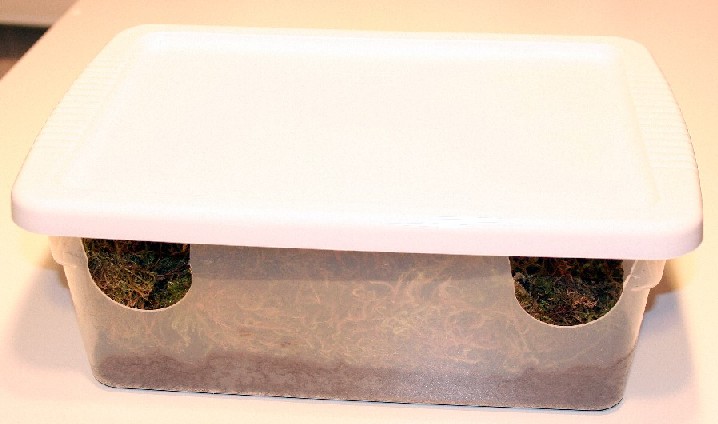
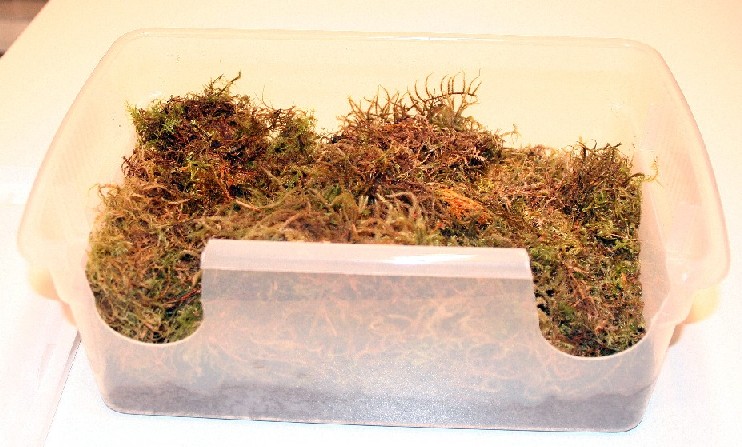
3) I provide damp hide boxes. A sweater box size for adults with holes in the sides. An inch of peat moss and another inch of green moss. All kept damp
4) Depending on your enclosure you can fine tune your system by moving the water bowl around. Closer to the warm end and more evaporation, closer to the cool end and less.
My cages:
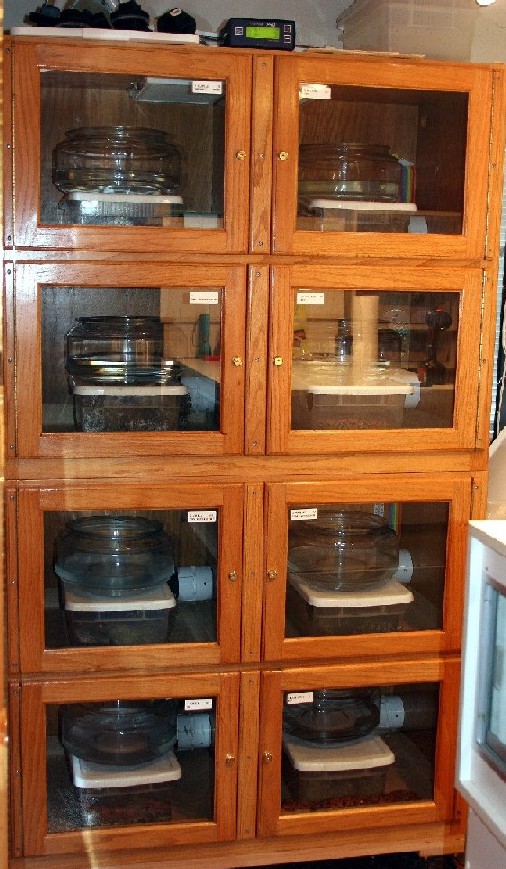

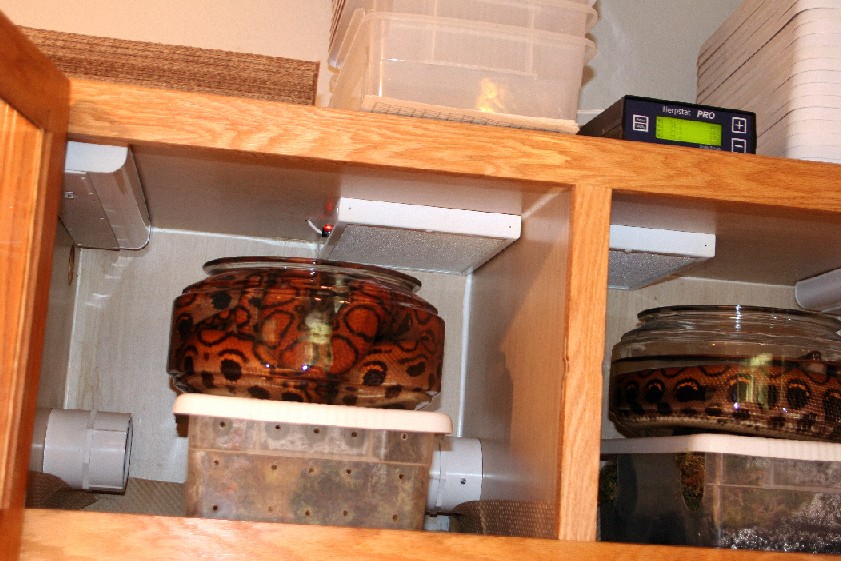
A moss box:
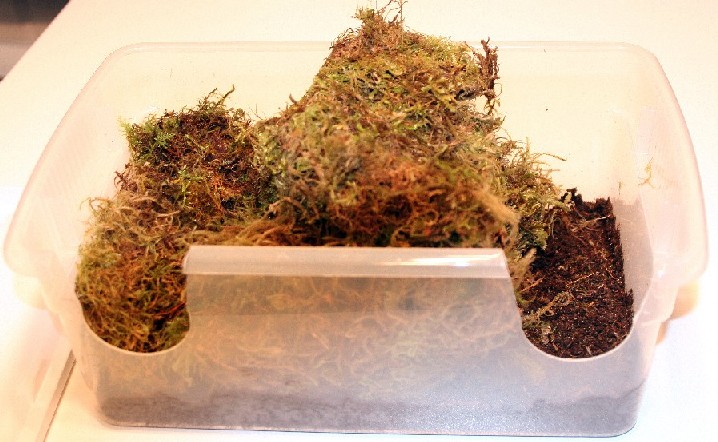
Thanks for reading and I hope this helps.
-----
Thanks,
Dave Colling
www.rainbows-r-us-reptiles.com
0.1 Wife (WC and still very fiesty)
0.2 kids (CBB, a big part of our selective breeding program)
LOL, to many snakes to list, last count:
24.36 BRB
19.19 BCI
And those are only the breeders
lots.lots.lots feeder mice and rats
Dave,
Thanks for posting the information, I noticed something in your cages that I didn't notice before and that is radiant heat panels. Are you using that as the only heat source?
I am not 100% how you have your cages built but are you using UTH as well I know when working with wood UTH isn't the best choice but you could make it work if you had the right tools and know how, which I am sure you do.
Thanks,
-----
Jason A.
"Long time Herper, first year Breeder `07."

Hey Jason, Yeah, I use the RHP's exclusively now on the breeding cages. When the first was built many years ago, it was heated with incandescent lightbulbs. (I know...VERY old school) The second cage has heat tape under the floor but no recess so works, but not very efficiently, much of the heat escapes into the room. Had I known better at the time I built, I could have done belly heat much better...Ah well!! So for those cages, without major re-work, RHP's are the way to go. And I do have to say the RHP's do a very good job of heating the enclosures. Very soft heat, no hot spots.
-----
Thanks,
Dave Colling
www.rainbows-r-us-reptiles.com
0.1 Wife (WC and still very fiesty)
0.2 kids (CBB, a big part of our selective breeding program)
LOL, to many snakes to list, last count:
24.36 BRB
19.19 BCI
And those are only the breeders
lots.lots.lots feeder mice and rats
Dave, thanks for posting those write ups and the advice. I plan on playing with the rheostat tomorrow so it doesn't get too hot mid day. You have some awesome animals on your site. I think in the next day or two I should be able to get the heat dialed in and get the humidity up a little more. Just a little adusting and checking. Completly opposite of the hot low humidity that I have for my Kenyan sand boas. I will try to get a picture of the snake and the setup tomorow if I can. Thanks again- Jeremy
np Jeremy, glad to help. Thanks for the kind words on my animals, I've searched high and low to find top notch animals for my collection. Always a plus when breeding.
-----
Thanks,
Dave Colling
www.rainbows-r-us-reptiles.com
0.1 Wife (WC and still very fiesty)
0.2 kids (CBB, a big part of our selective breeding program)
LOL, to many snakes to list, last count:
24.36 BRB
19.19 BCI
And those are only the breeders
lots.lots.lots feeder mice and rats
Dave pretty much summed up the things to do with your snake. Make sure and cover most of the tank so air doesn't circulate and you keep humidity levels steady.
Hope you stick around as this is a very friendly forum. People here will help out quickly but there's more than that. There are always tons of pictures to look at, many off topic but that makes them better, also lots of topics to discuss and just chat about.
Hope to see lots of pics of your new acquisition very soon. And good luck with everything. If you need any help don't be afraid to ask.
-----
Tim
0.1 Colombian Rainbow Boa
1.0 Albino Motley Corn
1.0 Black cat
Thanks for the warm welcome. Eveyone over on the sand boa page have always been great, glad to see the same is true over here.
-----
0.1 Rosy boa
4.7 Kenyan sand boas
1.0 Brazilian Ranbow Boa
Welcome to the forum.
The water bowl overlapping the under tank heater is a great way to help keep humidity up as you have done.
If you have the room however you may want to have a waterbowl for soaking on the cool side.
I have a small evap bowl overlapping the UTH and it works great but I have never seen my BRB's touch it for drinking or soaking. mine spend most of their time on/near the cool side hiding under the coolside water bowl. The cool side in mine is normally arround 73-76. It may just be mine liking it cooler but they do all their observed drinking and soaking in the cool bowl. Of course I have not taken a temp gun reading of the water temp in the hot side bowl so it may just be getting a little too hot in my tanks.
Either way if you have the room you might try it but I don't expect it's necesary.
Congrats on your acquisition and once again welcome to the forum!
Sean.
