Reptile & Amphibian Forums

Welcome to kingsnake.com's message board system. Here you may share and discuss information with others about your favorite reptile and amphibian related topics such as care and feeding, caging requirements, permits and licenses, and more. Launched in 1997, the kingsnake.com message board system is one of the oldest and largest systems on the internet.

Click for 65% off Shipping with Reptiles 2 You

Frank Please expand

Sighthunter Sep 18, 2007 04:21 AM

I would like you to expand my understanding on temperature.

My knowledge base on lizards is this, collard lizards in Kansas bask at 112F and will maintain this body temperature for about four hours at a time plus or minus as I use a laser temp to study them but almost always 112F.

When I hatch out youngsters I notice they will also get along in a colony and will bask and thrive at 112F and mimic the wild population in my understanding people keep captives to cool as my wild caught Adults will also thrive under these conditions. Their apatite is voracious as youngsters. It appears that they have a social structure in that the younger males (in my wild population) do not get the choice rock to occupy but are well within the territory of the other male with no ill effects. That is about all I know about lizards.

Should I ignore the above model or build on it? How does this parallel monitors or should I be thinking in a different direction? I know the variables are species and area dependant but say an equatorial specimen that basks for hours on end how hot will they prefer and you may use a specimen of your choice as an example. How deep is the natural burrow of the specimen of your choice and how cool are they when they immerge from underground? How long will the specimen bask?

Please keep it under 3 pages if possible as I am imputing the information and have slight brain damage from growing up with Scott if you know what I mean!
-----
"Life without risk is to merely exist."

Replies (13)

FR Sep 18, 2007 10:15 AM

Hi Bill, before we switch over to monitors, lets work on the Crots. We have those here and they are very similar to small monitors.

But I think you may be a little prejudiced. For instance, you call the rock an adult male or pair basks on, the best spot. You have to question that. I am sure there are hundreds of spots in that same area with the EXACT same temps. Please check where the lizards are not, as well as where they are.

Crots here are rarely saxocolis(living in rock crevice or under bark) They normally bask on small rocks(sometimes not so small) and live in burrows under or near a prime basking spot.

To understand this, They only use that Prime basking spot at certain times of the year, and use other areas inbetween(you know, when they are not on top that rock).

Your importance is that 112F, which I will not question, what I question is, how many other areas around that rock(if it is a rock) is that same temp. Once you understand, there are many areas or spots that male or pair could use, it will cause you to understand there are more reasons then physical they pick a certain rock. For instance, what will happen if you take that rock home and put it in your rock garden? If you do that while the lizards are in their burrows, they simply pick another one near that one. No worries. So again, why that rock?

So as you mentioned, there are other males, and you should of included other females, in that area, that appear to not use that rock. I say appear, as you may want to increase the time you look at that basking rock. As smaller individuals often use the same rock earlier in the day. On or different days.

But your right, on the day and time that male or female or pair, decides to use that "one" rock, the others simply move over. No fighting, no fuss.

This indicates a relationship with other lizards of its own kind. They also have a relationship with other species.

Now if you bring in a male or female from a foreign area, say a mile or more away. They will not allow it anywhere near them, not on that rock, or anywhere near, they will chase it over hill and dale and fight to the finish(or when one leaves) This indicates there are distint groups of the same species. Which indicates a form of social status. You know, us guys and you guys, much like keepers and academics. You know, we really have no REAL reason to fight, but we do. We do because we are social. It always boils down to us guys(our social group) and those guys(the others and who cares what they do, they are weird)

Lets take that and compare it to some birds. We commonly see a flock of birds(how social is that?) Yet, these dang dumb birds bicker and bicker and bicker. They always bicker. But if a member of another flock intrudes, that bickering becomes something else, ITS WAR I TELL YOU. hahahahaha they will not bicker with that one, they will fight it.

So what you see is, that collarded uses that one rock, as a post, a social post. He/she/they, go there to be seen. The reason its a social post is, they do not physically need that rock. They could use the next one over, or a branch or just the ground. The REAL truth is, they spend the vast majority of their life not on that rock. They also bask under small rocks(heat up faster).

I call that rock thing a line of succession, as they will yield that spot to their offspring, but not to the OTHERs(academics) Their will be a line of succession within the group.

Enough of that.

Yes, they are very comparable to many small monitors. Say, ackies. Certain types do exactly the same, live in holes and bask on a succession rock. They live in colonies(much denser) and have a hi-archy of succession. Did I say much denser.

Now you must consider, the amount of time they do the above, is very very short, is it not? what are they doing the rest of their lifes? Also what are they doing in the fall? in the winter? in early spring? My bet is, your seeing this in late spring, maybe early summer where your from(may be different here)

So, whats up the rest of the year??? To understand them, you must understand the rest of the year.

Now I going to hit you on the nockin, Do not worry about stuff like that rock. You need to worry about what it takes for reproduction, as without reproduction, those lizards will be exstint. When I study a reptile, I do not consider anything until I find the reproductive center. That is, I have evidence of GRAVID females, eggs, nests, babies. Without that, what are you looking at??????? Of course your looking at something, but not the important part.

So I warn you, find the base(the reproductive center) and look at the animals and what they do. That way, you can see the relationship on how it works for the purpose of recruitment. As recruitment HAS to be the center of understanding what they do.

And sir, that is the part missing in nearly all varanid field work.

In one arguement with a noted field reseacher, on his work with V.tristis. He had 2500 observations of V.tristis(I am guessing as I forgot the exact number, so its aprox.) During my questioning him, I asked how many reproductive events did you see? You know like copulations, his answer was one, they saw two tails sticking out of a hole in a tree. Hmmmmmmmm is that copulating???? And only for a short time. Us captive breeders know that they copulate for hours at a time over 3 to 5 days. So what was that? I then asked about nesting, again, one event. They saw a fat lizard go in a hole and come out skinny. I then asked, how many eggs, etc. The answer, we did not dig it up. Then I have to wonder what makes you think it nested and actually laid eggs. That answer was, they did not. I then asked did you see babies come out, the answer was no, did you dig it up after they hatched and count eggshells, the answer was no.

So as scientific has he wanted the paper to be, of 2500 observations, there was two(POSSIBLE) non proven reproductive events. Yet, the paper included a nearly full prediction of what these lizards do. You know, their natural history.

The point is, if you view 1000 individuals and included the breeding season(anything else would be worthless) You would have to see X percentage of gravid females in order to for that population to EXSIST. In my work, it averages about 20% of the population is reproductively important, that is, reliable and repeatitive. About 30% is reproductively viable but inconsistant. And 50% of the population is either toast or waiting in the line of succession. Of course this varies from year to year. So to fit our low 20%, he should have seen 50 reproductive events. That he did not meant he was not in the right place at the right time. So it becomes a meaningless study. Or as you said, something to right about, for the sake of writing. But did not INCLUDE what it takes for any and all animals to exsist.
We call the non breeders, gooners, as they do not follow a set path, they simply goon around until they die or find a vacant position in the group. Sorry went to long, whoops

The pic is Daniel Bennett on a collarded site near my house Cheers
Image

Sighthunter Sep 19, 2007 12:23 PM

My observations from a new angle. The structure of the colony I have been observing is as follows, The male has females along a 200 yard long stretch of rock fence. There is only one female with the dominant male at a time and they spend time side by side. I will now be studying the social structure as the less dominant individuals as well as trying to identify the individual animals. There always seems to be a subordinate males and females very near within five to ten feet but never next to the matriarchs as observed so far. I do know during bad weather they are under a rock waiting for it to warm up or quit raining.

Nesting Crotaphylus collaris are as follows I have found approximately 30 nests. The nests were under a flat rocks that is between 3 and four inches thick usually at the top of a small hill. The eggs are 9 to 12 on average and occasional communal nest as I doubt a collard lizard will lay 27eggs. The nest size is about 3” in diameter and backfilled with loose gravel toward the center of the rock although there have been exceptions. They sometimes utilize an old mouse burrow under the rock and rework it but 99% of nests seem to have been excavated. The eggs hatch around July 14 with near 100% success. I have found evidence that ants occasionally will eat an egg possibly a egg that did not hatch properly. I have found up to seven nests within twenty feet of each other suggesting at least seven adult reproductively mature females within the colony. Gravid females are seen near the middle of May.

I have seen two or so copulations and courtship but have failed to look at the social structure in the depth you are mentioning. After all my blabbering I need to go back and re-read your post a few more times as I get hyper and want to type. I know there are some holes in my thought process and if I can fill the holes I will be closer to the truth. Sorry for the rambling………Bill
-----
"Life without risk is to merely exist."

Sighthunter Sep 19, 2007 12:54 PM

The family has a social structure and you learn to work within that families social structure. The family can be any size, it can be two or 200 size does not matter. You will be molded by the family structure. The environment influences the family as does the season and predators. The family’s have a boundaries, imaginary fences. You stay on your side of the fence you are protected by the family. If your youngster wanders across the fence the opposing family eats your youngster for dinner.

So now my (pre programmed self) wants to say that males will vie for dominance within a family and chase some out to preserve genetic diversity so I just got lost. Do a few wondering lone males such as in lions round up a few wondering females or do they steal them or did I just skew into a parallel reality.

My instinct tell me that the hatchlings are not welcome within the family structure and families are formed as young animals disperse but I must think Birds! OK so birds do allow the youngsters to co-exist until such a time that they choose to leave or are driven away or made to fend for themselves.

Boy lizards are not as easy as snakes! I must be learning because I feel like I am back at school!
I need tutoring as I just got lost.
-----
"Life without risk is to merely exist."

Sighthunter Sep 19, 2007 02:07 PM

I understand that a monitor will manipulate its environment for many reasons. One of my pet peeves is “cold blooded) their blood can be 105F so how is that cold blooded. Back to the subject at hand. I understand a lizard must manipulate its environment in the temperature sense such as lack of food (turn off) go underground and cool off or food is in abundance (eat up and heat up) or I need to make eggs (eat up and heat up) all this I understand. I know that when a lizard is getting ready to hibernate it will clear out the food and shut down. I understand monitors do not need to shut down .

So I assume your answer to my original question is variable, offer a reasonable cool spot and a reasonable hot basking spot as well as burrows. I was wondering how hot an average monitor will bask? Pick one say what is the hottest one of your monitors will bask? I used the collard lizard as I take actual body temperatures at 112F assuming the gun is accurate. I want to know how hot is hot 140? I assume as you use birds as an example they like it around 100F as a baseline for most.
-----
"Life without risk is to merely exist."

FR Sep 19, 2007 04:53 PM

Hi Bill, SCOTT just called me, but I could not talk. I called back and left a message. hahahahahahaha
First, this is getting off topic, so your welcome to come over to our forum(varanus.net) We allow off topic reptile talk, as long as it can help us understand varanids, and boy we think about all wild reptile stuff does.

We normally use the varanid forum for all this kind of talk, but if its busy, we can always move it over to the general herp forum, but its never THAT busy.

About temps and lizards. There are some very important differences in how animals maintain their body temps.

Birds and mammals maintain a rather narrow body temp, and do so, mostly internally(metabolism) Reptiles, including varanids, use some metabolism and mostly the enviornment. Of course you know that. And so do the academics. Its how(the actual behaviors) that is the HUGE difference.

Academics somehow(got me, I have no idea how) they get their operating temps from the same temp they need. For instance, if what they need at the moment is 93.7F, they(odd people) think they should bask at 93.7F to get that. That is so far from how they do that, its scary off. They use much higher temps to attain set temps. Then move or pant or tail lift, or body angle, to maintain that needed temp. Or jump in the cool cool water, or in the exhaust of my mouse room. Yes, local lizards take advantage of the cooler air coming out of our room, in the hot part of the day, but in the cooler times, they use it to attain warmer temps. Those dang things are not stupid.

Then you must consider, they do NOT maintain one set temp. They indeed use the most efficient temp for the task at hand. Some tasks require high temps, some medium temps and some cooler temps. Hence the range we offer. They can pick what the HADIES they want. I do not have to know, what or why. They JUST have to have that ability.

Common tasks that require temps above base(cool shelter temps) are such things as.

Shedding
digesting food, different temps for different amounts.
growing
building the immune system
during certain periods of the reproductive cycle.

Your so very right, Varanids are NOT cold blooded, they are very much the opposite. They merely do not use metabolism to gain that heat. Their body temps are very similar to birds. Only it has a greater range. And they include cool temps for conservation of energy. You know, like some night hawks that drop their body temps during winter.

So, yea, come over and we can talk collard lizards like crazy and not have to make obvious connections to varanids. Cheers

Sighthunter Sep 19, 2007 08:50 PM

I apreciate the information and I will stay on topic listening works best but us hyper guys get answers in different ways. I will unplug my keyboard for a while. I am working on visiting you in January if you are open to it. I E-mailed you but I do not know if you got it. I am working on aquiring a group of monitors to learn as I go.........Thanks as I know Nubees can be a pain.......Bill

Sighthunter@aol.com
-----
"Life without risk is to merely exist."

FR Sep 20, 2007 11:04 AM

I have no problem with these discussions, as they help me too. Your observations of Collards are important in understanding monitors.

I also think our discussions ACTUALLY help more others, then you can imagine.

One of the biggest problems I see with varaphiles, you know, those book writers is This. MOST appear, at least the ones who fight actual captive progress, to be very varanid specific. That is, they have little reptiles experience. Everything they know is based on varanids, and truthfully, there is little known. So they are up a creek with a spoon for a paddle.

For instance, when I first came here, there were many experts. Some could be coached into allow their monitors to lay eggs, but sadly, as varaphiles, they have no idea how to hatch reptile eggs. So naively I would say, you know like you would set up a colubrid or python. They would say, what? never did that. So I thought, oK, these are lizard folks, then say, like you would set up beardeds. Again, they would say, What! Well, I flat could not understand that, you see, I was prejudiced, I thought everyone interested in reptiles(the experts) had to have had some experience with hatching eggs. Boy was I wrong.

The old timers, many of the authors, not only have not hatched varanids, but have not hatched anydang thing. Again, why I use the word ACADEMICS. AS many of these fine folks and they are fine folks, are truely academic to the base understanding of not only monitors, but all reptiles.

So, as you see, most do not understand why I often mention ACADEMICS. Those most, do not understand how serious this problem is. They are taking/considering advice from a title, not from experience. It appears you can gain a title, author/PHD/biologist, without ever doing anything. But simply by reading and writing.

Frankly, if I have any responsibility to share in my successes, it has to be getting keepers off on the right foot. They have to understand where there information is coming from.

So I enjoy your experiences, and I am sure others will to, particularly if we can link them to monitors. And without question, collards are small monitor like in many many ways. Cheers

Sighthunter Sep 21, 2007 01:11 AM

A simple question. Does the pH in the soil affect the hatchability of a (Monitor) egg. I ask because a monitor that lays an egg in sand that is Alkaline or one that builds a nest from leaf litter that is Acid have chosen opposites. Unlike a chicken egg that is exposed to less moisture (much less) a reptile egg seems to (in my understanding) wick up moisture from underneath. Does the pH of this water affect the albumen or embryo? Does it react with the calcium as calcium and acid will have a chemical reaction.
-----
"Life without risk is to merely exist."

FR Sep 21, 2007 09:19 AM

Are you sure your not Scott???? Actually, I do not know or care if they do or do not. Yes, its this kind of statement that slays the academics.

I do not care, because I have had no problem hatching reptile eggs. Any type. If there is no problem, I try not to create one.

With that said. It does appear that monitor eggs adjust to what they are laid in. After a period of time when in X conditions, died if changed from that condition. Of course that is not all die, but do experience stress if changed. My experience is, it takes about a 3 weeks to "SET".

I have not seen this with snake eggs at all. I have taken them from natural nests without problem. I have even hatched them in the car on extented road trips.

I realized decades ago, our artificial incubation is nothing similar to how they incubate in nature. Again, there is no need to change a simple successful method and make it hard and cumbersome.

Our eggs laid outside can take flooding and complete submersion, our inside eggs cannot. Our outside eggs can take huge variations in temps, our inside eggs cannot. The solution is simple, do not let the incubator/room, flood, or experience extreme changes. Both of which I do not allow anyway.

Many here get their shorts all knotted up is their Chickolater varies by 1/1000 of a degree. Not me, ours have no problem with a 20F degree flucuation. I have not concern if the eggs drop to 60F or raise to 100F. That is, if they do so slowly. Its simply not a problem.

I am caring on a bit as usual. But the problem with most(that are having hatching problems) are, they are attempting to hatch a dead egg. You see, reptiles lay, enlarged ovum(non fertilized, non shelled). They lay fertilized that have died in the female. They lay ferlitized that are weak for poor conditions, all the way up to strong healthy eggs. I would think common sense would dictate, one should understand the difference. As no method works with a DEAD EGG. Cheers

Sighthunter Sep 21, 2007 10:42 AM

I knew from you past posts what your answer was going to be but I wanted to see. I agree and I have a feeling, hunch, un-educated guess that temperature fluctuation is a good thing. The first reason is that it happens in the wild. Second reason is that like a cold can or bottle of beer or warm ones. A cold object attracts moisture and a warm object unless saturation level is reached expels moisture so yes (my reasoning)as I view it as an egg breathing.

The reason I asked in the first place I had some reptile eggs that would mold every year, (wet dry it did not matter. Ultimately they would hatch. One year I accidentally left them in sphagnum moss for a week and wha-la no mold? So I pondered that in the wild they all have differing nesting habits and it is possible with the lack of (TRUE ACADEMICS) that these reptiles were utilizing a burrow with feces and customizing it to suit them.

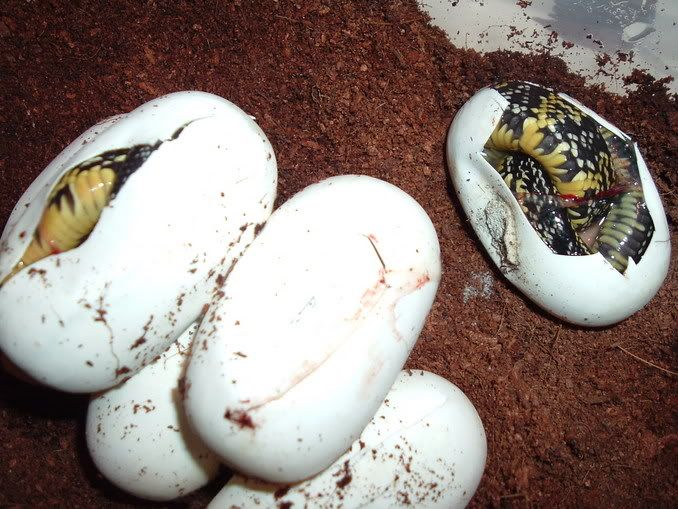
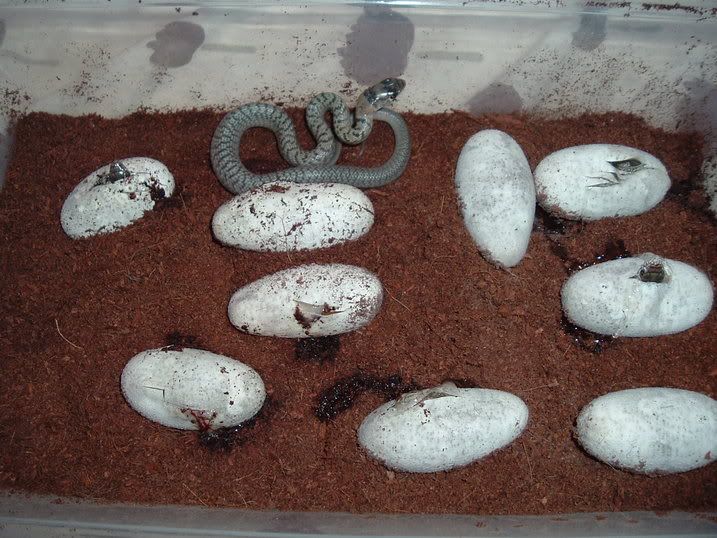
Yes I agree if it works why mess with it I still like to know why it worked. I now use coconut husk with close to 100% success.


Image
-----
"Life without risk is to merely exist."

SRX Sep 21, 2007 01:17 PM

...gets the best of me !

I'm coo coo for coco husk!

Sighthunter Sep 21, 2007 07:26 PM

Off topic sorry you must go.

Just kidding
-----
"Life without risk is to merely exist."

jw Sep 19, 2007 09:11 PM

this is the reason I like checking back on the monitor forum every once in a while, even though I haven't kept monitors for some time now. I LOVE the insights from observation, as it applies to all lizards (and probably animals for that matter). My main genus of choice is Abronia and i've been frustrated for 4 years by one female and for that matter a male from my group that simply refuse to or have no apparent interest in breeding. It's been bugging me until I just read this string and had the epiphany that just because they have the physical assets to breed, doens't mean they are part of that equation in life...they might just be "gooners". Love that! But I also hope you are wrong because I'd like to see all of my animals paired off and breeding. I don't keep them in colonies because I don't want someone getting killed off over time by constant oppression. I will have to now re-think everything I'm doing with my lizards. My inconsistent "success" with getting breeding and reproduction in the animals, might just be the norm for these guys. I wish I had 2500 hours to observe them in detail and watch interactions in the field...hahahaha, but that isn't going to be happening in this lifetime. I guess this discussion makes me realize how little I still know after keeping my group for over 4 years now.

Jason Wagner

Site Tools