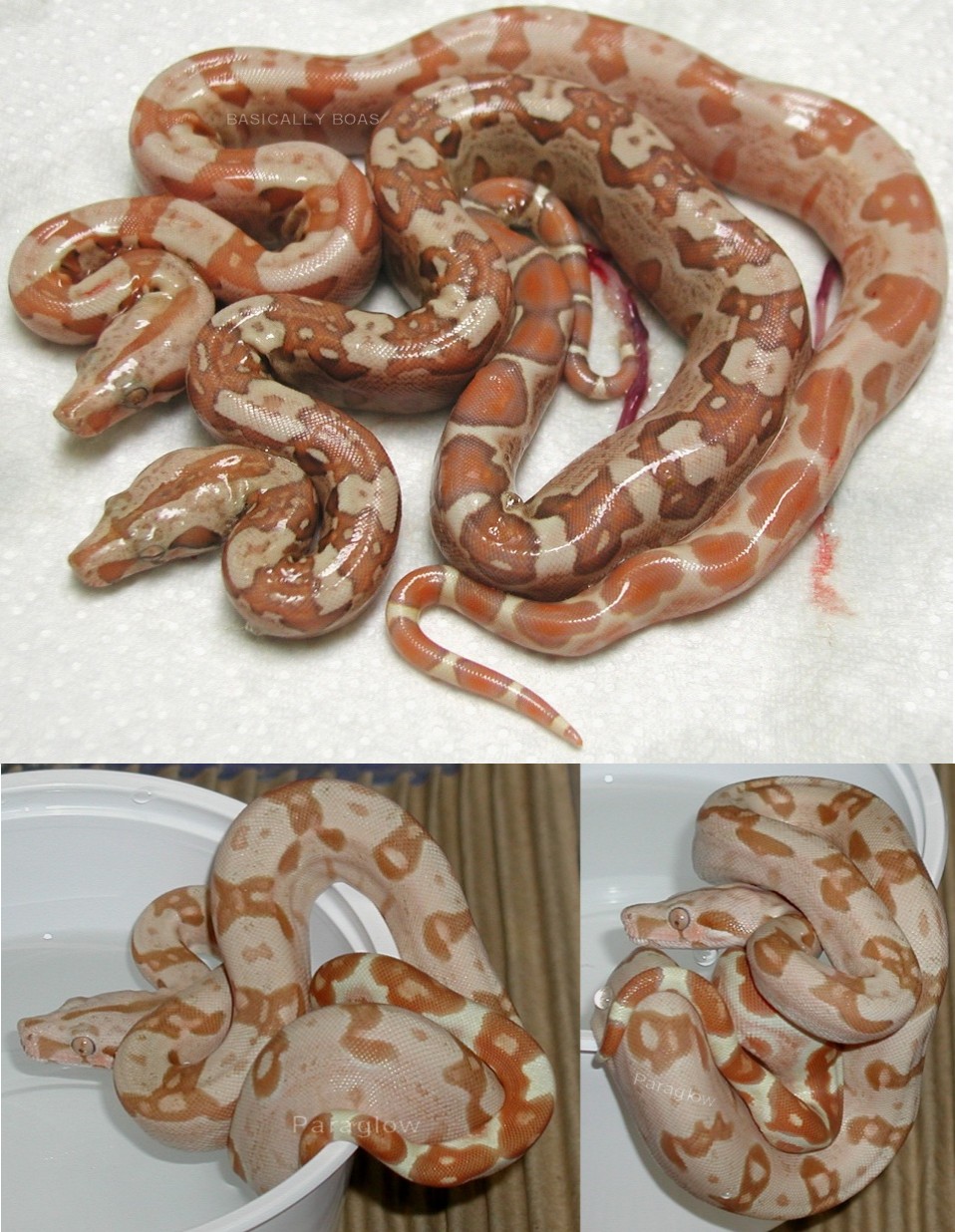
I have only been able to find one small picture of a t positive hypo on Jeremy Stone's page. I was wondering if anyone could post larger pictures or links of hypo t positives. Any locale is great.
-----
- Jason F.
Reptile & Amphibian Forums
Welcome to kingsnake.com's message board system. Here you may share and discuss information with others about your favorite reptile and amphibian related topics such as care and feeding, caging requirements, permits and licenses, and more. Launched in 1997, the kingsnake.com message board system is one of the oldest and largest systems on the internet.

T Positive Hypo Pics?
jayf
Sep 26, 2007 09:26 PM
Replies (22)
skyslinger
Sep 26, 2007 09:38 PM
has them. He is the only person that has produced them so far. I should produce some next year. Here is my female hypo het!

-----
Ty
Rat Race Solutions
www.ratracesolutions.com
jayf
Sep 27, 2007 09:40 AM
Very nice looking snake, is that a pure CA?
>>has them. He is the only person that has produced them so far. I should produce some next year. Here is my female hypo het!
>>
>>
>>-----
>>Ty
>>Rat Race Solutions
>>www.ratracesolutions.com
-----
- Jason F.
skyslinger
Sep 28, 2007 10:07 AM
np
-----
Ty
Rat Race Solutions
www.ratracesolutions.com
boaphile
Sep 26, 2007 09:56 PM
Absolutely! Bigg Mike from www.BasicallyBoas.com made the first T-Positive Hypo. Here it is wrapped around a wicked Paradigm T-Positive Boa right after birth. The lower shots are post shed of the "Paraglow" Paradigm T-Positive Hypo:
-----
Boaphile Home
All Original/Boaphile Plastics
The Boa Network
ajfreptiles
Sep 27, 2007 08:03 AM
I thought that the Paraglow was a T positive SUNGLOW??
That would be a complete step past the hypo stage!
That was just the way I understood it.
Andy Federico
-----

boaphile
Sep 27, 2007 10:19 AM
You are correct Andy. Technically the same thing though. T-Positive Sunglow is a T-Positive Hypo. By Hypo meaning the Hypos we all know and love vs. the simple recessive Hypos which are also technically T-Positive albinos. Salmon Hypos or Orange Tail Hypos. Now I'm confused too. LOL
When someone produces a VPI T-Positive Albino that is also a Hypo, they will be the first VPI T-Positive "Sunglows" and or T-Positive Hypos. I don't know if that has been done or not. I hope so and would love to see a pic of one if it has. Same thing just a different way of detailing it. Same as the Kahl stain Sunglows are technically Kahl Strain Albino Hypos. Same difference. None of these are the same as the way the Paradigm "Paraglow" works for sure. We all know that.
-----
Boaphile Home
All Original/Boaphile Plastics
The Boa Network
sdi
Sep 27, 2007 04:21 PM
“......the simple recessive Hypos which are also technically T-Positive albinos......
None of these are the same as the way the Paradigm "Paraglow" works for sure. We all know that.”
Sorry about the out of context quotes I want you to know where I am coming from. Please excuse my dialog. I know as much about genetics as I do about what motivated those guys to make that chicken nugget video. 
What I do understand is that it takes a sharp albino and a boawoman "hypo" to make a paradigm. Add a "traditional" hypo and you get a paraglow. The ingredients are straight forward. I have seen adult and neonate paradigms and adult and neonate VPI t-plus boas. I also used to own a Boawoman "hypo" which I purchased as a neonate and had until it was about twenty months old. He had a different appearance than the VPI t-plus boas, but he did have the lavender outlines around the tail although they were less pronounced.
What I do not understand is how a paradigm is also JUST a t-positive boa and here is why. I would be more apt to call the Boawoman "hypo" a t-plus due to its appearance and because the gene is passed in a recessive manner. Think of what it takes to get a boawoman “hypo” from paradigm related breeding combinations. The only way to do this is if both parents carry the boawoman “hypo” gene. What will a paradigm x paradigm breeding produce? If the boawoman "hypo" recessive gene and the sharp recessive gene combine on the same locust and produce a new mutation how is this JUST a t-plus boa? Especially when you already identified the boawoman "hypo" as a t-plus in this thread. Visually, a similar end product is achieved, however the path is different.
An earlier thread about the "t-plus" boas from Europe gave a very broad definition of the tyrosinase appearance which was fairly all inclusive in its description and is similar to the genetic definition. Under our current labeling system anything that pops up and looks like a t-plus, can be, regardless of the genetics at work. I am not saying this is right or wrong, I don't know. It seems like it would be a good idea to clearly define a boa that has a different genetic map (at least the part we can identify) with a different tag name for breeding purposes. We don’t call the super albino motley a snow boa even though they are similar appearing white boas. Similar outcome, different genetic path???
Think down the road when multiple isolated genes are combined and we have the "t-plus super hytec bloody ghost.....het stripe". It would make a big difference if this boa was actually a paradigm t-plus as apposed to a VPI t-plus and you wanted to breed it to a het for sharp strain. Not that you would but you get the point. If I paid the $250,000 price tag for the "t-plus super hytec bloody ghost.....het stripe" boa I would want to know the difference. I know there is a good corn snake example out there but I am not familiar with it.
Wouldn't it be advantageous to define the paradigm as something different than a t-plus? Not only to clarify the project in terms of the genetic path, but for differentiation in the market place as well.
Finally, I am not trying to stir the pot or discredit anyone. The VPI t-pos and the paradigm are both awesome projects. This has just never made since to me. Just a confused enthusiast here so for those who reply please be gentle. This is what the forums are for.
ajfreptiles
Sep 27, 2007 05:10 PM
Has anyone ever bred a VPI T positive to a Sharp strain yet??
If so what does it produce?
The Boa Woman Hypo resembles more of an "Ultra" gene as in the Corn Morphs...
I should have been more clear in my post above, as I also believe the Paraglow to be Het Sharp and also het Boa woman Hypo.
It is not even conclusive that the Sharp strain is a T positive animal, therefore it may not be T positive at all.
Andy
-----
boaphile
Sep 27, 2007 08:44 PM
This entire thing is difficult to think through when we have known everything we thought we have "known" for as long as we thought we knew it. That was a mouthful. Different and sometimes more complicated scenarios can be a little like trying to drive down two forks of the road at the same time. Frustrating.
Technically, "True" Albinos are either T-Positive or T-Negative. No one has done the test to find of the Kahl or Sharp strains are or are not T-Positive. So we do not know for sure. It is assumed that any genetic mutation that interrupts the production of melanin does so at the hands of tyrosinase. Tyrosinase interrupts the normal production of melanin resulting in a reduction in or the limitation of the production of normal levels of melanin or black. There is more than one way to skin a cat and more than one genetic mutation that will limit the production of melanin. The VPI T-Positive genetic trait is one way to accomplish this end. The Sharon Moore Caramel genetic trait is another. The Prodigy Boas are yet another. Each of these is inherited in a simple recessive manor. We know for a fact that the first are simple recessive and will prove out the Prodigy bloodline soon. The only litter produced so far points to the likelihood that they in fact have inherited this characteristic in the simple Mendelian recessive manor as well. Each of these mutations has it's own set of degrees to which the production of melanin is interrupted. So far as we know, each one is a separate bloodline. The Paradigm is produced differently.
The Paradigm Boas are the unique combination of two genetic mutations as everyone now knows. Paradigm Boas genetically accomplish a unique alteration in the production of melanin. However, the result, while slightly different in it's expression, is the same. The production of melanin is interrupted by tyrosinase. This still makes them T-Positive animals just the same. Certainly not achieved or expressed the same, but still T-Positive. I think it might make more sense if the term "T-Positive" is thought of more as the process rather than a name. Nobody producing Paradigm Boas is going to fail to tell people what they are. The "Paradigm" name will always be attached to anything produced from that bloodline the same as the "VPI" name will always accompany those bloodline animals, and eventually the "Prodigy" animals will do the same thing. We don't call a super albino motley a Snow Boa because it isn't one. But, the Paradigm Boa is a T-Positive Albino. Not the same as any of the others but T-Positive nonetheless as detailed.
It's all great fun. Discussion is a wonderful thing that we all learn from it. I love to contemplate, evaluate, cogitate and eat at Las Margaritas! They make the most wicked Chimichangas on the planet! It's getting late for me and I digress. Please excuse and poor grammar or misspellings. My brain is glue fume damaged...
-----
Boaphile Home
All Original/Boaphile Plastics
The Boa Network
jayf
Sep 27, 2007 10:21 PM
After reading your earlier post which I believe my reply sparked this whole hijacking (not that I mind as I love genetics talk) I had originally thought you did not understand the genetics behind the two inheritances and attempted to increase your familiarity with them.
However after reading your most recent post I believe that you do in fact understand the workings of the genetics behind these animals. On the same note, I believe that your original post could be read by others and lead to a misinterpretation of the genetic workings. I appologize if I sounded rude or anything similar, I did not mean it that way. It just makes my skin crawl when I hear someone selling a possible dominant or co-dominant hypo when they actually mean a possible homozygous or heterozygous hypo. Almost as much as the guy at the show that tried to sell me a het arabesque that was obviously a normal sibling as the trait is not recessive. Sorry I am off topic, just wanted to apologize.
-----
- Jason F.
Rainshadow
Sep 28, 2007 09:14 AM
To understand genetics,especially if we're going to devote so much of our time,and effort to genetic mutations...Albinistic appearence is not caused by the presence of tyrosinase Jeff...It is caused by the "inhibition" of it,which is why we refer to the classic,familiar form as "tyrosinase negative albinism" ,a biochemical condition caused by an anomoly that blocks,or inhibits the production of tyrosinase,which is one of the key building blocks of melanin,and other naturally occuring biochemicals that result in "normal" pigmentation.Tyrosinase Positive Albinism is believed to be a similar anomolous defect that differs in that,it does not effectively "block",or inhibit complete tyrosinase production,thus leading to the terminology,whether correct,or incorrect:"T-Positive Albinism"...no disrespect intended here,just trying to keep the essence of a potentially informative disscusion on the right track there's enough erroneous information being gobbled up out there without adding more...you may now go back for seconds on those Chimichangas...
-----
HarlequinBoa.com
boaphile
Sep 28, 2007 09:49 AM
My head hurts.
My brain works slower than it once did as is possibly obvious. I think of my brain a little like the tortoise vs. the hare. It's slow but it keeps on evaluating. Once settled I think I have a good way of putting the complex into more simple layman like terms. I guess I do that because it helps me understand it better myself.
I think I did know this once but somehow lost a clear understanding of it recently for some reason. I hope I have this correct now and can keep it straight in the future. So I'll put this into "simple" terms so I can understand and explain this in the future. The alteration of the production of melanin is caused by some other unknown genetic anomaly and not Tyrosinase. The presence of Tyrosinase is required in order to produce melanin. In the case of T-Positive "Albinos" or whatever we call them, the normal production of melanin is interrupted or inhibited so that melanin levels are not "normal" any longer but Tyrosinase is present allowing for some level of melanin production. In these animals melanin production is reduced altering the appearance from the "wild type" or "normal" Boa. The cause of the altered appearance is not related to Tyrosinase at all. The production of any melanin is evidence that Tyrosinase is present, thus the term "T-Positive". The specific cause of the reduction of melanin production is not currently known for any type of Hypo, Albino or T-Positive Boa.
I stand corrected. Thanks for the positive feedback Mr. Rainshadow!
-----
Boaphile Home
All Original/Boaphile Plastics
The Boa Network
skyslinger
Sep 28, 2007 10:28 AM
is generally accepted it is not necessarily true. The true fact is that there are several chemicals involved in the production or melanin and we cannot say for sure that ANY of the before mentioned "lines" are T positive. We only know that T negative albinos completely block the production of melanin (probably the first chemical involved) and the others only partially block it (probably one of the successive chemicals involved). So actually, (light bulb goes on in my mind here LOL) they would be Tyronisase (sp?) would be present and one of the other chemicals is "negative"/missing. So I guess I agree with you guys!
-----
Ty
Rat Race Solutions
www.ratracesolutions.com
Rainshadow
Sep 28, 2007 10:32 AM
I'm certainly no expert,however,I DID stay in a Holiday Inn Express once I wouldn't go so far as to say "albinism had nothing to do with tyrosinase" just that its presence is not the culprit behind the subsequent resulting appearence,but rather it is widely assumed to be the primary target of the inhibitor.In cases where we lack accurate test results we tend to default to what has been learned from studies done on similar conditions in other species,and this is where these terms,and presumed facts come from...albinism is what I call one of the "universal" genetic mutations,as it is widely known to occur in thousands of other species of animals...what we call "hypos" in the Boa Community,is something completely different,and another can of worms entirely,and I don't see a "universal" denominator,nor do I feel,(personally) that it has been properly catagorized...but,we'll save that for a future thread (*lol*) always happy to contribute,and shed a little light,where,and when I can...keep doing the good things you do..."R"
-----
HarlequinBoa.com
skyslinger
Sep 28, 2007 10:13 AM
that is exactly what I was thinking. You can't call a paradigm a T positive. It is actually a het T pos and het sharp. If it is a T pos then a sharp has to be T pos.
-----
Ty
Rat Race Solutions
www.ratracesolutions.com
ChrisGilbert
Sep 28, 2007 08:30 PM
That's the theory that the Sharp are T-plus.
The only snake to have the tests done were in Rat Snakes. There were two Albinos (like our Kahl and Sharp in Boas). They were bred together and DH were produced.
So tests were done, one was T-neg the other T-plus, even though they both "looked" T-neg. Just like Sharp and Kahl "look" T-neg.
Visually the Paradigm is a T-plus Albino. If the first Paradigm found was from unknown origins and the Sharp/Carmel combo wasn't known, it would be labeled T-plus Albino for sure.
The genetics carry a Sharp gene and a Carmel gene, though they interact to form a homozygous state as opposed to a DH.
Paradigm X Paradigm should produce 50% Paradigm, $25% Sharp, and 25% Carmel.
-----
http://www.GilbertBoas.com/
http://www.BoaList.com/
jayf
Sep 27, 2007 09:46 AM
I am under the impression that the paraglow is created by an animal having a sharp albino gene(het), a hypo gene, and a caramel albino gene(het).
Although it looks similar I do not believe it can be considered the same as an animal that is hypo homozygous t positive albino.
I would imagine they will appear similar but have very different genetics.
Someone please correct me if I am wrong, just trying to get things straight to avoid confusion.
-----
- Jason F.
ChrisGilbert
Sep 27, 2007 10:25 AM
The Paradigm is a form of T-positive Albino. So in that sense the Paraglow is a Hypo T-positive.
But you are right, the exact ingredients are 3 morphs instead of 2.
Jeremy produced the Nicaraguan T-positive Sunglow, and the Argentine version.
There are hets for the Colombian VPI line, but I am not aware of one being produced yet.
-----
http://www.GilbertBoas.com/
http://www.BoaList.com/
boaphile
Sep 27, 2007 10:27 AM
Two different genes that are on the same loci making a visual T-Positive animal because tyrosinase is causing the condition we see. I think these are actually technically "homozygous" for Paradigm T-Positive Albino requiring the Sharon Moore Caramel/Sharp Albino combination. That vs. technically "heterozygous" for both traits. Since they are on the same loci, that makes it homozygous. We will need Paul Hollander to confirm or deny that since he is our resident geneticist.
I too look forward to seeing some of the other T-Positive animals in the "Sunglow" or Hypo form. The future is wide open and exciting to think about isn't it?!
-----
Boaphile Home
All Original/Boaphile Plastics
The Boa Network
ChrisGilbert
Sep 27, 2007 11:16 AM
That's what I've said since day one. The Paradigm is like a third phenotype of the same genotype.
Glad Mike's litters have shown this to be the case. I still say we need Paradigm X Paradigm, but the evidence is fairly conclusive.
I do believe he mentioned that the Sharp and Carmel are likely forms of T-plus.
Many people, myself included, thought that about the Carmel, but were always told no because it didn't have the red albino pupils. We've always known that either Sharp or Kahl could be T-plus even though the didn't look that way.
-----
http://www.GilbertBoas.com/
http://www.BoaList.com/
jayf
Sep 27, 2007 01:38 PM
Having two different genes on the same loci is called heterozygous reguardless as to weather the genes are albino paired with a normal or a sharp paired with a caramel.
It is my opinion that this is simply a case of similar outcomes as a result of very different genetic paths. Both combinations obviously effect the production of melinin in some way.
Hopefully in three years I will be producing some T positive hypo CAs.
>>Two different genes that are on the same loci making a visual T-Positive animal because tyrosinase is causing the condition we see. I think these are actually technically "homozygous" for Paradigm T-Positive Albino requiring the Sharon Moore Caramel/Sharp Albino combination. That vs. technically "heterozygous" for both traits. Since they are on the same loci, that makes it homozygous. We will need Paul Hollander to confirm or deny that since he is our resident geneticist.
>>
>>I too look forward to seeing some of the other T-Positive animals in the "Sunglow" or Hypo form. The future is wide open and exciting to think about isn't it?!
>>-----
>>Boaphile Home
>>All Original/Boaphile Plastics
>>The Boa Network
-----
- Jason F.
rainbowsrus
Sep 27, 2007 04:21 PM
Paul has already referred to it as "Het sharp//boawoman caramel"
Heterozygous = two different genes within a single loci.
Homozygous = two of the same genes within a single loci.
Normally when we say "het albino" for example what we are really sating is het albino//normal but since the "normal" gene is understood it can be ommited. And by ommiting it, inversely we are implying the second gene to be a "normal" gene.
When describing the Paradigm, You could use either Paradigm as a named pairing or het sharp albino//boawoman caramel (or boawoman hypo?).
-----
Thanks,
Dave Colling

www.rainbows-r-us-reptiles.com
0.1 Wife (WC and still very fiesty)
0.2 kids (CBB, a big part of our selective breeding program)
LOL, to many snakes to list, last count:
24.36 BRB
19.19 BCI
And those are only the breeders 
lots.lots.lots feeder mice and rats 
