Reptile & Amphibian Forums

Welcome to kingsnake.com's message board system. Here you may share and discuss information with others about your favorite reptile and amphibian related topics such as care and feeding, caging requirements, permits and licenses, and more. Launched in 1997, the kingsnake.com message board system is one of the oldest and largest systems on the internet.

Click here for Dragon Serpents
https://www.crepnw.com/
Click for 65% off Shipping with Reptiles 2 You

my Rat Snake HAS NEVER EATEN!!....HELP!!

metalmistress3 Sep 28, 2007 06:10 AM

I have had this baby Leucistic Texas Rat snake for a couple months now.
Hasn't eaten once!! Has no interest. I keep the cage around 80-85 during the day. And around 70 at night.
I have tried to feed him at night and during the day.
Live and Frozen pinkies. The other night I cut the live pinkie's skull open and squeezed out brain juice then left it in the cage with him. Nothing!

I am afraid of this snake dying soon from starvation.

Any help/suggestions would be greatly appreciated!

P.S. I'm not sure how old he/she is....what would you say by looking at the picture...the age range of this snake?

Thanks!
Image
-----
0.2.0 Ball Python
0.0.1 Leucistic Texas Rat Snake
1.0.0 Husky/Wolf
0.0.1 Mexican Redknee Tarantula
0.2.0 Cats
0.1.0 Redtail Boa

Replies (9)

erikm Sep 28, 2007 10:52 AM

By looking at the picture I can tell you that pink mice are way too small for him. Try putting in a live small mouse at night and leave him in the dark with it for 20-30 mins. Don't disturb him at all!

Good luck!
-----
-------------------------------
globalreptiles.ca

metalpest Sep 28, 2007 11:13 AM

Try a fuzzy. If that doesn't work, try brumating him for a month. They can survive for quite a while without food, so he's probably not starving yet, just keep trying new things!

Do you place him in a deli cup for feeding? This will put him in a small area with the food, so he will find it.
-----
"I'll be back at 6 if not 7. 8 the very latest but definatly no later than 9...ish...Moscow time."

MurphysLaw Sep 28, 2007 06:16 PM

>>I have had this baby Leucistic Texas Rat snake for a couple months now.
>>Hasn't eaten once!! Has no interest. I keep the cage around 80-85 during the day. And around 70 at night.
>>I have tried to feed him at night and during the day.
>>Live and Frozen pinkies. The other night I cut the live pinkie's skull open and squeezed out brain juice then left it in the cage with him. Nothing!
>>
>>I am afraid of this snake dying soon from starvation.
>>
>>Any help/suggestions would be greatly appreciated!
>>
>>P.S. I'm not sure how old he/she is....what would you say by looking at the picture...the age range of this snake?
>>
>>Thanks!
>>

Do you have this snakes feeding records from the previous owner?
-----
If lead paint is so deadly why do they make it so delicious?

metalmistress3 Sep 28, 2007 09:23 PM

I don't have any feeding records. He's only a few months old, he's tiny, barely a foot long. I don't think he would be able to eat a fuzzy, and definitely not a full grown mouse! I guess he looks bigger in the picture than what he really is. I've tried feeding him in a deli cup, and in his cage, he just lays next to it.
Should I force feed?
-----
0.2.0 Ball Python
0.0.1 Leucistic Texas Rat Snake
1.0.0 Husky/Wolf
0.0.1 Mexican Redknee Tarantula
0.2.0 Cats
0.1.0 Redtail Boa
antelope Sep 29, 2007 01:23 AM

You will be surprised what they can scarf down, especially a T rat! I would try a brained pink in the deli cup in the dark, and then the next feeding a fuzzy, increase to two at fourth feeding, a hopper at 8th. My yearlings can easily handle full grown mice.
-----
Todd Hughes

BillMcgElaphe Sep 29, 2007 08:20 AM

In the wild, new hatchling Rats of this group (Grays, Yellows, Blacks, Everglades, Gulf Hammocks, Deckert’s, Texas etc.) eat rodent pinks if they are lucky to find them. They are and should be, of course, a keeper's first and cleanest choice.
.
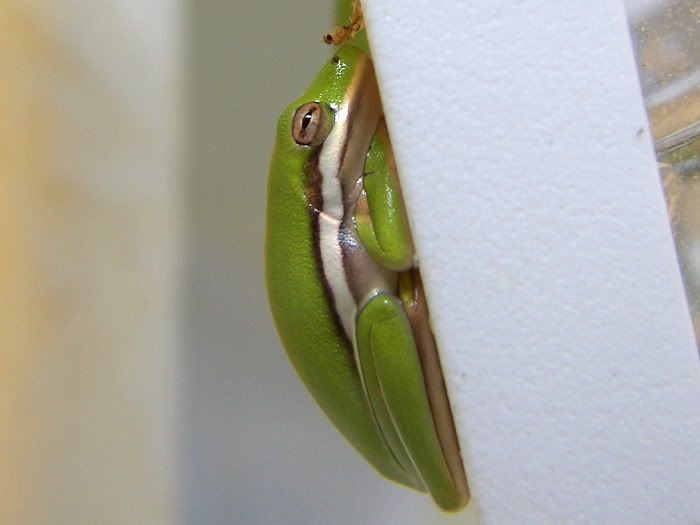
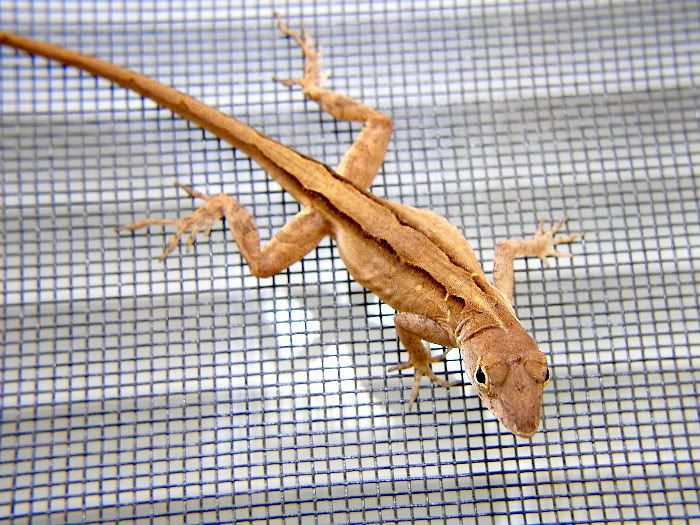
In nature, however, many, many hatchlings forage in nooks and crannies of trees (under loose bark, for example) and dine on Tree Frogs and lizards, well before they gobble up their first rodent.
If the animal is in danger of starving, get something into it like a small, North American tree frog (not terrestrial frogs or toads).
This is not a good food to continue (endoparasites), but 2 or 3 feedings and you can scent the pink with tree frog slime.
.
If none available, a small Anole is second choice.
.
There is a technique of tease-feeding pinks that has never failed for me but it takes some patience and finesse.
If you can get a natural feed, it's less stress for both of you!!!
Good luck.. Let us know how it works out.
.
First Choice - Young of the year:
.

.
.
Second Choice: small Anole.
.

.
-----
Regards, Bill McGighan

antelope Sep 29, 2007 11:12 AM

True, and feed them all the brown anoles you can catch!
-----
Todd Hughes

BillMcgElaphe Sep 29, 2007 11:14 AM

Yeah Boy, Todd
-----
Regards, Bill McGighan

BillMcgElaphe Sep 29, 2007 03:17 PM

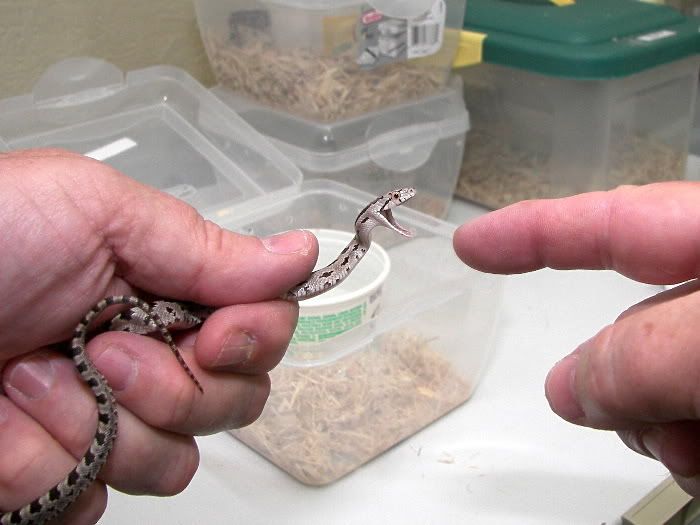
In response to an email I received from someone who wanted to know what method of “tease feeding” I mentioned.
There are several methods, but this works for me on all obsoleta and guttata hatchlings that refuse to eat pinks on their own.
.
If you have one that works, please don’t hesitate to comment.
.
Preparation:
Thaw a pink and dry it.
Insure you are alone and won’t be intruded on by anyone for about 15 minutes.
.
Steps:
Gently, but firmly, hold the hatchling 1 to 2 inches (2 1/2 - 5 cm) behind the head. Placing a threatening finger, or pink, in its face about ½ inch (1 ¼ cm) away, causes a defensive reaction.
.

.
.
It seems best to not get the animal any more excited than necessary.
It seems best to hold it close to or even touching a container.
I prefer to offer the pink with my hand, not tongs, because of better reaction time.
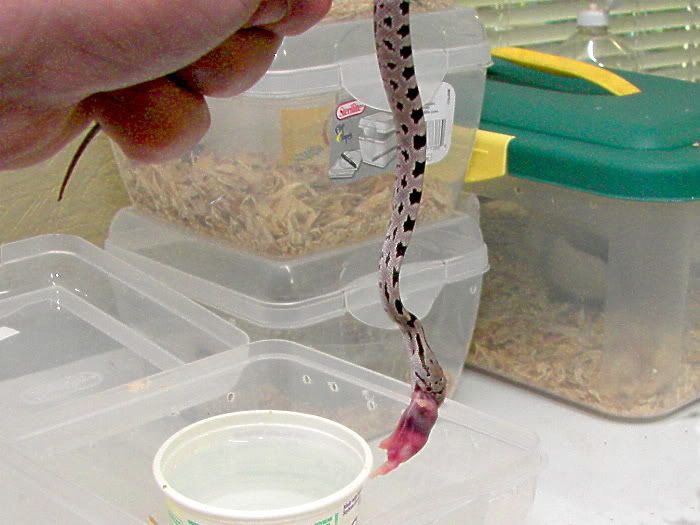
When the hatchling bites the offering, immediately let go of the pink.
Relax your grip on the “catch hand”, but don't drop the snake, if possible.
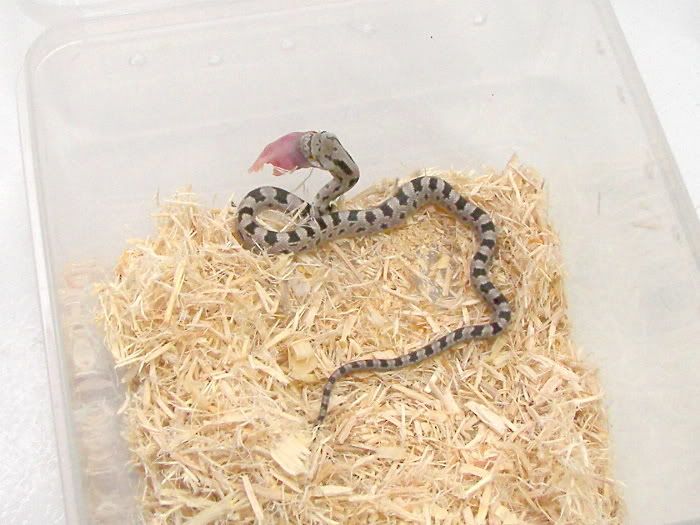
(You may have to repeat a few times for the neonate to hold and swallow.)
(If you don’t succeed in 4 or 5 tries, let the animal calm down for a ½ hour.)
.
.
.
.
Very important – if you succeed, remain absolutely still until pink is eaten and even then, move very slowly.
.

..

-----
Regards, Bill McGighan

Site Tools