


Reptile & Amphibian Forums

Welcome to kingsnake.com's message board system. Here you may share and discuss information with others about your favorite reptile and amphibian related topics such as care and feeding, caging requirements, permits and licenses, and more. Launched in 1997, the kingsnake.com message board system is one of the oldest and largest systems on the internet.

Click for 65% off Shipping with Reptiles 2 You
Southwestern Center for Herpetological Research
Click for 65% off Shipping with Reptiles 2 You

Up for the winter...

waspinator421 Oct 25, 2007 07:48 PM

I just took some pictures of all of my BRBs that are staying up for the winter. Keep in mind that they are all shot in their tubs, and with horrible lighting.

First up is Mauve, an '06 girl from Dave Colling. She is getting DARK DARK DARK! It really shows the rainbow, I love it!


Here is her sister, Bisque. She was curled up in her water dish and only gave me a head shot. She is just a tad less orange than the picture suggests.


This boy is Pixel, an '06 from Scott Sweeney. He is just about to shed, so is looking a bit crunchy.

Here is Copper, Pixel's sister. She has much better color than her brother. She wouldn't peek through the hole in her dish, so I had to take the lid off.

This is my newest male, Russet. He is an '07 from Bryan Hummel, and oh man he lights up the room! The picture doesn't do him justice.

And my newest girl, Paisley. She is an '07 from Bruce Delles... I can't get over this wild pattern! She enjoyed a small adult mouse yesterday.

And last but not least is my Yellow male, Flax. He is getting a late start on brumation this year because he had a prolapse a while back, and then some tummy issues. Since then he is all better now, but lost a little weight. I've had my other snakes brumating for almost a month already, but I wanted to get a little weight back on him before he cools. He left me a large smelly present today, and I snapped a few pictures while cleaning it up. They will be the last pictures of him for the year as he will be going back into the snake room to brumate soon.

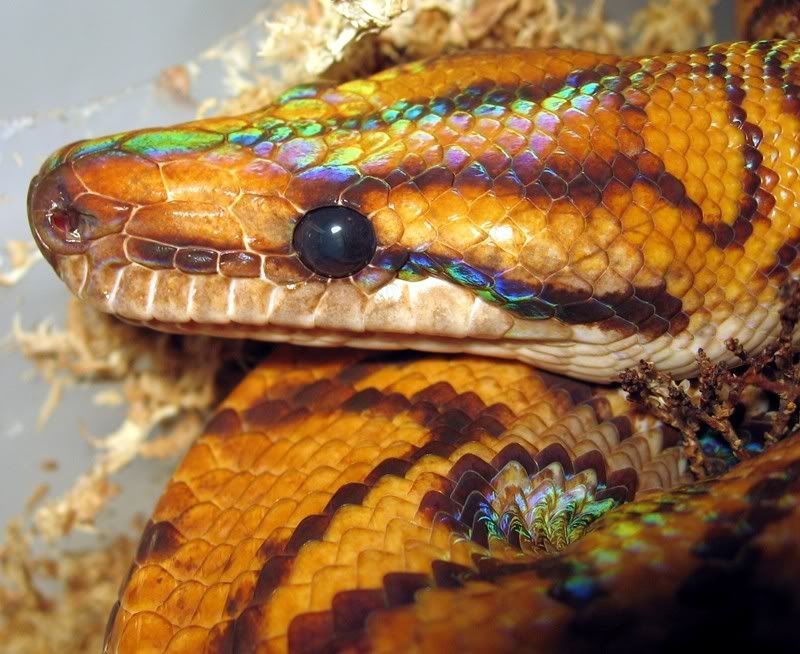
Well, that's it for tonight. They aren't my best pictures, but I didn't think you guys and gals would care.
-----
Aubrey Ross

©
www.SlipstreamSerpents.com

Replies (21)

natsamjosh Oct 25, 2007 08:36 PM

Great variety of BRB's! I say there are already a bunch of BRB
"morphs", made by nature.

Thanks for sharing.
-----
------
Thanks,
Ed

waspinator421 Oct 26, 2007 12:08 AM

Thanks Ed, and I agree... there is quite a bit of variety in BRBs already. It will just make it that much more interesting when we can incorporate different types of BRBs (orange, yellow, red, dark, etc.) with the morphs that are out there!
-----
Aubrey Ross

©
www.SlipstreamSerpents.com

natsamjosh Oct 26, 2007 06:33 AM

Aubrey,

Let me put it another way. Not to put you on the spot, this is more of a question for the forum, but what exactly do you mean when you differentiate "different types of BRB's" from "morphs"? What's the difference?

>>Thanks Ed, and I agree... there is quite a bit of variety in BRBs already. It will just make it that much more interesting when we can incorporate different types of BRBs (orange, yellow, red, dark, etc.) with the morphs that are out there!
>>-----
>>Aubrey Ross
>>
>>©
>>www.SlipstreamSerpents.com
-----
------
Thanks,
Ed

rainbowsrus Oct 26, 2007 11:36 AM

for what it's worth (something less than $0.02)

For my soapbox dissertation I'll divide BRB's (works for any species) into two categories, Morph and Phase.

Morph - a single gene driven, visually discernible, genetic anomaly. In other words, clearly genetic. follows generally accepted "rules" of inheritance. There are three basic ways a morph can express or display.

1) Recessive - morph gene is visually weaker than normal gene. In order for trait to show, there must be two copies of the mutant gene in one animal.
Examples in BRB - Hypo, Albino and Anery (anery is still not fully proven)

2) Dominant - Morph gene is visually stronger then normal gene AND there is no clear difference between a heterozygous and homozygous animal. If an animal has one mutant gene paired with a normal it will display the trait, also if there are tow mutant genes it will also display the same trait.
Examples in BCI - Hypo, arabesque, to my knowledge none identified/proven yet in BRB.

3) Codominant - Morph gene is visually stronger than normal gene AND there are two clear phenotypes or two clear visually different looks depending on number of mutant genes.
Normal//normal - looks like wild type
Morph//normal - looks like Morph
Morph//morph - second visual morph look
Example in BCI - Motley

Phase - Probably not single gene related, some level of inheritance but does not follow typical genetic inheritance rules. Examples in BRB that I can think of right off the top are:
High color,
High contrast
Bold crescent
Thin crescent
No crescent
Bullseye crescent

Bottom line, both phase and morph can be bred for but Morphs can and will follow certain rules.

Of course there can and will be single litter variance from those rules, ie hypo bred to het hypo won't always give you exactly 50/50, but hypo to normal or hypo to hypo will always give you known results:

Hypo x normal = entire litter is het hypo
Hypo x hypo = entire litter of hypos
-----
Thanks,

Dave Colling

www.rainbows-r-us-reptiles.com

0.1 Wife (WC and still very fiesty)
0.2 kids (CBB, a big part of our selective breeding program)

LOL, to many snakes to list, last count:
24.36 BRB
19.19 BCI
And those are only the breeders

lots.lots.lots feeder mice and rats

waspinator421 Oct 26, 2007 12:51 PM

Just popped in and looks like you really answered that question, Dave! That was a great explaination... thanks!
-----
Aubrey Ross

©
www.SlipstreamSerpents.com

rainbowsrus Oct 26, 2007 12:56 PM

LOL, guess I did, I really love the genetics behind all this stuff. I've been toying with it for a couple of years now with all of my BCI morph stuff. Think I have a fairly good grasp of how it works, of course there will alway be new morphs to understand and also the combination of morphs for designer morphs.
-----
Thanks,

Dave Colling

www.rainbows-r-us-reptiles.com

0.1 Wife (WC and still very fiesty)
0.2 kids (CBB, a big part of our selective breeding program)

LOL, to many snakes to list, last count:
24.36 BRB
19.19 BCI
And those are only the breeders

lots.lots.lots feeder mice and rats

Jeff Clark Oct 26, 2007 03:43 PM

Dave,
...I like the way you covered the subject of morphs but I think the word phase is too speciifc and is overused for these animals which produce such an enormous range of variation in their offspring. We see all sorts of people advertising that they are selling such and such phase and then look at their PICs and think they are crazy because their PICs just look like a normal range of variation of color and pattern in BRBs. There is an enormous amount of variation between animals born in the same litter. My male Sunkist which was one of the brightest orange ones that anyone was showing on the internet several years ago came from parents that were both so ugly brown that I would not even think of keeping them in my collection today. That dark 2006 Colling snake that Aubrey posted is another great example. That snake is many degrees of variation browner than any of your breeders. Aubrey knows there is a bunch of variation in BRBs because she has the collection of animals to demonstrate it, but someone else who might have bought that snake would likely be disappointed that it does not look like any of your breeders. I think we can breed as selectively as possible and will get a nice distribution of most of the babies looking generally like the parents but if I breed my orangest male to my orangest female and advertise the babies as "Clark Orange Phase" many of the buyers are going to be really happy with the way the snakes turn out as they mature but a few customers are gonna get snakes that do not turn out to be real orange and they are gonna be PO'd about me calling the snakes "Clark Orange Phase". To me the word phase is too specific to be used the way many people are using it marketing their animals.
Jeff

>>LOL, guess I did, I really love the genetics behind all this stuff. I've been toying with it for a couple of years now with all of my BCI morph stuff. Think I have a fairly good grasp of how it works, of course there will alway be new morphs to understand and also the combination of morphs for designer morphs.
>>-----
>>Thanks,
>>
>>
>>Dave Colling
>>
>>www.rainbows-r-us-reptiles.com
>>
>>
>>
>>0.1 Wife (WC and still very fiesty)
>>0.2 kids (CBB, a big part of our selective breeding program)
>>
>>LOL, to many snakes to list, last count:
>>24.36 BRB
>>19.19 BCI
>>And those are only the breeders
>>
>>lots.lots.lots feeder mice and rats

rainbowsrus Oct 26, 2007 04:01 PM

Jeff, thanks and I'd have to agree with you. I get so many people wanting a "high orange" or a "high red" and I have to keep telling them, it won't really show until after a few sheds. I can make some good guesses which ones will be better than other ones but no real way to tell short of raising them up.
-----
Thanks,

Dave Colling

www.rainbows-r-us-reptiles.com

0.1 Wife (WC and still very fiesty)
0.2 kids (CBB, a big part of our selective breeding program)

LOL, to many snakes to list, last count:
24.36 BRB
19.19 BCI
And those are only the breeders

lots.lots.lots feeder mice and rats

natsamjosh Oct 26, 2007 04:16 PM

I agree, I was going to question the term "phase" also. With all due respect, it sounds like, at least to me, that:
"phase" = "don't know how the genetics work."

Another question: would one even be able to tell, in certain
cases, whether a particular color pattern is a "phase" or a
phenotype of a snake het for codominant trait?

Oh, one more question, just for some fun. As Jeff said,
there is enormous variation in BRB offspring, but why stop there? Seems to me that all rainbow boas are "morphs", since
they genetically mutated from a common ancestor. Nature
has created some of the morphs already.

Anwyay, just stirring the pot a little. Hope everyone has a good weekend!

>>Dave,
>>...I like the way you covered the subject of morphs but I think the word phase is too speciifc and is overused for these animals which produce such an enormous range of variation in their offspring. We see all sorts of people advertising that they are selling such and such phase and then look at their PICs and think they are crazy because their PICs just look like a normal range of variation of color and pattern in BRBs. There is an enormous amount of variation between animals born in the same litter. My male Sunkist which was one of the brightest orange ones that anyone was showing on the internet several years ago came from parents that were both so ugly brown that I would not even think of keeping them in my collection today. That dark 2006 Colling snake that Aubrey posted is another great example. That snake is many degrees of variation browner than any of your breeders. Aubrey knows there is a bunch of variation in BRBs because she has the collection of animals to demonstrate it, but someone else who might have bought that snake would likely be disappointed that it does not look like any of your breeders. I think we can breed as selectively as possible and will get a nice distribution of most of the babies looking generally like the parents but if I breed my orangest male to my orangest female and advertise the babies as "Clark Orange Phase" many of the buyers are going to be really happy with the way the snakes turn out as they mature but a few customers are gonna get snakes that do not turn out to be real orange and they are gonna be PO'd about me calling the snakes "Clark Orange Phase". To me the word phase is too specific to be used the way many people are using it marketing their animals.
>>Jeff
>>
>>>>LOL, guess I did, I really love the genetics behind all this stuff. I've been toying with it for a couple of years now with all of my BCI morph stuff. Think I have a fairly good grasp of how it works, of course there will alway be new morphs to understand and also the combination of morphs for designer morphs.
>>>>-----
>>>>Thanks,
>>>>
>>>>
>>>>Dave Colling
>>>>
>>>>www.rainbows-r-us-reptiles.com
>>>>
>>>>
>>>>
>>>>0.1 Wife (WC and still very fiesty)
>>>>0.2 kids (CBB, a big part of our selective breeding program)
>>>>
>>>>LOL, to many snakes to list, last count:
>>>>24.36 BRB
>>>>19.19 BCI
>>>>And those are only the breeders
>>>>
>>>>lots.lots.lots feeder mice and rats
-----
------
Thanks,
Ed

sean1976 Oct 26, 2007 06:37 PM

You seem to be making the mistake that any specific aspect of a snakes appearance is the result of a single gene.

"Phase" reffers to a appearance of animal that is created by the combination of too many genes to track in the normal sence(i.e. they are selective/line bred phenotypes).

Some people make the mistake of labeling their offspring before the actual phase is known. This increases short term sales but causes pissed off customers and in the long run hurts their business. This is the issue Jeff raised. The simple solution is to label babies as undetermined phases or label them as "_____phase x _____phase" offspring.
A very similar example of phases and variation within a clutch is Thayeri/Variable Kingsnakes. A pair of any phase of them can throw babies of any of the other phases in addition to the phases of the parents. The real difference is that in Thayeri the offspring phase is discernable at hatching but with BRB's the phase is not necisarily discernable until they have shed a few times. This does not mean the phases do not exist, merely that they do not express until after a few sheds.

"Morphs" is a specific term that most commonly is used exactly as Dave defined it. A single gene causing a specific identifyiable and predictable effect on the animals phenotype.

As far as I know there does not currently exist a co-dom trait in the BRB populations. By the definition of the term you would be able to tell a co-dom apart from normal babies(but you may need to wait a few sheds).

Genetics is by far too complex a field for us to in the near future be able to predict results in an absolute way. It cannot be used like a roadmap to tell every aspect of how an animal will end up looking.

Sean.
-----
1.1 BRB
1.1 Triple Het TPRS's
1.1 Amel Bloodred Corns
0.1 Abbott Okeetee Corn
0.1 Blizzard Bloodred Corn
1.1 Thayeri Kingsnakes
0.1 Reeve's Turtle
0.2 Amstaff's
1.0 Pudytat

natsamjosh Oct 28, 2007 02:04 PM

>>You seem to be making the mistake that any specific aspect of a snakes appearance is the result of a single gene.

Absolutely not! I was simply trying to point out...

>>
>>"Phase" reffers to a appearance of animal that is created by the combination of too many genes to track in the normal sence(i.e. they are selective/line bred phenotypes).

... this. Which is exactly what I said - " 'phase' = 'don't know how the genetics work." ' You seem to be making assumptions that are incorrect, and in fact, I agree with most of what you are saying. But I appreciate the lecture.

But please, by all means, share you're expertise with the forum, please 1) read, and 2) answer the question I asked instead of
making strawman rebuttals.

>>
>>Some people make the mistake of labeling their offspring before the actual phase is known. This increases short term sales but causes pissed off customers and in the long run hurts their business. This is the issue Jeff raised. The simple solution is to label babies as undetermined phases or label them as "_____phase x _____phase" offspring.
>>A very similar example of phases and variation within a clutch is Thayeri/Variable Kingsnakes. A pair of any phase of them can throw babies of any of the other phases in addition to the phases of the parents. The real difference is that in Thayeri the offspring phase is discernable at hatching but with BRB's the phase is not necisarily discernable until they have shed a few times. This does not mean the phases do not exist, merely that they do not express until after a few sheds.
>>
>>"Morphs" is a specific term that most commonly is used exactly as Dave defined it. A single gene causing a specific identifyiable and predictable effect on the animals phenotype.
>>
>>As far as I know there does not currently exist a co-dom trait in the BRB populations. By the definition of the term you would be able to tell a co-dom apart from normal babies(but you may need to wait a few sheds).
>>
>>Genetics is by far too complex a field for us to in the near future be able to predict results in an absolute way. It cannot be used like a roadmap to tell every aspect of how an animal will end up looking.

>>
>>Sean.
>>-----
>>1.1 BRB
>>1.1 Triple Het TPRS's
>>1.1 Amel Bloodred Corns
>>0.1 Abbott Okeetee Corn
>>0.1 Blizzard Bloodred Corn
>>1.1 Thayeri Kingsnakes
>>0.1 Reeve's Turtle
>>0.2 Amstaff's
>>1.0 Pudytat
-----
------
Thanks,
Ed

natsamjosh Oct 28, 2007 07:15 PM

>>
>>As far as I know there does not currently exist a co-dom trait in the BRB populations.

Just because you don't know of any, doesn't mean they don't exist. Who's the one over simplifying things here?

>>By the definition of the term you would be able to tell a co-dom apart from normal babies(but you may need to wait a few sheds).

That's not the question I asked.

What I'm curious is about is how we will (with *BRB's*, not Kingsnakes), given
1) the severe complexity of the pigmentation/coloration
2) that codom traits can express themselves in various levels ranging between the to homo expressions.

be able to distinguish between "phase" and codominance.
-----
------
Thanks,
Ed

rainbowsrus Oct 25, 2007 10:09 PM

Very nice group of BRB's. Wow I had no idea those from 06 would color up so dark, you sure it wasn't playing the mud or something.
-----
Thanks,

Dave Colling

www.rainbows-r-us-reptiles.com

0.1 Wife (WC and still very fiesty)
0.2 kids (CBB, a big part of our selective breeding program)

LOL, to many snakes to list, last count:
24.36 BRB
19.19 BCI
And those are only the breeders

lots.lots.lots feeder mice and rats

waspinator421 Oct 26, 2007 12:09 AM

Thanks Dave. Well, they don't have access to mud that I know of, unless they found something that looks like mud..... eeeeww.
-----
Aubrey Ross

©
www.SlipstreamSerpents.com

TimS Oct 25, 2007 10:16 PM

man i think i need to steal flax from you lol

waspinator421 Oct 26, 2007 12:10 AM

Sorry dude, he's all mine! Muahahahahahahaha!!!!!!!
-----
Aubrey Ross

©
www.SlipstreamSerpents.com

TimS Oct 26, 2007 03:34 AM

lol if i get any more female rainbows im gonna have to get a male with her dont wanna try my luck with 1 male and 3 girls lol in pythons sure but not these goofy boas lol

rainbowsrus Oct 26, 2007 11:38 AM

In 2005 I successfully bred one male (Lefty) to four females (Petunia, Boo, Bulseye and It) resulting in 90 babies sired by oine male in one season......what a stud
-----
Thanks,

Dave Colling

www.rainbows-r-us-reptiles.com

0.1 Wife (WC and still very fiesty)
0.2 kids (CBB, a big part of our selective breeding program)

LOL, to many snakes to list, last count:
24.36 BRB
19.19 BCI
And those are only the breeders

lots.lots.lots feeder mice and rats

TimS Oct 26, 2007 01:36 PM

wow you just throw them all together for like a huge orgy lol or you do like with python guys do bounce him around every few days with the ladies then give him a few day rest and bounce around again.

rainbowsrus Oct 26, 2007 02:54 PM

I always leave my breeding groups together for the season. Only seperate to feed. That year I had 7 female and only two males so 1.3 and 1.4 all of the 1.4 females took and only 2 of the 1.3's took, still 6 great litters for my most productive year ever, 136 babies. Average litter size of 22 2/3!!!
-----
Thanks,

Dave Colling

www.rainbows-r-us-reptiles.com

0.1 Wife (WC and still very fiesty)
0.2 kids (CBB, a big part of our selective breeding program)

LOL, to many snakes to list, last count:
24.36 BRB
19.19 BCI
And those are only the breeders

lots.lots.lots feeder mice and rats

Jeff Clark Oct 26, 2007 03:14 PM

Tim,
....I am pretty sure that my male Branco has fathered as many as 6 litters in one year. I used to rotate all the males through all the female cages making changes every few days. Several years he was the only male I observed mating with many of the females. I have more active males in my collection now. I still rotate every few days but sort of divide the collection in half and not move any across the dividing line so that I can produce reasonable numbers of unrelated litters.
Jeff

>>wow you just throw them all together for like a huge orgy lol or you do like with python guys do bounce him around every few days with the ladies then give him a few day rest and bounce around again.

Site Tools
