Been reading Fry et. al's paper on venoms (the recent one) and his many media releases and articles that he's foisted on us, including in the daily papers and his own website and I cannot help but be alarmed at the tack he's taken.
It strikes me as a cynical grab for funds AND as a bid to give ammo to those regulation obsessed bureaucrats another excuse to ban or restrict the keeping of reptiles - this time the mildly venomous forms.
Claims of near death experiences as a result of allergic reactions to venom or saliva componants does nothing to further rational debate on these snakes or their relevant risks.
It's akin to trying to ban all dogs and cats on the basis that some may carry fleas, have mange, or salmonella.
Had Fry et. al. merely provided data without hyperbole then their paper may eventually have gained due respect and perhaps even made a useful contribution to our general knowlegde of these snakes.
However now it will go down in history (along with the his hype) as yet another nail in the coffin of private people being allowed the right to keep venomous and even very mildly venomous snakes.
I delayed posting on this so as to save anothe barrage of attacks on myself, but on Fri night at a local herp meeting several people there expressed outrage at Fry's comments as reported in the Melbourne media and hence I can say that the views above are not just my own.
ALL THE BEST IN HERP
Reptile & Amphibian Forums
Welcome to kingsnake.com's message board system. Here you may share and discuss information with others about your favorite reptile and amphibian related topics such as care and feeding, caging requirements, permits and licenses, and more. Launched in 1997, the kingsnake.com message board system is one of the oldest and largest systems on the internet.



Extreme science - or is it an extreme interpretation
Replies (28)
It is true that the results of this paper can easily be misinterpreted by less educated people - the fact that corn snakes produce the same toxins as elapids in minute quantities does not make them capable of doing any harm to a human being, or even to a mouse with their bite alone. That's why they are constrictors - their bite alone has no effect even on small animals. Any halfway intelligent person (which admittedly most politicians aren't) can understand this.
On the other hand, there really are some impressively hot colubrids that should be classified as dangerously venomous and regulated accordingly. Psammophis were being sold in pet stores to children in Georgia quite recently, and there was a very nasty bite to a store employee who had no idea that these colubrids were venomous. I don't think it would be a good or ethical thing to suppress this knowledge. We absolutely do not need any more Psammophis or Conophis for sale to little kiddies looking for a cheap pet snake for their aquariums. One more incident with one of these snakes, especially if it's a kid that gets bitten this time, is much more likely to cause the harsh legislative reaction you're talking about. How about some reasonable preventative measures? Good scientific documentation can only help in those efforts.
Dr. Fry certainly isn't making this stuff up - I have kept some of those "interesting" colubrid species and watched their mouse kill time. Pretty bloody impressive. Also the fangs on these critters are something to see. The Psammophis I was working with have larger and farther forward set fangs than comparatively sized Dispholidus. I was opening both types of mouths in immediate succession out of curiosity, and to hit them up with some Panacur and Flagyl because their fecals were nasty. Oh yes, and along with nice big fangs these guys are fast and whippy and have a strong feeding response, kind of like coachwhips on crack. Do you honestly want kids to be able to buy these things for their ten gallon aquariums? The regulations absolutely do need to be rewritten to place dangerously venomous colubrids like these in the proper legal category.
As for poorly educated bureaucrats who are likely to draw the conclusion that corn snakes are equal to cobras, one would hope that common sense would come into the picture at some point. Venomous and dangerous are two very different things as Dr. Wuster pointed out, and while dangerous snakes do need to be legally recognized as such, I do not believe that anyone could hope to sustain a legal argument that corn snakes and other commonly kept colubrids are dangerous in the face of vast evidence to the contrary.
"It is true that the results of this paper can easily be misinterpreted by less educated people - the fact that corn snakes produce the same toxins as elapids in minute quantities does not make them capable of doing any harm to a human being, or even to a mouse with their bite alone. That's why they are constrictors - their bite alone has no effect even on small animals. Any halfway intelligent person (which admittedly most politicians aren't) can understand this."
quote from AUSTRALIAN BROADCASTING CORPORATION
"The ratsnake, which is commonly sold in pet stores around the world, contained the same toxins as a cobra or death adder, and the toxins were just as potent."
To me this sounds like a ratsnake could be deadly. To bad the press left out the part about the minute quantities of toxins they produce and how harmlees ratsnakes are to man.
quote from Mr. Fry
3. "This has the potential to seriously screw up the pet trade"
What//!!?? Why would this seriously screw up the pet trade? The very few Colubribs that are capable of severe systemic envenomation are rarely kept or sold in the pet trade.
"On the other hand, there really are some impressively hot colubrids that should be classified as dangerously venomous and regulated accordingly. Psammophis were being sold in pet stores to children in Georgia quite recently, and there was a very nasty bite to a store employee who had no idea that these colubrids were venomous. I don't think it would be a good or ethical thing to suppress this knowledge. We absolutely do not need any more Psammophis or Conophis for sale to little kiddies looking for a cheap pet snake for their aquariums. One more incident with one of these snakes, especially if it's a kid that gets bitten this time, is much more likely to cause the harsh legislative reaction you're talking about. How about some reasonable preventative measures? Good scientific documentation can only help in those efforts."
No kidding, the two snakes you mention are already known to cause systemic symptoms. I would hate to see responsible people be punish because some stupid kid gets bit by a snake that should have never been sold to him. I guess we need to ban bicycles because some kid got hurt while ridding his bicycle. There's plenty of good documentation on colubrids of medical importance. Do you want me to cite them for you.
"Dr. Fry certainly isn't making this stuff up - I have kept some of those "interesting" colubrid species and watched their mouse kill time. Pretty bloody impressive. Also the fangs on these critters are something to see. The Psammophis I was working with have larger and farther forward set fangs than comparatively sized Dispholidus. I was opening both types of mouths in immediate succession out of curiosity, and to hit them up with some Panacur and Flagyl because their fecals were nasty. Oh yes, and along with nice big fangs these guys are fast and whippy and have a strong feeding response, kind of like coachwhips on crack. Do you honestly want kids to be able to buy these things for their ten gallon aquariums? The regulations absolutely do need to be rewritten to place dangerously venomous colubrids like these in the proper legal category."
Mouse kill time means crap! I have seen a rose hair tarantula kill a mouse in 30seconds or less and I have seen a cobra take over 5 minute to kill a mouse. Does that mean a rose hair is more dangerous than a cobra? Heck No!! Noone wants a kid to be able to buy one of these for a pet and if this does happen it would be a very rare event.
Mr. X
quote from AUSTRALIAN BROADCASTING CORPORATION
"The ratsnake, which is commonly sold in pet stores around the world, contained the same toxins as a cobra or death adder, and the toxins were just as potent."
"To me this sounds like a ratsnake could be deadly. To bad the press left out the part about the minute quantities of toxins they produce and how harmlees ratsnakes are to man."
It is a reporter's job to take the existing facts and put the most exciting, noteworthy and sensationalistic spin on them as is vaguely possible. That is what reporters do. You would be hard put to find a scientist in any field who has ever given an interview to a popular publication who has not been thoroughly annoyed by this process. There are always some good natured chidings and embarrassed statements on the science forums whenever one of its members is quoted by the press and the results of their study made to sound far more sweeping in its magnitude than it was supposed to be. I'll point you to the whole "Super Croc" debacle if you want to follow the difference between what the scientists really said and what the press turned it into. ("See the amazing croc that ATE DINOSAURS, film at eleven."
Blaming Dr. Fry for this process is kind of like saying it's his fault that the ocean is wet. That's just the way it is, whether any of us like it or not. The ocean is wet and reporters oversimplify and dramatize to sell papers. Should you ever find yourself giving an interview to a reporter, I can just about guarantee that no matter how cautious and careful you are to report only the facts, the story will be made as exciting as possible using as few of the facts as possible and discarding any inconvenient little points that might make the story less salable.
"What//!!?? Why would this seriously screw up the pet trade? The very few Colubribs that are capable of severe systemic envenomation are rarely kept or sold in the pet trade."
I have seen quite a few imported loads of Psammophis, Conophis and Telescopus in the past year. They are certainly not as commonly kept or sold as corn snakes and king snakes, but I have personally seen what I would conservatively estimate to be well over 100 specimens between those three genera in the last year for sale to the pet trade. And I certainly do not personally see every snake that is for sale, so I should think that the numbers of these going out to pet stores is not insignificant.
"Mouse kill time means crap! I have seen a rose hair tarantula kill a mouse in 30seconds or less and I have seen a cobra take over 5 minute to kill a mouse. Does that mean a rose hair is more dangerous than a cobra? Heck No!! Noone wants a kid to be able to buy one of these for a pet and if this does happen it would be a very rare event."
Mouse kill time is certainly not the ideal indicator of medical significance, in part because an animal may exercise from none to all of its potential to envenomate. I have a few lazy hand raised specimens that don't envenomate their prey and aren't allowed to eat live food because the mouse would probably chew their eyes out while they were slowly trying to swallow it butt first. If you judged a snake's potential to envenomate by what these guys do with their food, you might be (foolishly) freehandling them. LOL
But when I see a bitten mouse drop with severe hemorrhaging from the bite site and other orifices, it does make me suspect that there might be some interesting biochemical activity happening that is worth a bit of studying up on. Removing bitten mice from both Dispholidus and Psammophis cages and observing the symptoms produced remarkably similar results.
Now, this was not science. No real conclusions can be drawn from this very informal at-home observation, except that I am definitely not interested in freehandling either species. All you can get from mouse kill time is some hint of what the animal might be capable of, with due allowances for the vast differences between mice and humans.
As for tarantulas tearing up a mouse, I am not actually certain that envenomation is much involved in the process of a rose hair eating a pinky. I no longer keep Theraphosidae because I became severely allergic to their urticating hairs, but I have observed this process and it looked fairly straightforward and mechanical to me. If you are actually putting adult mice in with rose hair tarantulas, I can only assume that you don't like your spiders very much. Not only is there a potential of injury, they can run into some health issues when fed large or frequent mammalian meals.
Thanks for your opinion
At the tampa show last september one of the vendors (can't remember who) had a glass aquarium, I think a 20 tall, full of hatchling/juvenile Psammophis. Can't remember what species he claimed they were but there had to be between 30 and 50 snakes in there- going for something like $35 each and marketed as an exotic alternative to corns and kings. To add insult to injury I think I saw a kid handling one when I walked past the last time.
Van
While I agree that this news is certainly interesting and is worthy of being published I do feel that the emphasis on the lack of danger from the majority of colubrids was sorely lacking. Sure it was mentioned but not nearly as many times as all colubrids are venemous was plastered all over it.
As was previously stated this is the kind of ammo the snake grabbers live for and BGF has handed them an early christmas present with this one. Am I saying the data should have been hidden? Not at all but I do feel that proper explanation of just how minute the toxins are in the harmless colubrids should have been stated far more strongly than it was. I suppose all we can do now is hope that the politicians have half a clue and don't read this one the wrong way but then again when have they ever let common sense get in the way of anything.
To clasify all colubrids as venemous is to me insane as yes they may produce some of the same agents but are far from dangerous. Humans associate the word venemous with dangerous despite the fact that this is not always the case and in states where venemous aren't allowed what happens if the powers that be take that literally?
Lastly the point about the rose hair is quite true and a large reason I don't really like the current system of testing lethality in venemous animals as mice are a very poor indicator of human reaction. An example of this would be how every Tarantula there is can put down a mouse in very little time where they are harmless to humans. The fact is their venom works very well on mice but not humans and this may very well be the case with other venom types as well.
Phil
I cut and pasted the following from another list:
Ray,
Having struggled through this report and all the technical information, it seems to me to only really say that people who suffer allergies may be at risk from mildly venomous snakes. As if we didn't already know that was the case!!!! Perhaps beekeepers should have DWAA licences in view of the fact that some people have hugely dangerous allergic reactions to them. All in all, i think this report is an attempt at gaining publicity by exaggerating the risks involved with mildly venomous snakes so as to make it newsworthy. The huge amount of technical information is there just to impress authorities in order to gain funding in my opinion.
-----------------
Eddie Munt
Shop-owner,member of IHS,Pet Care Trust.
Ah Ray, you're a classic and I love ya for the amount of amusement you bring into my life.
Do you even know anything about the area? How many Psammophis have you seen? Not many (actually, how many of the animals you 'describe' have you seen?)
I love the dig about shameless publicity.... excuse me but aren't you regularly flogging your latest taxonomical travesty online?
In anycase, I'd love to see you attempt to refute the science of any of this.
You instead seem to want to slander us by portraying us as wanting to get everything banned when in fact we regularly lobby politicians in countries we don't even live in, with the aim of keeping venomous reptiles (and herps in general) readily available.
What we are saying (in simple terms to help you out) is that the development of venom came long before any of the snakes we think of as harmless. The vast majority indeed contain the same sorts of toxins that are in cobra or death adder venom. The potencies are also similar. The yield is low in some (but massive in others) and the delivery is inefficient in some (but very effective in others).
Thus, there is a complete sliding scale of the danger level and this needs to be recognised as such. That is all.
Go back under your rock.
Cheers
Bryan
BGF, Er, you are changing the topic away from your own indiscretions - your claim that your allegedly new findings may create havoc for the pet trade is certainly not helping the private keepers. Me thinks you'd be better off under a rock.
In terms of taxonomic matters, yes I do post details of my new papers on the www including here.
Why?
I refer you to something you are obviously unfamiliar with.
It's called the "Rules" as published by the ICZN.
Recommendation 8A in the current edition reads as follows:
Recommendation 8A. Wide dissemination. Authors have a responsibility to ensure that new scientific names, nomenclatural acts, and information likely to affect nomenclature are made widely known. This responsibility is most easily discharged by publication in appropriate scientific journals or well-known monographic series and by ensuring that new names proposed by them are entered into the Zoological Record. This is most easily achieved by sending a copy of the work to the Zoological Record, published by BIOSIS U.K.
Relying on this (above), I also draw the attention of interested persons to a few more taxonomic papers at:
http://www.smuggled.com/pap1.htm
ALL THE BEST
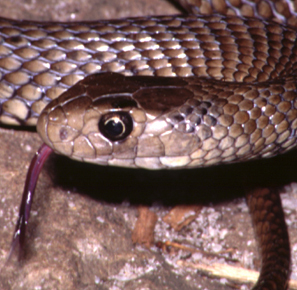
New elapid species from Australia
And what indiscretions would those be? The discovery that three-finger toxins predate the evolution of fangs? Should I have suppressed that knowledge and let someone get hammered hard by something like a Psammophis. Get real. I would think that dissemination of knowledge rather relevant to private keepers would be something that would be appreciated. I didn't create the snakes, merely discovered the evolution.
BGF
BGF Wrote:
"I didn't create the snakes, merely discovered the evolution."
Oh come on. Surely your not the first person to have worked out that snakes evolved venom?
Give me a bucket!
PS - You are entitled to dislike my taxonomy, but as least I know the rules! (see my previous post)
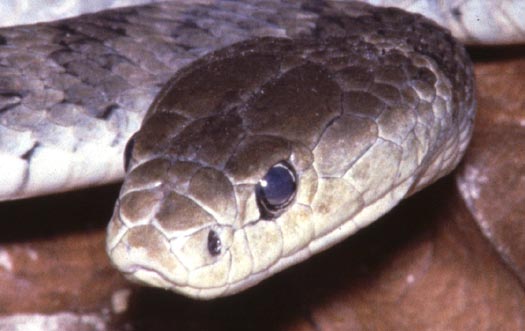
New Species of Rough-scaled snake
And ours is the first paper detailing the ancientness of certain toxin classes. A titbit that you seem incapable of grasping.
BGF
Er, hasn't it already been widely reported that some dinosaurs were venomous or had toxins? ... um, before your latest pearl of wisdom claiming that the pet trade is due for upheaval?
So, is your next taxonomy paper going to be on dinosaur toxins? How do you plan to do gel columns on those? LOL
>>So, is your next taxonomy paper going to be on dinosaur toxins? How do you plan to do gel columns on those? LOL
He'll just wait for someone else to mention it in conversation somewhere and then publish it in the Bundoora School District Young Naturalists' Newsletter
Cheers,
Wolfgang
-----
WW
Somehow I have this feeling that if this guy ever does write a paper on dinosaur toxins, he'll have no trouble examining about the same number of type specimens as he apparently did for all his other publications. LOL
BGF Wrote:
"I didn't create the snakes, merely discovered the evolution."
Oh come on. Surely your not the first person to have worked out that snakes evolved venom?
Give me a bucket!
PS - You are entitled to dislike my taxonomy, but as least I know the rules! (see my previous post)
New Species of Rough-scaled snake
-----------------
>>Eddie Munt
>>Shop-owner,member of IHS,Pet Care Trust.
Oh Wow! If a pet shop owner says it's bunk, then it must be so. Who would know better about venom molecular evolution than a pet shop owner, after all?
Did you ask his views about designing a space station on Mars as well, while you were at it?
ROFLMAO!!!
Cheers,
Wolfgang
-----
WW
To WW, The qualifications of the pet store owner are irrelevant. What is at issue are the sensationalist fear mongering quotes used by Fry and yourself which will be seized on by regulators to restrict the private keeping of innocuous species.
Assuming the WW and Fry are not fools (perhaps a dangerous assumption), it is fair to agree that these men knew their paper and media releases would create major headaches and problems for private keepers now and in the future as this release and paper are quoted and re-quoted as a basis to call for a tightening of already overly restrictive laws.
Any claims WW and BGF make of being allies of private keepers have been shown to be a lie by their sensationlist claims and cynical attempt to create a "problem" for which they can then seek government funds to "fix".
OK Children....Enough with the ego bashing! Both sides have valid arguements. I have worked with most of the snakes you have talked aout over 25 years. Been bitten many times in that period. The problem is not with the research. The media will a(and does) use every oportunity to exploit the "dangers" of reptiles. That the info is real or made up makes no difference to them. Personally I did not know that about corn snakes, but I'm not going to shiver under my bed about it. Some restrictions are necessary. I have seen TOO MANY macho idiots thru the years that do a lot more damage to our rights than one paper. There should be an age limit on ANY opistoglyphic species. Children have NO Business keeping these (and some dumb adults). But Freedom of choice is a right that should be protected. I agree that some inspection of facilities is necessary....but I'm still steaming over Fla's increase of 2,000% on the cost of V permits. But I digress... Thankyou Mr. Fry for your information. Accurate or not...It gives room for thought...and personally I think that is healthier than suppressing out of the fear of consequences....I've seen what that can do to a herp society. Frank
I think you have grasped the essentials of it all. We are certainly not advocating bans (quite the contrary in fact as is evident on the law forum). However, as the snakes are very much a sliding scale of danger (rather than clear cut vipers/elapids with a few 'exceptions' thrown in), there should be a sliding scale of experience necessary. I think people should have the right to keep whatever venomous they want but that the education aspect should be adhered too. However, most herp societies aren't proactive in this regard so end up getting utterly screwed by the politicians.
The scariest part about the colubrids is the lack of antivenom (and lets not kid ourselves, some of these species are quite capable of lethal envenomations).
Cheers
BGF
True enough....That is why in Gainsville (many years ago) I pushed for and got a legal commity started when the state threatended to restrict even "non-venomous species". I was at the Daytona expo and saw the lack of education and fear that was displayed by the officers who were supposed to be enforcing regulations there. We need to educate...and we need to work together to police ourselves. It is the only chance that we have to keep The uneducated from doing so. Frank
I should add that this post was not intended to ridicule Eddie Munt, but as a pi$$take of Hoser's usual "science by opinion poll" approach.
Cheers,
Wolfgang
>>-----------------
>>>>Eddie Munt
>>>>Shop-owner,member of IHS,Pet Care Trust.
>>
>>Oh Wow! If a pet shop owner says it's bunk, then it must be so. Who would know better about venom molecular evolution than a pet shop owner, after all?
>>
>>Did you ask his views about designing a space station on Mars as well, while you were at it?
>>
>>ROFLMAO!!!
>>
>>Cheers,
>>
>>Wolfgang
>>-----
>>WW
>>
>> WW Home
-----
WW
The paper is badly written but at the end of the day is not the problem and no one with half a brain has called for suppressing of science - even bad science.
Where the problems are created are with Fry's self promotion and claims that his allegedly new finds (which are not so new) will cause chaos and upheaval in the snake keeping community and in terms of laws.
Fry is no dill (or I assume not) and both him and WW would be aware that such comments and widely publicised ones at that - will be seized upon by regulators to shut down private trade as and when they see fit.
Any "after the fact" lobbying by Fry to stop this wil be trivial compared to the general damage his statements have and will make over time.
>>The paper is badly written but at the end of the day is not the problem and no one with half a brain has called for suppressing of science - even bad science.
>>Where the problems are created are with Fry's self promotion and claims that his allegedly new finds (which are not so new) will cause chaos and upheaval in the snake keeping community and in terms of laws.
As we said before, Ray, we look forward to your criticisms of our science and what's new and what isn't (all in your best writing style, of course - LOL!!). You know about as much about toxin gene evolution as I know about the Melbourne taxi system, so it should give us all a few chuckles before bedtime.
Cheers,
Wolfgang
-----
WW
and it should be something that is discussed and dealt with accordingly, But in the right way. I definately think that BGF fairly spoke of the animals and the danger. If you read his comments, he clearly states that just because some of the snakes produce the same toxins, doesn't mean they are capable of producing the same reaction as far more dangerous elapids and such. I think his paper was very well written and his comments very well spoken. There is no hype about anything he is doing, he is a very well educated herpetologist. I think what you need to remember is that alot of reptiles are very understudied and we have alot to learn. Thankfully there are the BGF's in the world to shed some light on these animals, so we can appreciate them even more. Every outcome of research does not conform to our liking and yes, sometimes it can be shocking, but there is not reason to "shoot the messenger".
Just my thoughts,
Kevin
Sorry to jump onto the bandwagon of this debate at such a late date, but I'm interested to hear about these herpers who were "outraged" by the paper. Living as we do in a country where there are a grand total of FOUR species of snakes which this article would even affect. None of these species are even very commonly kept, with the possible exception of Dendrelaphis punctulata. Since we also live in a country where we are allowed to keep everything up to Taipans (in most states), I fail to see how this could be such a great cause of "outrage". Were these outraged people under the age of 18? The only people this could possibly affect (at a Melbourne herp society meeting) are kids under 18 or people without any experience who can't get a specialist license. IF (and it has certainly never been said that they are) these particular 4 species of snakes turn out to be capable of delivering a semi-serious bite, I think it probably is better than people under 18 don't have access to them anyway .
regards,
Tim
P.S. Argument ad hominem Ray, if the science is so bad, why haven't you pointed out the flaws?
Here in NSW (not sure about Vic) the established opisthoglyphs (Boiga irregularis etc) are on class 1 anyway, along with numerous species of small elapids. So, the likelihood of there being even a minor change is the laws is pretty much NIL.
