found in Kingsville, Texas
Reptile & Amphibian Forums
Welcome to kingsnake.com's message board system. Here you may share and discuss information with others about your favorite reptile and amphibian related topics such as care and feeding, caging requirements, permits and licenses, and more. Launched in 1997, the kingsnake.com message board system is one of the oldest and largest systems on the internet.


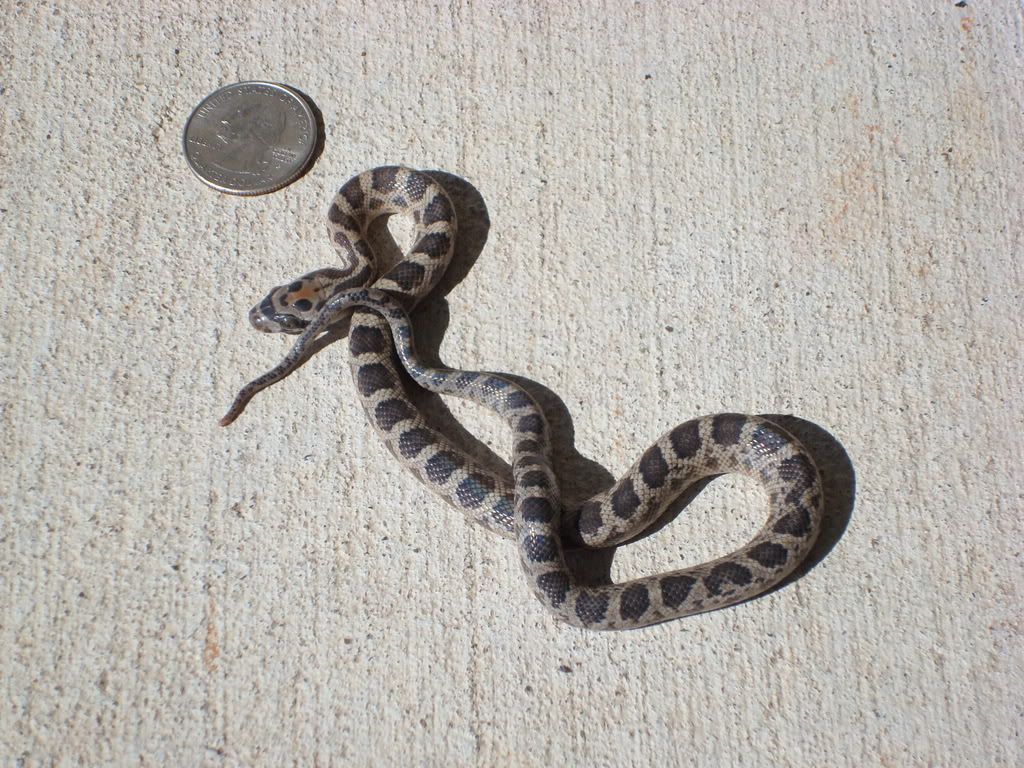
hey Elaphe fanatics, what is this?
wolfpackh
Dec 19, 2007 12:26 PM
Replies (24)
DMong
Dec 19, 2007 04:07 PM
n/p
-----
"Better to be silent and thought a fool, than to open mouth and remove any doubt!"
shaky
Dec 19, 2007 08:33 PM
I love the skull head pattern
Its got to be a TX rat
Does it want to bite whenever you come close?
-----
Austin Herp. Soc.
tbrock
Dec 19, 2007 09:34 PM
Interesting head pattern, coloration, and locality! I would also say Texas rat snake (Elaphe (Pantherophis) obsoleta lindheimeri. That is the furthest south I have personally heard of them. They are fairly common in the floodplain of the Nueces River, in Nueces County, just a few miles north of Kingsville (Kleberg County).
-Toby Brock
-----
The Ratsnake Foundation
wolfpackh
Dec 19, 2007 10:21 PM
i originally posted the pic in Field Notes & Observations The pic was sent to me via a relative. Four of these had turned up in his apartment. I travelled down to K-ville recently and found a roadkill within the apt complex. My guess was great plains or texas rat. I was told they had attitudes, but I convinced him to release the animals unharmed. Appreciate the feedback folks. Probably a freshly hatched TX rat
keown
Dec 19, 2007 11:08 PM
Toby,
Texas Rats (Pantherophis obsoletus-I think that is the most up-to-date name for them in the rat snake musical chairs game) have been present in both Kleberg and Jim Wells Counties for years, though not nearly as abundant as they are in Nueces County and around the Nueces River. Dixon (2000) acknowledges their presence in Kleberg County and Dixon and Werler (2000) show them in Kleberg County. I occasionally collected them in Kleberg Co. back in the late 60s and 70s mostly in the Kingsville vicinity and also in the Chapman ranch area near the Nueces-Kleberg County line. I am fairly certain that the snake in question is indeed a young Texas Rat Snake, but I am still a little interested in how it got that rusty red spot on its head.
-----
Gerald Keown
Southwestern Center for Herpetological Research
www.southwesternherp.com
Shaky
Dec 20, 2007 07:15 AM
The critter actually looks like it may have some other influence in there, like emoryi, but most likely its just a pretty lindy.
>>Toby,
>>
>>Texas Rats (Pantherophis obsoletus-I think that is the most up-to-date name for them in the rat snake musical chairs game) have been present in both Kleberg and Jim Wells Counties for years, though not nearly as abundant as they are in Nueces County and around the Nueces River. Dixon (2000) acknowledges their presence in Kleberg County and Dixon and Werler (2000) show them in Kleberg County. I occasionally collected them in Kleberg Co. back in the late 60s and 70s mostly in the Kingsville vicinity and also in the Chapman ranch area near the Nueces-Kleberg County line. I am fairly certain that the snake in question is indeed a young Texas Rat Snake, but I am still a little interested in how it got that rusty red spot on its head.
>>-----
>>Gerald Keown
>>Southwestern Center for Herpetological Research
>>www.southwesternherp.com
-----
Austin Herp. Soc.
wolfpackh
Dec 20, 2007 12:44 PM
last pic

tbrock
Dec 20, 2007 06:19 PM
>>Toby,
>>
>>Texas Rats (Pantherophis obsoletus-I think that is the most up-to-date name for them in the rat snake musical chairs game) have been present in both Kleberg and Jim Wells Counties for years, though not nearly as abundant as they are in Nueces County and around the Nueces River. Dixon (2000) acknowledges their presence in Kleberg County and Dixon and Werler (2000) show them in Kleberg County. I occasionally collected them in Kleberg Co. back in the late 60s and 70s mostly in the Kingsville vicinity and also in the Chapman ranch area near the Nueces-Kleberg County line. I am fairly certain that the snake in question is indeed a young Texas Rat Snake, but I am still a little interested in how it got that rusty red spot on its head.
>>-----
>>Gerald Keown
>>Southwestern Center for Herpetological Research
>>www.southwesternherp.com
Hi Gerald,
Thanks for the interesting info on collecting lindheimeri. I checked my copies of Texas Snakes by Dixon and Werler (both 2000 and the 2005 field guide), and could find no mention of Texas rats in either Jim Wells or Kleberg Counties. On the range map, in both books, it looks like the prospective range touches the far northeastern corners of both of these counties. Is the first Dixon (2000) reference you mention possibly an academic paper, which I might not have seen? I do believe you about finding lindheimeri in these counties, and am not trying to discredit you at all. I think outside the box of researchers' prospective ranges, myself. I have personally seen lindheimeri in a few spots around Nueces County, which I thought were odd habitats for them (arid scrub and cropland), and much more typical for southwestern rat snakes (Elaphe (Pantherophis) emoryi meahllmorum). There is some riparian habitat in Kleberg and Jim Wells Counties, which would be good Texas rat habitat, so their existence in these counties does not surprise me on this level. I just had not personally heard of them being there.
On the subject of Pantherophis, yes according to Utiger et al., lindheimeri should be in this genus, and I personally agree with him. I used Pantherophis for a good while, but (after some wavering between) decided recently to go back to using Elaphe for the Pantherophis snakes until it is more widely accepted in the scientific community. I acknowledge both taxons like this: Elaphe (Pantherophis) obsoleta lindheimeri.
Here is a young adult Texas rat snake in a deep crevice of an old willow stump. The stump was in the Nueces River floodplain.
-Toby Brock
-med.JPG)
-----
The Ratsnake Foundation
keown
Dec 20, 2007 10:03 PM
Hi Toby,
Yes, you are partially correct and I apologize. I know that I need to get my bifocals adjusted to read some of those range maps. But you are correct Dixon and Werler (2000) do not show E. o.lindheimeri or P. oboletus in Kleberg or Jim Wells Counties. I managed to misread their map. However, when I went back and rechecked my reference to Dixon (2000) Amphibians & Reptiles of Texas (Map #113) he does in fact show lindheimeri as having been vouchered from Kleberg County. He also shows it occuring in some other counties that I personally think is somewhat unlikely such as Duval, Jim Hogg, Hidalgo, and Cameron Counties. I do know that it does occur in Kleberg and Jim Wells Counties as I have collected them in those counties. I seriously question their occurance in Duval, Jim Hogg, Hidalgo and Cameron Counties. Over the years I have collected extensively in three of those counties and have never seen a single specimen from any of the three. I do list lindheimeri (P. obsoletus) as occuring in Hidalgo County on our web site based upon literature records only.
Also, the Texas Cooperative Wildlife Collection at Texas A & M do list vouchered specimens of Elaphe obsoleta from Kleberg, Duval, Jim Hogg, and Hidalgo Counties. Of course they do not classify them down to the subspecies but lindheimeri is the only subspecies that would come anywhere close to being in any of those counties. Makes me wonder just how accurate the locality data is on some specimens that end up being in their collection. I can attest to them being in Jim Wells and Kleberg Counties but have some doubts about those other counties listed in Dixon and by the TCWC data base.
And seriously, thanks for bringing it to my attention that I really do need to get my eyeglasses adjusted.
-----
Gerald Keown
Southwestern Center for Herpetological Research
www.southwesternherp.com
tbrock
Dec 20, 2007 10:53 PM
Gerald,
My turn to apologize now. LOL I was not aware of Amphibians and Reptiles of Texas (2000) by Dixon, so I need to add another book to my library. Based on what you've said, I would tend to agree with you that it is unlikely that lindheimeri exists in Duval, Jim Hogg, Hidalgo, and Cameron Counties. Also, the habitat seems wrong in those counties, to me. It is interesting that Dixon would have vouchered specimens listed in his Amphibians and Reptiles... book, but would say nothing of this, nor reflect it in the range map of either of the Texas Snakes books. My guess is that some of the vouchered specimens at TCWC might be aberrantly patterned southwestern rat snakes (meahllmorum).
BTW, nice looking website you got there.
-Toby Brock
-----
The Ratsnake Foundation
antelope
Dec 22, 2007 01:09 AM
I am thinking some of the vouchered animals were maybe collected before all the habitat was fragmented. Those sabal palm communities can hold some interesting stuff, and the resacas are a great place to find things as well. Unfortunately today, the sabal communities are very few and far between. I am also looking at the side blotches on this animal. See the "little state of Texas shaped blotches? These are common in both species, but tend to elongate on every one of the T-rats I have seen as adults and lose their shape. P.g. emoryi have the mickey mouse heads and heart shaped blotches more often than the southern populations of P.g. meahlmorrim in my observations. I wil go with a weird P.g.m., but that is just spec. I have not yet found a T-rat in Jim Wells or Kleberg county, but my transects are usually one liners!
-----
Todd Hughes
tbrock
Dec 22, 2007 01:42 PM
>>I am thinking some of the vouchered animals were maybe collected before all the habitat was fragmented. Those sabal palm communities can hold some interesting stuff, and the resacas are a great place to find things as well. Unfortunately today, the sabal communities are very few and far between. I am also looking at the side blotches on this animal. See the "little state of Texas shaped blotches? These are common in both species, but tend to elongate on every one of the T-rats I have seen as adults and lose their shape. P.g. emoryi have the mickey mouse heads and heart shaped blotches more often than the southern populations of P.g. meahlmorrim in my observations. I wil go with a weird P.g.m., but that is just spec. I have not yet found a T-rat in Jim Wells or Kleberg county, but my transects are usually one liners!
>>-----
>>Todd Hughes
I also made a response to you and John over on Field Notes...
Good point about the sabal palms and resacas, etc., Todd, and I agree that they would be excellent Texas rat habitat. I am in agreement with you on the shape of the dorsal and dorso-lateral blotches being less like lindheimeri and more like meahllmorum, but the colors are wrong, imho, for meahllmorum. One thing to keep in mind is that markings in lindheimeri can be extremely aberrant, just as they can be in meahllmorum. I also think that it is not a far fetched idea that it could be a meahllmorum x lindheimeri hybrid. Another possible hybrid that has just occurred to me is meahllmorum x Pituophis catenifer sayi, both of which are very common snakes in the Kingsville area. Pituophis has been crossed with guttata, in captivity, so it could happen in nature as well, however unlikely that may be.
-Toby
-----
The Ratsnake Foundation
keown
Dec 22, 2007 04:06 PM
I also just made this post over on the Field Notes Forum.
The other possibility that stays in the back of my mind is that perhaps it is an "accidential"/escapee. From all the posts it appears that a number of these same snakes appeared in a short time frame in and around that apartment complex and its parking lot. Perhaps it is not something native....but perhaps the offspring from an escaped snake. I wonder if there is a 'herper' living in that complex?
Outside of that possibility I'm still leaning toward an aberrant lindheimeri. Would still like to see that critter up close and personal.
-------
Also Todd, I keep forgetting about habitat changes/fragmentation in that area. It has been some years since I worked those counties around that area hard. For example, in Jim Wells County an area where I occasionally found lindheimeri was along the San Fernando Creek east of Alice. Back in those days that was a good sized year round flowing creek that was fed by the discharge from the city's sewer treatment plant. That creek flowed adjacant to the Country Club and in that area it was bordered by huge oak trees laden with Spanish Moss. It was an lush area and herp life was abundant...red-eared turtles, softshell turtles, leopard frogs, green tree frogs, Indigo Snakes, Rough Green Snakes, Diamondback Water Snakes, Ribbon Snakes, Texas Rat Snakes, and more. I used to get the Texas Rat Snakes out of the oak trees along the creek. However, if I was to go back to that same stretch of San fernando Creek today, the creek is dried up and the lush growth is gone...most likely most of the species that I used to find there are gone also. These kind of habitat changes are fairly abundant throughout much of Jim Wells County.
-----
Gerald Keown
Southwestern Center for Herpetological Research
www.southwesternherp.com
antelope
Dec 23, 2007 12:56 PM
agreed, the habitat changes, another reason why finding animals gets harder unless one changes their criteria for species. When one moves out, something usually takes its' place.
-----
Todd Hughes
keown
Dec 23, 2007 03:45 PM
Todd & Toby,
I just noticed that over on the Field Notes Forum where they have been posting about this same snake, somebody has decided over there that it is a Texas Glossy Snake. I don't think it really fits that way either. This is one of those times when it would really be nice to see the actual snake...belly pattern, anal plate, eyes, scales, etc.
Hey, I hope both of you guys and your families have a Merry Christmas. Todd hope to see you over at the other place over the holidays....why not invite Toby along?
-----
Gerald Keown
Southwestern Center for Herpetological Research
www.southwesternherp.com
tbrock
Dec 23, 2007 04:36 PM
>>Todd & Toby,
>>
>>I just noticed that over on the Field Notes Forum where they have been posting about this same snake, somebody has decided over there that it is a Texas Glossy Snake. I don't think it really fits that way either. This is one of those times when it would really be nice to see the actual snake...belly pattern, anal plate, eyes, scales, etc.
>>
>>Hey, I hope both of you guys and your families have a Merry Christmas. Todd hope to see you over at the other place over the holidays....why not invite Toby along?
>>-----
>>Gerald Keown
>>Southwestern Center for Herpetological Research
>>www.southwesternherp.com
Gerald,
I saw that post also, and I agree with you that it does not seem like a glossy. I can't tell if the scales are keeled or not, but that would be one quick way to tell that it is not a glossy. Something about the head and eyes doesn't look like Arizona to me, and I still think it is a rat snake (or mostly rat snake at least). I have been searching through my books and field guides for photos of baby glossies, but have not found any to compare it to.
Merry Christmas to you and yours as well, Gerald. Todd has invited me, and I will be along as soon as I am able.
-Toby Brock
-----
The Ratsnake Foundation
wolfpackh
Dec 23, 2007 06:44 PM
the pupils are round, scales lightly keeled, and there are ventral markings typical of the genus Elaphe. there is no hint of Arizona or Pituohphis in this snake IMO.
tbrock
Dec 23, 2007 11:34 PM
>>the pupils are round, scales lightly keeled, and there are ventral markings typical of the genus Elaphe. there is no hint of Arizona or Pituohphis in this snake IMO.
Well, that settles that question imho. Arizona would have smoothe scales, plain ventrum and the pupils would be slightly elliptical in strong light. I think it is mostly down to meahllmorum or lindheimeri, or a cross of the two. I would have kept such an odd specimen to see how it develops.
-Toby
-----
The Ratsnake Foundation
JediKnight1971
Dec 23, 2007 09:25 PM
Sorry guys, but this is not a Texas (Western) Ratsnake... I have seen lots of juvenile emoryi with this same aberrant pattern. Not all emoryi read books and know that they HAVE to have a spearpoint on the head... LOL! Post a photo of the belly and I bet you will see the diefferences...
Neat looking emoryi...
Happy herpin'...
MP
tbrock
Dec 23, 2007 11:44 PM
>>Sorry guys, but this is not a Texas (Western) Ratsnake... I have seen lots of juvenile emoryi with this same aberrant pattern. Not all emoryi read books and know that they HAVE to have a spearpoint on the head... LOL! Post a photo of the belly and I bet you will see the diefferences...
>>Neat looking emoryi...
>>
>>Happy herpin'...
>>
>>MP
Yep, I've seen my share of emoryi meahllmorum with aberrant or nearly absent spear points. That is not what I am looking at. Eye and head shape and coloration are all extremely aberrant for meahllmorum of that area, and make me think of lindheimeri. Otherwise, the markings all fit for meahllmorum. I am kind of in the middle on this one, and undecided. I have seen lots of young and adults of both rat snake species, and this baby does not fit either very comfortably imho.
-Toby Brock
-----
The Ratsnake Foundation
jediknight1971
Dec 24, 2007 10:44 AM
Yeah, but the blotches are to "well-defined" for lindys... even the oblong pattern is not oblong enough. The head is to round (lindys typically have a much longer head, even when in the "flat-headed" defensive posture & even as juveniles), the eyes too large, and again, the pattern is not right. I would bet my subocularis collection that this is an emoryi! LOL!
Happy herpin'...
MP
tbrock
Dec 24, 2007 12:14 PM
>>Yeah, but the blotches are to "well-defined" for lindys... even the oblong pattern is not oblong enough. The head is to round (lindys typically have a much longer head, even when in the "flat-headed" defensive posture & even as juveniles), the eyes too large, and again, the pattern is not right. I would bet my subocularis collection that this is an emoryi! LOL!
>>
>>Happy herpin'...
>>
>>MP
Okay, I give in! LOL! Betting your subocs is pretty confident, and I won't try to top that. I'll just say that it is a really weird looking specimen for that area. Emoryi (meahllmorum) is definitely the most common lampropeltine in the area, and I am willing to admit that it is a strong possibilty. I would like to see that snake in about a year, to see how it develops.
-Toby Brock
-----
The Ratsnake Foundation
antelope
Dec 25, 2007 02:12 AM
I will do a drive by later on in the year to try and scoop some. It is definitely a weirdo, all I can say is I have seen a lot of meahlies with no belly pattern as well, but have not seen many around here without the classic spear point.It is a rat snake, that is my final offer, lol! I just might take you up on that subocularis collection bet! Merry Christmas, y'all!


-----
Todd Hughes
tbrock
Dec 26, 2007 12:04 PM
I agree with you on both points about markings in meahllmorum, Todd, especially in the Kingsville area. I have seen several from Kingsville, over the years, which were very typical specimens, although we know that some very aberrant ones do exist (eg. your Nueces Co. reverse-striped specimen). The more I look at this animal, the more I think it is meahllmorum, though. Even in extremely aberrant animals, I think some traits are fairly consistent. This snake has way too many dorsal blotches to be a Texas rat - somewhere in the neighborhood of 55 - 60, by my count. According to Dixon and Werler (2005) meahllmorum have 39 - 67 (avg. 55), while lindheimeri have only 27 - 37 middorsal blotches (no avg. given).
Other than meahllmorum, I agree with Gerald about the possiblity of it being an escaped or released animal. If so, we can only guess what its parents are imho. Maybe guttata, emoryi, meahllmorum x (?)...
Here is a photo of a 2005 baby meahllmorum, showing the middorsal blotches, which I count at 50 - 51.
-Toby Brock

-----
The Ratsnake Foundation
