I am a little aprehensive here out of fear that another argumenet may come out of this but I feel the awnser I was seeking got lost in the previous threads arguement. How can someone who is new to the hobby know what they are getting. I know in my previous thread I mentioned Kathy and Don, and I understand that these are only 2 of the reputable breeders out there. What i was trying to get at was you cant really blame people like me who are new to the hobby cause when we go to a show and someone says that a certain snake is say a normal/classic how am I supposed to know that they have bread it with a monkey. I know this is a bit of an stretch but seriously when i see what looks like something and someone says thats what it is what am I to do. I would like to assume that the people running the shows would have a good idea of who they let sell snakes at shows. I know it can be hard but I think maybe if this was such an issue that maybe the reputable breeders would get together and maybe not let these people sell at the shows they host. I know that you will always have people out there who dont neccisarily care but what about the people like me who do. I just wish there was a better way for someone like me who is new to corns to know that what I am getting is what was promised. I hate to think i am bringing home something that isnt what i thought it was to begin with. Especially when i am interested in breeding. I would like to be able to get hatchlings that are somewhat predictable. I dont want monkeys LOL
-----
My inside problems only effect the outside world....And I am ok with that.
Reptile & Amphibian Forums
Welcome to kingsnake.com's message board system. Here you may share and discuss information with others about your favorite reptile and amphibian related topics such as care and feeding, caging requirements, permits and licenses, and more. Launched in 1997, the kingsnake.com message board system is one of the oldest and largest systems on the internet.



Again How????? (Kinda long)
Replies (17)
My best advise would be to pick up as many good books on the subject of cornsnakes(or whatever species/ssp.) that you can and learn as much as possible. Also, the more snakes you get exposed to in person at shows, and yes, even pet stores, you can slowly get accustomed to the differences in the many different types of morphs, subspecies, etc... "where there is a will, there is a way", at least most of the time..LOL
Nothing beats exposure exposure exposure!!!
Genetics, and HOW mutations are created is key to understanding how many things will/should look. If you enjoy them, which it certainly sounds like you do, then stick with it and you WILL LEARN!. You will surprise yourself one day!
This is how I started in snakes at age seven, and am now 47, I LOVED them, and I had to know MORE!
best regards, ~Doug


-----
"Better to be silent and thought a fool, than to open mouth and remove any doubt!"
...you are asking for a simple single answer to a complex question.
The simple answer: Buy from a source you can trust.
The accurate answer: It all depends on what your interest's in the animal are and your own background knowledge.
If your interest is in a pet and not a breeder then it does not matter what the animals genetic history is if you like it then buy it.
If your interest is in potentially breeding then genetic history becomes important. Yes even for hybrids  since you do not want to misrepresent what the person buying the hybrid from you is getting.
If you do not yet have enouogh experience to weed out, at least the more obvious ones, hybrids then you must rely on someone elses skills and reputation. This is where you are relying on the fact that a successfull breeder with a good reputation will lose more money to lost business if they misrepresent their stock then they will have made on your individual sale(to take the sinical approach). This is also why I recommended you either buy from one of the reputable big names or you buy from someone that they and others has recommended as a honest reliable breeder with good stock.
If you do have some experience/knowledge to use in weeding out specimens then you can take a slightly more risky route of buying at one of the shows that is primarily for breeders instead of the general public. Once again here reputation and the average quality of the vendors will lessen the odds of getting something unexpected.
I would not recommend shopping for breeders at a show whose emphasis is the general public or from breeders you do not have some sort of quality refferals to unless you are very confident in your abilities with the specific species to recognize what you are looking at.
Sean.
-----
1.1 BRB
1.1 Triple Het TPRS's
0.1 Silver TPRS
1.1 Amel Bloodred Corns
0.1 Abbott Okeetee Corn
0.1 Blizzard Bloodred Corn
1.1 Thayeri Kingsnakes
0.1 Reeve's Turtle
0.2 Amstaff's
1.0 Pudytat
How do you know who to trust when buying a used car?
The answer is that you don't.
Most snake breeders (and car salespeople) have reputations.
That's about all you can go on.
Though it does help to educate yourself as much as possible when considering making a purchase of a snake (or car).
You may find that in the case of snakes, you're making a big deal out of nothing for several reasons:
1) Corn snakes are cheap in price, if someone sold you something "impure," and you demanded a refund, what would that amount to?
2) There's no economical way to prove that a snake is carrying the genes of another (aka intergrade, hybrid, non-locality).
3) Intergrades and hybrids exist in nature, so even wild caught stock isn't necessarily "pure."
There are plenty of good breeders out there. The ones that have been around a long time have done so for a reason - they're reputable. So I think the answer to your question would be to get recommendations as to what breeders are working with the species/morphs that you're interested in.
There have been many, many hybrid/antihybrid discussions on this forum. By doing a search, you may be able to determine who's against "impure" stock and that may help in your decision making process (I'm assuming you'd like to keep things are "pure" as possible).
Tim

Third Eye
>>I am a little aprehensive here out of fear that another argumenet may come out of this but I feel the awnser I was seeking got lost in the previous threads arguement. How can someone who is new to the hobby know what they are getting. I know in my previous thread I mentioned Kathy and Don, and I understand that these are only 2 of the reputable breeders out there. What i was trying to get at was you cant really blame people like me who are new to the hobby cause when we go to a show and someone says that a certain snake is say a normal/classic how am I supposed to know that they have bread it with a monkey. I know this is a bit of an stretch but seriously when i see what looks like something and someone says thats what it is what am I to do. I would like to assume that the people running the shows would have a good idea of who they let sell snakes at shows. I know it can be hard but I think maybe if this was such an issue that maybe the reputable breeders would get together and maybe not let these people sell at the shows they host. I know that you will always have people out there who dont neccisarily care but what about the people like me who do. I just wish there was a better way for someone like me who is new to corns to know that what I am getting is what was promised. I hate to think i am bringing home something that isnt what i thought it was to begin with. Especially when i am interested in breeding. I would like to be able to get hatchlings that are somewhat predictable. I dont want monkeys LOL
>>-----
This is America
The shows can not refuse a person a spot at a show just because a few breeders don't think they have enough knowledge.
That could get ugly, quik.
If a person proves to knowingly deceive the public then that person can be refused a spot at a show but otherwise if a person pays the fee they have as much a right as anyone else to sell at a show.
Now having said that...the best way for an inexperienced keeper to protect themselves is to be prepared.
Have a list of questions ready when you go to buy a snake.
If you see a snake you like ask about the parents.
Ask what the parents were, ask what their parents were, ask where they got the parents or the snake in question.
Ask if there are any known hets. Ask if there are any possible hets.
Ask date of birth.
Ask how many times the animal has fed.
Ask if it is eating live or frozen/thawed.
If they can't or won't answer your questions move on.
If you have an idea what you are looking for then someone will have it.
Don't be impulsive.
Be patient. Whatever you want there is a reputable dealer that has it.
-----
Corn snakes and rat snakes..No one can have just one.
"Resistance is futile"
Jimmy Johnson
(Draybar)
Draybars Snakes
_____
That's some darn good advice Jimmy!
comming from you I take that as a true compliment.
-----
Corn snakes and rat snakes..No one can have just one.
"Resistance is futile"
Jimmy Johnson
(Draybar)
Draybars Snakes
_____
>>>>don't let the ney-sayers scare you.
No matter what the a few people seem to think there are many many honest people out there. The number of honest breeders is much greater then the number of dishonest breeders.
There are too many people gaining enough knowledge to see through most of the scams.
Yes, there will always be dishonest people out there but that is true in every walk of life. The percentages are the same.
If you are prepared they have no target.
-----
Corn snakes and rat snakes..No one can have just one.
"Resistance is futile"
Jimmy Johnson
(Draybar)
Draybars Snakes
_____
Thank you Jimmy. this was more so what I was trying to ask about. I Just wish it was easier for someone new like me to know about these questions to ask when buying thier first snakes. I was lucky actually that my first corn (an okeetee male) came from someone I know and trust and has been in the hobby for 30 years and has a pretty good rep in St. Louis. He doesnt generally sell his to the public himself but he does sell them to a herp shop near his home. He is also the one who turned me on to KS.com. I am not the type of person who jumps into things lightly. I do my homework first. Thats why I asked this question.
-----
My inside problems only effect the outside world....And I am ok with that.
Why not set up standards for breeding, organize some sort of regulatory group to keep everyone honest. Only those who have proved they are honest breeders that keep there genes under control can be a member of said group. sure people would still buy from small time breeders that are not members but knowing there is somewhere they can go to get a for sure thing would be nice.
Foot Hill Reptiles
but no easy answers!
Anyone who has been breeding corns for a long time will know their own bloodlines pretty well, and have a pretty good (or very good) idea of what they consist of. BUT - even in some lines that I have bred since the late '80s or early '90s, I still outcross now and then for new blood. And even if I see the parents of new acquisitions, it is not likely I will see the grandparents and great grandparents.
There have been a few times that I was very interested in a new baby or two at a show because it was very unusual for one reason or another. But upon closer questioning (or inspection), it became apparent to me that the unique baby was the product of a little bit of kingsnake or other "exotic" influence. It can be very subtle if it was a couple of generations ago. If it had been even less of a percentage, nobody could have been very sure of it. And that is how hybrid blood can be introduced, although after more generations of breeding into corns, the percentage will be very, very small. But it is still there, and as others have said, it could be anywhere, even possibly in a wild snake, or more likely, snakes at shows and shops.
Also, it can be difficult to say for sure what genes are NOT in a particular line, if the breeder has done some outcrossing. For example, I have used hypo so much in my bloodred projects that I usually just say that any of my normal bloods COULD be het for hypo. OTOH, my use of other genes (charcoal, amel, anery, etc) has been fairly restricted in my bloods, so I can FAIRLY well declare that my normal bloods are free from those genes unless they came from certain clutches. That is just one example. Any longtime breeder will be able to tell you which bloodlines he / she has worked with for a long or short time, and what the likelihood is of unexpected results. But something from many generations ago that was thought to have been "bred out" by now, can still pop up unexpectedly from time to time.
Because I have worked on certain lines for a long time, I also know that way back in the history of my candycanes, a couple of light colored creamsicles were used as founder stock in the late '80s or early '90s. That means that abut 15 - 20 years ago there was an injection of part emoryi blood in the new morph that was to become candycanes. Of course, back then, emoryi was classified as a subspecies of corn. Now it has been given its own species. So now my modern candycanes probably still retain a couple of percentage points of emoryi in them. It is not a secret, for those who care. But of course, some that come from shows may or may not have more or less emoryi - no way to tell. So you have to decide if it is important to you. If some possible emoryi blood (even a few percentage points) is important, then don't buy my candycanes, or any from anyone who has not kept their own lines since the beginning of the morph. If you can't trace it back to the beginning, it may well have a little emoryi in it. And of course, that may be true of almost any other morphs as well.
But then I also know that my other long term lines that are not creamsicle crosses, do not have any creamsicle influence - unless it came sneaking in with some well screened new blood I acquired elsewhere - no way to know for positive.
I feel that the ACR (American Cornsnake Registry http://herpregistry.com/acr/index.php ) will EVENTUALLY help the situation. Although the info is only as good as the person who registers animals, eventually there will be a photo record for several generations online, for each registered snake. Then a potential customer will be able to look through the photos and see what morphs (or if there was a non corn in the genetic background) and decide for himself whether the bloodline meets his needs. The registry is still pretty new, although they have over 5,000 corns registered. It will take a while before many animals have 3 or more generations with photo records. But it has to start somewhere - the sooner the better. Take a look at it if you are not already familiar with the project.
As others have said, if you want a pet, just get the best deal on a healthy animal that you like. If you want to breed and know genetic lines, buy from a long time breeder who can answer some questions about their bloodlines. Even longtime breeders will have better answers for some lines than for other lines. So question carefully and choose according to the answers you get. And consider supporting the ACR for the future of the hobby.
Believe it or not I found our about the ACR through your site. I dont know yet if I am going to breed corns. Like I stated earlier in a reply I do my homework first and I am still searching. But I do plan on using the ACR if that is a route I plan on taking. I think that it was a wonderful idea and more people should look into it.
-----
My inside problems only effect the outside world....And I am ok with that.
I really believe it is a great start to what needs to be done in our hobby. I think it will take a long time to be a really great help, but if nobody starts because of that, it will never get done. And even now, it is a good way to keep records online so customers can look up info for themselves, and good for the credibility of individual breeders and also for the hobby.
I believe Chuck (the originator of the ACR) is hoping that other specialists breeders will want to do the same for their species. He will probably work out some licensing and support agreement with anyone who wants to do a registry for boas, pythons, etc. Chuck is a computer programmer and wrote all or most of this stuff himself.
a bit extreme. You may even recall a few chats we had.
Well, I honestly can see a need for it. Maybe I did not have the foresight, the full picture in my head, or I was just ignorant? But clearly there must be something for the more serious breeders.
Thats not to say you can't pick up an unknown and work out a good possibilty of what it is. But that is generations of work most people will not end up doing.
-----
Thanks for reading.
Big Tom
point, anyone can register their corn or hybrid corn and describe it to the best of their ability. Even if you just have a pair or two to breed(and even if you don't consider yourself a "serious" breeder), at least the beginning of your "dynasty-to-be" will be preserved for posterity.
True, the pair of corns bought at the local show may not be exactly what you think they are, genetically. But if you record all of the info you have about them and their progeny, and record it all with photos, then a few generations from now a potential customer will thank you for the work you have done to help unravel the heritage of his new pet.
IMO it may not help so much with this generation but you have to start somewhere. The way I figure it maybe it wont mean a whole lot today but down the road the ACR could become a great tool for someone who is interested in breeding to be able find what they want to breed and where to get them. I really do think it is a great idea and I hope it gets more and more support.
-----
My inside problems only effect the outside world....And I am ok with that.
It does seem to be a great project and I do plan on registering my cornsnakes once they hit breeding age. Hopefully it will continue to grow.
Sean.
-----
1.1 BRB
1.1 Triple Het TPRS's
0.1 Silver TPRS
1.1 Amel Bloodred Corns
0.1 Abbott Okeetee Corn
0.1 Blizzard Bloodred Corn
1.1 Thayeri Kingsnakes
0.1 Reeve's Turtle
0.2 Amstaff's
1.0 Pudytat
all my troubles work out ok, I think I may register my bloods.
The 30" female with major issues was not interested with a pinky covered in nutribac. She has lost a lot of weight. And all I can remember as a kid is "someone"
(I do not want to name drop him as I dont really know him, although he was around a lot when I was a kid, and he has a PHD and is a major herp guy.) phew
use to get snakes, and fed them by any means something as he said you don't want the stomach to shut down.
So I force fed her a pinky loaded with a nutribac last Thursday. So far so good. I hope I did not jinx myself.
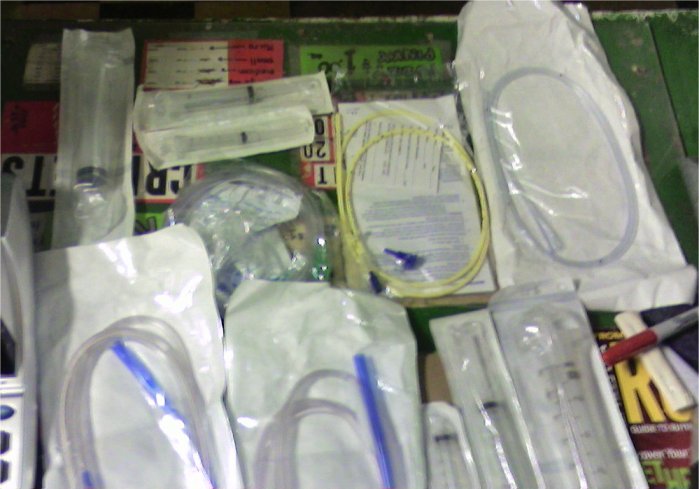
But just today a good friend got me a few items.
Also wet nutribac acts like a super glue with your skin. It actually took off a bit of my finger.
But tomorrow I make various feeding tubes if I need them.
-----
Thanks for reading.
Big Tom
