If you had large diverse population of mid-spectrum king snakes, say 100 unrelated speckleds, would it be possible to selectively breed them till you ended up with lines that looked like typical easterns and California kings?
Reptile & Amphibian Forums
Welcome to kingsnake.com's message board system. Here you may share and discuss information with others about your favorite reptile and amphibian related topics such as care and feeding, caging requirements, permits and licenses, and more. Launched in 1997, the kingsnake.com message board system is one of the oldest and largest systems on the internet.



Thought exercise
Tony D
Jan 14, 2008 08:36 PM
Replies (16)
Patton
Jan 14, 2008 09:00 PM
Sure, if you had a few thousand years to spare!
-Phil
-----
Work is the curse
of the drinking class!
Patton
Jan 14, 2008 09:01 PM
.....And Monkeys at a typewriter could write War and Peace. LOL!!!!
-Phil
-----
Work is the curse
of the drinking class!
EddieF
Jan 14, 2008 09:06 PM
Wow. Turns out I'm as ill suited for thought exercise as I am for regular exercise!
-----
1.1 Florida Kingsnake
1.0 Kisatchie Cornsnake
DMong
Jan 14, 2008 09:41 PM
That really made me laugh!!!
thanks, ~Doug
-----
"Better to be silent and thought a fool, than to open mouth and remove any doubt!"
antelope
Jan 14, 2008 11:25 PM
No, I think they evolved, but if you had hundreds of years, you may be able to breed the latter back to the former, lol!


-----
Todd Hughes
elaphopeltishow
Jan 15, 2008 08:53 AM
Presupposing that there are people with working brains enough to exercise on this forum.
"Doctor, my brain hurts."-Gumby
FR
Jan 15, 2008 09:40 AM
Hi Tony, it would not be a problem. In fact, it would be very easy to do, but boring.
When I read what folks think about genetics here, I wonder, what they are thinking. Most if not all here think only on the surface. They also use terms like Phenotype. But I am not sure they understand what that means.
Genes are not only a tool that allows an animal to stay current(in exsistance) but they are also a record of its history. Hence, gene sequencing to determine relationships with other species.
Which leads to this. In order to surface old(past) traits, you must inbreed and keep inbreeding. Out breeding keeps current characteristics on the surface, by allowing dominate genes to constantly prevail.
Inbreeding digs deeper into recessive traits which is the past history of an animal.
Once many years ago, I had this discussion with a very talented young herper, Steve Osbrone. At the time, I was practicing lots of outcrossing with montane kings. He was against that at the time(that changed didn't it) During our discussion, I mentioned that outcrossing is not what makes oddities. I mentioned, that inbreeding is how you obtain the crazy stuff, at the time, striped blairs, patternless alternas, non-typical of any normal population.
A couple years when by and he called me up to tell me ask/tell me something. He said, he was breeding his animals pure, but a strange thing happened. His pure greeri, produced a perfect thayeri. There were also a couple other examples of that.
In reality, I do not think(or needed) large numbers to accomplish that type of result, you only needed multiple generations of direct inbreeding and the selection of traits you are looking to surface.
Again, this is only theory in how it works, but not theory in that it works, as we did do this very thing many many many times.
The suspect that continued inbreeding reveals a common ancestor amoung closely related species or subspecies.
In my experience, inbreeding never expressed the current F-1 color and pattern. After three generations(average) of direct inbreeding, the offspring were very very different then the adults. After 8 to 10 generations, there was no indication of a locality specific pattern or color. Cheers
Jeff Schofield
Jan 15, 2008 11:08 AM
I think we really have to realize how flexible the genes are that we are playing with. There is a reason that we widely view ssp not determining sp. based on pattern or anomalies. For this reference I will add Milksnakes into the discussion...Milks are one of the most widest ranging as well as the most variable sp. of vertebrate in the world. We as breeders have been working with animals which are still in current flux. Let me state the example of the coastal plains milk....
This ssp. has been defined and sunk yet we as keepers maintain its individuality. Before the internet most of us bred for locality because it increased the chances of getting like individuals, which was most beneficial sight unseen. Some of us who were trying to reprove ssp. status through crosses to test gene flow then wondered out loud not if but how quickly pattern variation could redefine ssp.. Isolation and fragmentation, naturally occuring or manmade, has changed this animal as much as any other. It has always been my belief that there has to be a constant supply of new bloodlines within such CB lines regardless of breeding for locality or not. It is more obvious that we are selectively breeding for what we want, not what science or mother nature refers to as "pure". I have anecdotally compared these coastal milks as well as AZ MT kings, noting that with each generation there is a significant reduction in the black pigment despite parent lines. We as keepers alone are impacting the very color and pattern of the animals we intend to reproduce. I take this into account now every time I do any captive breeding because the IDEA of purity is nothing but a subjective spin of the genetic wheel. Those who claim to hold the high ground find themselves defending what cant be defended. For years I have based my idea of purity or locality only to f2, beyond that its completely useless. Just my 2cents,Jeff
Tony D
Jan 15, 2008 12:35 PM
Unfortunately Jeff I think this drift we see from what I call un-natural selection is almost unavoidable. From thayeri to coastals to goini, the "normal" phenotypes I see today are much different from what they were 15 - 20 years ago.
Jeff Schofield
Jan 15, 2008 12:55 PM
Tony, this is kinda getting back to our arguements from years past. I have aknowledged that, but the locality animals are now more than ever an important "spice" in the soup. Keeping locality lines going is important. Continual influx or gene flow sounds good, but I look through my collection now and see how morphs have taken over.....not good. I still have locality GA easterns, my MONSTER ISLAND milks but thats about it. In fact I didnt make available my milks this year because even WITH f1 MORPHS I couldnt interest enough people last year to move more than a few animals. In many ways what I have found maybe one of the last "new" localities out there, but with no locality breeders they arent "worth" working with to most folks. I suggest everyone take a good,long look at the classifieds section with this thought in mind. I know its not the hobby we started with, the question should be is this the way we all want it to go? Its strange that some are NOW looking for locale FL kings....GA easterns are going for $150ea not $5ea. About 5 years ago I got on the milk forum and encouraged people to put aside a small space in their collection for a STRANGE species....say an indonesian tree snake,etc... That went over like a lead balloon. It wouldnt be a bad idea to try and have some UNMORPHED NA locality animals better represented in the hobby....but at who's expense? I remember finding a NICE Calvert co. cornsnake and keeping it for years trying to find a locality match.....I have to think this has got to be as interesting as an albino at this point....there are fewer of them in the WORLD.
DMong
Jan 15, 2008 11:52 AM
All of which is quite true, inbreeding is where other less dominant traits would begin rising to the "phenotypic" surface!(no pun intended).LOL....although some of which can be VERY un-wanted as well(lack of vigor, deformities, etc...)
Osborne(or anyone for that matter) creating what "looks" to be a textbook thayeri now and then from a greeri breeding(especially a leonis type), isn't anything outlandish at ALL. I think you were just using that as a good example of what HE saw, and is a prime example of what you stated earlier about other traits rising to the surface to be exhibited after repeated inbreeding,......and again, I concur!
best regards, ~Doug
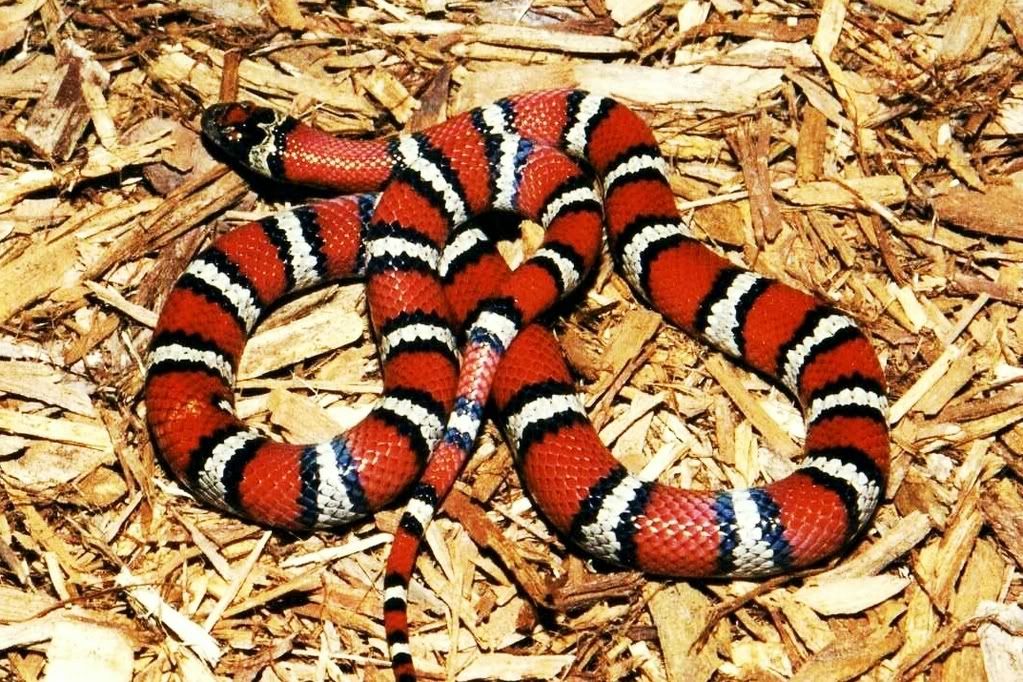
-----
"Better to be silent and thought a fool, than to open mouth and remove any doubt!"
Tony D
Jan 15, 2008 12:08 PM
You pretty much hit what I was getting at. I asked the question relative to a post below about kings of questionable origin.
thomas davis
Jan 15, 2008 01:40 PM
great stuff FR thanks for posting ,,,,,,,,,thomas davis
-----
Morphs... just like baseball cards BUT ALIVE, how cool is that???
my website www.barmollysplace.com
CrimsonKing
Jan 15, 2008 02:11 PM
Now when you say....
"His pure greeri, produced a perfect thayeri."
Do you know if he then bred that snake(s)?
I mean, thayeri as we know them, can be all over the board as far as looks go, within any single clutch, while greeri are generally not as "variable" within a clutch.
Did this thayeri looking greeri produce "variable" babies???
What was it bred to??
I have certainly had mexicana and thayeri that resemble very much a greeri but never had my greeri produce babies that then produced variable (as much as thayeri) offspring.
Could his original greeri have been hiding a thayeri somewhere in the woodshed??
:Mark
-----
Surrender Dorothy!
Jeff Schofield
Jan 15, 2008 11:14 AM
Tony, with the abbarrant patterns over represented in captive populations I can easily see how you could easily produce Eastern, Florida, speckled, goini and OBX from that line. It stands to reason that all this is possible. But I would hesitate to say the whole animal, knowing each of us as keepers KNOW alot more than general phenotypical patterns. Individual head shape, color, and size would all evolve independently and back crosses would tend to slow the process. What do you think? J
Aaron
Jan 15, 2008 12:18 PM
The genes might be there and theoreticly anything is possible. You could spend ten years getting the cal king pattern only to find that you have lost the cal king body size or head shape in that offshoot. It would be very hard to get everthing right to where it would consistently produce each and every trait of a particular subspecies in the same snake, with no traces of other traits.
It would be much easier to just start with pure subspecies, keep records and every 10 years or so add a pure wildcaught to your genepool.
