ok,i know that there are lucy texas rats,and lucy black rats.are there any lucy yellow rats or lucy corns?i mean "pure blooded",with no added influence from the texas or black rats.
-----
0.1 cb spotted turtle (parker)
0.0.6 wc baby stinkpots
0.0.1 cb peninsula cooter (gizmo)
0.0.1 wc yellow belly slider (snaps)
1.0 cb albino corn(rusty)
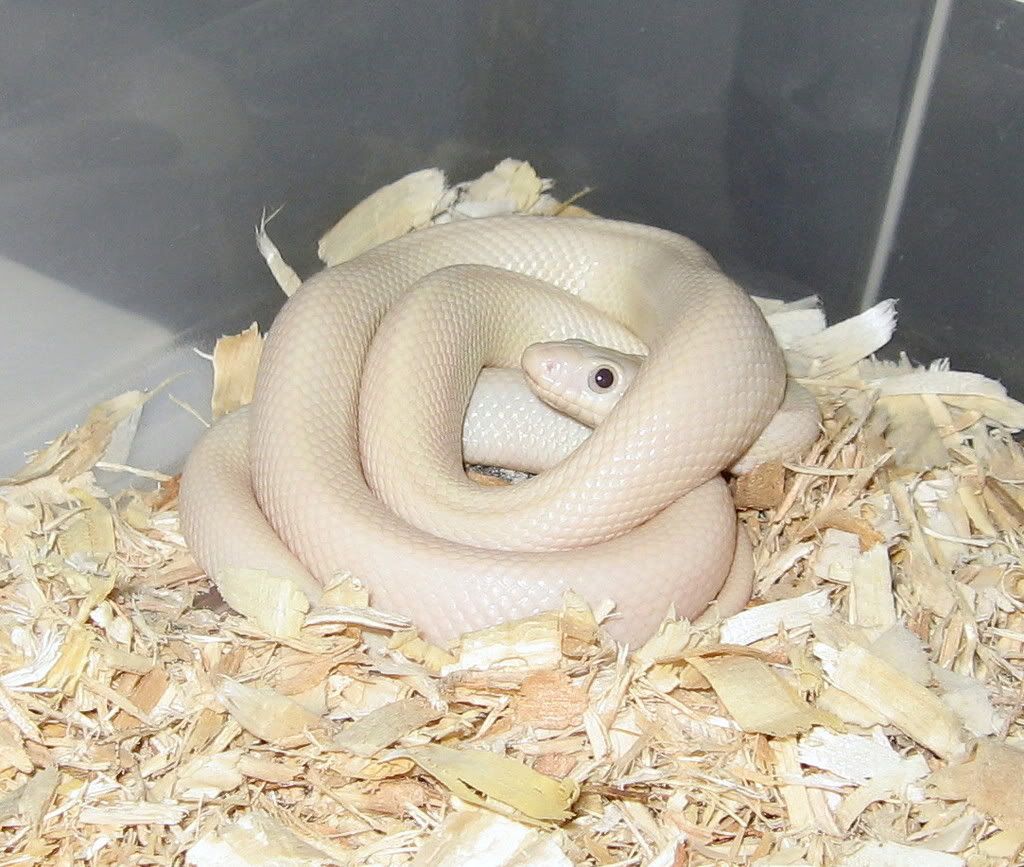
1.0 cb albino lucy texas rat(frost)(pink eyes,all white)
0.0.2 wc halloween crabs
0.2 irritating cats (sassy & miley)
2.0 cb children (sidney,12 & kaelan,4)
0.1 wc wife (danae,age withheld due to fears for personal safety)
Reptile & Amphibian Forums
Welcome to kingsnake.com's message board system. Here you may share and discuss information with others about your favorite reptile and amphibian related topics such as care and feeding, caging requirements, permits and licenses, and more. Launched in 1997, the kingsnake.com message board system is one of the oldest and largest systems on the internet.


lucys?
megalon
Jan 17, 2008 07:44 AM
Replies (23)
Elaphefan
Jan 17, 2008 05:20 PM
There was a male Texas rat snake captured as a hatchling in Texas in 1962. Dr. Bechtel used it in his study of the genetics of color mutations in Elaphe obsoleta. In 1981 he produced four leucistic animals from an F1 cross and in 1982, he produced 1 more from this same cross. Of the five lecustic animals that he produced, three showed marked bilateral exophthalmia (bug eyed).
I personally would discount any claims made of finding an adult leucistic rat snake that was a “native animal”. There is a report of a leucistic black rat snake being found in Ohio, but since leucistic rat snakes were common in the trade by then, I think it was more likely than not an escaped or abandoned pet. Maybe someone else can give you more info.
Dwight Good
Jan 17, 2008 06:06 PM
>>There was a male Texas rat snake captured as a hatchling in Texas in 1962. Dr. Bechtel used it in his study of the genetics of color mutations in Elaphe obsoleta. In 1981 he produced four leucistic animals from an F1 cross and in 1982, he produced 1 more from this same cross. Of the five lecustic animals that he produced, three showed marked bilateral exophthalmia (bug eyed).
Nice reference to Dr. B. If you check some of his other works on obsoleta genetics, you'll find that he crossed the leucistic texas rat line into black rats as early as 1981. His goal was to test whether or not the leucistic gene was allelic with either the tyrosinase positive or tyrosinase negative albino genes. To accomplish this he used a normal black rat, double het for both forms of albino.
>>>>I personally would discount any claims made of finding an adult leucistic rat snake that was a “native animal”. There is a report of a leucistic black rat snake being found in Ohio, but since leucistic rat snakes were common in the trade by then, I think it was more likely than not an escaped or abandoned pet. Maybe someone else can give you more info.
While it certainly wouldn't be impossible to find a leucistic animal (other than a Texas) in the wild, it does seem improbable.. at least to me. As you suggest, based on the popularity of leucistic texas rats in the pet trade (by far the most popular obsoleta mutant ever) a leucistic "find" would most likely (statistically speaking) be an escaped or intentionally released pet. Does it really matter though? Like I've said before.... Texas, black, grey, or whatever, a white snake is a white snake.
dg
GRich
Jan 17, 2008 10:08 PM
I wish I could find more of Dr. B's work. I have his book and I've scoured the internet for more obsoleta articles and, like I said, I have his book.
-----
Gregg
The Corn Snake Pit
Dwight Good
Jan 18, 2008 02:18 PM
>>I wish I could find more of Dr. B's work. I have his book and I've scoured the internet for more obsoleta articles and, like I said, I have his book.
Are there any libraries near you? I found most of his works at a local library.
Good luck,
dg
BillMcgElaphe
Jan 18, 2008 09:30 AM
Dwight Goodand Elaphefan,
Hey guys, not an argument here, just two anecdotes:
Take them for what they are worth from the internet.
(Let me preface this with, after 50 years of field herping, I’ve never found an amelanistic, leucistic, or axanthic reptile in the field.)
.
Just shy of 40 years ago, my wife and I visited an excellent, starting-up, private zoological facility. The very credible owner/curator told me a story of a local guy bringing him an adult, all white Black Rat Snake, unfortunately in two pieces.
I recently communicated with that curator and he said it was definitely leucistic. Obviously this animal’s genes never made it into herpetoculture.
.
I personally saw the Ohio, leucistic, female Black Rat in September of 1992, just a short time after capture.
My first feeling (Gestalt) was that this was definitely a wild specimen; scars and body build that made it probable that this animal had led a life of hunting and fighting parasites. Head to body proportion pointed to wild caught. (Dwight, I know you know what I’m talking about here from field herping experience.)
Body language and enthusiasm of the guy who kept it, indicated nothing less than sincerity.
.
I fully understand the probabilities of an all white Black Rat Snake NOT surviving to adulthood, but I think forested mountain animals, and animals that live in snake friendly barns stand a better chance of avoiding sight-hunting predators such as Marsh Hawks and their kind.
.
Anyway, It really is a non issue because, as mentioned, “Texas, black, grey, or whatever, a white snake is a white snake.” Here, here.
-----
Regards, Bill McGighan
Dwight Good
Jan 18, 2008 02:29 PM
>>I personally saw the Ohio, leucistic, female Black Rat in September of 1992, just a short time after capture.
>>My first feeling (Gestalt) was that this was definitely a wild specimen; scars and body build that made it probable that this animal had led a life of hunting and fighting parasites.
I'm not trying to discredit that find, but scars and body build do not prove it was not an escaped/released animal. I've seen captive animals with scars and also captive animals that look like they "had led a life of hunting and fighting parasites." Again I am in no way trying to say the find is not legit, just pointing out that those criteria are not enough for me personally. Heck, I've said it before.. even if my own grandmother brought me a leucistic rat snake she caught in her back yard I'd be a skeptic.
>> Head to body proportion pointed to wild caught. (Dwight, I know you know what I’m talking about here from field herping experience.)
Actually I don't follow you here? I've seen hundreds of captive bred obsoleta over the years as well as quite a few wild ones in many states. Head to body proportion varies with individuals in my experience and has absolutely nothing to do with whether the animal is wild caught or captive bred. I've seen wild snakes that were fat and well fed, as well as near anorexic ones. The same can be said with captive animals. ???
The whole leucistic texas rat / black rat thing has been beaten into the ground in my opinion. I guess it all depends on who you trust and how much money you want to spend. My personally opinion is that I will NEVER buy a leucistic "black" rat snake. But that is just me.
dg
BillMcgElaphe
Jan 18, 2008 04:54 PM
DG said:
“Heck, I've said it before.. even if my own grandmother brought me a leucistic rat snake she caught in her back yard I'd be a skeptic.”
Hmmmm - Not even Grandma Dwight? Man, you KY guys are hard.  LOL
LOL
And “I guess it all depends on who you trust”.
I won’t flog the horse any more than to say I agree totally that if it’s important for you to find a specific variant or morph line, you must find a breeder you trust, research the lineage, and do your homework.
If you want a pretty, white American Rat Snake, any leucistic should work!
-----
Regards, Bill McGighan
KJUN
Jan 18, 2008 09:09 PM
>>Head to body proportion varies with individuals in my experience and has absolutely nothing to do with whether the animal is wild caught or captive bred.
First, I think you are under-generalizing here. It is a WELL established fact that ratsnakes have pheontuypic plasticity inm the shapes of their heads, and adult ones IN THE WILD "almost always" have larger heads (comparatively speaking) than cpative ones of the same size. Diet relate, and I am firmly convinced wild rats eat and digest things they can NOT do in captivity do to the way snakes are maintained in captivity. Sure, they COULD be "just like wild ones, but they'd need cages of a VERY large size that was not very homogeneous in temps, etc.
SSecond, if a white ratsnake is a white ratsnake, do you feel the same about a HET white ratsnake just being a het white ratsnake? What about a normal from two het parents? Is a ratsnake just a ratsnake? Obviously, I think it is pretty plain that I do not think THAT way........ Anyway, it doesn't matter that much because ialso do NOT believe the Leucistic black rat is pure black rat.
....but, due to outcrossing if it is not actually pure, the leucitics SOLD as black rats do tend to behave better than the AVERAGE ones sold as Texas rats....and they do tensd to have slightly different builds that should be obvious to people that work with captive ratsnakes AND observe them in the wild.
I knew what Bill meant about the "difference," and I am firmly convinced that his references, as a GENWERAL rule, are accurate AND useful.
KJ
-----
KJUN Snakehaven
Kevin Saunders
Jan 18, 2008 10:02 PM
I'm getting a little off topic here, but when I was an undergrad someone told me about a paper on the phenotypic plasticity of rat snake cranial morphology. Well, I think it was a paper, but it may have been a portion of a book or some other source, but anyway it caught my interest. I have since forgotten where his information came from, but I'd like to read up on this more. Can you point me to any sources for this information by any chance? Thanks.
KJUN
Jan 19, 2008 06:34 AM
>>I'm getting a little off topic here, but when I was an undergrad someone told me about a paper on the phenotypic plasticity of rat snake cranial morphology. Well, I think it was a paper, but it may have been a portion of a book or some other source, but anyway it caught my interest. I have since forgotten where his information came from, but I'd like to read up on this more. Can you point me to any sources for this information by any chance? Thanks.
There have actually been a couple of studies, but I don't have my citations here at home. If I think about it Wednesday when I return to that office (and have a spare second o look for it!), I'll try to find the paper and post the citation.
-----
KJUN Snakehaven
Dwight Good
Jan 19, 2008 10:47 AM
>>>>Head to body proportion varies with individuals in my experience and has absolutely nothing to do with whether the animal is wild caught or captive bred.
>>
>>First, I think you are under-generalizing here. It is a WELL established fact that ratsnakes have pheontuypic plasticity inm the shapes of their heads, and adult ones IN THE WILD "almost always" have larger heads (comparatively speaking) than cpative ones of the same size.
KJ,
I do agree with you about phenotypic plasticity, there's no denying that fact in relation to the size/proportion of the animals' heads. However in my experience I have not seen a trend in wild or captive animals that would allow me to comfortably state whether an animal is captive or wild caught simply based on head and/or body shape. I've personally observed obsoleta type animals in the wild in 11 states and have seen/owned many wild and captive animals from different locales as well.
I have to admit as a neophyte keeper I actually thought I could sex obsoleta based on head shape... lol. At the time, all the adult males in my small collection had short stubby heads and the females had longer, more slender head structure. Of course after my collection started to expand and I realized this generalization was entirely inaccurate.
>> Diet relate, and I am firmly convinced wild rats eat and digest things they can NOT do in captivity do to the way snakes are maintained in captivity. Sure, they COULD be "just like wild ones, but they'd need cages of a VERY large size that was not very homogeneous in temps, etc.
I definitely agree, wild snakes do tend to eat more opportunistically than captive animals and surely eat things that captive snakes would never be offered. However, even in captivity some snakes seem to prefer larger meals and others prefer smaller meals. I can't say that I've noticed any differences in head shape in my own captive raised animals based on diet but its kinda like apples and oranges in that regard, there is really no control for the data to be of use. The wild snakes are going to eat larger prey when necessary, no doubt, so I'm sure phenotypic plasiticity does play in their head/body proportions. I probably shouldn't have used the words "absolutely nothing to do with" in my previous post (statement above, top of this post), that was truly inaccurate. But my point was that generalizations about head shape between WC and CB snakes are not always accurate and don't follow any hard rules, in my experience. *shrug*
>>>>SSecond, if a white ratsnake is a white ratsnake, do you feel the same about a HET white ratsnake just being a het white ratsnake? What about a normal from two het parents? Is a ratsnake just a ratsnake? Obviously, I think it is pretty plain that I do not think THAT way........ Anyway, it doesn't matter that much because ialso do NOT believe the Leucistic black rat is pure black rat.
Of course I am with you again on that... lol. My point about the "white ratsnake is a white ratsnake" was to the people that actually pay more money for a leucistic "black" rat when they could get a leucistic Texas rat for less. A white rat snake is a white rat snake. Now a white milk snake or a white king snake might be a different story.
How do I feel about het white rat snakes? LOL, I think you have been around on this website long enough to remember all the "black x texas" animals that used to be advertised on the classifieds just after the alterna.com days. Where are those snakes now? Its certainly curious that you don't see ads for those type snakes anymore.
To be honest, with all the outcrossing to black rats over the years and the Loves' outcrossing leucistic Texans to their local yellow/glades rats, you never know what you are getting with a leucistic rat anymore. How messed up is that?
>>>>>....but, due to outcrossing if it is not actually pure, the leucitics SOLD as black rats do tend to behave better than the AVERAGE ones sold as Texas rats....and they do tensd to have slightly different builds that should be obvious to people that work with captive ratsnakes AND observe them in the wild.
I've never kept leucistic "black" rats and have only seen them at shows so I'll have to take your word on that. *evil grin* But I will say that all the leucistic texas rats I've owned and/or produced over the years had quite a bit of variation in their attitudes. Some were nippy, others were not. Personally I don't think it matters much what subspecies the animal is, its individual disposition will vary and so will the way it is raised in captivity. With handling even the most aggressive snakes I've ever owned settled down, some more than others. I personally disagree with the generalization that leucistic "blacks" are tamer than Texans and their head shape is different. Can you say "bull butter"? LOL, but that's just me.
>>>>>>I knew what Bill meant about the "difference," and I am firmly convinced that his references, as a GENWERAL rule, are accurate AND useful.
Absolutely no disrespect to Bill (or you) but I disagree based on my personal experience with keeping the species (almost exclusively) for the past 12 years and observing them in the wild in many different areas and habitats. I guess I just see things differently than you guys, which is OK.
Thanks for chiming in KJ, its good see someone from the old days posting. After the k.com ban of 2002, there aren't many of the "old farts" still posting.
Later,
dg
KJUN
Jan 19, 2008 11:08 AM
>>To be honest, with all the outcrossing to black rats over the years and the Loves' outcrossing leucistic Texans to their local yellow/glades rats, you never know what you are getting with a leucistic rat anymore. How messed up is that?
Yeah, I watch the hundreds(?) of salmontine boas (hypo Argentine boa crosses) and wonder why you don't see the NON-hypo boas produced as siblings to those.....but you do see a LOT of ugly (not very dark) boas being SOLD as Argentine boas. Coincidence? LOL
>>Thanks for chiming in KJ, its good see someone from the old days posting. After the k.com ban of 2002, there aren't many of the "old farts" still posting.
LOL. I come back every so often, watch posts get removed, and remember why I don't waste time making LONGS posts....because 2/3rds of them go away....lol.
-----
KJUN Snakehaven
brhaco
Jan 20, 2008 05:28 PM
I was at OSU at the time, and knew the herper who collected the leucistic-he was considered a very reliable and honest guy in the Ohio herp community, and the animal appeared to me to be a wild caught animal (for all the reasons Bill went into).
There was much discussion among Ohio herpers at the time about the possibility of fakery, but those who knew this individual personally had few doubts.
That said, I'm doubtful if anyone has kept that line pure and untainted by lindheimeri genes for the last two decades!
-----
Brad Chambers
The Avalanche has already started-it is too late for the pebbles to vote....
KJUN
Jan 20, 2008 06:12 PM
I don't think the word of the collector is in doubt. I believe the question is "was it a wild-produced pure leucistic black ratsnake or was it a released/escaped Texas ratsnake (or a ratsnake hybrid) that he found surviving in the wild?" I don't think there is a way to prove anything, BUT does anyone have an image running around of the ORIGINAL F1 hets as ADULTS resulting from the leucistic bred to a pure black ratsnake???
-----
KJUN Snakehaven
brhaco
Jan 20, 2008 07:28 PM
That would be great to have-the hets would show a lot.
The reason none of us thought it was an escaped lindeimeri is twofold-first, he found the animal in a rather remote section of rural ohio, far from any population center. Second, back then leucistic lindheimeri were not nearly so common as they later became. This was the mid 80s, when leucistics were still rare enough to bring hundreds of dollars each.
-----
Brad Chambers
The Avalanche has already started-it is too late for the pebbles to vote....
blueselaphe
Jan 22, 2008 12:58 PM
I also heard that the Ohio leucy was a different strain from what was on the market at the time and when bread together they produced all normals. This was at a show that had leucistic blacks produced by Dwight Good.. Hahaha! Glad I didn't buy from that guy!
-Blue
rosyboastore
Jan 22, 2008 10:39 PM
That would be interesting, if breeding the Texas lucy's to an Ohio lucy produced "wild patterned" snakes. I have and adult male Ohio black rat that could be ready to go. Does anyone around central Ohio have a Texas lucy ready to go?
-----
Jamie W.
(url)http://rosyboas.tripod.com(/url)
DMong
Jan 23, 2008 11:13 AM
But the fact is, how do you know with absolute certainty, that BOTH the Texas leucy, AND the Black leucy would be in their absolute "pure" form?.....meaning, NO gene-flow from one another.
There is NO WAY of distinguishing the two, or combination of the two since they both have identical meristics(scalation), and having "zero" pattern, no way to tell there either!
Maybe somewhere, someone has kept the lineage separate from one another(if there really is a true leucistic Black Rat form) but AGAIN, how would you know this?,......hmmmm, this is something most people will NEVER know.
best regards, ~Doug
-----
"Better to be silent and thought a fool, than to open mouth and remove any doubt!"
Dwight Good
Jan 24, 2008 08:54 PM
> This was at a show that had leucistic blacks produced by Dwight Good.. Hahaha! Glad I didn't buy from that guy!
Haha, yeah that's funny. Several times at the Daytona show over the years as I've browsed the tables I've been told "I bought these straight from Dwight Good" by the vendor. That always makes me laugh.
One guy in particular had lavender black rats labeled as "brindles." When I attempted to gently point out his mistake, he proudly proclaimed that "Dwight Good looked at them and said they were brindles." LOL.
dg
DMong
Jan 25, 2008 01:03 AM
I would have LOVED to have been there to see that!..LOL!
That is "true" humor at it's BEST!.........that would make a great comedy skit on TV!
~Doug
-----
"Better to be silent and thought a fool, than to open mouth and remove any doubt!"
BillMcgElaphe
Jan 25, 2008 07:13 AM
Too Funny...
-----
Regards, Bill McGighan
blueselaphe
Jan 29, 2008 02:24 PM
Ha,ha,ha! ROFL Then again most people wouldn't beleive I met up w/ Mike J. to buy rats in an Ohio rest stop, unless you knew either of us.
>DISCLAIMER- Both of us had the approriate permits for such a transaction, both of us still have copies of those permits on file and neither currently reside in that state!< BB Leagle Dept.
-There is a guy on here who is selling what look to be Lavenders as brindles, they are still pretty
-Blue
blueselaphe
Feb 21, 2008 10:00 AM
Copies from Kinsnake Classifieds; New world Rat Snakes on Feb 21, 2008!
"0.1 Normal Black Rat 66% het leucistic (looks like a rusty to me which is usually proof it is a het)
He is from Michael Joliff stock and are the BLACK rats and not the TX rats."
Kills me!
-Blue
