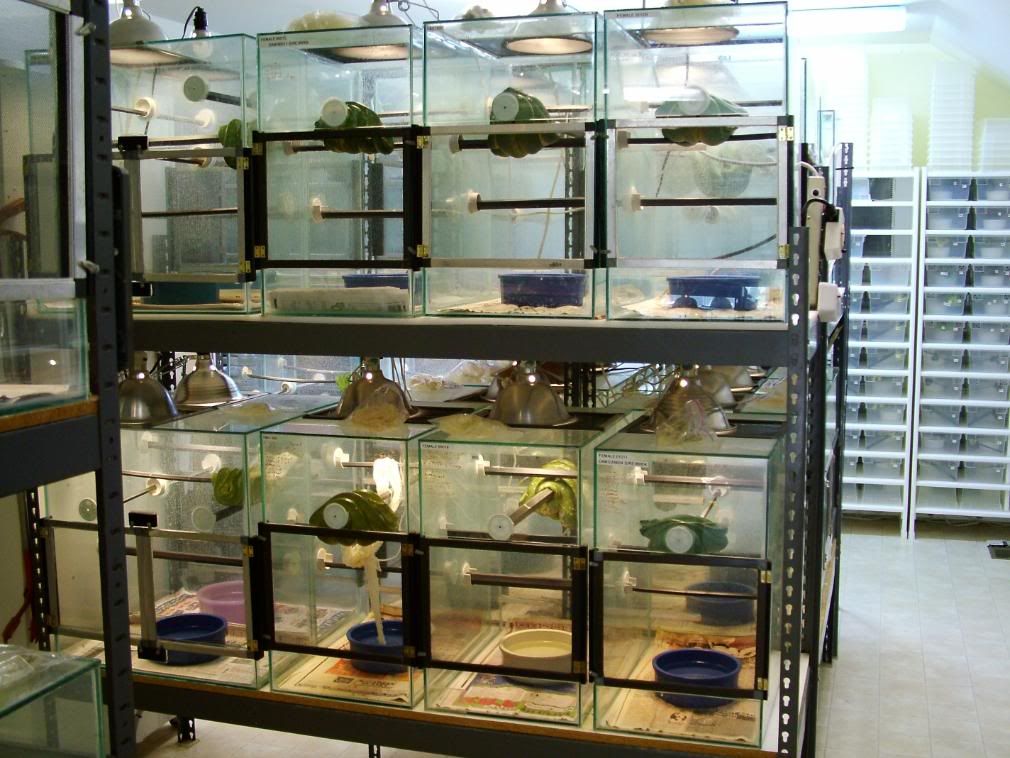
At some point a collection's size would dictate a financial advantage to heating a room vs. heating each enclosure.
Rico,
This is probably going to not be viewed by most people, but the size of a collection would have to be remarkably small in order to justify heating the room vs. heating an enclosure.
Let's say if you did not have HVAC for your snake room and had to use 60 watt bulbs instead of 40 watt bulbs. Your amperage draw per light bulb would then be 0.5 amps (amps = watts divided by voltage).
I have a 17' x 9' snake room in the back of my garage in Rapid City, South Dakota. Yes, it gets cold here. I have 1500 watts of electric heat running on 220 voltage, meaning my rooms only requires 6.8 amps of power when it's running.
So, 6.8 divided by 0.5 = 13.6
In other words, once I go over 13 cages it's cheaper for me to heat the room than to heat the cages. Actually, the number is probably quite a bit lower. More on that later.
Now, I am running my heaters on 220 volts which helps. If I used 110 volt space heaters (which I have) then the number of cages would double to 27. Again, that number is probably high.
But even that is misleading because neither the space heaters nor the radiant electric heaters have to run all the time. On the coldest days when I'm in and out of the snake room all day the heaters still cycle on and off. And keep in mind my snake room opens to my garage which is quite cold so I'm letting all that heat out. Even then the heaters still cycle on and off.
Point is that even with 110 volt space heaters one probably would need a very small collection to justify room heat over cage heat. My room is 17 x 9 and in a very cold garage and I probably see cost savings at about ten cages.
In the typical house in the typical small room the numbers are probably even lower.
BTW, if you're scratching your head trying to figure out who the heck I am, I'm the Chris Harper who is friends with Tom Weaver (Denver Zoo) Bill Hughes and Terry Phillip.
-----
Currently keeping a small collection of various Gonyosoma. Both G. janseni and G. oxycephala.