Reptile & Amphibian Forums

Welcome to kingsnake.com's message board system. Here you may share and discuss information with others about your favorite reptile and amphibian related topics such as care and feeding, caging requirements, permits and licenses, and more. Launched in 1997, the kingsnake.com message board system is one of the oldest and largest systems on the internet.

Click here to visit Classifieds
Click for 65% off Shipping with Reptiles 2 You

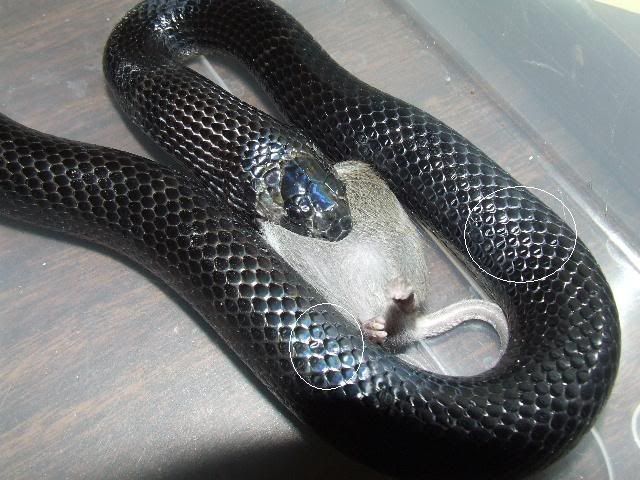
Pics of scale issues of black milk

classdwhite Feb 25, 2008 10:27 PM

So this is what i was talking about. circled are some off the "indented" scales, they go the whole way down the side of the snake and just up to the top scales at the top. what would cause this and what can i do to fix it? as i said before shes kept at low to mid 70s w/ a uth set to 81 ish, 55-60% humidity, and a large water bowl she can fit in with ever freshly changed water. so what should i do? And the pics make her scale issues look better than they really are, so sad it really takes away from her beauty....


-----
* 1.1 Black Milksnakes
* 1.1 Eastern Kingsnakes
* 0.1 Jungle Carpet Python
* 1.0 Ball Python
... and sadly had to get rid of all my boas

Replies (19)

DMong Feb 25, 2008 11:22 PM

Well, in my opinion, the conditions of husbandry seem pretty good, and a 55-60% humidity doesn't sound bad either. Many snakes actually have a tendency to do this to some degree, it's just that black colored snakes with big scales seem to accentuate the dimples much more than a snake that has a lot of pattern and color to it. Indigos are pretty notorious for this as well. The color black just seems to display imperfections WAY more than other colors, just as a shiny black car will show every single flaw in the body work.

This is probably something that cannot be helped, but you could raise the humidity even higher by covering a larger portion of the enclosure, and adding some moist spagnum moss inside an open plastic box put inside the cage as well to see if this just MIGHT help some.

best regards, ~Doug
-----
"Better to be silent and thought a fool, than to open mouth and remove any doubt!"

rg Feb 26, 2008 08:03 AM

I had this same thing occur with my Cal. Kings years ago when I fed them as much as they could eat...which was a TON by the way!

Over feeding may not be the case here...but I would suspect that the snake is growing extremely fast due to you feeding it a bit too often and/or pray size that is a bit too big...the scales are stretched out just a bit, which causes the scales to dent in.

I don't think it is a problem...but how often and how much do you feed the snake?

-Rusty

Patton Feb 26, 2008 10:12 AM

I think there is something your missing here. In the wild a snake may use basking sites as high as 100 degrees to digest their food and speed up their metabalism. The scale indention is because the snake is becoming "fat" because of the heat gradient that you are forceing upon it. At 81 degrees your Milk doesn't have the temps. it needs to properly metabalise it's food and therefore is displaying the artificialy indused symptoms of obesity. A perfect thermal gradient of 50's to high 90's is pretty impractical to reproduce in captivity, but a more realistic gradient of mid 70's to 90 is not. If you do try this, you'll notice a very big increase in growth and activity by your Milk Snake. Another good tip is to throw away those stick on thermometers and get an infra-red thermometer. Pro-Exotics has them for pretty reasonable prices now. They will make a huge difference in your husbandry skills. Good luck!
-Phil
-----
Work is the curse
of the drinking class!

jawn Feb 26, 2008 03:17 PM

for gaigea ...

I just got back from the western mountains in Panama .. hunting for gaigea but with no luck. I was shocked at how cool it was and the locals say that this is one of the warmest times of year.

I get the impression that it is "fall" there right now and that their summer was just a little warmer with more rain then I got when I was there. The crops lined up with that theory and also the local description of the weather was that. They don't go by our typical 4 seasons anywhere in Panama.

I was using a temp gun reading the forrest floor, grass in the sun and pavement in the sun and shade. I wish I documented this better but here are some rough temperatures ...

Daytime forrest floor and bush 55-60
Nightime forrest floor and bush 50-55
Sunny vegetation (moist) - 55-65

Daytime highs were aproximately 70 (in town) and I think the highest reading I took on any vegetation was something like 62 even in full sun.

Now I was a little out of the habitat venturing into dense forrest but basically I think temperatures of 80 degrees at this altitude are unheard of. I could be wrong. One other thing to keep in mind is that they don't really get dry heat in this climate either .. its always moist, damp and cool if not soaking wet and cold. Even in the sun the natural ground doesn't often warm up or dry out.

I don't even think I took blacktop readings much higher than 80 in the sun. I will have to check my photos. In good sun at lower elevations the pavement was easily 130 or higher ...

I think room temperatures of a northern climate would be perfect for this snake if not too warm in the summer (50-60 in winter and 65-75 in summer?) .. the main thing to keep in mind I think is that they have a great metabolism and don't burn many calories at this temperature so they probably don't need to eat much - especially when its a rodent diet.
-----
Jon Wedow
Sharp Dressed Snakes


zach_whitman Feb 26, 2008 04:58 PM

First of all I know that on a sunny day even at only 50-60 ambient temps, dark rocks (and black snakes) in the sun are much hotter than 80 degrees. I live in the rockies so I am taking into account altitude, the sun is stronger the higher you go. IE ambient temps drop because the air holds less heat but radient heat increases because the light is stronger.

Obviously you are right in some ways. Many people breed gigae with no heat whatsoever. And the snakes wouldn't be black if it wasn't pretty cool where they are from - obviously since you were just there and described the conditions. Thanks for that info by the way.

But where what happens in the wild an what happens in captivity breaks down is in two places. First the amount and type of food, and second the type of heat. A black snake in the sun will warm up to much higher than ambient temps, but in a cage he cant do that. he needs the physical temp.

Also if you are feeding huge amounts (and I don't know of any gigae that will refuse a meal) but not providing warm enough temps, they get fat. Hence the problems with so many fat gigae in captivity. If you keep them cool then you have to feed less. And if you want fast growth you can't just feed them 10 mice a week without providing the temps to metabolize it.

CFLowers Feb 27, 2008 01:23 AM

What about snakes with the scales spaced apart like when it get stretched from the food in the belly... but all over the entire snake what causes that?

antr1 Feb 27, 2008 07:55 AM

typically that is caused by obesity, but can also occur when a female is gravid, or ovulating (if she is already on the heavy side)
-----
"The band is just fantastic, that is really what I think. Oh by the way, which ones pink?"

jawn Feb 27, 2008 09:28 AM

Thinking back, my readings were at the upper limit of the elevation range and we didn't really get full sun for long on the days that I was measuring. Basking temps could very well rise high but not for long I would imagine. Maybe on a good day.

I think my readings were accurate but they were a generally taken in overcast which seems common for the area.

Interesting climate data for Boquete, Panama:
http://www.boqueteweather.com/climate/data_2007.htm

My readings were a few hundred metres above this elevation.
-----
Jon Wedow
Sharp Dressed Snakes

westernNC Feb 26, 2008 05:51 PM

I keep andesiana and gaigeae at room temps between 65 and 75 with a heat source that will take temps around 90. They never sit on the hot side. In fact, I have seen the andesiana curled up in their water bowl when I cut the A/C off to the room last summer and temps got above 80.

Thanks,
Michael

classdwhite Feb 26, 2008 10:29 AM

what you guys have said so far makes sense. i just upped the temps on the thermostat so lets see what happens. and to how much i feed her, maybe between 6 months and a year i did feed her a LlTTLE heavy but much, but now, at around 14 months shes about 39" like 350 grams and i feed her 1 rat pup a week.

To the poster that said this happened to his cali kings, was this permanent to your snakes? like if you slowed down the feedings did your snakes "grow back into their scales" i guess you could say?

Thanks for the help everyone!
-----
* 1.1 Black Milksnakes
* 1.1 Eastern Kingsnakes
* 0.1 Jungle Carpet Python
* 1.0 Ball Python
... and sadly had to get rid of all my boas

zach_whitman Feb 26, 2008 04:59 PM

just make sure that as you turn up the heat you also increase ventilation or decrease the room temps so that you still get a cooler side.

Patton Feb 26, 2008 07:46 PM

I don't think that you have to worry about it being permanent.
Although it can be very tough to get a snake to lose weight safely. I think the key is to jump start their metabolism. I would give them the option of a little warmer temps. and feed smaller prey more often. This will usually help speed up the snakes metabolism, and over time your snake will outgrow the obesity. I think a lot of people misread my post. The key is to give the snake the choice. Granted a Black Milk may only use 85 substrate temps for 5 minutes in one season, but that 5 minutes of elevated temps. my save it's life, or prevent future health problems. I have seen California Mountain Kings basking on rocks, with a recent meal in them, when the ambient air temp. was in the low 50's, but their body temp was 80 degrees. This type of environment would be very tough to replicate in captivity. To touch on the point that Michael brought up about his Black Milk using it's water bowl when temps are raised. There is a lot more going on there than what we perceive. Snakes, being ectotherms, are not susceptible to hypothermia like a "warm" blooded human would be. Temperatures in the air, and even in the substrate, will change a lot quicker than the temp. of water. Since snakes do not perspire they do not necessarily cool off as we would, just by taking a dip in water. Now if the water is cooler than the surrounding area, then yes they will. On the other side I have found a lot of my collection will spend a lot of time in their water bowl during hibernation, and using a laser thermometer I've discovered that the water bowl was as much as 5 degrees higher than the ambient air temp. So what my snakes were doing was in effect "basking" in their water bowl. Yet at 55 degrees a human would be risking hypothermia. Another thing is that they just might be trying to re-hydrate. I think that giving your snake as many options as possible, within reason, will benefit you and the snake. The strict caresheet rules do not always apply. Good luck.
-Phil
-----
Work is the curse
of the drinking class!

zach_whitman Feb 26, 2008 09:12 PM

I don't know about the water bowl stuff. Water pulls heat from the body faster than air. You would be cold in a 65 degree swimming pool but not a 65 degree room.

A snakes body temp is always slightly above the ambient temp. They may be ectotherms but they still have a metabolism and their bodily functions do create some heat. So being in water will cool them better than air of the same temp.

Last summer I lived in an attic apartment and had real problems keeping the place cool enough on really hot days. I would come home and find everyone in the waterbowls. The bowls were small though (baby snakes) so I know that they are the same temp as everything else.

The soaking while hibernating thing is really interesting. None of my snakes have ever done that. Did they do it when it got too cold? Also, I thought that infrared guns can't measure water temps acurately...could be wrong about that.

Patton Feb 26, 2008 11:03 PM

A 65 degree snake would stay 65 in 65 degree water or 65 degree air, or a 55 degree snake would warm up in 65 degree water. Lets say it's a nice cloudless day and the ambient air temp. is 68 and a snake basking on a rock could easily bring it's body temp up to the high 70's or even 80's. Where this snake lives there is a pond that has standing water that is averaging about 62 degrees. Within the next few days a storm rolls in and the air temps drop to a high of 50. Yet the temperature of the water will not drop as drastically, therefore becoming a resource for the snake to maintain a higher than ambient air body temp. I have seen snakes in the field in the water when the air temps. are both higher and lower. I think you are confusing a humans need to keep an internal body temp. of 98.6 with a snakes use of it's surroundings to reach an ideal body temp. If a snake has the ability to reach the body temps. that are necessary for it to digest food, it will take advantage of it, eat and use those resources. If the snakes body needs to obtain 62 degrees or better to maintain it's immune system, whether by basking or setting in a 62 degree body of water. If a relatively warmer body of water is available, it will use it, or vise versa if it needs to maintain a cooler temp.
-Phil
-----
Work is the curse
of the drinking class!

westernNC Feb 27, 2008 11:18 AM

np

zach_whitman Feb 27, 2008 06:59 PM

Except two things.

A water bowl is not a pond. Even though water changes temps slower than air, a small bowl in a cage will reach the air temperature in less than an hour (depending on the size of the bowl and how fast temps change)

The second thing is that snakes are always slightly above the temperature of their surroundings. Their cells and muscles and metabolic reactions that keep them alive do produce minimal amounts of heat. So if it is 70 degrees ambient temp the snakes core temp is probably more like 73 (for larger/thicker snakes this difference is even greater)

So what I was saying is that a 93 degree snake will cool off faster in 90 degree water than it would in 90 degree air.

westernNC Feb 28, 2008 08:40 AM

I also appreciate what you posted below about tips to keep humidity up in the cages. I noticed my female andean struggling with their last shed and plan to move to a bigger water dish and cover most of the lid in the cage. I was misting her every other day, but still felt like it was just evaporating with my central heat/air keeping the humidity so low in my house.

Any tips on what would cover the lid and still look attractive?

Thanks,
Michael

Patton Feb 28, 2008 10:21 AM

If you have access to plexi-glass, a cut to size piece should work just fine.
-Phil
-----
Work is the curse
of the drinking class!

justinian2120 Mar 01, 2008 09:33 PM

is my vote....plenty of great tips in the thread but i really liked how d.mong made the black car analogy....maybe it's no coincidence too that it's seen so often in drymarchon genus;eastern indigoes are known to dessicate very easily in captivity.i don't suspect the snake's overweight unless you're consistently seeing interstitial skin(which is not apparent but appears to be getting close to that point in your pic)....
-----
"with head raised regally,and gazing at me with lidless eyes,he seemed to question with flicks of his long forked tongue my right to trespass on his territory" Carl Kauffeld

Site Tools