My adult pair of Fox snakes came today from Exotic pets. They are beautiful and large. They allready ate 2 large mice. They are very active and seem to like climbing on the tree limbs I put in the enclosure. Doing business with Exotic Pets was also a pleasure. Cheers Greg.
Reptile & Amphibian Forums
Welcome to kingsnake.com's message board system. Here you may share and discuss information with others about your favorite reptile and amphibian related topics such as care and feeding, caging requirements, permits and licenses, and more. Launched in 1997, the kingsnake.com message board system is one of the oldest and largest systems on the internet.


Adult fox snakes came today
choppergreg74
Feb 26, 2008 05:24 PM
Replies (27)
DMong
Feb 26, 2008 05:37 PM
That's great Greg!,.....I look forward to any pics you post of them in the future!
~Doug
-----
"Better to be silent and thought a fool, than to open mouth and remove any doubt!"
BillMcgElaphe
Feb 26, 2008 06:21 PM
Congrats....
I'm sure you'll enjoy them.
They are more like keeping a snake between a Rat Snake and a Bull Snake.
Big ones are not picky; chicks, ducklings, quail eggs, mice, rats, moles, shrews, etc.
If you don't want them to rub their rostral shield raw, give the ample horizontal plane and deep aspen.
Keep us posted on your progress.
-----
Regards, Bill McGighan
choppergreg74
Feb 26, 2008 07:23 PM
I have them in a 28x24x24 vision. They are quite active. I may put them in a 36x24x21. My babies seem to like the climbing also.
wolfpackh
Feb 26, 2008 08:24 PM
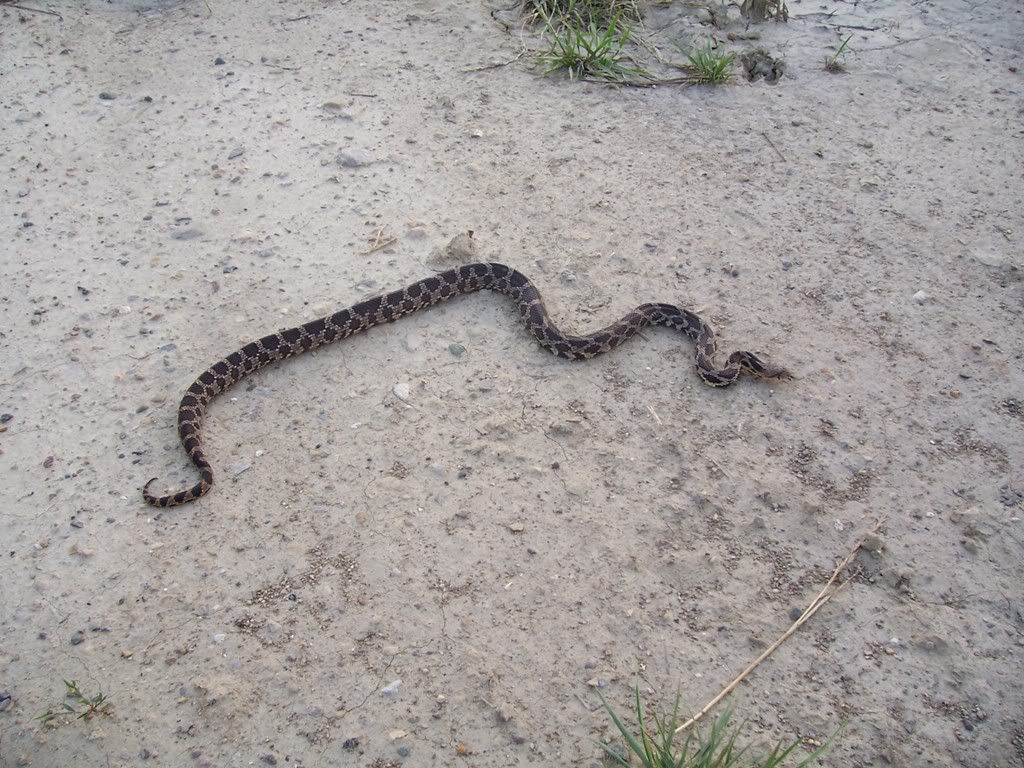
a highly underrated snake. i go the simple enclosure route: newspaper, hide, and dish. they tolerate cooler temps as well. mine prefer fat fuzzies and hoppers rather than adult mice and they rarely constrict preferring to press the prey against the bottom or sides of the cage. i suppose this behavior could be due to the fact that in the wild they encounter some prey in tunnels or whatnot. gravid female below: photographed and released.
DMong
Feb 26, 2008 09:34 PM
Very cool indeed!,......Did you place her on the ground for the pic, or was that pic taken just as she was while heading somewhere?
great animals!
~Doug
-----
"Better to be silent and thought a fool, than to open mouth and remove any doubt!"
choppergreg74
Feb 26, 2008 10:55 PM
I am glad these snakes are not that popular. That was a very cool pic indeed. They do remind me much of bullsnakes,ratsnake crosses. I do not know too much about taxonomy. But why are they grouped as Elephe or Pantherophis? They do not really have the same physical structure as many of our ratsnakes, or corn snakes. Even holding them they do not feel as powerful of a constrictor as most other ratsnakes. I wonder if someday they may be considered a monotypic secies? But like I said I know very little of taxonomy or what criteria go into grouping animals into species.
ratsnakehaven
Feb 27, 2008 09:31 AM
Taxonomists today use genetic information to help classify various reptiles, etc. They still use morphology and internal structures and other things from the past, however, because this is a field that is still evolving, to say the least. As methods get better and more refined the taxonomy gets better, more accurate, hopefully.
Fox snakes do seem like a cross bt. bullsnakes and common ratsnakes, because they basically lie bt. them ecologically and are adapted that way. They are grouped in the Elaphe or Pantherophis genus, because they are closely related to these ratsnakes. Pantherophis came about to help distinguish bt. Old World and New World ratsnakes, Utiger et al, 2002.
As far as not having the "same physical structure", I'm assuming you mean in the way they handle. They are a bit more heavy bodied and possibly move a little differently and may not constrict as much; but they are in every way a ratsnake, morphologically and genetically. ASAMOF, Pituophis is a ratsnake genus too, as they are closely related to Pantherophis, and are in the tribe, Coronellini (Utiger et al, 2005), which includes all North American ratsnakes: Pituophis, Pantherophis, Bogertophis, Lampropeltis, Arizona, Rhinocheilus, etc, and all the Old World, Elaphe (not including the new genera of ratsnakes from Utiger et al, 2002.) Sorry about the taxonomy discussion. Just mentioning this so you know where I'm coming from, and to help answer your questions.
Going back to the ecology of fox snakes just for a moment, Western fox snakes in particular, they spend a lot of time underground, in burrows, and they have some techniques for killing and eating their prey, much like bullsnakes, that has to do with being in confined spaces. They also take baby birds and eggs out of their nest which are mostly not constricted, imho. Just a matter of learned behaviors, but doesn't mean they couldn't constrict if they had a larger prey item, like a squirrel or rabbit or something like that.
Didn't mean to ramble, just interested, and trying to help.
Cheers...TC
>>I am glad these snakes are not that popular. That was a very cool pic indeed. They do remind me much of bullsnakes,ratsnake crosses. I do not know too much about taxonomy. But why are they grouped as Elephe or Pantherophis? They do not really have the same physical structure as many of our ratsnakes, or corn snakes. Even holding them they do not feel as powerful of a constrictor as most other ratsnakes. I wonder if someday they may be considered a monotypic secies? But like I said I know very little of taxonomy or what criteria go into grouping animals into species.
-----
Ratsnake Foundation
DMong
Feb 27, 2008 10:17 AM
n/p
-----
"Better to be silent and thought a fool, than to open mouth and remove any doubt!"
wolfpackh
Feb 26, 2008 11:53 PM
found her under a piece of tin, posed her for a pic and put her back. summer 2006, old pic. i dont see foxies becoming extremely popular, they never have been a big item. they're gorgeous snakes and rarely bite. no taxonomy guy here, i still refer to elaphe as elaphe, sick of the name changes. i just view em' as the books describe: swamp/prairie elaphe unique to the great lakes region.
ratsnakehaven
Feb 27, 2008 08:46 AM
If they are too active, maybe they should be cooled down a little. How warm are they?
Do you also have baby fox snakes?
Sorry about being so curious, but I have an interest in this species too. Thanks..
TC
>>I have them in a 28x24x24 vision. They are quite active. I may put them in a 36x24x21. My babies seem to like the climbing also.
-----
Ratsnake Foundation
ratsnakehaven
Feb 27, 2008 08:37 AM
There are two types of fox, Eastern and Western. Can you say which yours is? I tried to check Exotic Pets, but couldn't find a website.
Also interesting that they are adults. Do you know if they are captive bred or wild caught?
Anyway, congrats, and hope they do well for you. 
Terry
>>My adult pair of Fox snakes came today from Exotic pets. They are beautiful and large. They allready ate 2 large mice. They are very active and seem to like climbing on the tree limbs I put in the enclosure. Doing business with Exotic Pets was also a pleasure. Cheers Greg.
-----
Ratsnake Foundation
wolfpackh
Feb 27, 2008 10:29 AM
westerns make decent captives. i have never owned an eastern, but have heard they can be difficult.
ratsnakehaven
Feb 27, 2008 08:28 PM
>>westerns make decent captives. i have never owned an eastern, but have heard they can be difficult.
I don't think Easterns are difficult necessarily, but they are protected, which might make them difficult to get. They're listed in Michigan, where I live, and in Ontario. Also in Ohio, the only other State with Easterns, that I know of, there's some protection. I understand they can only be kept, if they are pit tagged, and maybe have to have a permit, or something along those lines. Anyway, Westerns seem to be the way to go for a lot of folks.
We have them in the Upper Peninsula of MI, but they look a little different from the one you showed. Is yours from the Chicago area? I do think Westerns are underrated and would probably do pretty well in captivity, if they can be acclimated. What I like to do is start with juveniles, whenever I try a project with a w/c snake. I think cb are fairly well available, however, so one wouldn't have to find their own, if they could find a breeder.
Anyway, I just like studying them in the wild. Good luck...
Cheers...TC
-----
Ratsnake Foundation
wolfpackh
Feb 28, 2008 08:16 AM
northwestern Ind. locale. The two foxies i do have are WC juveniles and they are doing great. And after praising the western, I admit WC adults often refuse to eat.
ratsnakehaven
Feb 28, 2008 09:57 AM
>>northwestern Ind. locale. The two foxies i do have are WC juveniles and they are doing great. And after praising the western, I admit WC adults often refuse to eat.
Yep. I got this one from the Wisconsin x MI borderlands in '06, caught in a drift fence. Kept it a couple days, then let it go. Wanted to keep it to study, but we were just short on room and time at the time.
Are your juvies from IN? That would be pretty interesting since they are quite rare in IN, to my knowledge. I went there last summer and saw my first live bullsnake ever. I'll probably go back this spring to do a little field work.
Hope the juves continue to do well. I may have to try them again someday.. Any pics?
TC

-----
Ratsnake Foundation
wolfpackh
Feb 28, 2008 12:42 PM
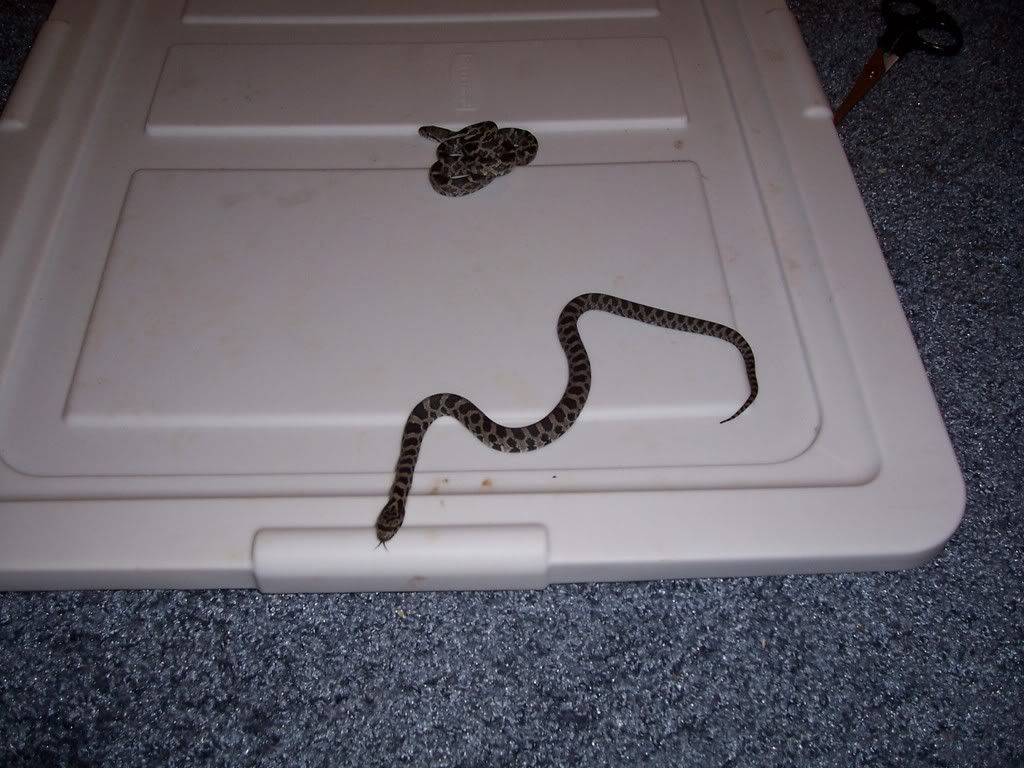
that's textbook vulpina. here's a juvie fox w/ a juvie obsoleta in the background.
wolfpackh
Feb 28, 2008 12:47 PM
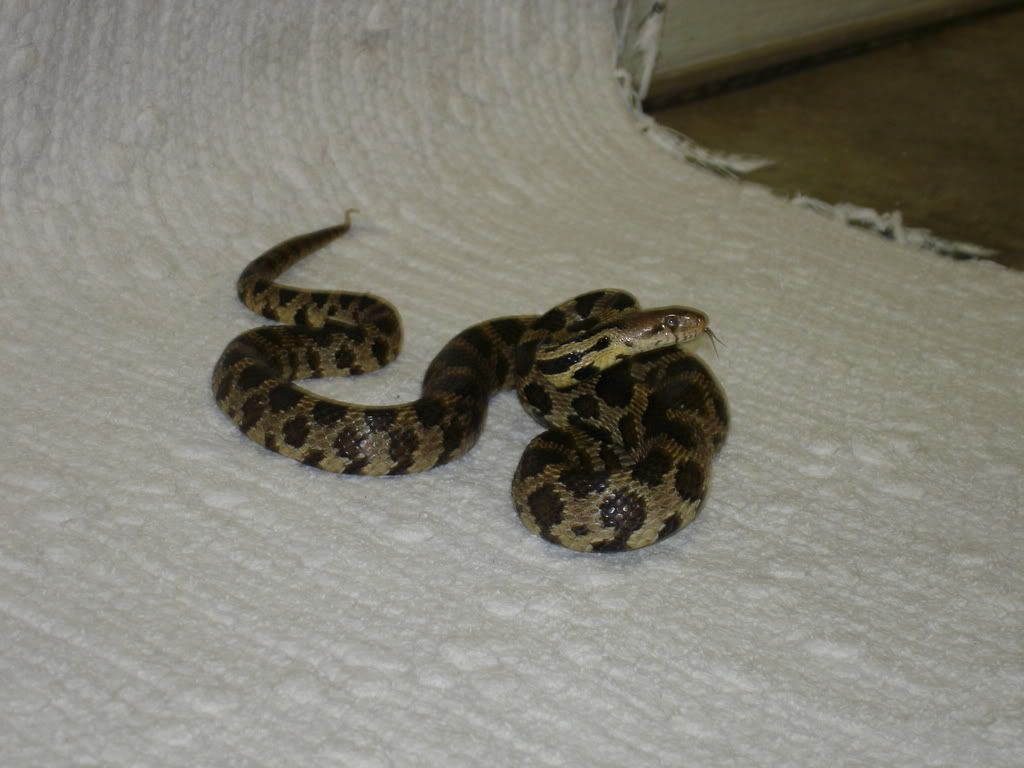
another Indy specimen, so no they are not uncommon. I know areas where bullsnakes are. I have never found a fox snake where the bullsnakes occur.
wolfpackh
Feb 28, 2008 12:48 PM
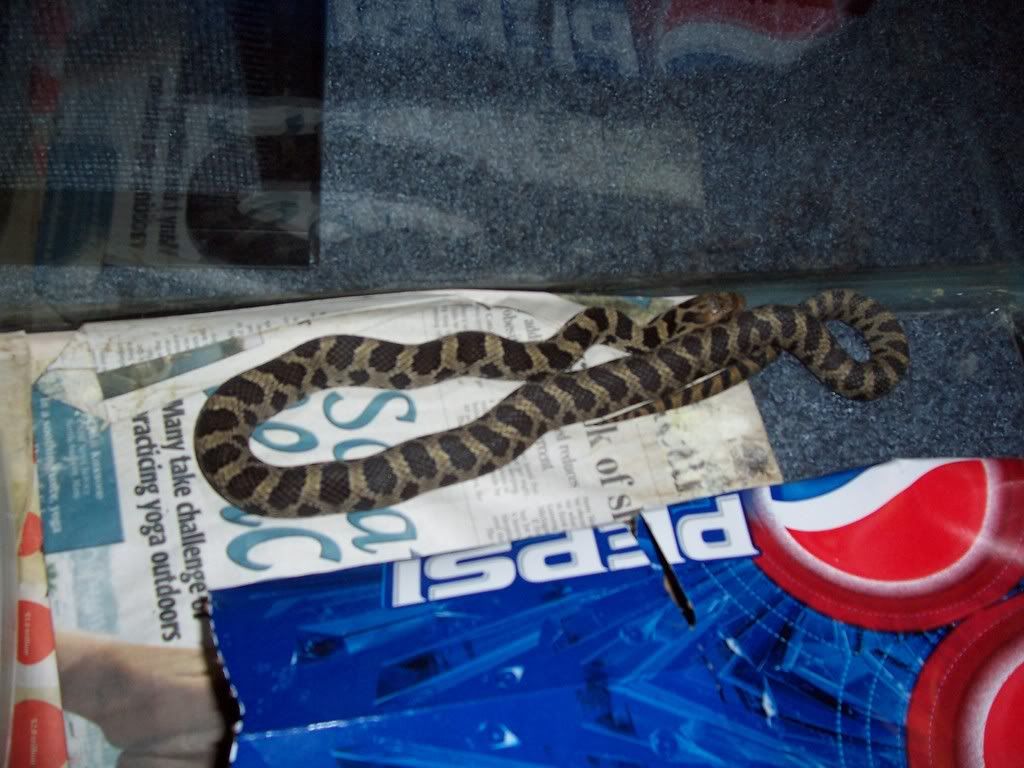
here's the juvie from 2006 today. Folks, thats all I got. Enjoy
ratsnakehaven
Feb 29, 2008 07:39 AM
>>another Indy specimen, so no they are not uncommon. I know areas where bullsnakes are. I have never found a fox snake where the bullsnakes occur.
>>
Ok, I can be a little "slow" sometimes. I've always thought the fox snakes and bullsnakes occupied the same habitat in n.w. IN, but I got a field guide out today and took a close look. Lo, and behold, they have a much wider range than I thought.
I guess it makes sense that bullsnakes wouldn't occupy the same habitat, because they have different adaptations, with bulls being adapted to more of a semi-arid habitat, but I'd always heard they were found in pretty close proximity, maybe where two different habitats meet each other. Oh well, maybe I'll learn more this spring when I head down that way. Maybe we could even meet up somewhere.
I really liked your photos, especially the last one of the '06 juve. The one I posted yesterday doesn't have too much contrast, but the ones from the north shore of Lake Michigan have more of that. Here's a pic I took in the summer of 2006 of a couple DOR's I found while cruising through one morning...

-----
Ratsnake Foundation
wolfpackh
Feb 29, 2008 08:27 AM
the fox snakes flourish in the black muck soil habitat while the bulls stick to the sand prairie. Unfortunately, bull snakes are a hot item to collectors. The morons collect every bullsnake they come across leaving only blue racers and I am sure if they come across vulpina they get bagged too. Those roadkill look fresh, I'd voucher those.
ratsnakehaven
Feb 29, 2008 03:23 PM
Yep, there are plenty of fox snakes vouchered in MI..
I'm going to have to look over the regs for Indiana. I'm not sure which species are listed by the DNR? I would think bullsnakes would be, since their habitat is critical and they are fairly scarce. I know they're protected on the reserve where I found this gravid female crossing the road...

I had a fun photo session with this girl and then turned her loose off the road, btw. Some very restricted habitats and preserves should be protected from collection. The snakes need a place they can live in peace and not be threatened with extirpation. But it's really all in the habitat, imho. If the habitat can be protected, the snakes should be able to survive.
I don't think it's a big deal if a hobbyist collects one snake for his/herself, especially if it's in a large and productive habitat, but commercial collectors should not be allowed in these areas. I would think the State agencies involved would have some ways of catching them and an appropriate punishment.
Thanks for the info about the black muck soil. That makes sense..
PS: Have you ever seen collectors taking multiple bullsnakes?
Cheers...TC
-----
Ratsnake Foundation
DMong
Feb 29, 2008 12:47 PM
That's too bad they are dead, those look like some sweet examples. I'm glad you at least were able to get some good shots of them, as their photos do contribute to the herp community.
~Doug
-----
"Better to be silent and thought a fool, than to open mouth and remove any doubt!"
ratsnakehaven
Feb 29, 2008 04:11 PM
Thanks, Doug.
One was a cute little yearling...

I was sure wishing I had found that one alive. I do collect a lot of photos and usually the DOR's too. What's really hard to get on these guys is information about their habits, life history notes, etc.
PS: I agree this type of info is important to the herp community and one reason I joined the RF..
Later...TC
-----
Ratsnake Foundation
TJ.
Mar 02, 2008 05:55 PM
Hey TC...Do you have any pics of Fox Snakes from the U.P.? We cruised thru there a few years ago (first time ever...nice place!) and were hoping to see some but didn't find any. One state park we camped at said they had them there, but were not a very common sight at all. Would love to see some pics... especially if they look different than ones from the lower states. Thanks. TJ from Southern Minnesota.
ratsnakehaven
Mar 02, 2008 08:46 PM
TJ, look through my posts on this strand, especially the ones that say (pic) in the subject line. I think I posted at least three.
Cheers...Terry
-----
Ratsnake Foundation
choppergreg74
Feb 27, 2008 08:54 PM
Hi guys/gals Thanks for the great taxonomy info. I realy need to learn more in this area. Today the fox snakes really calmed down. One was coiled up outside the hide, while the other was perched on a tree limb all day hanging out. I counted close about 40 blotches going down the back of one. The same applied for the other; however this one has a zig zag where all the blotches on the last quater of the snake connect. Kind of like a partial Zig Zag corn. The babies are really cool. They to have about 40 blotches from neck and cloaca. The babies were a freak find at Hamburg. Someone had some babies 2 or 3 years back. I always wanted a pair but never saw them again. Then on Sat. one guy had a real skinny pair there. He told me he had bought a bunch of easterns and these were the only two he held back for himself but decided to sell them. For $25 each how could you loose. When I did not spend any more at the show I came home and ordered the two adults on line. They were expensive $200 plus shipping but well worth it to me. They are well over 3 feet. Cheers
ratsnakehaven
Feb 28, 2008 08:00 AM
Hi, Greg.
You're welcome on the taxonomy stuff, one of my interests.
Sounds like you have some nice little Easterns. Hope they do well for you and you can get them fattened up. Maybe the adults are Easterns too. Didn't Exotic's ad tell you which? Some folks consider Easterns and Westerns as two different species. Some still call them subspecies of "vulpina." At any rate, they undoubtedly can be crossbred. I wonder if there are any hybrids out there already? Look forward to photos...
Hopefully, the adults will acclimate well. Sounds like they are getting used to their new surroundings. I think security is a main issue in calming them down, so good hiding places, etc. Best of luck with them and let us know how they are doing...
PS: I wrote an article on Westerns in Feb. and on Easterns for March (in our newletter), in case you were interested.
Regards...TC
-----
Ratsnake Foundation
