Reptile & Amphibian Forums

Welcome to kingsnake.com's message board system. Here you may share and discuss information with others about your favorite reptile and amphibian related topics such as care and feeding, caging requirements, permits and licenses, and more. Launched in 1997, the kingsnake.com message board system is one of the oldest and largest systems on the internet.

Click for 65% off Shipping with Reptiles 2 You
https://www.crepnw.com/
Click for 65% off Shipping with Reptiles 2 You

Chaco help

sned25271 Feb 29, 2008 07:14 PM

I have 7+ years of experience with sulcatas, redfoots, leopards, and the testudos. I work at a vet clinic and a client asked if I would give her chaco tortoise a home. Of course I said yes because you don't see chacos everyday. She found it in her neighborhood in 1983 and it was already full grown. She hibernated him every year like a desert tortoise. She knew chacos were non-hibernators, but he would hibernate in a box in her closet every year.

So, I have been looking for info on these guys, but there is very little. I know they can be fragile, but this guy lived with CA desert tortoises. So, I am looking for humidity and temp requirements mainly, but any other tips would be greatly appreciated. Thanks!!

Replies (12)

davidfabius Feb 29, 2008 09:22 PM

I have 7 years of experience with sulcatas, redfoots, leopards, and the testudos. I work at a vet clinic and a client asked if I would give her chaco tortoise a home. Of course I said yes because you don't see chacos everyday. She found it in her neighborhood in 1983 and it was already full grown. She hibernated him every year like a desert tortoise. She knew chacos were non-hibernators, but he would hibernate in a box in her closet every year.

So, I have been looking for info on these guys, but there is very little. I know they can be fragile, but this guy lived with CA desert tortoises. So, I am looking for humidity and temp requirements mainly, but any other tips would be greatly appreciated. Thanks!!

Hello, from my experience, you should begin by keeping it by itself.
Crowding them is a cause of immunity depression.
I have known chacos kept for years both in backyards in Montevideo, with lots of rain in winter, as well as inside heated apartments, and both have thrived.
Their range is wide, so actual habitat conditions are not uniform.
A summer temp of 85-90 by day (with cooler areas) and a winter temp of 50-65 will work well.
its important to avoid humidity in winter.

"Summer" should last no less than 6 months, actual hibernation not over 4 months.
babies can be kept heated year round, but MUST have available a wet area . Dehydration is the single biggest problem with baby chacos. Hope this helps,

David

VICtort Feb 29, 2008 11:29 PM

Wow, that is amazing, the hibernation idea. Of course, where that animal actually came from might be pretty temperate and way down South. You can't argue with success, so maybe retain some of what was done by the previous owner. Hopefully EJ will chime in here, I think he worked with Chacos in the past. Good luck, I hope you will post a photo sometime.

sned25271 Mar 01, 2008 01:02 AM

The previous owner lived just a couple miles from me. I am in southern california, btw.

platynota Mar 01, 2008 12:52 PM

hi there i've kept chacos for nearly 5 years. i'd be happy to help you out with any concerns you might have with yours. email: kepler_23@hotmail.com
as far as chaco hybernation is concerned, a friend in Argentina has said that he does semi-hybernate his chacos during the winter, but out of fear of keeping them at temperatures say between 40 and 60, i've never done it. it is completely unnecessary (at least so it seems now) because the chacos become very dormant during the late fall and winter months naturally, even with the daylight on in 70s temps. they'll eat very little during this time, but of course you should still offer a little food and make adjustments according to their needs and moods. for any other info, don't hesitate to write.

davidfabius Mar 01, 2008 09:24 PM

Actually, in Cordoba Province,winter temps may dip below the 30's, whereas in Santiago del Estero winter is milder.
Both provinces are part of the natural range.
The eggs will be laid in late summer and become dormant in winter, with a quick development in the next summer, when they actually hatch

egyptiandan Mar 02, 2008 06:26 PM

Hi,
I'm just wondering if it might be a Texas tortoise as it was found walking around in southern California. If you could post a picture that would help us figure out what you have.

Danny

sned25271 Mar 03, 2008 12:06 PM

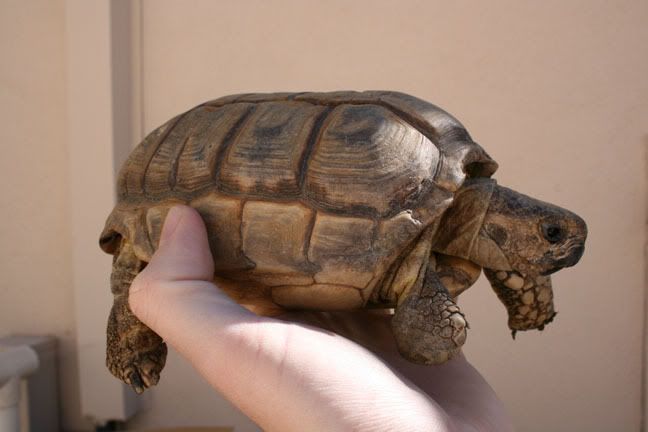
BTW, he has a club foot.

Image

sned25271 Mar 03, 2008 12:06 PM

.
Image

sned25271 Mar 03, 2008 12:07 PM

.
Image

egyptiandan Mar 05, 2008 03:04 PM

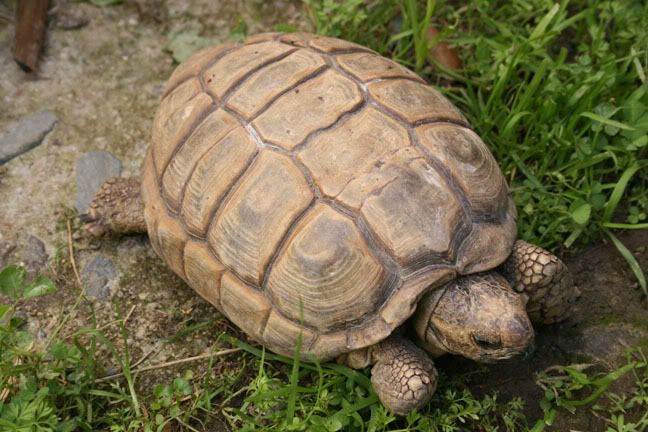
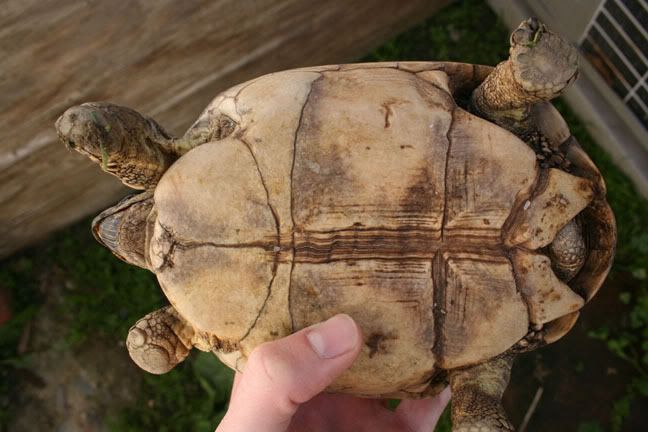
You do have a Chaco tortoise. He's had a rough life, but he looks good.

Danny

EJ Mar 02, 2008 07:27 PM

While it absolutely chokes me to say this... Dan has keyed onto an important point.

Did you know the Chaco was originally described as a Sulcata?

The chaco is very similar to the young Sulcata, Desert tortoise, Texas tortoise... I've seen many of these and sometimes I can't tell the difference.

The point is... do you know you have a Chaco? Don't get angry. they are very difficult to distinguish between the group.
-----
Ed @ Tortoise Keepers
Trying to keep the fun in Chelonian care

davidfabius Mar 03, 2008 06:55 PM

I agree with Ed, some "chilensis" look very much like sulcata.
Especially so the Patagonians, not the Chacos. The marginals over the neck tend to curl like in a sulcata.
Once I learn how to post photos, I will show you examples
The photos though, look like a regular Chaco, which has experienced a nice growth in the last years, so whatever way they kept it, it was right.

David

Site Tools