Reptile & Amphibian Forums

Welcome to kingsnake.com's message board system. Here you may share and discuss information with others about your favorite reptile and amphibian related topics such as care and feeding, caging requirements, permits and licenses, and more. Launched in 1997, the kingsnake.com message board system is one of the oldest and largest systems on the internet.

Click here to visit Classifieds
Click for ZooMed
Click for 65% off Shipping with Reptiles 2 You

ID this snake

Redmoon Mar 12, 2008 11:22 PM

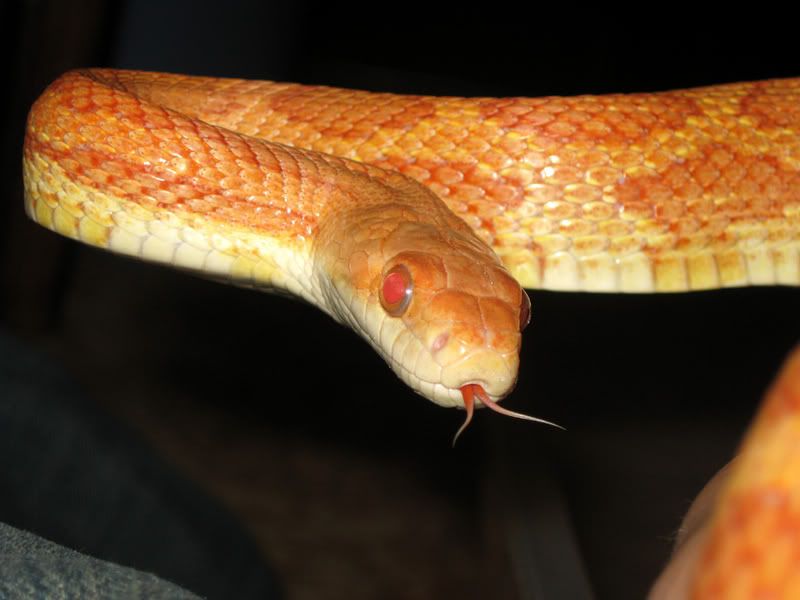
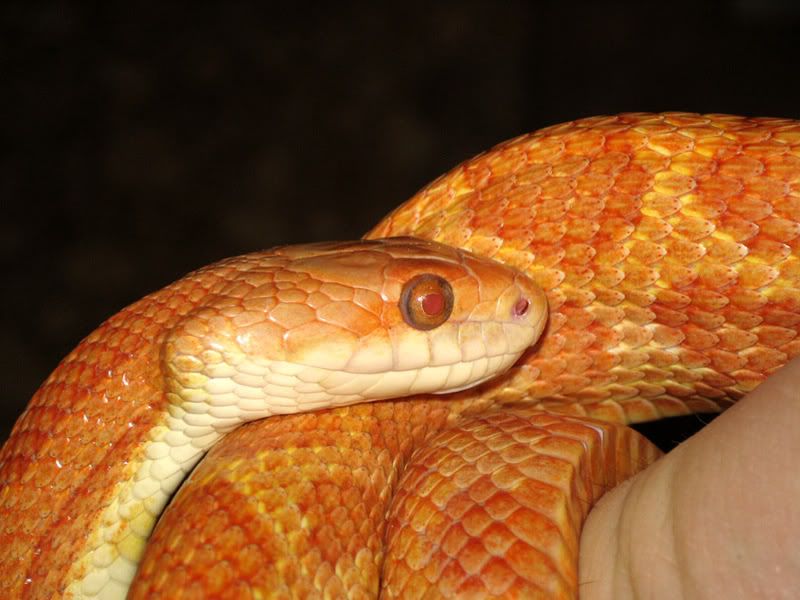
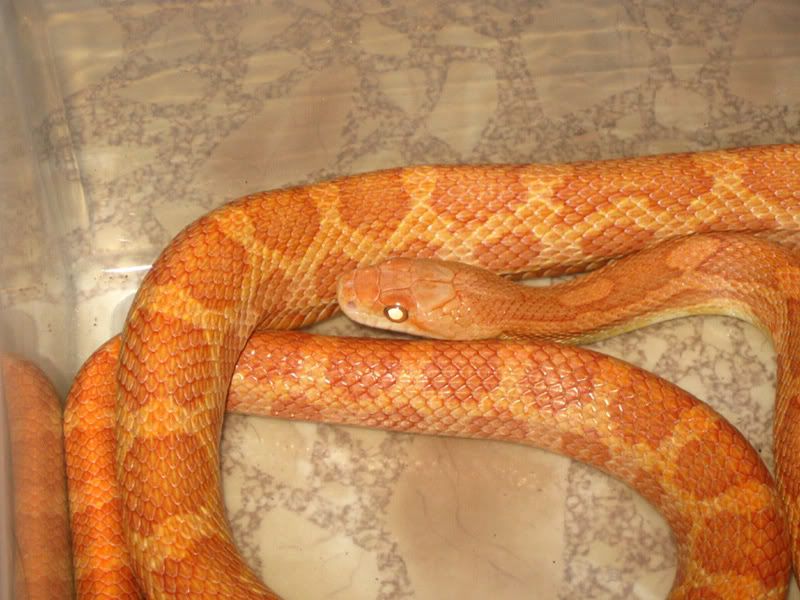
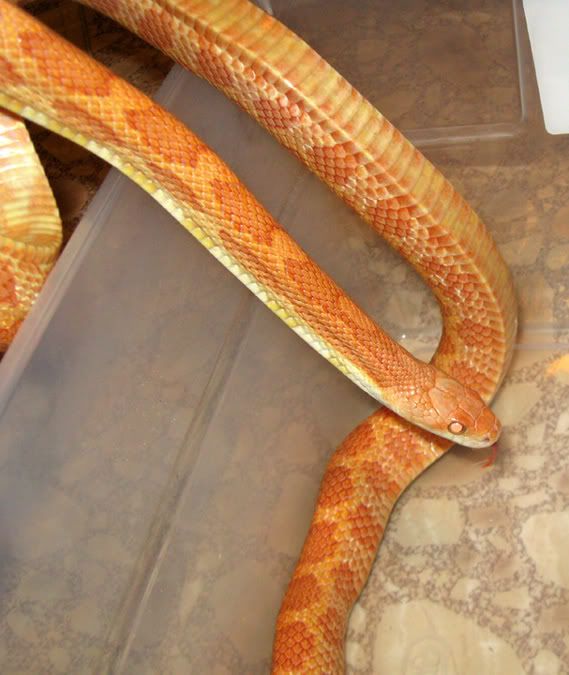
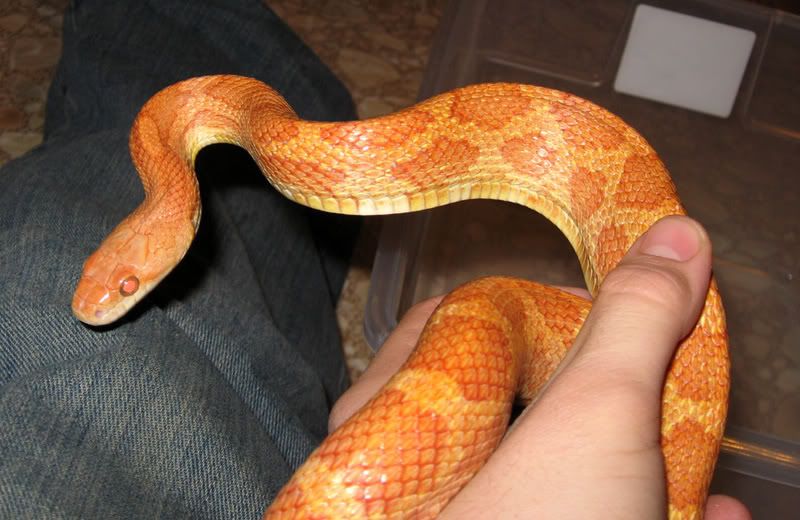
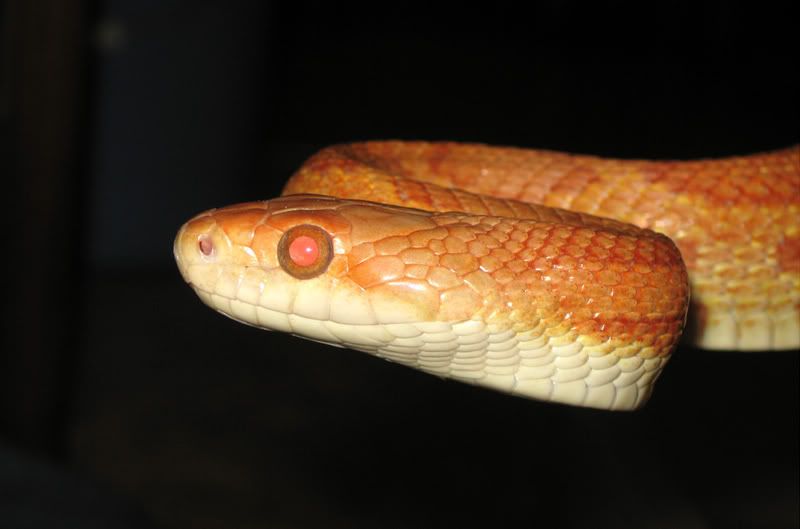
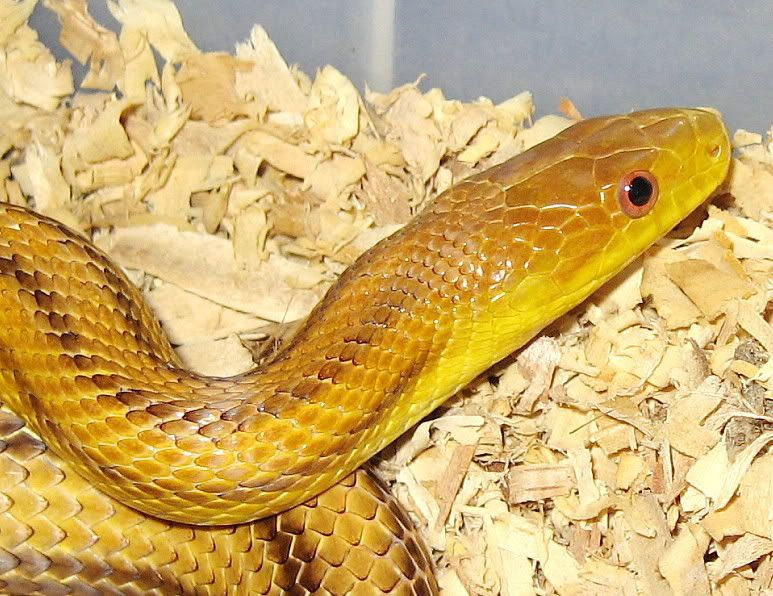
I've posted pics of this snake before, trying to get an ID, and here are some new pics. As he has aged, his colors have changed a lot, with a good bit of red coming through now, and I figure maybe there will be other perspectives this time around. Before I say anything else, based on appearance, what would you guys say he is?


Replies (18)

tspuckler Mar 13, 2008 07:10 AM

It's an amel black rat snake.
Third Eye
Third Eye

Redmoon Mar 13, 2008 12:06 PM

That's what he was sold to me as . . . I just question it because of the amount of orange he's got! It's actually gotten BRIGHTER as he's aged, rather than fading, as is standard. I still haven't seen any albinos with his colors. Babies, and yearlings, but by the time they're a few years old, they've all been darker. He's got to be close to 6 years old at this point, and his colors still seem brighter with every shed. His offspring aren't a very solid black, either.

And the attitude! He's got a VERY typical Texas rat attitude. About half the time, he'd rather bite me than anything else.

Anyone have any pics of albino Texas rats to compare him to?

thanks,
Ronnie Nocera

draybar Mar 13, 2008 03:36 PM

>>I've posted pics of this snake before, trying to get an ID, and here are some new pics. As he has aged, his colors have changed a lot, with a good bit of red coming through now, and I figure maybe there will be other perspectives this time around. Before I say anything else, based on appearance, what would you guys say he is?
>>
>>
>>
>>
>>
>>

I don't mean to be too mean but damn.....it's Still an albino black rat snake
-----
Corn snakes and rat snakes..No one can have just one.
"Resistance is futile"
Jimmy Johnson
(Draybar)
Draybars Snakes

_____

DMong Mar 13, 2008 04:43 PM

It sure does "look" like a brightly colored albino Black Rat to me too,......but as you very well know, today's stuff can have almost any type of lineage involved. I "think" I have seen other ones like it before, but I can't remember exactly where. Also, I certainly don't know the genetic background of the ones I saw either. Problem being, things can look much closer to what they are "supposed" to be with a little "back-breeding" for a greater percentage of the targeted species/ssp.,...know what I mean?

I'm not saying this is, or isn't the case here, I just don't know.....only the guy who bred it really knows with absolute certainty.

Great looking animal for sure!

~Doug
-----
"Better to be silent and thought a fool, than to open mouth and remove any doubt!"

Redmoon Mar 13, 2008 11:14 PM

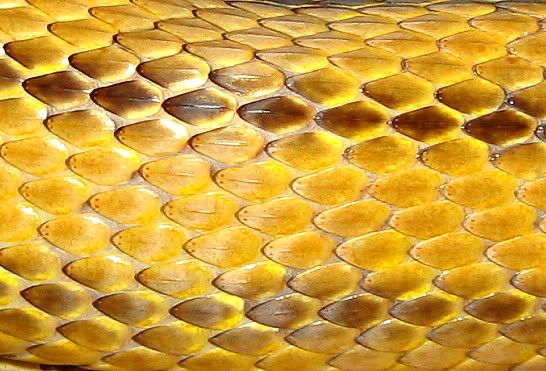
That's kind of how I feel, Doug. A lot of people say that it looks pure, but to me, there are a couple little things that just nag me, and say there's got to be something more to it. Several of my black rats have different head shapes, but his head is flatter than any of my others. Look at it again in the side picture. Also, he has keeled scaled starting about 2/3 of the way back. None of my black rats have keeled scales. Maybe this is just a locality thing, and he's genetically from a more southern locale of black rat, where they come with less black in them and more of other colors. As a baby, it did look 100% black rat. However, how many different strains of albino, lavender, hypo, etc. . . look the exact same as babies, and turn into completely different animals?

Draybar, this is more in reference to what you said-
I guess the biggest reason I bring this up every once in a while is this- I've still never seen a single snake that looked like him. In colors, the closest I've ever found was an albino emoryi rat snake, and a creamsicle corn. Maybe if I hadn't seen those, or if I saw a black rat that looked more like him, I wouldn't question it. Really, what I'm hoping for by posting some pictures every once in a while is someone to chime in and say, "OH! I have a black rat that looks EXACTLY like that. Here, compare!" Maybe someone who has that line Doug is thinking of will see this, and post something about it. There are a lot of people who check these boards now who didn't the last time I posted pics, and as I said, he's changed a bit. If you compare these pics to the last ones, he has a lot more red in him now than he did 2 years ago, and much bolder colors, compared to the soft tones he had when those last pics were taken.

As Toby said, attitude really isn't a giveaway. I have Everglades who have worse attitudes than any Texas rat I've ever seen, so I do know that. . . But at the same time, I've NEVER seen, or even heard of at CB black rat with an attitude similar to his. Wild caughts, I've seen with attitudes. But normally even long term captive wild caughts are pretty friendly, and half the time, they're friendly right off the bat.

While nothing individually really says he's not pure black rat, the fact that he has the attitude, doesn't look like any other I've seen, has keeled scales that none of my black rats do (but my Everglades do, and I'm not sure what other subspecies do), and has a flatter head shape, similar to other species (and subspecies) of rat snakes, compared to the sloping nose I'm used to in black rats.

Also- Blue, it's definitely not a T albino. This animal is definitely amelanistic, without any brown color. He's bright orange, with a bit of yellow & red thrown in. If you want, I could e-mail you some pictures, if you're curious to see what I'm talking about. Just send me a PM through here, and I'll send them to you. T albino normally have a brown, or "lavender" look to them. If I'm correct, T albino animals aren't actually amelanistic, they simply don't process the melanin correctly. It shows up, but in a different way than the "normal." Going by the standard term, "albino" means lacking pigment. Technically, ANY animal that lacks a certain pigment normally present in that animal is albino. Thus, leucistics are a type of albino, even though when we hear/say albino, we think amelanistic. Anyone care to correct me?

thanks for the responses, guys!
Ronnie Nocera

tbrock Mar 14, 2008 06:54 AM

Ronnie,

The last black rat I kept was cb from Columbus, MO locality parents. This snake was as mean as any Texas rat I've ever had. I did eventually get it tamed down enough to handle, but it would still usually nip me at least once for every handling session. You mentioned keeled scales, which this specimen also had - just as strongly as the average Texas rat. Being from MO, Burbrink would consider this snake to be obsoleta (Western rat snake - along with Texas rats), with two other 'species' of black/North American rat, allagheniensis (Eastern) and spiloides (midland). Maybe the western form of North American rat has keeled scales while the others don't? I have had other black rats that had smoother scales also. In other words, it seems possible that some wild populations of black rat might be more closely related to Texas rats than to black rats from other areas/regions.

-Toby Brock
-----
Southwestern Center for Herpetological Research

DMong Mar 14, 2008 08:33 AM

Toby, I was also going to respond with a very similar post, but since you already did, there's not much of a need....LOL!

best regards, ~Doug
-----
"Better to be silent and thought a fool, than to open mouth and remove any doubt!"

Redmoon Mar 14, 2008 09:23 AM

It's extremely difficult to tell with so many North American rats. Whether you subscribe to the whole three species thing or not, there is a ton of overlap between the species, localities, subspecies, whatever you want to call them. They did all evolve from the same species anyway, and there is no real geographic barrier between them, since they both climb and swim, and aren't separated by huge areas.
I was unaware that Texas rats are keeled, as I don't have any Texas rats. I know my Everglades are lightly keeled, so, maybe it's a southern thing, too, and not just a Western thing?

I was just randomly looking through pictures last night, and I did find a snake that looks quite a bit like him. Not sure if these will work, so I'll post the link to the pic, too- .
http://www.rci-enr.net/neo-slither/pictures/YA/4874.jpg
I did a bit of sleuth work, and found that it's a black x Everglades cross.
Maybe this is some of the background, with some of that back-breeding going on. I could very easily believe someone bred one of these with an albino black rat, and then offspring were bred with black rats. Even one generation of the Everglades in there, 5 or 6 generations back would give that orange to him, and would explain the keeled scales.

thanks,
Ronnie Nocera

DMong Mar 14, 2008 09:37 AM

That is truly a strong possibility, and it looks VERY similar!

I can easily see that happening too. I was going to mention the possibility of Everglades in my other post, but I thought the blotching would be more subdued, so I didn't bother. But now that I really think about it, as mentioned before, a successive generation or two of "back-breeding" would help re-define the blotching once again. After all, amelanism just voids the longitudinal striping in them, and leaves the other underlying pattern pigment to be displayed, i.e., blotches.......as in pretty much like yours possibly?

~Doug
-----
"Better to be silent and thought a fool, than to open mouth and remove any doubt!"

DMong Mar 14, 2008 09:20 AM

Yeah, I definitely see the issue here, and that was a well thought out, and worded post you made too.

This is one of those things that's just hard to "nail down" for absolutely certain. For all practical purposes, a Black Rat is what I see, and probably like you also,....I'm a stickler for EXACTNESS when it comes to genetic lineage in my collection of animals. But as Toby also mentioned, many Black Rats often tend to have some degree of keeling in the scales, ranging from totally smooth, partial keeling, semi keeled, moderately keeled, and even fairly heavy keeling. This actually leads me to believe it might pure, or at least purer than I first suspected.

It's a safe assumption that it has NO guttata influence at all, that I can see, due to the total lack of any "chevroning" of the head, ventral checkering, etc...in addition to the moderate keeling, ....cornsnake influence would have smoothed out the scales even more, and left telltale "marker" evidence of the other traits too.

Some things just remain sort of puzzling..LOL!

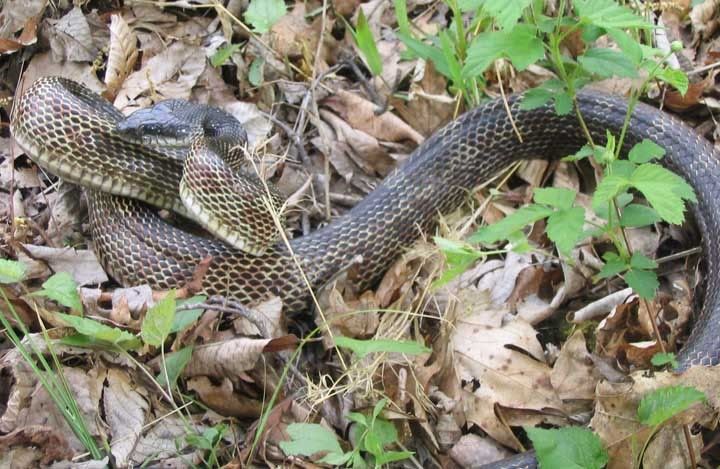
In any case, yes, the obsoleta complex often can have keeled scales to some degree, as this pic of my central Florida Yellow Rat also displays.

Cornsnakes can even sometimes display a very slight "semi-keeling" to their scales, but I'm sure this doesn't pertain to your situation with this particular animal, so I wouldn't be too alarmed..LOL!

It seems to me if it had any other influence to make the strong orange coloration(unless VERY distant) it would express more trait "markers" in the way of subdued, or random blotching(Bubblegum Rat), or at least faint head "chevron", ventral checkering, smoother scales, as in(cornsnake), or even "Creamsicle" influence.......does this seem to make sense to you as well?

best regards, ~Doug
Image
-----
"Better to be silent and thought a fool, than to open mouth and remove any doubt!"

Redmoon Mar 14, 2008 10:17 AM

>>I'm a stickler for EXACTNESS when it comes to genetic lineage in my collection of animals.

That's the biggest thing here. I love locality animals, and know EXACTLY what they are. I keep pure Sears bloodline Hog Island boas, and I love the fact that I know exactly what's in them, even though some crosses are "prettier". I don't mind a mixed animal- as long as it's labeled as such.

I agree that it looks MOSTLY pure black rat. I don't see any guttata, or anything like that- the only influences I see would come from other obsoletas (if you're still subscribing to them all being subspecies of E. obsoleta). Everything you said definitely makes sense.
As we both said in the other reply- maybe it's got a hint of influence from an Everglades, like that "bubblegum" posted over there. I guess I'll have to be content with labeling him "possibly integrade" for now.

thanks again!
Ronnie Nocera

DMong Mar 14, 2008 12:53 PM

Yes, I think we're both on the "same page" here. Just enjoy it, and keep your eyes open for any sign of animals around that look just like it, and I will do the same. Of course, some slight variation is to be expected.

I guess that's what makes it so darn hard to nail down in the first place!..LOL!!

take care, ~Doug
-----
"Better to be silent and thought a fool, than to open mouth and remove any doubt!"

hermanbronsgeest Mar 14, 2008 02:54 PM

To determine the purity of your "Black Ratsnake", you first need a 100% monkey proof definition of what a "Black Ratsnake" really is. Burbrink et al may have overanalyzed their data a little bit (well...), but they actually digged up some very interesting stuff. You see, when you read those distribution maps you see all these imaginary dotted lines, dividing the supposed polytypical species into it's doubtfully distinct subspecific entities. In reality however, it's not exactly like the USA is divided by snake proof fences, with Black Ratsnakes on one side and Texas Ratsnakes on the other. In fact, there's lots and lots of geneflow, stretching it's influence over hundreds of miles, having isolation by distance and natural selection as possibly the only mechanisms preventing the species to become one big happy intergrade. So forget about those lines, forget about subspecies, and forget about purity (whatever it means). The only thing that really matters is locality.

No locality data on your snake? Don't worry, be happy.

DMong Mar 14, 2008 04:11 PM

That's extremely hard to argue with,......I honestly tend to think that's the best way to look at it.

Now a Yellow Rat from the eastern coast of central Florida is another story!..LOL!

I fully concur!

~Doug
Image
-----
"Better to be silent and thought a fool, than to open mouth and remove any doubt!"

Redmoon Mar 14, 2008 05:02 PM

Most definitely. That's one of the reasons I said I'm a big fan of locality animals, and mentioned the huge overlap. I'd love to have an idea of what he is, but not because it makes me feel like he's any less of a snake to not know. I want to know simply because I'm curious. I simply want to know. I hate it when there are things I don't know, and can't learn!

Ronnie Nocera

tbrock Mar 14, 2008 06:06 PM

You summed it up pretty well there, Herman! I only use Burbrink's proposal as an example. I agree that he seems to have over-analyzed a lot, but he makes some good points as to which localities/regions may be more closely related. I still tend to think of obsoletus as one species.

-Toby Brock

-----
Southwestern Center for Herpetological Research

tbrock Mar 13, 2008 05:44 PM

Black rats can have the same "attitude" as Texas rats. They are both obsoletus after all... You can also find this attitude in yellow and gray rats. It is not a good indicator for subspecies of obsoletus - or for species of North American rat snake, if you are a Burbrink follower...

-Toby Brock
-----
Southwestern Center for Herpetological Research

blueselaphe Mar 13, 2008 06:40 PM

I can't see the pics (government will spen a mil on drill bits, but I can't get decent internet!)on my gove box, but if you are talking bright non-fadeing colors in an amel black rat could it be a T amel? I know they hold their color very well.
-Blue

Site Tools