I am not sure how to ask this but, what do you need to breed together to get a motley? One of my favorite boa morphs.
Reptile & Amphibian Forums
Welcome to kingsnake.com's message board system. Here you may share and discuss information with others about your favorite reptile and amphibian related topics such as care and feeding, caging requirements, permits and licenses, and more. Launched in 1997, the kingsnake.com message board system is one of the oldest and largest systems on the internet.


Motley
metalandsnakes
Mar 18, 2008 05:41 PM
Replies (12)
fgs
Mar 18, 2008 05:46 PM
You need a motley to start the process.
When bred to a normal half of the babies will be motley / other half will be normals. The normals will not be het for anything.
Motleys are a co-dominant gene trait.
I hope this helps.
Brian
-----
Brian Gundy

www.for-goodness-snakes.com
jscrick
Mar 18, 2008 07:31 PM
Helps me. Wasn't sure about the "not het" part.
jsc
-----
"As hard as I've tried, just can't NOT do this"
John Crickmer
Ophidia_Junkie
Mar 18, 2008 08:27 PM
But the Motleys are Het for normal. 
PBM
Mar 18, 2008 09:07 PM
Het for super
ChrisGilbert
Mar 18, 2008 09:23 PM
n/p
-----
Gilbert Boas
The Boa List!
PBM
Mar 19, 2008 11:05 AM
nm
metalandsnakes
Mar 18, 2008 10:22 PM
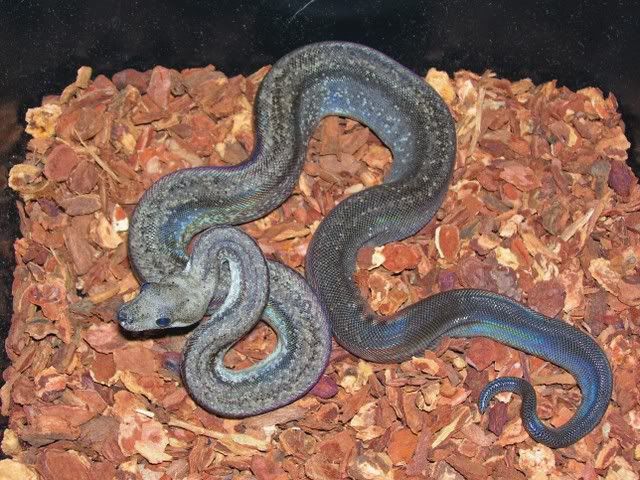
so the motley is a co-dom, so what does a super look like? or is the nice looking motley the super?
jscrick
Mar 19, 2008 10:37 AM
Motley Super is pure "Black".
There is a good pic. a few days back by Tracy Barker.
jsc
-----
"As hard as I've tried, just can't NOT do this"
John Crickmer
PBM
Mar 19, 2008 11:11 AM
nm
jscrick
Mar 19, 2008 12:59 PM
I put the black in quotation marks to signify dark unicolor.
I'd name that one a Buttermilk Boa, as in Buttermilk Racers here in Texas. Wonder what an Albino of that will look like?
Very cool!
jsc
-----
"As hard as I've tried, just can't NOT do this"
John Crickmer
Ophidia_Junkie
Mar 19, 2008 05:42 PM
Actually only the central American Motleys turn black or grey or what ever color. The Colombian Motley in Super form is vastly different in appearance. I could not find a picture to link to.
Best way to describe the Colombian version is a plain back (almost patternless), with thin stripes on either side running the full length of the body to the tail. Or close to it.
A picture is worth a thousand words though. Forgive my feeble description. LOL
Rick
PBM
Mar 20, 2008 05:14 PM
Linda's actually appeared much more brown, which was sort of shocking as the follow up supers to the purple patternless. I think there's going to be more variation as more are produced. Pete had one at Tinley as a yearling that looked very gray, more so than mine. I like those with variation more than the solid monotone animals at this point. But, they're all cool. There are some issues with them that do need to be worked out, and I'm not sure it's strictly an inbreeding issue as most assume. I'm sure we'll see as more are produced.
