Reptile & Amphibian Forums

Welcome to kingsnake.com's message board system. Here you may share and discuss information with others about your favorite reptile and amphibian related topics such as care and feeding, caging requirements, permits and licenses, and more. Launched in 1997, the kingsnake.com message board system is one of the oldest and largest systems on the internet.

Click here to visit Classifieds

Reason for striking coloration

markg Apr 25, 2008 05:34 PM

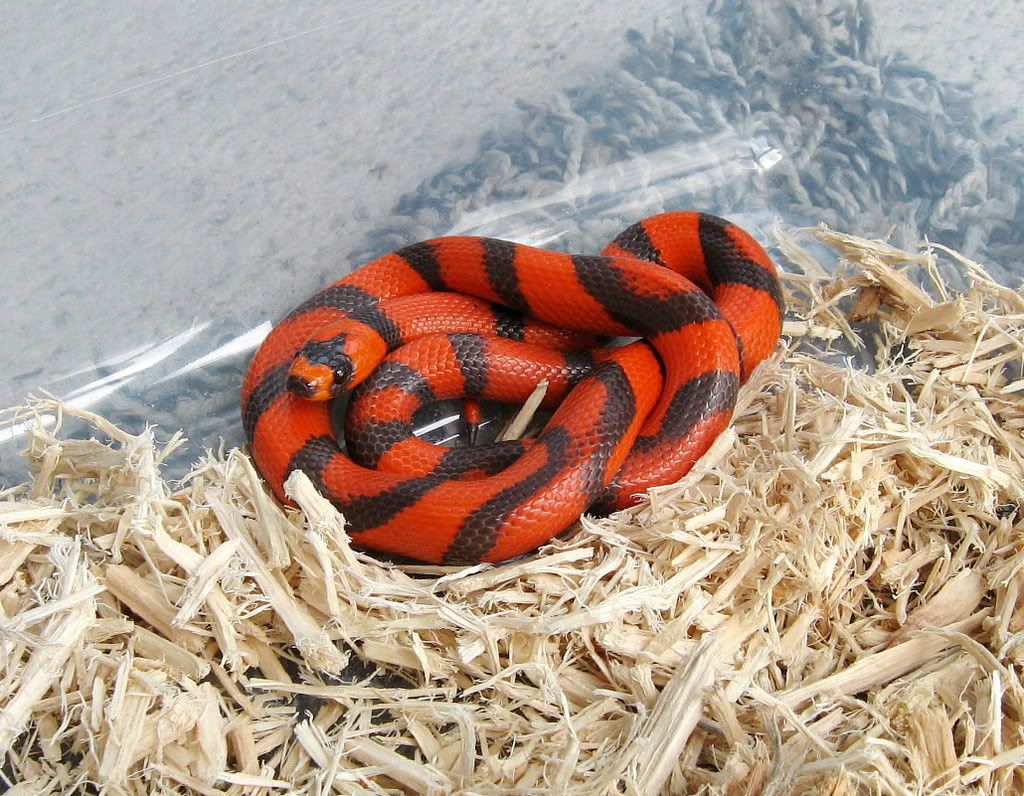
What is the consensus for the reason for striking coloration of milksnakes? Is it that predators (like predatory birds) avoid red-ringed animals? Still seems strange for a secretive snake to have warning colors for diurnal birds.

On the coloration note, here's what to wear when your wife wants you to do something..

-----
Mark

Replies (41)

Patton Apr 25, 2008 07:27 PM

For some reason that couch is awfully pixilated on my computer. LOL!!! Cool pic! My wife is in the Army, she'll get a kick out of it.
-Phil
-----
Work is the curse
of the drinking class!

DMong Apr 25, 2008 09:07 PM

First off......hahahahha!, that pic's too funny, I REALLY like your reason for using the cryptic pattern/coloration!..LOL!

Well, about the "loud" colors,.......it does certainly seem that many "other" animals make use of loud obvious colors/patterns to thwart-off many would-be predators. I've seen some documenteries in the past that give pretty good credence to this phenomenon. I'm not so sure that WE understand all about it, but it seems that many wild animals are quite aware of this.

I've also heard of some studies that suggests that the symetrical banding pattern is very confusing to animals.

In the end, I have to believe there's something to this vivid pattern of colors that helps them survive, venomous mimicry, confusion, or whatever it may be.

I think a predator would get dizzy from some of the snakes in herpetoculture today!...LOL!

~Doug

Image
-----
"Better to be silent and thought a fool, than to open mouth and remove any doubt!"

DMong Apr 25, 2008 09:12 PM

Go to the "other" forum and ask "FR"!..hahahaha!,..just kidding!, please DON'T!,...I can only take so much without my tall rubber boots!

~Doug

-----
"Better to be silent and thought a fool, than to open mouth and remove any doubt!"

charleshanklin Apr 26, 2008 12:22 AM

doug you better watch it. FR already scolded you once this week LOL.
-----
i'm not over weight i'm under tall

antelope Apr 26, 2008 09:51 AM

True dat!
-----
Todd Hughes

DMong Apr 26, 2008 11:17 AM

Well,...he hasn't done it to me.............YET!..LOL!, but has to many others.

take care buddy!

~Doug
-----
"Better to be silent and thought a fool, than to open mouth and remove any doubt!"

Patton Apr 26, 2008 06:32 AM

.
-----
Work is the curse
of the drinking class!

Jeff Schofield Apr 26, 2008 01:36 AM

These are designed so that a predator wont know which end is the head and which is the tail. Northerly forms refer to more cryptic coloration because they have less predators and can more easily forage above ground....See, there is 7 years of Biology in one paragraph.....Grrrr,stupid degree

CKing Apr 29, 2008 01:06 AM

>>These are designed so that a predator wont know which end is the head and which is the tail. Northerly forms refer to more cryptic coloration because they have less predators and can more easily forage above ground....See, there is 7 years of Biology in one paragraph.....Grrrr,stupid degree>>

Banded coloration tends to be disruptive. A predator simply cannot recognize the animal as a snake when it is resting.

Striped coloration servies a different purpose. A predator watching a moving snake that is striped will often focus on the stripe. When the snake moves using rectilinear motion, the stripe remains stationary even when the snake moves. Therefore the predator does not detect any motion until it is too late and the snake has disappeared into the underbrush. I know because this is what happened to me when I was watching the dorsal stripe of a garter snake and it disappeared right in front of my eyes.

Jeff Schofield Apr 29, 2008 02:11 AM

That makes no sense. Brightly colored banded snakes RELY on a predator recognizing as a snake FIRST.

CKing Apr 29, 2008 08:09 AM

>>That makes no sense. Brightly colored banded snakes RELY on a predator recognizing as a snake FIRST.>>

That is the common misconception. Many people believe that brightly banded snakes such as the tricolored kingsnake are conspicuous and therefore these are warning colors. Since these snakes themselves are not dangerous, they must be mimics of a dangerous animal, such as coral snakes.

Tricolored kingsnakes are certainly conspicuous when you remove them from their natural habitat. A tricolored kingsnake, or even a banded phase common kingsnake, when it is stretched out and crossing the road, is highly visible and immediately recognizable. However, when they are coiled and resting in their natural habitats, they blend in very well with their respective backgrounds. The cryptic coloration of tricolored kingsnakes in wooodland and forests have been independently observed by Goodman and Goodman (1976. Contrasting color and pattern as enticement displays in snakes. Herpetologica 32:145-148) and by Zweifel (1952, Pattern Variation and Evolutioin of the mountain kingsnake, Lampropeltis zonata. Copeia 1952:152-168).

Besides, even those who believe that the tricolored pattern is aposematic admit that there is not one single observation in nature in the entire history of mankind to show that the supposedly aposematic coloration of tricolored kingsnakes saved a snake from attack by a predator. There is nothing in the written or oral records of human beings to suggest that a predator, upon seeing a tricolored snake, shows fear and flee without attacking the snake. Therefore we have a total lack of evidence that the tricolor pattern is capable of deterring potential predators, despite literally thousands of years of observations of nature by human kind. At some point, we would need to conclude that such lack of evidence is really evidence that the tricolored pattern lacks the ability to warn predators. Faith works in religion, but it does not work in science. In science, evidence counts, and the supporters of the aposematic theory has no evidence that the tricolored kingsnake deters predators.

There was a study using clay models which suggests tricolored models are attacked less frequently than models that are unicolored. But this study is flawed. The results are consistent with the tricolored being seen less often also. The fewer attacks on the tricolored models can just as easily be explained by their disruptive coloration. Besides this study is not a substitute for real life observations between tricolored kingsnakes and predators in nature. As I write this, the supporters of the aposematic theory are still waiting for the first observation in nature of a predator being deterred by the tricolor pattern and as a result refrains from attacking the snake. How much longer will the aposematic theorists wait before they finally admit they are wrong? My guess is that they will still insist that tricolored kingsnakes are aposematic when they are on their death beds and the evidence they need are still not available.

Jeff Schofield Apr 29, 2008 07:40 PM

You cant do a study, get the results, then pass them off because you dont like the results. The study happened, YOU have decided that its not relavent AFTER the study is concluded. This is not science, its conjecture. The fact that they are more or less common has no relavence. To bring up your thoughts, how they look on roads is immaterial. There havent always been roads you know. Aposamatic coloration for poisonous snakes and their mimics has been shown as a deterrance to predation.

CKing Apr 29, 2008 08:41 PM

>>You cant do a study, get the results, then pass them off because you dont like the results. The study happened, YOU have decided that its not relavent AFTER the study is concluded. This is not science, its conjecture.>>

I have no arguments with the results. I merely disagree with the conclusion. As we all know, all scientific papers have separate results and discussion/conclusion sections. Of course there are times when the results are questionable. But even if scientists agree that the results are reliable, they may not agree with the author's interpretation of the results. Such disagreements are perfectly legitimate. I am not questioning the results of Brodie's experiment with clay models. I am questioning his conclusion that because the tricolored clay models were attacked less often, it means that the tricolored models are aposematic. These models may simply be harder to see for the birds. If the birds do not see them, then they cannot possibly attack the clay models. Brodie's experiment did not address the possibility that the birds simply did not see the tricolored clay models.

>>The fact that they are more or less common has no relavence. To bring up your thoughts, how they look on roads is immaterial. There havent always been roads you know.>>

Of course I know. Tricolored kingsnakes, when they are removed from their natural environment, look striking. One of the situations in which they are found in unnatural settings is when they venture out onto roadways. When they are out on roadways, which is an unnatural environment for them, they look conspicuous and striking.

>>Aposamatic coloration for poisonous snakes and their mimics has been shown as a deterrance to predation.>>

Not at all. Harry Greene, who is one of the supporters of the aposematic theory of the tricolored pattern, pointed out in his own book that there is not one single observation in nature that shows the tricolored pattern has deterred a predator from attack. Not one, despite countless man-hours of observations by scientists, amateur naturalists, nature lovers, state and national park employees, hikers, farmers, ranchers, and other people who just happen to be outdoors. Imagine the staggering odds against the lack of evidence if the tricolored pattern is really so effective at deterring attacks. Yet, if you ask Harry Greene himself whether he thinks the tricolored pattern is aposematic, he would almost certainly say that it is.

Jeff Schofield Apr 29, 2008 09:45 PM

On the fact that birds DO see color. Deer DONT see color. And if you find big poop in the woods, and a bear lives in the woods, even if no one has EVER seen him poop, chances are its bear poop! Biology is a soft science but you have to go along with logical studies until something else is proved dont you? I am not saying be a lemming by any means, but dont disagree to disagree without some kind of counter proposal....what else could have caused the proliferation of color and banding in unrelated genera of snakes worldwide besides predation??? The fact that it is so prevalent and mostly on cryptic sp.? Snakes are rather simple animals, there is no social or sexual purpose. It is not because its advantagous catching prey. By elimination alone it HAS to be predator avoidance.

CKing Apr 29, 2008 10:36 PM

>>On the fact that birds DO see color. Deer DONT see color. And if you find big poop in the woods, and a bear lives in the woods, even if no one has EVER seen him poop, chances are its bear poop! >>

Don't know. I am not on expert on scat. I would not assume that a big pile of manure necessary belongs to a bear.

>>Biology is a soft science but you have to go along with logical studies until something else is proved dont you?>>

Biology is not a "soft science." Biology is science.

>>I am not saying be a lemming by any means, but dont disagree to disagree without some kind of counter proposal....>>

I disagree with the mimicry hypothesis because there is simply no evidence in nature of predators avoiding the tricolored pattern or fearing it. I do have an alternative hypothesis, i.e. crypsis, and there are observations to support the crypsis theory.

>>what else could have caused the proliferation of color and banding in unrelated genera of snakes worldwide besides predation???>>

Crypsis. The tricolored pattern is good camourflage coloration.

>>The fact that it is so prevalent and mostly on cryptic sp.? Snakes are rather simple animals, there is no social or sexual purpose. It is not because its advantagous catching prey. By elimination alone it HAS to be predator avoidance.>>

You have not eliminated crypsis (cryptic coloration), and you still have no evidence to support aposematism. I am still waiting for Harry Greene to write a second edition of his book, in which he finally shows us evidence that a predator, upon seeing the tricolored pattern, will flee instead of attacking the so-called coral snake mimics. Such evidence did not exist in the first edition of the book. I am confident that such evidence will never surface, because the aposematism hypothesis is simply false.

Jeff Schofield Apr 29, 2008 10:44 PM

Hard science is physics, chemistry. 1 1=2.Hard science. Biology is soft science because there is no smoking gun. I am going to look up this Harry Greene fella and see who is paying for his research...etc..

CKing Apr 30, 2008 09:27 AM

>>Hard science is physics, chemistry. 1 1=2.Hard science. Biology is soft science because there is no smoking gun. I am going to look up this Harry Greene fella and see who is paying for his research...etc..>>

Of course I disagree with that blanket statement. There is a lot of stuff in physics that cannot be falsified. How can you falsify string theory for example? How do you falsify the existence of extra dimensions, which are predicted by string theory? By definition, beings that exist in a world with n dimensions are trapped in that world, and they are unable to experience or even comprehend a world with n 1 or greater numbers of dimensions. So, by definition, the extra dimensions predicted by string theory cannot be falsified by human beings. That is hardly "hard science."

Speaking of physics, physicists have demonstrated the existence of neutrinos, the so-called ghost particle, by observation. As elusive as the neutrino is, it seems that evidence to support the hypothesis that the tricolored pattern of the kingsnake frightens predators is even more elusive. That is because the neutrino has been observed, but no one has ever observed a predator, upon observing the tricolor pattern of a harmless kingsnake in nature, became frightened and then left the kingsnake alone. I think the more appropriate name for the coral snake mimicry hypothesis is the phantom hypothesis because the coral snake mimicry hypothesis exists only in the minds of its believers.

DMong Apr 30, 2008 12:55 PM

I must say, I have also read some literature pertaining to this, as well as ALL your post regarding this, and I really tend to agree as well that the banded/ringed patterns of many snakes serve more as a "disruptive" appearance for their silhouette, rather than a venomous mimicry.

This type of pattern as you may already know, has been utilized for navy ships as well for disrupting the large silhouette of ships in the ocean. This pattern when compared to even a conventional dull gray colored ship, amazingly stands out FAR less when viewed from a moderate distance. The visual proof of this phenomenon was simply astounding!

This brings up another question of mine,.....then why would a venomous Coral Snake need it,....what is it supposed to be mimicing?...LOL!........Coral Snakes being of a more docile, placid nature than many other species, I'm inclined to think that it is much better off NOT being noticed by others, rather than being noticed. You can't wan't to eat or molest what you can't see in the first place.

My thought process with this certainly isn't "rocket science", but I do have a good capacity to think and observe well, and have been heavily involved with many types of snakes for over four decades.

Also on a funny parting note, I have put many tri-colors in front of some of my dogs, and the only thing they wanted to do, was take a bite out of them. Now on the other hand, I've walked my dog outside and he thought a solid brown broken stick was a large snake, and was EXTREMELY hesitant, and wary of the stick!..LOL!.........and, no, that wasn't a proving scientific result of any kind, just a funny observation!

best regards, ~Doug

-----
"Better to be silent and thought a fool, than to open mouth and remove any doubt!"

Joe_M Apr 30, 2008 05:04 PM

While I am not a biologist, chemist, nuclear physicist, or even brain surgeon for that matter, I do see a lot of relevance to Doug point of "What is a coral snake mimicking?" Another poster stated that he believed the eastern milk is mimicking a fox snake, because coral snakes are not present in the eastern's range. Why is the eastern mimicking a FOX snake? They pose very little to no threat against a potential predator; and to steal Doug's point, what is the fox snake mimicking?

My personal SWAG is that it is more of a camouflage / breaking up of pattern to elude the site of potential predators, and if seen, to confuse. I really enjoy listening to the different theories, but think some may be looking too deep into this with the mimicry theories. Again, just one opinion from a person with an engineering background, with little biology involved.

I think this milk may be mimicking a candy cane, which is not a great choice around my kids during the holiday season, lol.


-----
Joe

Sunherp May 01, 2008 02:12 PM

I just read the post about the fox snake mimicry. That would serve no purpose. None. The pattern shared by those two species (as well as numerous others) is the result of either convergent evolution or is an ancestral trait. Either way (the arguments for either hypothesis could go on for a long time), no mimicry is involved between them. I've heard some semi-convincing arguments for copperhead mimicry, but that's for another thread... LOL

Hope all is well with you and your little gem of a snake.
-Cole

CKing May 04, 2008 10:16 AM

>>I must say, I have also read some literature pertaining to this, as well as ALL your post regarding this, and I really tend to agree as well that the banded/ringed patterns of many snakes serve more as a "disruptive" appearance for their silhouette, rather than a venomous mimicry.
>>
>> This type of pattern as you may already know, has been utilized for navy ships as well for disrupting the large silhouette of ships in the ocean. This pattern when compared to even a conventional dull gray colored ship, amazingly stands out FAR less when viewed from a moderate distance. The visual proof of this phenomenon was simply astounding!
>>
>> This brings up another question of mine,.....then why would a venomous Coral Snake need it,....what is it supposed to be mimicing?...LOL!........Coral Snakes being of a more docile, placid nature than many other species, I'm inclined to think that it is much better off NOT being noticed by others, rather than being noticed. You can't wan't to eat or molest what you can't see in the first place.>>

Coral snakes also live in woodland type habitats, especially the tropical species. They are also rather secretive snakes. It is to their advantage to blend in with the environment as well. Yes, indeed, even venomous animals can benefit from camourflage, if for no other reason than being less obvious to one's prey. A snake, no matter how deadly venomous, still need to eat. And a conspicuous snake may starve to death because it cannot get close enough to potential prey to catch them. Many species of lizards have excellent color vision, so many of the tricolored kingsnakes (which feed largely on lizards) would starve if their lizard prey can see them easily before they can get within striking distance. Of course, a tree dwelling venomous snake that feeds largely on birds must also be cryptic to be able to remain unnoticed by its prey. Conspicuous warning coloration are also conspicuous and alarming to one's prey. This fact is often overlooked by the supporters of coral snake mimicry.

>> My thought process with this certainly isn't "rocket science", but I do have a good capacity to think and observe well, and have been heavily involved with many types of snakes for over four decades.
>>
>> Also on a funny parting note, I have put many tri-colors in front of some of my dogs, and the only thing they wanted to do, was take a bite out of them. Now on the other hand, I've walked my dog outside and he thought a solid brown broken stick was a large snake, and was EXTREMELY hesitant, and wary of the stick!..LOL!.........and, no, that wasn't a proving scientific result of any kind, just a funny observation!
>>
>>
>> best regards, ~Doug
>>
>>
>>-----
>>"Better to be silent and thought a fool, than to open mouth and remove any doubt!"

Most mammals do not have good color vision because of a nocturnal ancestry. Humans are exceptional in this regard because of our diurnal primate ancestry. That is why many scientists believe that the tricolored pattern is effective only on avian predators. In fact, experiments using captive mammals show that they have no fear of tricolored snakes but they do fear the agressive vipers. Nevertheless, there is a total lack of evidence that avian predators fear tricolored snakes in nature, and there seems to be no experiment which uses living captive tricolored snakes and birds. Tricolored snakes are not that rare, and even if the experiment results in a bird eating a few tricolors, it would be a worthy sacrifice for science. OTOH, such an experiment could blow away the myth that the tricolor pattern is aposematic, and that tricolored kingsnakes are mimics of the venomous coral snakes.

Jeff Schofield Apr 30, 2008 05:32 PM

Maybe it was my mistake,seeing that we are on the milk forum, to think we were talking about TRI COLORS. I can agree on regular banding, but tri colored banded pretty much occurs only where tri color poisonous snakes occur(mimicry). Now of course the genetic drift does occur, but again I thought we were talking about tri colors.

Sunherp May 01, 2008 02:20 PM

The frequency of species displaying tricolor banding increases drastically as the tropic zone is approached. The center for elapid radiation is the American tropics. Tricolored colubrids sympatric with elapids more closely resemble the elapids than do allopatric or parapatric colubrids. Food for thought.

-Cole

CKing Jun 12, 2008 11:39 AM

>>The frequency of species displaying tricolor banding increases drastically as the tropic zone is approached.>>

Not quite correct. The tricolored snakes are often found in wooded areas. In more open habitats, the tricolored snakes are often nocturnal or they have lost their red coloration. The classic example is the diurnal Lampropeltis zonata herrerae, which has lost its red coloration. Snakes like Lampropeltis triangulum campbelli and L. t. celaenops are mostly nocturnal.

>>The center for elapid radiation is the American tropics.>>

Not quite. Australia has a large number of elapids. Don't forget that the sea snakes and cobras are also elapids.

>>Tricolored colubrids sympatric with elapids more closely resemble the elapids than do allopatric or parapatric colubrids. Food for thought. >>
>>-Cole

In most cases, scientists would invoke convergent evolution to explain such a phenomenon. But since the coral snake mimicry hypothesis is more of a dogma than a falsifiable scientific theory, many scientists would of course suggest mimicry as the only plausible explanation.

Sunherp May 01, 2008 02:02 PM

Biology is NOT soft science. It IS chemistry and physics. No further comment on that.

If I'm reading this correctly, Cking isn't saying that the tricolor pattern doesn't serve as a predator avoidance strategy. Even pattern disruption and flash coloration work to deter predators. There are multiple models by which an animals can come to the tricolored pattern. To name a few major ones:

One is true aposematic coloration, bright coloration by a toxic species.

Another is mimicry. There are two general forms that are often discussed; Batesian and Mullerian. Google 'em to learn more.

Yet another is (as CKing describes) outline or focus disruption.

What is commonly overlooked, is that one model does not necessarily preclude the others. A pattern that may be disruptive in some situations (e.g. curled under grasses and leaves) may also be aposematic or mimic aposematry when the animal is uncovered from it's hiding area. Mimicry can often work in rings where a combination of Batesian and Mullerian mimicry strategies interplay. The situation with tricolored snakes in the western hemisphere is probably quite complex.

Color and pattern manipulation is easy and fairly quickly done in nature.

Just thought I'd throw in my .02 on the subject.

-Cole

markg Apr 29, 2008 02:54 PM

More on the striped snakes.. ever try to catch a striped racer? They have two stripes that converge on the tail. When you try to follow the snake going into brush, your eyes tend to focus more where the stripes converge. By the time you recognize where the convergence is (on the tail) most of the snake is in the bush out of reach. Very effective.
-----
Mark

Jeff Schofield Apr 29, 2008 07:56 PM

Mark, I think there is something to that, as it applies to diurnal snakes. It would make sense in areas where avian predation is prevalant. You see alot of the non cryptic species such as racers and coachwhips and other fast snakes. We also know that stripes makes you LOOK faster than you are....ever seen a muscle car with a stripe?? Looks fast when its not even moving...

waspinator421 Apr 27, 2008 12:58 AM

LOL!! At first when I opened your post, I thought "Why is there a picture of a couch??" Then I saw it!! That is great!!
-----
Aubrey Ross

©
www.SlipstreamSerpents.com

peter54 Apr 27, 2008 06:43 AM

Milksnakes coloration is a natural protective mimic of the poisonous coral snake. The coral snake has been more widely spread earlier thru historic times and therefore there are several subspecies to the milksnake with warning colors in areas where there are no coral snakes today.

One subspecies to the milksnake species, the eastern milksnake, ranges thru areas where coral snakes have never been present and therefore it mimics the coloration of the fox snake (Panterophis vulpina) instead.

markg Apr 28, 2008 01:47 AM

Great explanation. Thanks.
-----
Mark

CKing Apr 29, 2008 12:43 AM

>>Milksnakes coloration is a natural protective mimic of the poisonous coral snake. The coral snake has been more widely spread earlier thru historic times and therefore there are several subspecies to the milksnake with warning colors in areas where there are no coral snakes today. >>

Problem with that explanation is that no one has ever observed a predator, upon seeing the tricolored pattern of a milk snake, avoids it and let the snake go. There is not one single observation of that nature in the history of mankind. Think about that! In comparison, there are hundreds of sightings of the Loch Ness monster on record.

>>One subspecies to the milksnake species, the eastern milksnake, ranges thru areas where coral snakes have never been present and therefore it mimics the coloration of the fox snake (Panterophis vulpina) instead.>>

The fox snake and the eastern milksnake are similar in coloration not because of mimicry, but because that type of coloration is more cryptic than the tricolored pattern in the type of habitat inhabited by both species. Similarly, the coral snake and the tricolored kingsnakes both live in woodland and forest type habitats. They are similar in coloration because tricolored pattern is cryptic in such habitats. In general, snakes tend to be cryptic, even highly venomous species. It is better not to be seen than to be feared, and that seems to be the strategy for practically all snakes, venomous or not.

peter54 May 01, 2008 03:54 PM

One explanation to this problem - that no none has ever seen a predator avoid a milksnake although it carries colors that should warn predators off - maybe lays inside the first explanation, that there no longer are any coral snakes in the wast majority of the milksnake species total range. If there where coral snakes still in those areas, I'm sure that predators would think twice before attacking a milksnake.

CKing Jun 12, 2008 11:49 AM

>>One explanation to this problem - that no none has ever seen a predator avoid a milksnake although it carries colors that should warn predators off - maybe lays inside the first explanation, that there no longer are any coral snakes in the wast majority of the milksnake species total range. If there where coral snakes still in those areas, I'm sure that predators would think twice before attacking a milksnake.>>

The milk snake ranges all the way down to South America. There is no shortage of coral snakes within the entire range of the milk snake. If there is no fear of the tricolor pattern and if the tricolor pattern is conspicuous, then the tricolor pattern would have been eliminated by predators. On South Todos Santos Island, that is exactly what has happened. The tricolored L. zonata found there has no red in its pattern, almost certainly because a tricolored snake, active diurnally on a desert island, would be quickly caught and eaten by avian predators. L. z. herrerae shows that the tricolored pattern is conspicuous in open habitats, and it shows that there is no fear of the tricolored pattern by predators. The tricolor pattern has not been eliminated in other locales probably because these snakes are actually cryptic in those localities (with woodland and forest habitats) or because the snakes are nocturnal in habits.

donv Apr 27, 2008 04:26 PM

That reminds me of an old far side cartoon where the wife answers the door to this monster. She's dressed normally but the husband has some crazy zig zag clothing on that perfectly matches the wallpaper. The caption was something like, "Harold, like the speckled moth, blends in perfectly with the surrounding environment. Mildred, of course, was immediately devoured.

CKing Apr 29, 2008 12:27 AM

>>What is the consensus for the reason for striking coloration of milksnakes? Is it that predators (like predatory birds) avoid red-ringed animals? Still seems strange for a secretive snake to have warning colors for diurnal birds.
>>
>>On the coloration note, here's what to wear when your wife wants you to do something..
>>
>>
>>-----
>>Mark

I think you may have answered your own question. LOL.

That camourflage suit you wear would have stood out if you were standing against the wall in the background.

The same is true of a tricolored kingsnake. Take it out of its natural habitat, and it looks striking. Because of that, many scientists have come up with the explanation that the tricolored kingsnake's striking coloration is some sort of warning to potential predators. It seems logical but there is one big problem with that explanation. The tricolored kingsnakes are docile animals and they are non-venomous. Who is scared of a tricolored kingsnake? To get around this problem, some scientists then claim, without any supporting evidence, that the tricolored kingsnake is some sort of mimic of the coral snakes, which are venomous. But that hypothesis is also problematic because many tricolors do not occur in the same area as the snakes that they supposedly mimic. To make things worse for the mimicry theorists, there is not one single observation available in the entire history of mankind to show that predators, upon seeing a tricolored kingsnake, will become so frightened that it will leave the snake alone and go away. Considering how many scientists, nature lovers, state and regional park employees, herpers, hikers, and other people who are outdoors every day and every year, it is simply ridiculous to think that predators will avoid eating a tricolored kingsnake but nobody has ever seen that. That is simply incredulous.

I don't spend a lot of time outdoors, and yet this year I saw a red-tailed hawk flew towards a large gopher snake. The hawk was all set to attack the snake but let the snake go because it was apparently too big for the hawk to risk attacking it. Either I am extremely lucky to see a predator avoid eating a snake, or the supporters of the mimicry theory are exremely unlucky not to observe a similar avoidance incidence. Sometimes, scientists would simply have to admit that if there is no empirical evidence to support a hypothesis after literally centuries of observation, then perhaps they should conclude that the mimicry hypothesis should be abandoned.

Further, scientists who have actually spent time in the field observing tricolored kingsnakes, such as R. G. Zweifel of the American Museum of Natural History, write that the tricolored kingsnakes are cryptic in their natural environment. So, what we have is direct evidence of crypsis, or camourflage coloration but no evidence of aposematism, or warning coloration. Yet those who believe in the mimicry theory will simply ignore observations by Zweifel and others, and continue to believe that tricolored kingsnakes are examples of aposematism and coral snake mimicry.

With the help of DNA evidence, we now know that the milk snakes L. triangulum, are descended from a mountain kingsnake. L. pyromelana is in fact likely to be the first tricolored species that evolved. It is a woodland and forest inhabitant. Quite simply, the tricolored coloration is adaptive in such habitats. Woodlands are littered with fallen leaves, and these are often reddish in color. Red is therefore rather cryptic in woodland habitats. We see evidence of this in other kinds of animals as well. Skinks that live in woodland habitats have blued tails, but skinks that live in grassland habitats have pink or red tails. That is because skinks are always ready to sacrifice their tails to avoid being eaten. The skink's tail is designed to attract the attention of predators. And it is apparent that skinks "know" that red and pink tails do not stand out in woodland habitats. Scientists are of course smarter than skinks, and they should know what skinks "know." Of course I am not suggesting that skinks are smarter than some scientists, but it is quite clear to me that some scientists sometimes do ignore facts. When one ignores facts, then it is easy to believe that tricolored kingsnakes are mimics and aposematic.

So in conclusion, tricolored kingsnakes are "striking" in coloration because they are camourflaged in their own habitat. They only look striking when they are removed from their environment. They look no more striking in their natural surroundings than you do with that outfit on your own couch.

markg Apr 29, 2008 02:49 PM

Awesome explanation. I appreciate the info. Now that I think about it, seeing mtn kings in the wild, I can see that if crawling in the open, their outline would be broken up greatly among the leaves and debris on the ground.

That seems more plausible than every tricolor king/milk is mimicing a venemous coral snake. Besides, many snake predators will tackle a coral snake with the same gusto as a non-venemous snake. And now you have stated that going further, animals really do not fear a red-ringed snake any more than any other snake.

You made another excellent point - these animals have striking coloration when in an acrylic display with a black background, but this does not mean they stand out in their habitat.
-----
Mark

CKing Apr 29, 2008 08:54 PM

>>Awesome explanation. I appreciate the info. Now that I think about it, seeing mtn kings in the wild, I can see that if crawling in the open, their outline would be broken up greatly among the leaves and debris on the ground.>>

Thank you. I am glad you agree.

>>That seems more plausible than every tricolor king/milk is mimicing a venemous coral snake. Besides, many snake predators will tackle a coral snake with the same gusto as a non-venemous snake. And now you have stated that going further, animals really do not fear a red-ringed snake any more than any other snake.>>

Coral snakes themselves are rather docile and they have short fangs. They are hardly the fearsome animals that they are often portrayed by the people who support the aposematic theory of the tricolored pattern. Predators are cautious. I cannot read the mind of a hawk, but I believe that they treat all snakes as potentially venomus and try not to get bitten. An aggressive snake that strikes repeatedly or one that is too big for the predator to handle would probably be more fearsome to an avian predator than one that has a particular color or color pattern.

>>You made another excellent point - these animals have striking coloration when in an acrylic display with a black background, but this does not mean they stand out in their habitat.
>>-----
>>Mark

Thank you again. As Zweifel and Goodman and Gooman observed, mountain kingsnakes are in fact cryptic in their native environment: the woodland floor. As the original poster showed, he is perfectly camourflaged on his couch. But if we put him in an aquarium large enough to hold him, his outfit would look striking and conspicuous too.

antelope Apr 30, 2008 02:18 AM

If the avian predators in the study attacked even one clay model, wouldn't that prove they saw it?
-----
Todd Hughes

CKing Apr 30, 2008 06:08 AM

>>If the avian predators in the study attacked even one clay model, wouldn't that prove they saw it?
>>-----
>>Todd Hughes

Of course, it proves that they saw it if they attacked it. It also proves that they have no fear of the tricolored pattern if they attacked it. In fact, if the number of attacks is the same as the number of times the models are seen by the avian predators, then it actually disproves the hypothesis that the tricolored pattern deters predators. At least it shows that the tricolored patterned models failes to deter predators. Anyhow, meaningful data in support of the mimicry hypothesis must come from the use of live animals, not clay models.

antelope May 01, 2008 12:32 AM

Then toss that one out completely. I dunno, I have attacked many poisonous cheeseburgers because I was too hungry to care!
-----
Todd Hughes

peter54 May 01, 2008 04:04 PM

I don't believe in this explanation, even if it is fairly well grounded. I think that if this really should be it, I mean that tricolor Lampropeltis only appear color striking out of their natural habitat, they would have developed much duller colors thru time.

Otherwise one could ask why not every snake species has more striking colors, at least the species living in the same habitat as tricolor kings and milks do.

Site Tools