Reptile & Amphibian Forums

Welcome to kingsnake.com's message board system. Here you may share and discuss information with others about your favorite reptile and amphibian related topics such as care and feeding, caging requirements, permits and licenses, and more. Launched in 1997, the kingsnake.com message board system is one of the oldest and largest systems on the internet.

Click here for Dragon Serpents
Click for ZooMed
Click for 65% off Shipping with Reptiles 2 You

Tricolored pattern and mimicry/crypsis

Sunherp May 01, 2008 02:53 PM

The discussion below on mimicry/crypsis holds special interest for me. I've included a link to a discussion about this very topic for those of you who care. The discussion was participated in by both acedemics and lay-persons. Take a few minutes to read through a few pages of the responses and post back here with your thoughts.

-Cole
Link

Replies (10)

jawn May 01, 2008 06:51 PM

great topic, thanks for posting. looks like i'll have to sit back with a couple beers for this read .. then finish it of at work tommorow. on break of course haha
-----
Jon Wedow
Sharp Dressed Snakes

Joe_M May 01, 2008 07:09 PM

Yes, thanks for posting the link Cole. Very interesting opinions.

I wouldn't drink too many as the posts get pretty complicated at times without the added help.
-----
Joe

Sunherp May 02, 2008 09:11 AM

It's pretty interesting stuff. I posted a few ideas (some of the most supported ones) on the original thread. Some of the current sharpest minds in evolutionary mechanisms have posted under that link. Crack a beer and enjoy!

-Cole

BTW, JAWN, I saw your ad in the newest REPTILES mag. Sweet!

-Cole

cn013 May 02, 2008 01:28 PM

Nice thread Cole... well I'm on board with giving it a re-read with a brew or two myself. I read through it a couple of times prior.... Batesian mimicry interests me alot as far as elapsoides are concerned. I've long been wrapping my head around why the lil' guys would need to represent an elapid here, especially, in FL. Given their fossorial nature it'd seem unlikely that they would encounter much to defray attack aside from being on 'the move.' Even while 'under bark' so to speak the mechanism would only really give reason to pause to a large, overly curious woodpecker! Perhaps that's part of it.... I dunno.
Though admittedly this is a casual interest and I've not gone so far as to actually look for and read any of the studies involving avian predatory responses referenced... the circumstances and varied 'loops' involved w/ pattern/color are fascinating. To this lay-person anyhow! Again interesting thread...

Chris

Jeff Hardwick May 02, 2008 04:21 PM

An interesting study was done in 1995 re avian predators and their reaction to mono,bi or tri colored snakes. The PDF is available through the teriffic Sierra Herps site but has been available through other sources as well.

http://www.sierraherps.com/pdf/Eckerman[1]_Mimicry.pdf

When we look at corals and milks actively prowling the time is often early AM or late PM when light is fading (or tall grass and forest provide cover) or for the tropical corals, prowling is done late at night (pers experience). The flashy colors do not reveal in low light and these snakes have never been selected by evolutionary/predatory pressure to change from a flashy pattern to cryptic browns or black.
Exceptions exist though: a black coral snake was found in Orlando years ago and Shannon has a patternless blanchardi from an area know to produce patternless blanchards. I have a patternless gentilis also.
These exceptions could be remnant genes that re-surface and would prevent the species from being eliminated if the environment were to put pressure on the bi or tri colored patterns. A safeguard gene if you will. Maybe.
But that line of thought proposes that flashy bands are a recent evolutionary development and these snakes may have been dull brown snakes eons ago and I'm lacking suppotive data aside from a few "safeguard" examples. Colors don't fossilize unfortunately.
Nevertheless, we have flashy snakes that apparently warn and startle predators and can also benefit the snake as a hunter/predator.
Check out Eckerman's paper if you don't already have it wallpapering your snake room.
Jeff

-----
It doesn't matter who votes. What matters is who counts the votes............Josef Stalin

Dniles May 03, 2008 08:27 PM

wow, this paper is awesome. Didn't know it was out there...thanks for the link.

Dave
DNS Reptiles

CKing Jun 12, 2008 08:29 AM

>>An interesting study was done in 1995 re avian predators and their reaction to mono,bi or tri colored snakes. The PDF is available through the teriffic Sierra Herps site but has been available through other sources as well.
>>
>>http://www.sierraherps.com/pdf/Eckerman[1]_Mimicry.pdf
>>
>>When we look at corals and milks actively prowling the time is often early AM or late PM when light is fading (or tall grass and forest provide cover) or for the tropical corals, prowling is done late at night (pers experience). The flashy colors do not reveal in low light and these snakes have never been selected by evolutionary/predatory pressure to change from a flashy pattern to cryptic browns or black.>>

L. zonata is active during the day time, but it lives in woodland habitats in general, where its colors blend in surprising well with the woodland floor. The tricolors are only strikingly colored when they are lifted out of their native environments and put in a cage in the lab or when they are crossing a road. When they lie motionless on a woodland floor, they can be quite cryptic. The same is true of a zebra. If you put it inside a cage in a zoo, it is strikingly colored. If you go to a zebra's natural environment, you will realize that it is well camourflaged. In low light, a moving tricolor becomes a unicolor light gray one without any hint of its bold pattern. So, whether moving or at rest, tricolor snakes are actually cryptic, not conspicuous, in their native environment.

>>Exceptions exist though: a black coral snake was found in Orlando years ago and Shannon has a patternless blanchardi from an area know to produce patternless blanchards. I have a patternless gentilis also.>>

An exception to the L. zonata tricolor pattern occurs naturally on South Todos Santos Island. L. z. herrerae is phenotypically more like the common kingsnake than the mountain king that it is. If the tricolor pattern is meant to be conspicuous and meant to frighten predators, then a desert island would be a perfect place to be conspicuous and frightening. Instead, herrerae loses its bright red coloration in an open habitat. Therefore herrerae is a strong argument against the whole idea that the tricolor pattern evolved to frighten predators. Not coincidentally, Gilbert's skink (Eumeces gilberti) has a red tail, and it lives in open grassy habitats. A skink's tail is meant to attract attention, so it is designed by natural selection to have the highest visibility in any given environment. In open grassland habitats, red is highly visible. So, it is no coincidence that E. gilberti has a red tail. Skinks that live in woodland habitats (e.g. Eumeces skiltonianus), however, do not have red tails. They have blue tails instead. Why? Because blue tails are more visible in a woodland habitat then red tails. If the coral snakes and milk snakes want to look conspicuous, they would need to be blue colored in woodland habitats and they would be red on a desert island. Instead we see the exact opposite: they are red in woodland habitats but they lose their red color in open habitats, proving that they evolved to have cryptic coloration. Some of you may jump in and point out that some milk snakes are red and they live in open grassland habitats. Let me point out that the milk snakes found in open habitats are often nocturnal. For example, L. t. campbelli and L. t. celaenops spend most of the day underground and are only active at night. Remember also that at night and in low light red turns to black, so red color can be cryptic even for a nocturnal animal. If you ever drive through a tunnel and you are followed by a red automobile. Just look at the car through the rear view mirror and see it turn black when you go through the tunnel.

>>These exceptions could be remnant genes that re-surface and would prevent the species from being eliminated if the environment were to put pressure on the bi or tri colored patterns. A safeguard gene if you will. Maybe. >>

Or perhaps a black snake can absorb more sunlight directly so it gets warmer quicker. Some of the Sierra Nevada populations of L. zonata are black and white, presumably because it helps them thermoregulate at high elevations.

>>But that line of thought proposes that flashy bands are a recent evolutionary development and these snakes may have been dull brown snakes eons ago and I'm lacking suppotive data aside from a few "safeguard" examples. Colors don't fossilize unfortunately.>>

It is true that fossils do not show colors in life. However, L. triangulum is an old species, and phylogenetic analysis show that the genus Lampropeltis diverged very early into L. zonata, L. pyromelana and L. triangulum, all of which are tricolored. Either they evolved their tricolor pattern independently or their common ancestor was a tricolor. A tricolored common ancestor is most likely. Lampropeltis is in turn descended from a New world ratsnake, quite soon after the ratsnake entered the New World about 25 million years ago, IIRC. L. zonata itself is said to be older than 10 million years according to Rodriguez-Robles. So we are looking at the tricolor pattern having evolved as early as 25 million years ago and persisting for all these years.

>>Nevertheless, we have flashy snakes that apparently warn and startle predators and can also benefit the snake as a hunter/predator.>>

Again, these snakes only look flashy when they are put in a cage in a laboratory. They don't look flashy if you try to find them in their native environment. Anyone who has looked for these snakes in nature would know that they are not easy to find unless you know where to look.

>>Check out Eckerman's paper if you don't already have it wallpapering your snake room.
>>Jeff

Unfortunately, many herpetologists just cannot get over the bright colors of the tricolor snakes and fail to see that they are in fact cryptic in their natural environment. So the myth that the tricolors use their "warning coloration" to frghten potential predators persist even in the scientific literature, in textbooks and in the popular literature. What these scientists ignore is that a predator has to hunt. Unless tricolored kingsnakes are vegetarians, they need to be cryptic to stalk their prey. Having bright flashy colors is simply not a good idea for a predator. We don't see tricolored lions for example, because they would starve to death since their prey would see them before they ever get close enough to make a kill. The same is true of tricolor kingsnakes. They hunt rodents and lizards, animals that have good color vision, so they cannot afford to be flashy and conspicuous to their prey. In sum, flashy colors is maladaptive for a predator like a kingsnake and they only look flashy when they are inside a cage. Further, even warning colorations are not 100% effective. It is better not to be seen than to be harmed or killed by a naive or color blind predator. And that is what L. z. herrerae teaches us. It makes no sense to be conspicuous by being tricolored and diurnal in open terrain.

Finally, what is the evidence that the tricolored pattern frightens predators? There is none. Harry Greene, in his book Snakes, the evolution of mystery in nature, points out that there is not one single observation in nature of a predator, upon seeing the tricolored pattern of a harmless snake, became frightened and not attack it. It shows, if nothing else, that the whole idea of warning coloration is entirely dreamed up by "scientists" who just cannot get over the fact that tricolor kingsnakes look striking in a cage in their laboratory. Well, get over it! Tricolored kingsnakes do not look striking in their natural environment. Kingsnakes are not mimicking anything. They merely evolved their colors because these colors help them hide in plain sight. The tricolored kingsnakes would have evolved their tricolors even if coral snakes never existed.


Jeff Hardwick May 02, 2008 04:50 PM

I don't have mockingbirds here but you Florida guys have shrikes, jays and mockers all over your yard. Try this with the kids:
collect some half inch dowels or conduit pipe and paint them in mono, bi, and tri colored patterns and see how the birds react when the models are placed near the nest or favorite feeder.

I have a published study somewhere in the house that was done years ago with painted dowels and the results boiled down to more bands, more fear. Birds ignored the mono color, 50% were stressed at the bi color model and 100% were alarmed/agressive to the tri-color model.

If we had hawks to work with, it would be ideal. Anybody keeping a hawk or two or have a nest in the back yard?
Jeff
-----
It doesn't matter who votes. What matters is who counts the votes............Josef Stalin

DMong May 03, 2008 01:44 AM

Many years ago, as a kid, I would let my Burmese Python cruise around in the my huge backyard so he could get some exercise, and take a dump, man! he was like a friggin' Mockingbird "magnet"!,....they would gather from all over the place to jump around in trees, and on the ground close to the snake raising their wings in defiance of the snake...keeping just out of reach. What was funny is, the more that came, the more would follow because of all the comotion they all made.

On the same token, I have seen lone Mockingbirds doing this behavior while I was outside,.....remembering this behavior from my past experience with the big Python,....so I quickly learned that it more than likely is because a snake is in the area, or other animals as well that they don't particularly like. Sure enough, more often than not, I'd see a diurnal Black Racer appear on the scene.

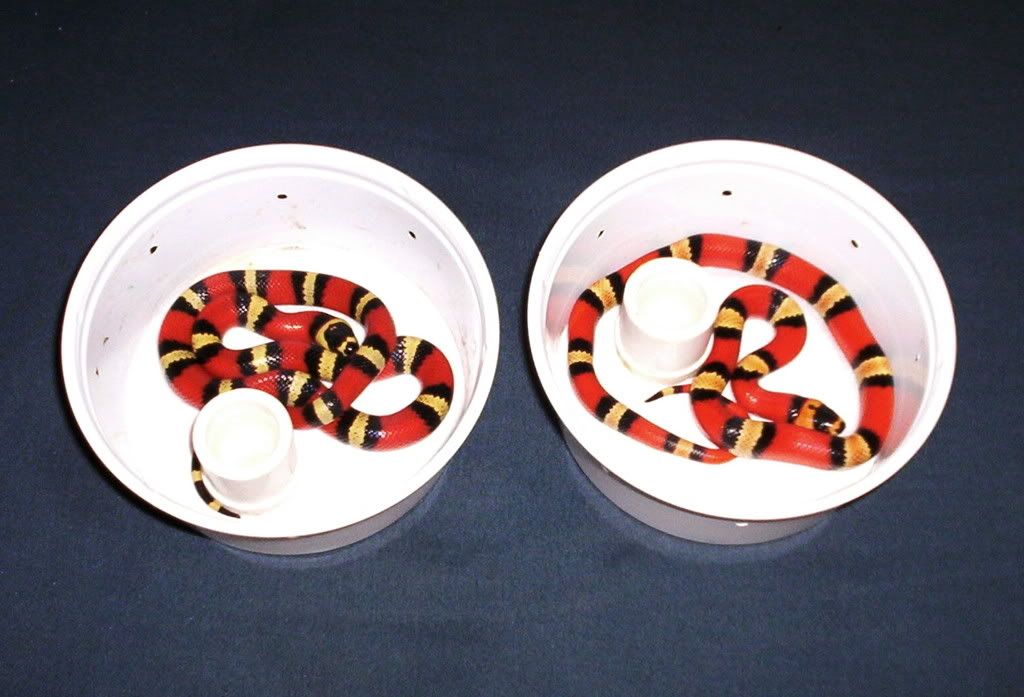
I think in grass, and leaf litter, tri-colored snake's ringed pattern helps greatly in breaking up their silhouette, making them much more cryptic than in the bottom of a twenty gallon aquarium at a pet store, especially in the low light situations you mentioned. Look at a tiger,....they stand out like a sore thumb out in the open by themselves, but put them in some tall brown grass like what's in their native environment, and they friggin' disappear!...it's all about how light and shadows play on each other, and the way an animal perceives the two.

See!,....notice how these two milksnake's practically disappear in the bottom of their deli cups!..LOL!!!

~Doug
Image
-----
"Better to be silent and thought a fool, than to open mouth and remove any doubt!"

CKing Jun 12, 2008 09:03 AM

>>I don't have mockingbirds here but you Florida guys have shrikes, jays and mockers all over your yard. Try this with the kids:
>>collect some half inch dowels or conduit pipe and paint them in mono, bi, and tri colored patterns and see how the birds react when the models are placed near the nest or favorite feeder.>>

Why not use the real thing? Tricolored snakes are commonly found in pet stores. If a scientist really really wants to do a meaningful experiment, he can walk into just about any pet store that sells reptiles and buy a tricolored kingsnake. If the warning coloration hypothesis is correct, then he won't need more than one snake. OTOH, it can get pretty expensive quickly if he has to keep getting new ones to replace those that have been maimed or killed to continue his experiment. LOL.

>>I have a published study somewhere in the house that was done years ago with painted dowels and the results boiled down to more bands, more fear. Birds ignored the mono color, 50% were stressed at the bi color model and 100% were alarmed/agressive to the tri-color model.>>

So, birds are afraid of painted sticks. Wow! Very informative experiment! Now, let's try the same experiment with hawks and live snakes, if the scientist can get a large enough grant from the government that is. It would not be pretty to see the hawks gobble up these frighteningly expensive tricolor snakes. Sticks are cheaper, but I think a bird, any bird, can probably figure out that the sticks are not snakes.

>>If we had hawks to work with, it would be ideal. Anybody keeping a hawk or two or have a nest in the back yard?
>>Jeff

Yes, a hawk would be an ideal experimentalal subject, since it would almost certainly put to rest the very idea that the tricolored kingsnakes have warning colors. If the hawk can talk, it may say something like "yum yum red." LOL. So far, I have not seen any scientist experiment with hawks and real life tricolored kingsnakes. I wonder why? Are they afraid of what they may observe?

As a substitute for hawks, I suggest trying the same experiment with domestic chickens and tricolored kingsnakes. The results would not be very pretty, at least for those who have to pay for the snakes and those who support the coral snake mimicry theory.

Site Tools