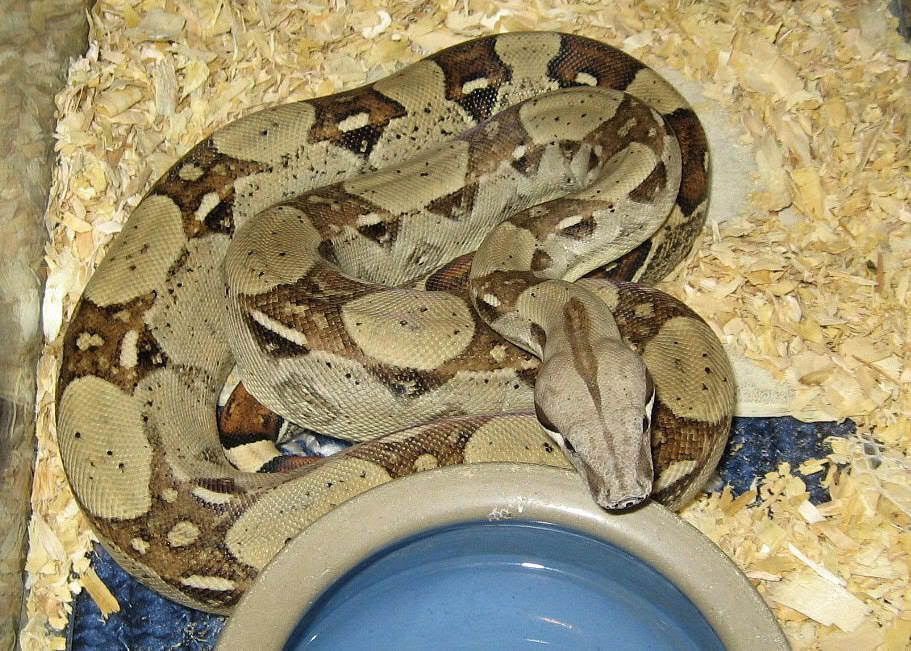
Just wondering if anyone could tell me what type of boa this is or if it is het for something, it has alot of pink, dont know if you can tell from pic, its whole belly is very pink.
JSbarnwell

Reptile & Amphibian Forums
Welcome to kingsnake.com's message board system. Here you may share and discuss information with others about your favorite reptile and amphibian related topics such as care and feeding, caging requirements, permits and licenses, and more. Launched in 1997, the kingsnake.com message board system is one of the oldest and largest systems on the internet.


Type of boa
jsbarnwell
May 08, 2008 02:32 PM
Replies (12)
chrish
May 08, 2008 03:19 PM
Many boa constrictors are pink on the sides and belly. It is quite common in some parts of their range. I don't think it represents any particular region of their range or morph, some are just very pink. I have sound quite pink animals in southern Mexico.
If you post this on the Boa forum, you are sure to get more detailed answers.
-----
Chris Harrison
San Antonio, Texas
DMong
May 08, 2008 04:05 PM
That's a common Colombian Boa Constrictor(Boa c. imerator), As Chris mentioned, it is quite common for them to exhibit some pink coloration along their sides, and ventral surface. They typically get darker with age as well.
No way to tell if it's heterozygous for anything by looking at it though.......but it looks nice!
Here's a young female Colombian Boa of mine, she was extremely light gray as a baby, and has darkened up some since then, she's about eight and a half pounds now.
best regards, ~Doug


-----
"Better to be silent and thought a fool, than to open mouth and remove any doubt!"
DMong
May 08, 2008 04:06 PM
n/p
-----
"Better to be silent and thought a fool, than to open mouth and remove any doubt!"
chrish
May 08, 2008 04:27 PM
I always thought imperator was diagnosed by the presence of the crossbar between the eyes. Mind you, its been 20 years since I did any reading about boa taxonomy and there wasn't much good available back then.
Here's an imperator from Mexico (with crossbar)

and one from Panama (again, with crossbar)

Are some Colombian boas considered B.c. constrictor? By what I remember, yours would be an intergrade if it isn't B.c. constrictor.
-----
Chris Harrison
San Antonio, Texas
DMong
May 08, 2008 09:56 PM
Chris,.....As you probably know, the problematic name "imperator" has an EXTREMELY large, very generalized range. The more northern forms of imperator(mexicana) can typically have the cross-bar marking on the head, but many Latin American/South American forms do not.
I don't really specialize in boas as I do different forms Lampropeltis, etc... but I do know enough about them to know their taxonomic status can be highly problematic and variable, and without locality data, it can be very tough to get an exact "handle" on some of their geographic lineage.
As to the question if the one I had pictured is an intergrade, well, it's not an imperator from Mexico(mexicana?), and it ain't from the Amazon Basin(true red-tails, i.e. constrictor, or a number of many other ssp.), actually, I don't even have a clue as to where it came from, or who might have bred it, because I traded it from a local pet store for an Andean Milksnake breeder I no longer needed, for the newly born female Boa, because I had a lone Adult Colombian Boa here for years doing absolutely nothing, so I wanted a reasonable mate for him.
All I really know is that she is a more southern form of imperator than the Mexican race, but not a "Boa c.constrictor" per se from Suriname, Guyana, etc..., or any of the other ssp.
best regards, Doug
-----
"Better to be silent and thought a fool, than to open mouth and remove any doubt!"
mike1234
May 08, 2008 11:24 PM
it looks like a coloumbian with those colors, but i cant promise im right. it isnt het for anything though. my female coloumbian has a lot of pink, and my male has a lot of orange, but they will produce normal babies when they reach maturity.
viborero
May 09, 2008 08:08 AM
....every Colombian Boa I ever had would have their belly turn very pink right before a shed.
It is impossible to know at a glance if a snake is het for something by the very nature of the term. Homozygous means that the trait (amelanism, anerythrism, genetic striping, etc...) is visually expressed, while heterozygous means the trait is carried in the genetic code, but not visually expressed. The only way to know that is to have reliable information from the breeder, which I can assume you don't have.
-----
Diego
anuraanman
May 09, 2008 10:34 AM
Technically it would be possible to tell if an individual were het for something IF that trait was dominant. Pretty much every trait that people breed for in morphs is recessive though so practically speaking people are correct whey they say, "no, you can't tell". In most cases where there is a dominant gene though you can't tell if it's het specifically as the same phenotype would also result from homozygosity -- you would only be able to tell that it has at least one copy of that gene. I can't think of any snake examples but there are some genes where having one copy of a dominant gene (het) results in a trait being expressed and having two copies of a gene increase that trait's intensity. I forget what the word for that is called.
natsamjosh
May 09, 2008 01:42 PM
Hypo-melanism in Boa Constrictors is a phenotype that occurs when only one of the alleles is the hypo mutation. There seems to be some controversy over whether it is dominant or incompletely dominant. Regarding the term you forgot, I like the term incomplete dominance, but some use the term co-dominance. It can be pretty confusing since different people and different textbooks use those terms differently.
Thanks,
Ed
>>Technically it would be possible to tell if an individual were het for something IF that trait was dominant. Pretty much every trait that people breed for in morphs is recessive though so practically speaking people are correct whey they say, "no, you can't tell". In most cases where there is a dominant gene though you can't tell if it's het specifically as the same phenotype would also result from homozygosity -- you would only be able to tell that it has at least one copy of that gene. I can't think of any snake examples but there are some genes where having one copy of a dominant gene (het) results in a trait being expressed and having two copies of a gene increase that trait's intensity. I forget what the word for that is called.
anuraanman
May 09, 2008 03:39 PM
Ah! I think I was taught it as "co-dominance" but incomplete dominance is a term I had forgotten as well. Thanks for reminding me 
Kiley
viborero
May 09, 2008 04:38 PM
Sure, like the Salmon/Super Salmon gene. For the purposes of this post I figured I'd keep it simple. 
-----
Diego
jsbarnwell
May 09, 2008 03:09 PM
His belly is always very pink, more so after a shed actually, I will try to post a pic later.
jsbarnwell
