This thread I suppose is partially to vent, partially to show what I found, and partially to ask the opinions of those who have more experience than myself. As was posted on an eariler thread, I lost a boa to God knows what. No warning, no lingering illness, no malfunctions in heating or caging....just instant death. I have had necropsies done before at the University of Penn Vet Clinic but I was told that they only did them on "current patients" of specific doctors there and NOT just on the basis of immediate need. As a result I opened her up myself. This is what I found.
.
Her
.

.
Beginning disection
.

.

.

.
What sucks is that it looks like she took and was gravid. I come to this conclusion as is dark striping on the ova that apprear to be in the beginning stages of developing into snakes.
.

.

.
Liver looks ok
.

.
Stomache...a little small as she hasn't been fed in a couple of months due to breeding.
.

.
This concerned me and perhaps some of you with more knowlege can help me out here. If you noticed in the first couple of pix there was a pretty good amount of fat deposits. Well here is the heart and I am no expert, but, does this ammount of fat around the heart look normal?
.

.

.
Not sure how much I learned except that I didn't get skunked this season, she just didn't have a chance to drop them. Looks like only one side ovulated too (which may explain why males were still interested in her). The fat deposits were a bit disturbing but I am not sure if they are in the normal range. I found no tumors like the doctors did on Pandora when doing her necropsy. Any opinions would be appreciated.
.
Thanks for the long read.
-----


Reptile & Amphibian Forums
Welcome to kingsnake.com's message board system. Here you may share and discuss information with others about your favorite reptile and amphibian related topics such as care and feeding, caging requirements, permits and licenses, and more. Launched in 1997, the kingsnake.com message board system is one of the oldest and largest systems on the internet.



Necropsy (EXTREMELY GRAPHIC)
Replies (13)
I have no comment on the looks of things as I have never opened one up. I did want to say sorry for your loss and although I am sure it was difficult, I think you did the right thing by trying to find out what went wrong.
I have found that many Vets do not cater to reptiles- and some that will, really only have a shallow understanding on how they are put together.
I was wondering if you took any additional pictures when she was open towards the end by the cloca. I had issues this year as well and I tried to intervene and help, but I could not find any documentation that really showed how things were connected.
Sorry again for your loss.
-----
Thanks
Shawn Morelan
www.Southernboids.com

Thanks for the condolences. Didn't do much near the cloaca other than feel for anything blocking the opening. It was clear and appeared to be normal. Didn't see worms or other parasites.
-----
Hi Shawn,
This picture may help you a little. Brett Gardin let me use his pictures on my site for a Boa Anatomy page I made a few years ago.
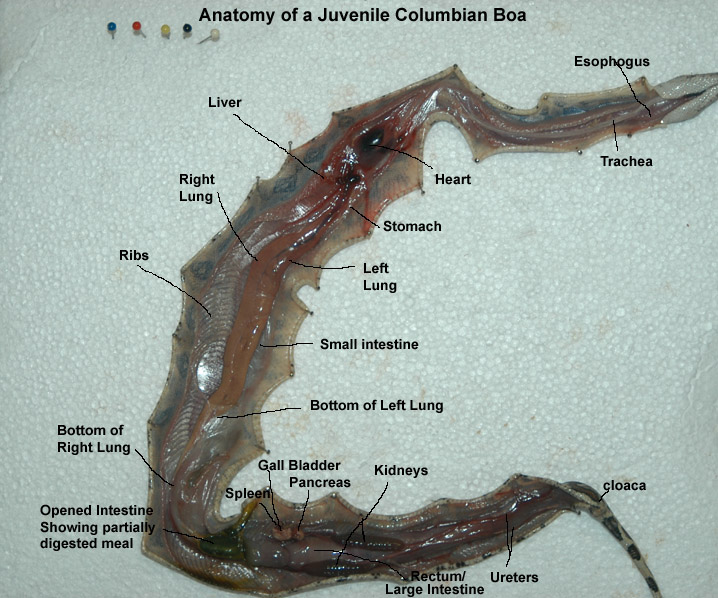
There are more anatomy pictures at this link too. http://www.mccarthyboas.com/AnatomyPics.html
Take care
Tom
-----
McCarthyBoas.com
Thanks for that,This can be a great help for me!
. . . . . . . . Lar M
-----
Boas By Klevitz
Sorry for your loss. She certainly did not look obease or unheathly from the outside. It would be interesting to compare the amount of fat deposits a large group of boas in the wild to the amount in most snakes in captivity. I wonder if what we consider as normal feeding is too much for our boas...???? Just wondering - I'm a CPA not a doctor so I don't know more than any body else in this hoppy.
She was a really nice boa and as I said above looked incredibly healthy from the outside. I'm sorry again for you losse.
Kevin
I am sorry for your loss. I have had the experience of a gravid female dying several times with no obvious cause of death. In people autopsy usually does not show an acute cause of death. When an acute cause is present it is usually an acute heart attack with arterial blockage, a massive pulmonary embolism, an aortic dissection,a ruptured aneurysm or a massive intracerebral hemorrhage.
I have never seen any acute cause of death in the females I have autopsied that were gravid. I suspect that they harbor some kind of low level infection that takes off with the immunosupression of pregnancy. Other than an obvious respiratory infection I am not sure what signs of a growing septicemia in a snake would look like. Sometimes they have funky urates which I think is usually blown off as a manifestation of pregancy but may represent something more like a kidney infection. I have heard of mucosal hemorrhages in the GI tract of some females which I believe would be of an infectious etiology although it could have been ischemic damage.
I don't know if there is any correlation between slug litters and death in subsequent pregnancy. The stress of delivering a slug litter in some females may cause subtle anatomical injuries that result in weakened structures or areas more likely to become infected.
It would be interesting to hear from other breeders who have had similar experiences if they noted any unusual behavior or had documneted previous pregnany failures in females that went on to die during pregancy.
Again sorry for your loss.
Bill Kirby
Hey Dank, sorry for the loss man. That's a shame.
In answer to your question, no the heart ain't supposed to be encased in fat. My first Suri died suddenly around 8 yrs /- and we opened her up in Biology class, and she looked a lot like that. Except mine also had fat deposits around the liver as well. Her heart was totally encased, and we actually didn't find it at first.
That was like 1984, and to be honest, I never speculated as to the cause back then. But yours ain't the first to come along and remind me of my case. It has me thinking now.
You think maybe a diet thing? What are you feeding? I'd like to hear more if you get more to tell.
Sorry again for your loss.
Rick
While the heart may not be supposed to be encased in large amounts of fat the body naturally deposits fat around the heart, kidneys, and in the pelvic cavity for protective reasons so their is always some. It's referred to as the KPH percentage and is used in yield grading in food animals. Obviously obese animals often have large amounts of KPH fat, but they are currently doing studies in people as to why some thin people still have a high percentage of epicardial fat. It can certainly contribute to cardiac pathologies, but doesn't always. It's something that would probably aide in a diagnosis if there were more clues like arteriosclerosis, vascular plaque, etc, but alone is rather insignificant.
wouldn't that fat, that's supposed to be present, be more like marbled throughout, rather than layered?
Ken,
...I have opened up quite a few dead boids including some gravid ones. I see a dead snake and/or a bad Python egg as a learning tool and we are not going to learn much unless we open them up to see what we can find. One of them that I dissected was a large gravid Bci and your PICs look almost exactly like how she looked. It is really tough seeing all those clean healthy looking masses in the oviducts. Most seemingly healthy well nourished adult boids have fat deposits around the heart. I think some fatty deposit there is normal but I have no real idea what amount is healthy and what is too much. In your sixth PIC I notice a dark area and a nearby greenish stain at the very left edge of the PIC? If that is down near the gallbladder or bile duct and you knicked either of them cutting her open then it is probably normal but if not it might be an indication of some sort of pathology. Other than that everything looks good. The first two possible pathologies that come to mind in seemingly healthy gravid boid deaths are infections and blood clots. Gravid boids are likely at increased risk for both of those. A blood clot can end up in the heart or lungs or brain and kill an animal very quickly. A clot somewhere else in the musculature or organs can lead to death but should cause some ischemic damage with visible bruising or organ breakdown along the way so that when you open the snake up something would look discolored or possibly bloody or rotten looking. I think many of us are to the point in this hobby where we can keep boids healthy long term without many problems until we start breeding them. The stress of reproduction with all that energy/fat being converted to babies puts more strain on the snake and so when we do have problems it is often related to reproduction. Having a gravid one that seems healthy like yours just up and die can be VERY frustrating.
Jeff
>>This thread I suppose is partially to vent, partially to show what I found, and partially to ask the opinions of those who have more experience than myself. As was posted on an eariler thread, I lost a boa to God knows what. No warning, no lingering illness, no malfunctions in heating or caging....just instant death. I have had necropsies done before at the University of Penn Vet Clinic but I was told that they only did them on "current patients" of specific doctors there and NOT just on the basis of immediate need. As a result I opened her up myself. This is what I found.
>>.
>>Her
>>.
>>
>>.
>>Beginning disection
>>.
>>
>>.
>>
>>.
>>
>>.
>>What sucks is that it looks like she took and was gravid. I come to this conclusion as is dark striping on the ova that apprear to be in the beginning stages of developing into snakes.
>>.
>>
>>.
>>
>>.
>>Liver looks ok
>>.
>>
>>.
>>Stomache...a little small as she hasn't been fed in a couple of months due to breeding.
>>.
>>
>>.
>>This concerned me and perhaps some of you with more knowlege can help me out here. If you noticed in the first couple of pix there was a pretty good amount of fat deposits. Well here is the heart and I am no expert, but, does this ammount of fat around the heart look normal?
>>.
>>
>>.
>>
>>.
>>Not sure how much I learned except that I didn't get skunked this season, she just didn't have a chance to drop them. Looks like only one side ovulated too (which may explain why males were still interested in her). The fat deposits were a bit disturbing but I am not sure if they are in the normal range. I found no tumors like the doctors did on Pandora when doing her necropsy. Any opinions would be appreciated.
>>.
>>Thanks for the long read.
>>-----
>>
Again, I put this series of pix out there to see if anyone's opinions could shed some light on this loss. I tried to get the "professionals" to help out around here and found no luck (even though they had done it for me before). Thanks for the input. All opinions are welcome at this point. Just wish I could have gotten a TRUE vet to do the necropsy for me. It could have prevented alot of speculation on my part.
-----
Sorry for your loss. I too sufferd the same loss of one of my Nics. All similar circumstances to you. She was 12 days over her POS, next day I found the poor animal as in the pics.
I decided to open her up - just in case there were any babies there. I did notice- (if you look carfully)Maybe one or two of the "slugs" look they are bad- maybe damaged. If this was the case, is it possible that they could have poisned her some how.?
Alan

Sorry hit enter key too early. - Other picture

