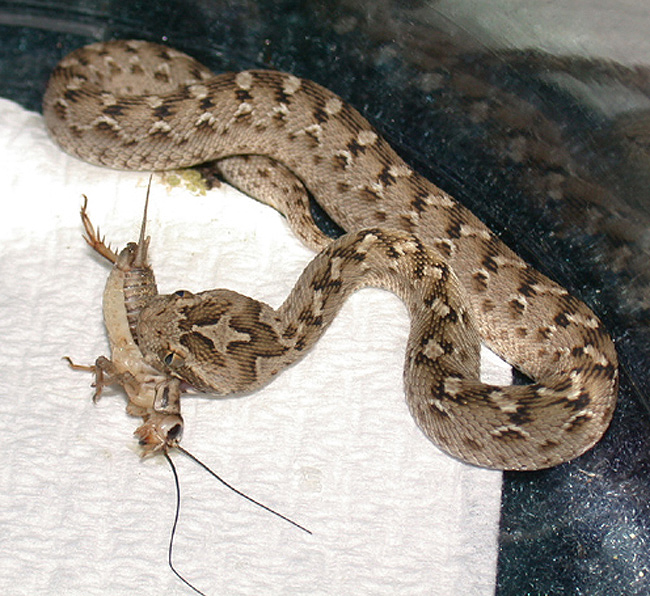
I posted question a while back asking if anyone had suggestions on feeding the baby saw-scaled vipers born at our refuge. I got a reply suggesting warmed pink and someone else suggested a technique thy had used of pinning the snake between 2 sponges (to small to hold safely) and annoying them with pinky parts until they bite the defensively. They showed no interest in pinks, they just seemed scared of them and while I was able to get a few defensive bites with the sponge trick, they just held on long enough to make sure they were dead and then spit them out. Pinks left in thier containers over night went uneaten.
Nothing was working and these guys had gone through the first few weeks of thier life without eating so I was getting a little worried. I scrounged the web for info and didn't find a single comment about feeding neonate saw-scales in captivity (or closely related species).
I was off onto other things and got to reading a study about the feeding habbits of black racers which said that even young adults seemed to eat mostly insects in the wild. Whenever I have read about a news snake I'm researching "insects" are usually included in the list prey items, but I always sort of assumed they were a last resort if they couldn't find anything else. I'm not sure why I thought that other that the fact that I've NEVER heard of anyone feeding insects to a snake. So that started me thinking abou the saw-scales. How often could a desert snake come across baby mice? What would be more common? Insects... So off I go to the pet shop for some crickets (they don't have much of a selection of insects) to give them a try.
The first saw-scale takes one right off the hemostats! It takes him a while to kill it, but then he eats it while I watch! The others were a little less enthusiastic, but when I leave the room one other is eating and by the end of the day four more have eaten the ones left in thier containers. So, now 6 of 8 have eaten for me and I'm a happy guy.
Sorry for the long post, but I thought some people might find this useful/interesting. I'll try to get a pic of one of these guys eating a cricket next time.

Photo gallery
-----
Larry D. Fishel
Side effects may include paralysis
and death but are generally mild.
 Hope the remaining two get with the progam! I wish you the Best of luck with them!
 Are these eight neonates E. carinatus?