Reptile & Amphibian Forums

Welcome to kingsnake.com's message board system. Here you may share and discuss information with others about your favorite reptile and amphibian related topics such as care and feeding, caging requirements, permits and licenses, and more. Launched in 1997, the kingsnake.com message board system is one of the oldest and largest systems on the internet.

Click here for Dragon Serpents
https://www.crepnw.com/
Click for 65% off Shipping with Reptiles 2 You

kingsnake id

rangeramy May 27, 2008 04:53 PM

Sorry I don't have any info except that these are all siblings (3 in pic) and they were called 'California kingsnakes'. Call me a newb, but I don't think that's right. Can anyone help me id these snakes? they are in captivity, so my geographic region doesn't help-- sorry!

Thanks!

Amy in AZ

Link

Replies (9)

herpsltd May 27, 2008 05:13 PM

They look like Variable Kingsnakes [ Lampropeltis m. thayeri]....TC....gotcha again Dmong...

rangeramy May 27, 2008 05:24 PM

Cool. Thanks for the quick id!!

Would it be correct to say they're a subspecies of Gray-banded?

DMong May 27, 2008 05:53 PM

Well, Nuevo Leon Kingsnake's(Variable Kings) are basically in the same "complex" as Gray-Banded Kings, but "Gray-Bands" are actually now fairly recently classified as their own species(Lampropeltis alterna), whereas they used to be taxonomically classified as one of the three mexicana complex, and scientifically known as Lampropeltis mexicana alterna, with two phenotypes(looks), blairi, and alterna, with variations also being intermediate between the two. The Durango Mountain King(Lampropeltis mexicana greeri) is also another of the three within this complex, and they are ALL very closely related.

The name "Variable King" is quite fitting for these animals, as even several animals from within the same given clutch can have very different looks, as the photo also suggests, they can even come in a solid black melanistic form.

Tom was correct in his ID, and those are indeed Variable Kings(Lampropeltis mexicana thayeri), otherwise known as Nuevo Leon Kingsnakes because of their natural range in and Nuevo Leon, Mexico and the surrounding areas.

best regards, ~Doug
-----
"Better to be silent and thought a fool, than to open mouth and remove any doubt!"

rangeramy May 27, 2008 07:01 PM

Great. Thanks for the thorough info. I like this kind of technical stuff.

Now...if only I had grabbed those snakes sooner --I'm sure they're gone already, they were up for sale at $25 apiece yesterday on craigslist...but I didn't know what they were! Silly me!

chrish May 29, 2008 07:31 AM

whereas they used to be taxonomically classified as one of the three mexicana complex, and scientifically known as Lampropeltis mexicana alterna, with two phenotypes(looks), blairi, and alterna, with variations also being intermediate between the two. The Durango Mountain King(Lampropeltis mexicana greeri) is also another of the three within this complex, and they are ALL very closely related.

This group is actually more complex than that. While alterna was brought out from the rest of the mexicana group, there are serious questions about whether it should be in many people's mind.

So while the "traditional" taxonomy lists Lampropeltis alterna plus three subspecies of Lampropeltis mexicana (mexicana, greeri, thayeri), there is a separate species that was described a few years back from coastal Sinaloa (Lampropeltis webbi), an undescribed form from the mountains of NE Mexico, and then there is the issue of where Lampropeltis ruthveni fits in this whole mess!

I suspect the taxonomy of these "mexicana" snakes is going to change in the next few years as people are actively working on trying to sort it out. Anyone trying to write a book on Mexican Kingsnakes should write it in pencil for the time being!
-----
Chris Harrison
San Antonio, Texas

DMong May 29, 2008 10:30 AM

Oh!,...I absolutely agree with everything mentioned, the whole group is very problematic. I used to breed a number of these animals some years back, and was quite amazed at the taxonomic unstability of these animals.

Yes,..the "ruthveni" thing as well, also being removed from mexicana some years ago, and described as it's own species.

Then you have ruthveni also being sold in the hobby as Jalisco Milksnakes(arcifera) etc..., whereas the "Lake Chapala" animals are the "true" Jalisco's, and are extremely rare in the hobby.

Yes, I'm fully aware of the problematic nature of mexicana as a whole, as well as ruthveni, but I certainy didn't want the original poster to be more confused by adding any of this to the post.

I couldn't agree more with your comment on any future authors writing their books in pencil!..LOL!

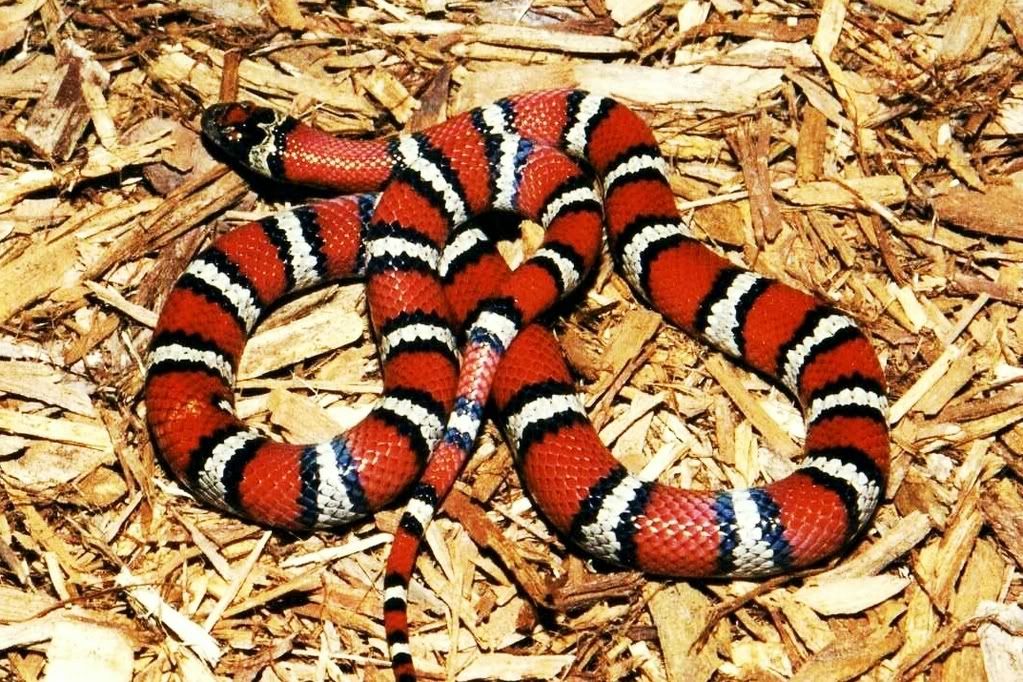
Here's a couple that I produced in the past.

best regards, ~Doug

-----
"Better to be silent and thought a fool, than to open mouth and remove any doubt!"


DMong May 29, 2008 04:07 PM

n/p
-----
"Better to be silent and thought a fool, than to open mouth and remove any doubt!"

DMong May 27, 2008 05:59 PM

You're quick with the "buzzer" today,....like on the game show "Jeopardy"!..hahaha!,.....and of course, the correct ID as well!

~Doug
-----
"Better to be silent and thought a fool, than to open mouth and remove any doubt!"

Orocosos May 27, 2008 10:11 PM

Not a Cal king. It looks to be like a L. mexicana thayeri or greeri. I'm not exactly sure which one, but the advertisement as a Cal king is incorrect. Thayeri are nice snakes though.

Site Tools