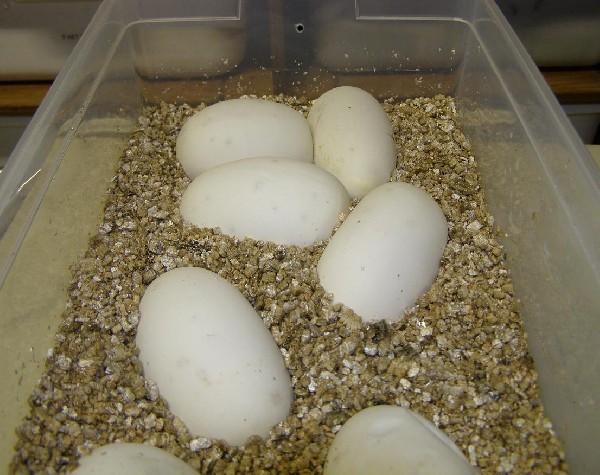
My eggs are looking bumpy. Could it be humidity.
Temp 89
Humidity 70%
?
Thank you
Reptile & Amphibian Forums
Welcome to kingsnake.com's message board system. Here you may share and discuss information with others about your favorite reptile and amphibian related topics such as care and feeding, caging requirements, permits and licenses, and more. Launched in 1997, the kingsnake.com message board system is one of the oldest and largest systems on the internet.


Proper humidity for eggs?
insomthegreat
Jun 01, 2008 10:57 PM
Replies (13)
toshamc
Jun 01, 2008 11:10 PM
Good to shoot for close to 100% humidity - somewhere in the nineties will work tho.
-----
Tosha
JET Pythons

insomthegreat
Jun 01, 2008 11:18 PM
How can I raise the humidity in my incubator?
I would google but I got 2 hours of sleep because I had to build my incubator in 1 day because I didnt think the eggs would come.
I built this to the "T".
file:///C:/Documents and Settings/Owner/Desktop/view.php.htm
I gotta work tomorrow this is getting out of control.
Thank you
insomthegreat
Jun 01, 2008 11:26 PM
Link proably wont work unless your somewere in my house using my computer since its on my desktop.
The guys name was BrandonSande Diy Incubator but I cant find it now.
tomsey
Jun 02, 2008 05:09 AM
>>How can I raise the humidity in my incubator?
Don't raise the humidity in the incubator, raise it in the egg container that sits in the incubator.
Just put a piece of plastic wrap over the top of your plastic egg container and then put the lid on. This will hold the humidity in.
What are you using for egg substrate?
How do you have your eggs set up now in the incubator?
insomthegreat
Jun 02, 2008 10:00 AM
Im using perlite. the eggs are not touching the subtrate they are on a piece of eggcrate
http://www.jcs-lighting.co.uk/images/uploads/Louvre_Eggcrate.jpg
The eggs look like they have a bad case of acne? Thick and then thin shell.
insomthegreat
Jun 02, 2008 10:05 AM
I put plastic on top of the box and then put the top back on last night after seeing ralph davis on youtube but the humidity is still 70. Might be the perlite or maybe they should be touching the substrate?
mikebell
Jun 02, 2008 11:15 AM
Humidity is extremely hard to measure accurately. I don't think any small hygrometer will do an accurate job. If you have them on egg crate OVER WET perlite, you have 100% or near humidity. Humidity isn't the issue. Can you post a pic. It isn't rocket science.
Mike
insomthegreat
Jun 02, 2008 12:55 PM
It doesent matter how much water I add to the perlite since the eggs are not touching it rite.
I think im good, the eggs just look spotty but they are fat and plump.
mikebell
Jun 02, 2008 01:01 PM
If your eggs are on egg crate and above the perlite and water it should be wet. The only thing the perlite does in this case is keep the water from sloshing around when you pick up the box. Plain water would work just fine if you could keep from sloshing it on the eggs, which would be very hard to do. If your eggs are plump, humidity is fine.
kingofspades
Jun 02, 2008 02:21 PM
I have my set up like that, with the eggs on crate...and my humidity gauge reads only 40%, but my eggs are nice and plump, even with only 6 days left before pipping!
-----
"What is man without the beasts?
If all the beasts were gone,
men would die from great loneliness of spirit.
For what happens to the beasts,
soon happens to men.
All things are connected."
-Chief Seattle (Duwamish Tribe)
fgs
Jun 02, 2008 09:35 AM
I incubate my ball python eggs using a small lidded plastic shoe box. I drill a 1/8 inch hole at both ends of the shoe box. Location is not important as long as the holes are above your nesting material. I weigh the plastic box and zero out it's weight. I then place and weigh vermiculite so that it is about two inches deep. I then add the same amount of water by weight to the vermiculite. Then mix both contents by hand. Place the eggs onto the vermiculite so they are slightly sumberged.
Set your incubator at 89 degrees and wait. You should have a healthy group of baby ball pythons between 55 and 60 days.
If you have any specific questions you can reach me on my cell at (408)981-6694.
Don't worry about adding more humidity creat your own.
Best of luck
Brian
-----
Brian Gundy

www.for-goodness-snakes.com
BrandonSander
Jun 02, 2008 04:35 PM
Like some of the others have said, with the egg crate method, the great thing is there is no guess work involved in the amount of water you need.
You can over saturate the perlite or vermiculite without worrying that it may adversely affect the eggs since they are drawing the necessary humidity from the aid not the substrate. As the humidity in the air is removed the evaporation of the water in the substrate will replace it.
Purchasing a better quality hygrometer and ensuring it's proper placement will help you determine a more exact reading on the amount of humidity you actually have. Some hygrometers will not read above 90% others may have a lower reading level. Be sure that the probe is not touching anything. If it touches the egg crate, side of the tub, or substrate you may over saturate the probe and you will get an inaccurate reading. Use suction cups to attach it to one of the sides of the tub and be sure the probe isn't touching anything for the best reading.
I've had bumpy eggs like you are describing. They come out fine, but within a day or two they develop these thick, irregular bumps in some areas and in others it seems as if the shell is thinner than it should be... kind of like all of the calcium was pulled from the thin areas and gathered into thick little "piles". Don't worry about this, I've had it happen in the past and all of my eggs hatched just fine. Like the others said, as long as the eggs are candling okay and are plump you shouldn't have anything to worry about. Treat them like ordinary eggs.
robyn@ProExotics
Jun 02, 2008 05:39 PM
humidity and the visual calcification of your eggs are two entirely separate things.
you want very high humidity in the incubator. wet air, but dry eggs.
as for the weird calcification, which is what it sounds like, without a pic, it happens in some clutches, right from the jump. it isn't what i WANT to see, i would rather see perfect smooth, white leathery eggs. but those clutches hatch out just fine in proper incubation conditions.
-----
robyn@proexotics.com

