Reptile & Amphibian Forums

Welcome to kingsnake.com's message board system. Here you may share and discuss information with others about your favorite reptile and amphibian related topics such as care and feeding, caging requirements, permits and licenses, and more. Launched in 1997, the kingsnake.com message board system is one of the oldest and largest systems on the internet.

Click for ZooMed
Click here to visit Classifieds

Feeder question...

Jonathan_Brady Jun 18, 2008 09:28 PM

Historically, I've always fed my boas rats as soon as they could handle the littlest pink rat I could find. I'm starting to wonder if I should go through the mouse spectrum first and the reason I'm wondering that is all the evidence out there that fat rats cause digestion problems in boas.

My thoughts are this:
If you compare an adult mouse to a rat pup (the two are approximately the same weight), the mouse is (in theory - and I could be wrong on this as I have no data to back this assumption up) the leaner of the two. Which makes me think the mouse may be the better, more nutritional prey item for a boa due to the lower fat content.

I'm looking for feedback on this theory. Thoughts?
jb
-----
Jonathan Brady
*You have the right to remain silent. Anything you say will be misquoted, then used against you.*

Replies (17)

LarM Jun 19, 2008 03:54 AM

One of the online rat feeder suppliers has a chart that shows nutritional value for each size mouse and rats. Rats come out with more nutritional value on the chart looked like to me. Problem is I don't remember which supplier had the chart,LOL.
. . . . . . . Lar M
-----
Boas By Klevitz

Jonathan_Brady Jun 19, 2008 07:59 AM

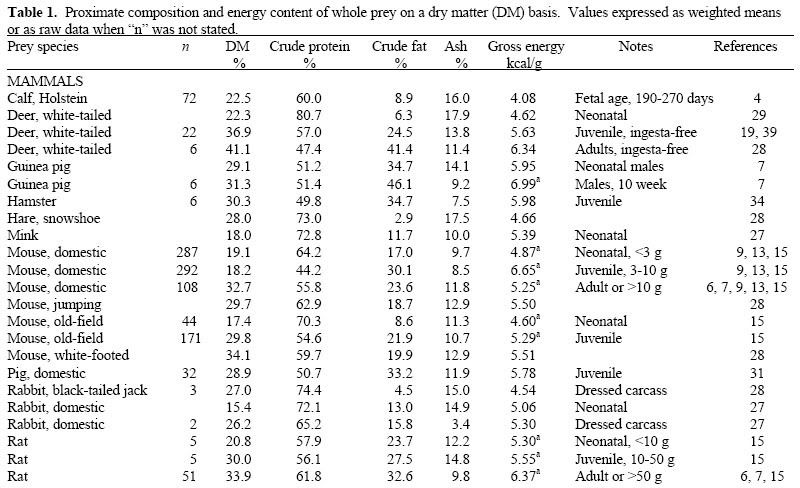
Here we go. Found this on the following site:
http://www.nal.usda.gov/awic/zoo/WholePreyFinal02May29.pdf

It looks like based on crude protein % and crude fat %, mice weighing between 3 and 10 grams are the best for boas. Mice over 10g show about equal ratios as similarly weighted rats. However!!! Rats at that size do have bellies full of moms VERY FATTY milk, so this could pose a problem (and based on the experience of some people I've talked to since posting the original thread yesterday, DO pose a problem) for baby boas. The problems experienced are runny, clay-like stools and regurg.

The recommendation I received was to start on mice, feed mice until they are no longer an adequate meal for a boa, then switch to small rats weighing approximately 70 grams. With this feeding regimen, the runny stools and regurg are supposed to clear on their own. I've never had the regurg problem (probably because I space out my feedings) but I have experienced the runny stools and just attributed it to a baby boas underdeveloped/underutilized GI tract.

Thought the info I gathered was helpful and that it may be helpful to others.

_______________The above is just opinion and anecdotal evidence, except for the chart posted, that's science! lol____________

jb
-----
Jonathan Brady
*You have the right to remain silent. Anything you say will be misquoted, then used against you.*

Jonathan_Brady Jun 19, 2008 08:06 AM

oh, it also looks like guinea pigs and hamsters are OUT! But rabbits are a great source for boas based on the protein to fat ratio.

By the way, anyone know a reputable MINK dealer with good prices? :D
-----
Jonathan Brady
*You have the right to remain silent. Anything you say will be misquoted, then used against you.*

kcpits Jun 19, 2008 01:45 PM

Hey Johnathan you know you might be on to something there I would think we could buy skinned minks pretty cheap LOL...
Joel

LarM Jun 19, 2008 01:03 PM

Glad you found one of the charts. I personally like to feed apropriate sized mice until the Boa outgrows the mouse as a good food sized item. I've tried pinky rats with some young Boas but mice work better more completely digested stools. The real interesting thing to me seems to be as soon as the Boa reaches the size to handle the small rat, I switch a Boa over to Rats. They seem to have a huge increase in growth at that point.
. . . . . . . Lar M
-----
Boas By Klevitz

natsamjosh Jun 19, 2008 03:32 PM

Good post. I've used that prey analysis also, and I think
it is very relevant/important not just for boas, but for other snakes that might consume an even lower fat diet in the wild than
wild boa constrictors. For a snake that eats mostly
reptiles/fish/amphibians in the wild (ie, whose digestive system is honed for a low fat diet), you can see from the chart how
much extra fat a captive specimen would be getting if fed beefy,
farmed rodents.

Thanks for posting this.

Ed

>>Here we go. Found this on the following site:
>>http://www.nal.usda.gov/awic/zoo/WholePreyFinal02May29.pdf
>>
>>
>>

BrownsBoas Jun 19, 2008 09:05 AM

I have always started my babies on hoppers get them feeding well then I offer a rat pup! Once they are eatting both I alternate a rat pup one week and then a properly sized mouse item the next! Variety seems to be a good thing!

Al Brown/Brown's Boas

colubridman Jun 19, 2008 10:44 AM

Johnathan I've always used mice until an adult mouse is not big enough and then went to rats with good results.

-----
Randy Whittington

kcpits Jun 19, 2008 11:42 AM

You are probably correct, I guess it would depend on your feeding program. I personaly feed all my adult boas (B.c.c) one or two xl rats every ten to fourteen days for females and one large rat every fourteen to twenty one for the males. They do not have any problems digesting and are certainly not obese just great muscle mass!! On neo's and sub adults I feed every ten days the appropriate rat and all thrive and grow nicely. Just for your info I did buy guinea pigs once and noticed that after the third feeding on that diet the bowl movements were not at all regular and the stools became very pastey and stinky, so from then on I have only fed rats. I know of someone that tried to save money and purchased a certain bloodline of lab rats that have very high fat content and he had serious problems and lost some snakes as well. All my opinion but I hope this helps
good luck and grow them slow
Joel Thomas

bcijoe Jun 19, 2008 12:22 PM

how mice are 'supposedly' alot easier to digest, especially for a baby boa, and even moreso for baby bcc, which we know can be sensitive to feedings as a neonate.

my thoughts were, I used to not want to even have any mice, and solely use rats, and this worked fine, even having babies starting on rat pinks.

then over time, I realized the babies would thrive better, digest better and quicker, starting on mice.. you wouldn't see those 'half digested poops' at all.

especially with bcc, and smaller, dwarf, and insular bci.

-Joe
-----
Thanks and take care - Joe Rollo
'Tis not the stongest of the species that will eventually survive, nor the most intelligent, but the one most responsive to change' Charles Darwin

geckomill Jun 19, 2008 01:06 PM

Do you think thats related to fiber from the extra fur that a mouse has? I always bounce from rat to mouse and haven't had a problem

bcijoe Jun 19, 2008 04:52 PM

That's one thing, and all the rest of the mouse would seem to be weaker, thinner, smaller, smaller and weaker bones, thinner lined organs, less muscle, and therefore easier to digest overall.

I think the balance of what's in the meal is much better for a young/weak digestive system and for a baby boas growth.

Almost like eating a small balanced meal instead of a large steak alone.

One will burn quicker and more efficiently while the other may linger and actually give you heartburn for a while before it starts to really breakdown, in a much slower way.

Atleast that's what I felt..
-----
Thanks and take care - Joe Rollo
'Tis not the stongest of the species that will eventually survive, nor the most intelligent, but the one most responsive to change' Charles Darwin

workingstiff Jun 19, 2008 08:08 PM

Properly fed BCC,BCA,BCL and BCI ssp there should be no
"half digested poops"from neonates.
Such a thing as never been seen here and never will.

>>then over time, I realized the babies would thrive better, digest better and quicker, starting on mice.. you wouldn't see those 'half digested poops' at all.
>>
>>especially with bcc, and smaller, dwarf, and insular bci.
>>
>>-Joe
>>-----
>>Thanks and take care - Joe Rollo
>>'Tis not the stRongest of the species that will eventually survive, nor the most intelligent, but the one most responsive to change' Charles Darwin

jbn9960 Jun 19, 2008 01:53 PM

I've been using these to raise out a small group of boas, sometimes giving two at a time. They seem to digest these better, smaller less stinky stool. They also seem to be active a day or two later as opposed to being sluggish for 3-4 days. I think these are great, anyone else try these?

Jack

kcpits Jun 19, 2008 02:14 PM

I have not, can you elaborate on size and who supplies them?
Joel

jbn9960 Jun 19, 2008 08:00 PM

Ball python breeders use them especially with finicky eaters becuase they are a natural prey item of the ball. They get to be about 60g so a bit bigger than a large mouse. They rarely cannabalize and will take care of each others young. Very prolific and IMO way less stinky than mice. You can get them at reptile shows sometimes where I got mine and began my colony. Some online distributors offer them frozen but many are out of stock recently.

madisonrecords Jun 20, 2008 10:29 AM

Babies in the wild, are eating frogs and lizards. Those are a baby Boas primary food source.
Once they have graduated to small mammals, sounds like all things should be the same as captivity! Wrong, comparing the captive bred rodents that are fed to our Boas to wild rodents
and wild mammals of appropriate size in the wild, is like comparing; " a N.B.L. team to a group meeting at Over Eaters
Anonymous. "

In the wild, not only do the Boas get more exercise, but even more importantly;" their prey is in great shape! "
Their prey is up and down in trees and always foraging and active
and eating " fruits and berries and nuts and other items that
along with exercise, contribute to a lean and muscular physique. "
In captivity, the prey is locked away in a box to be breeding
factories and raised on mostly high protein chow and have a fat
percentage that is much far greater.

In the end, all the empiricle data and observances that I have
made and talking to others and comprising other data, it stands
to an obvious conclusion; " these boas and do not do well digesting fat. "

Well, you are what you eat and that stands for Boas too.
Now, take a rabbit for instance. I can take a rabbit and
feed it to an adult Boa. Then, I can take two or three large
rats and feed them to another adult Boa. The two to three adult
rats will weigh far less than the rabbit and the Boas are being
housed with the exact same parameters and the Boa that ate the
rabbit, will defecate twice or better as fast, than the one that
ate the rats.
Common sense and does not take countless hours in a lab or a
" Masters Degree " to figure it out.

The rabbit weighs much more than the rats, BUT the rabbit has much less fat and the diet of the rabbit also contributes to
it being a lean animal " most rabbits are raised on alfalfa pellets. "

Rabbits have always shown to put more muscle and length on a
Boa vs. rats adding mass " or for better words, FAT. "
Now, is there a way to make the rats leaner? Sure there is.
You simply need to allow them more room and most importantly give them a diet that comes closer to what they are eating in
the wild.

I know breeders that breed their own rats and the rat chow is
one step away from being " Trail Mix. " You could literally
grab a handful and eat it yourself and his Boas are muscular
and look like they are plugged into a light socket!

I buy my rats, from someone who does the same as mentioned above.
So, fat prey and overfeeding are the contributers to a Boas early
life in captivity. To some, it is about raising them quick and making a buck. For others, they love the Boas and want them to live as long as possible. If you want them to live as long as possible, the answer to making that happen " as so many answers in life " are as plain at times as the nose on your face, common sense...........John J


Site Tools