

Reptile & Amphibian Forums

Welcome to kingsnake.com's message board system. Here you may share and discuss information with others about your favorite reptile and amphibian related topics such as care and feeding, caging requirements, permits and licenses, and more. Launched in 1997, the kingsnake.com message board system is one of the oldest and largest systems on the internet.

Click here to visit Classifieds
Click for ZooMed

Dimpling in eggs

bwaffa Jul 08, 2008 08:16 AM

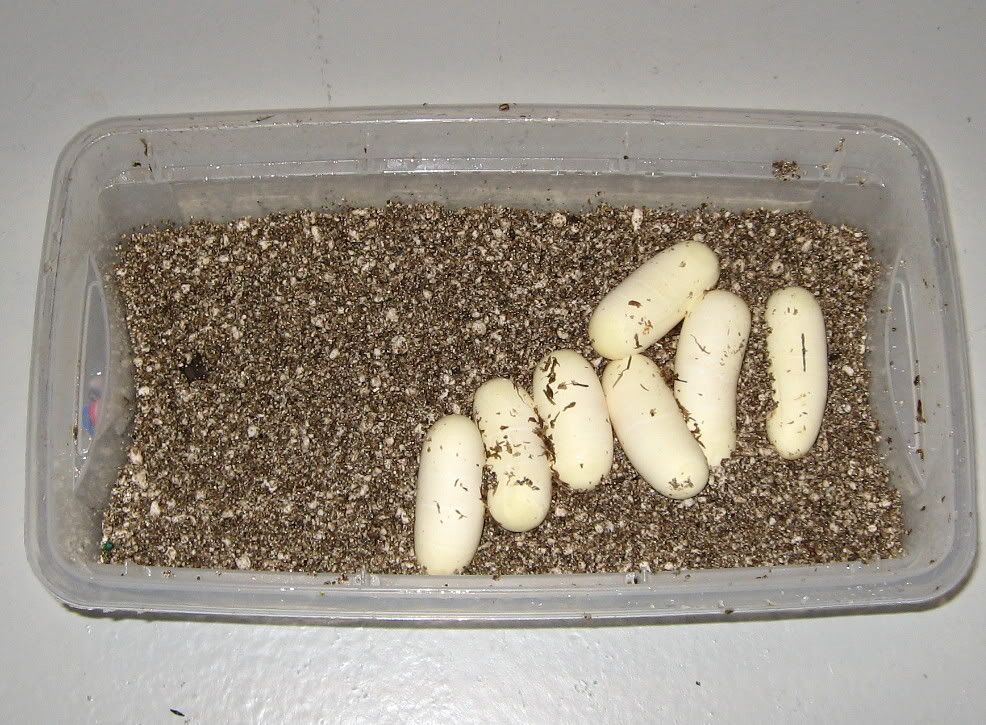
So one of my new snakes decided to drop eggs on me a week after I picked her up from a show. I wasn't planning to breed her for another year (frankly, she's just too small right now), during which time I intended to prepare and educate myself much more than I've had the chance to in the last few days... So unfortunately I'm totally new at this.

I have five unexpected eggs. Two, I'm certain, are not going to make it (i.e. they're virtually green). The other three appear normal in shell thickness and coloration, but two of them are dimpling heavily. The dimples seem to be growing in size.

I've got the eggs on vermiculite in an incubator cycling between 79 F at night and 84 F during the day with a fairly constant relative humidity of about 75%.

Should I be concerned about the dimples? Also, I've read that I should not try to remove the bad eggs (they are, indeed, stuck to the others), is this true?

Any advice and/or suggestions would be GREATLY appreciated.

Thanks a lot!

Brad
Replies (2)

Jeff Hardwick Jul 08, 2008 09:29 AM

>>I have five unexpected eggs. Two, I'm certain, are not going to make it (i.e. they're virtually green). The other three appear normal in shell thickness and coloration, but two of them are dimpling heavily. The dimples seem to be growing in size.

The dimpling is most likely caused by dessication - seal up the incubator and mist lightly every day. You would like to see dew forming on the lid or wall somewhere to assure 100% humidity.
Mist them today and see if they don't plump up in the next 3-5 days. Mist lightly every day or two unril you see some dew forming or can measure 99% humidity.
The green eggs were probably not fertile - it happens to us all.

>>I've got the eggs on vermiculite in an incubator cycling between 79 F at night and 84 F during the day with a fairly constant relative humidity of about 75%.

Push the humidity to 90-100% and try to keep the temps 78-80. 84 is too close to the max tolerance where a spike could cause problems with the hatchlings. 80 is very safe.

>>Should I be concerned about the dimples? Also, I've read that I should not try to remove the bad eggs (they are, indeed, stuck to the others), is this true?

Well, if the eggs are glued together, there's no choice really. Leave them and they'll collapse and the viable eggs will continue to develop.

To help with the humidity, place the egg bowl in a closed container with a quarter inch of water so the egg bowl is sitting or floating in water. At about day 50, dump the water (still wet tho) so the hatchlings don't drown.

Good luck......Jeff
-----
Politics' is made up of two words, 'poli,' which is Greek for 'many,' and 'tics,' which are blood-sucking insects.- Gore Vidal

DMong Jul 08, 2008 11:12 AM

I agree 100% with what Jeff mentioned, humidity has to be WAAAY up there!. Also as he mentioned, the slightly lower temps of 79-81 are MUCH safer, and give a couple degrees of "buffer" if there should be any sort of temp problem. Temps of 84 and beyond are just an invitation to problems that you otherwise wouldn't encounter at all with the lower ones. Some have even claimed more robust hatchlings, and more yolk absorbtion with slightly lower temps. Many deaths and deformities can be attributed to temps that were too high.

Also, make sure the vermiculite is moist, but NOT wet,...then if the eggs are indeed viable, you should see them swell back up slightly to normal again in a few days. I like to "embed" the eggs just slightly in the vermiculite /Perlite mixture.

Remember though,...too much moisture can even literally swell the eggs to the point of drowning the embryo, and can even cause the egg to rupture slightly and leak.

If you have any loose eggs, it can also be a good idea to "mark" them with a pen on the top surface so they don't get accidentally turned if you later need to take them out to add more moisture, etc.... This can disorient the position of the growing embryo inside, and cause it to waste valuable energy re-orienting itself in the egg again. Turned eggs have been said by many to kill the embryo as well,....But since I have never bothered to carry out any such experiment, I really couldn't say from first-hand experience. I figure....why take the chance on it being true!..LOL!....Now I've also heard of people accidentally spilling the container of eggs, and then the person not knowing exactly how they were originally oriented, and then later go on to hatch out just fine, but I also suspect that in exactly which stage of embryonic growth that this occurs at could have a lot to do with it as well.

Good luck with the eggs!

best regards, ~Doug

Image
-----
"Better to be silent and thought a fool, than to open mouth and remove any doubt!"

Site Tools
