


~~~Joannie
Welcome to kingsnake.com's message board system. Here you may share and discuss information with others about your favorite reptile and amphibian related topics such as care and feeding, caging requirements, permits and licenses, and more. Launched in 1997, the kingsnake.com message board system is one of the oldest and largest systems on the internet.


~~~Joannie
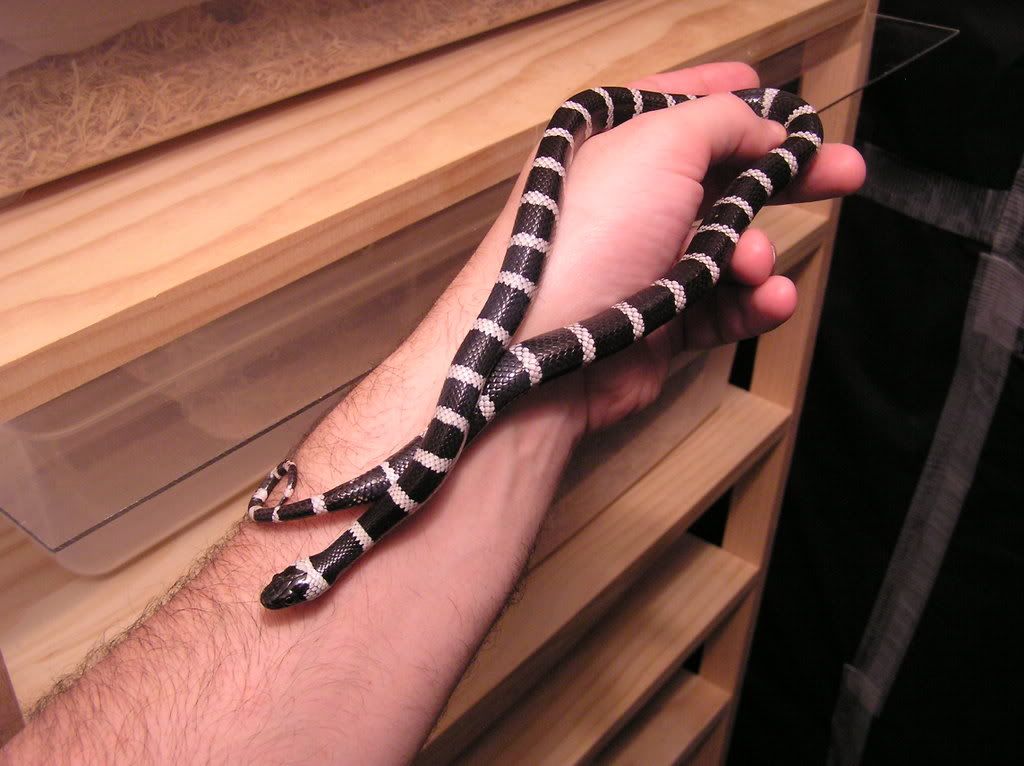
That is a California Mountain Kingsnake - Lampropeltis zonata.
Congrats!
-----
I decided my old sig was too big.
thanks. any idea how big it might get? it's about 18" now.
and what's the difference between kings and milks..all the pics I've seen look the same?
~~~Joannie
I've not kept the species (but I'm insanely jealous - I live in Redding and look for those every time I get up into the cascades) but I believe they usually max out around 30 to 36 inches.
If you have trouble getting it to feed on rodents - try lizards, they really prefer lizards when small - but at 18 inches, it may take rodents now (I would try fuzzies first then hoppers).
The Cascade Mountain zonata are interesting - it use to be believed that they were an intergrade between Sierra and St Helena subspecies - but I believe mtdna studies have shown that they are St Helena (or Sierra - I forget which).
A good book - "Mountain Kings" by Brian Hubbs.
-----
I decided my old sig was too big.
A great NATURAL intergrade are the Cascade zonata (multicincta x zonata zonata). Where did you come by this specimen Joannie, if you don't mind me asking?
Jerry Kruse 
Thanks Jerry, northern California, near Mt. Shasta. If you're familiar with the area I can be more specific. I've had him about 2 months, he loves to be held. It was hard to get him to eat at first, but I hand fed him and I was more persistant than he was. Now he takes it right out of my hand almost immediately.
I do have questions about him since I've not a lot of knowledge of snakes. If you're interested (I don't want to bore anyone).
Thanks
-----
~~~
Joannie
Here is a more definitive explanation of the law around collecting -- although this is not a complete list, it does highlight California zonata. Please feel free to ask me/us questions either via e-mail or on the forum.
5.60. Reptiles.
(a) General Provisions: Only the following reptiles may be taken under the authority of a sportfishing license, subject to the restrictions in this section. The limit for each of the species listed below is two, unless otherwise provided. Limit, as used in this section, means daily bag and possession limit. No reptiles shall be taken from ecological reserves designated by the commission in Section 630 or from state parks, or national parks or monuments.
(b) No sportfishing license is required for the sport take of any rattlesnake.
(1) Painted turtle (Chrysemys picta): Limit: No limit.
(2) Slider Turtle (Pseudemys (Trachemys) scripta): Limit: No limit.
(3) Spiny softshell turtle (Trionyx spiniferus): Limit: No limit.
(4) Western banded gecko (Coleonyx variegatus)
(5) Desert iguana (Dipsosaurus dorsalis)
(6) Chuckwalla (Sauromalus obesus)
(7) Zebra-tailed lizard (Callisaurus draconoides)
(8) Colorado Desert fringe-toed lizard (Uma notata)
(9) Mojave fringe-toed lizard (Uma scoparia)
(10) Desert spiny lizard (Sceloporus magister)
(11) Granite spiny lizard (Sceloporus orcutti)
(12) Western fence lizard (Sceloporus occidentalis): Limit: Species No. 12-16 have a limit of twenty-five (25) in the aggregate
(13) Sagebrush lizard (Sceloporus graciosus): Limit: Species No. 12-16 have a limit of twenty-five (25) in the aggregate
(14) Side-blotched lizard (Uta stansburiana): Limit: Species No. 12-16 have a limit of twenty-five (25) in the aggregate
(15) Western skink (Eumeces skiltonianus): Limit: Species No. 12-16 have a limit of twenty-five (25) in the aggregate
(16) Desert night lizard (Xantusia vigilis): Limit: Species No. 12-16 have a limit of twenty-five (25) in the aggregate
(17) Long-tailed brush lizard (Urosaurus graciosus)
(18) Tree lizard (Urosaurus ornatus)
(19) Small-scaled lizard (Urosaurus microscutatus)
(20) Desert horned lizard (Phrynosoma platyrhinos)
(21) Short-horned lizard (Phrynosoma douglasii)
(22) Great basin collared lizard (Crotaphytus bicintores)
(23) Banded rock lizard (Petrosaurus mearnsi)
(24) Baja California collared lizard (Crotaphytus vestigum)
(25) Long-nosed leopard lizard (Gambelia wislizenii)
(26) Gilbert’s skink (Eumeces gilberti)
(27) Western whiptail (Cnemidophorus tigris)
(28) Southern alligator lizard (Elgaria multicarinata)
(29) Northern alligator lizard (Elgaria coerulea)
(30) California legless lizard (Anniella pulchra), except black legless lizard (Anniella pulchra nigra): Limit: One (1)
(31) Rubber boa (Charina bottae), except southern rubber boa (Charina bottae umbratica)
(32) Rosy boa (Lichanura trivirgata)
(33) Ringneck snake (Diadophis punctatus)
(34) Sharp-tailed snake (Contia tenuis)
(35) Spotted leaf-nosed snake (Phyllorhynchus decurtatus)
(36) Racer (Coluber constrictor)
(37) Coachwhip (Masticophis flagellum), except San Joaquin Coachwhip (Masticophis flagellum ruddocki)
(38) Striped whipsnake (Masticophis taeniatus)
(39) California whipsnake (striped racer) (Masticophis lateralis), except Alameda whipsnake (Masticophis lateralis euryxanthus)
(40) Western patch-nosed snake (Salvadora hexalepis).
(41) Glossy snake (Arizona elegans)
(42) Gopher snake (Pituophis melanoleucus): Limit: Four (4)
(43) Common kingsnake (Lampropeltis getula): Limit: Four (4)
(44) California mountain kingsnake (Lampropeltis zonata), except San Diego mountain kingsnake (Lampropeltis zonata pulchra) : Limit: One
(1). Special Closure: No California mountain kingsnakes shall be taken in Orange and San Diego counties, and in Los Angeles County west of Interstate 5.
Jerry Kruse
" alt="Image">
To simplify for this scenario - With respect to the Zonata in the cascades - collection is legal but you can only collect and possess 1 zonata.
The San Diego subspecies is protected and you can not collect / posses any - and there also are some regional protections down SoCal way.
But the cascades (where you collected yours) - collection is allowed.
Technically you are suppose to have a valid fishing license when you collect it.
-----
I decided my old sig was too big.
Actually they may not be intergrades even though their phenotype seems to be between the two.
In the Zonata book by Mulks (another must have - Hubbs book is more informative, Mulks book has stellar photography) it cites the research, I'd have to look it up and I loaned my copy out.
I think was Berkeley or Davis that did the genetic study on Zonata.
-----
I decided my old sig was too big.
Was woudering if a band count would help. If I remember right, the St.Helena has more than 60% of red bands across the midline of the back, while the Sierra has less than 60%. Not sure what it would be with an intergrade?
Scott D
Mount Shasta (Úytaahkoo in Karuk), a 14,179-foot (4,322 m)[1] stratovolcano, is the second-highest peak in the Cascade Range and the fifth highest peak in California. It is a member in the Cascade Volcanic Arc and is located in Siskiyou County, and has an estimated volume of 108 cubic miles (450 km³), making it the most voluminous stratovolcano of the Cascades.[5] Physically unconnected to any nearby mountain, and rising abruptly from miles of level ground which encircle it, Mount Shasta stands some 10,000 feet (3,000 m) above the surrounding area. The mountain is managed by the U.S. Forest Service, Shasta-Trinity National Forest.
The mountain has attracted the attention of poets, authors, and presidents. Shasta was memorably described by the poet Joaquin Miller: "Lonely as God, and white as a winter moon, Mount Shasta starts up sudden and solitary from the heart of the great black forests of Northern California."[6] Naturalist and author John Muir said of Shasta: "When I first caught sight of it over the braided folds of the Sacramento Valley, I was fifty miles away and afoot, alone and weary. Yet all my blood turned to wine, and I have not been weary since."[7] Theodore Roosevelt said "I consider the evening twilight on Mt. Shasta one of the grandest sights I have ever witnessed."[8]
Nothing like a bit o' learning for all for those unfamiliar.
Jerry Kruse
good thing I got my fishing liscense this year then
-----
~~~
Joannie
Help, tips & resources quick links
Manage your user and advertising accounts
Advertising and services purchase quick links
