Reptile & Amphibian Forums

Welcome to kingsnake.com's message board system. Here you may share and discuss information with others about your favorite reptile and amphibian related topics such as care and feeding, caging requirements, permits and licenses, and more. Launched in 1997, the kingsnake.com message board system is one of the oldest and largest systems on the internet.

Click here for Dragon Serpents
Click for 65% off Shipping with Reptiles 2 You

A totally different type of clutch.....

Nathan Wells Jul 24, 2008 11:01 PM

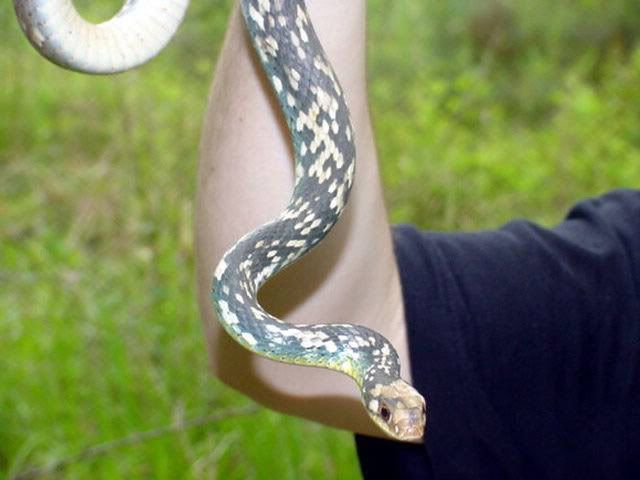
Although these are not milk snakes, they are definitely incredible animals nonetheless. They are day old Buttermilk Racers (Coluber c. anthicus), a large unique looking snake that inhabits much of East Texas and Western Louisiana. They are quite common here in Montgomery County, Texas and I have been observing and enjoying them since I was a young kid. Like many of the racers and coach whips, they will become completely different looking as they age. Buttermilks develop into amazing grayish-blue adults with varying amounts of bright white speckling.

I came across a very large (nearly 5 1/2 foot) female back in late May cruising not far from yard one early morning. I captured her for a quick photograph and low and behold, she laid 27 pearly white eggs during the night while in the container. I released the female and put the eggs on a nice bed of perlite and set them up like I do with any triangulum or alterna. I had hatched out a number of these along with Yellow-Bellied Racers in the past so I figured, what the heck, we'll try it again.

This morning, I walked into find this....

A better close up shot of a few

And another

They are beautiful little guys but, what's more impressive is what they eventually turn into. Here's a few that my buddy Robert Edwards and I have have found while herping over the last couple of years.


I traditionally produce over 200 milk snake and gray-band babies a year. But even though I'll be up to my ears in them in a few months, it's always fun to produce something totally different.
Thanks for looking.
Nathan Wells

Replies (20)

waspinator421 Jul 25, 2008 03:19 AM

Wow! Those adult snakes look pretty darn cool... especially that last one! Which one was the mother of this clutch? I've never heard of Buttermilk Racers, nor seen anything like them for sale. I may have to get me some someday!

Nice job!
-----
Aubrey Ross

©
www.SlipstreamSerpents.com

Nathan Wells Jul 26, 2008 04:53 PM

unfortunately, the pics of the mother didn't come out as good as I would have liked however, she definitely resembled the snake in the last series of shots. Robert Edwards took that fantastic close up.
Nathan

tspuckler Jul 25, 2008 06:42 AM

Now that is really cool, Nathan!

Tim

Nathan Wells Jul 26, 2008 04:54 PM

Thanks Tim. When are you ever going to make it down for some good Texas-style herping??
Nathan

RG Jul 25, 2008 07:55 AM

I must say, I've captured many black racers (and coachwhips)growing up in Florida over the past 30 years...it was always a challenge to keep up with them and try and not get "hit".

I thought I knew about every type of North American snake..but Buttermilks...caught me totally by surprise. I think they are really awesome looking snakes!

My friend found a large clutch of eggs when he removed an old tree stump...all the eggs were about 12in underground (where most snakes lay)...he gave them to me to incubate and most of them hatched...I knew from the beginning they were black racers...the eggs are very distinct looking.

Thanks for posting...how long did they incubate for???

Nathan Wells Jul 26, 2008 05:01 PM

Thanks Rusty, I knew you liked these guys. Eggs incubated at 79-81 degrees and began hatching around 53 days.
Nathan

Dniles Jul 25, 2008 08:48 AM

Those are really cool, Nathan!

Dave
DNS Reptiles

Nathan Wells Jul 26, 2008 05:04 PM

glad you enjoyed the post. Hope all is well buddy.
Nate

jawn Jul 25, 2008 09:06 AM

Very cool snakes Nathan! Thanks for sharing.

How many of the eggs made it all the way?
-----
Jon Wedow
Sharp Dressed Snakes

Nathan Wells Jul 26, 2008 05:05 PM

Thanks Jon. Some of the eggs were obviously infertile to begin with and went bad right away. Out of the 27, 16 hatched without problems.
Nathan

vjl4 Jul 25, 2008 09:29 AM

Those are pretty cool Nathan, I like the last pic a lot. It makes me wonder what other snakes people here play with. I am partial to Kenyan sand boas myself...

-----
“There is a grandeur in this view of life, with its several powers, having been originally breathed into a few forms or into one; and that whilst this planet has gone on cycling according to the fixed laws of gravity, from so simple a beginning endless forms most beautiful and most wonderful have been, and are being, evolved.” -C. Darwin, 1859

Natural Selection Reptiles

Nathan Wells Jul 26, 2008 05:07 PM

Hey man, if you really like that picture, you should buy one of our herp society (ETHS) shirts that have that exact snake pictured on the front. They came out pretty good.
Nathan

Joe_M Jul 25, 2008 03:10 PM

Very nice Nathan. Do they have the same temperment (nasty) as the Northern black racers we have in the northeast.
-----
Joe

Nathan Wells Jul 26, 2008 05:17 PM

they are very much like most other racers and coach whips. When discovering them in the field, either by walking up on one or by flipping debris, they seem to first hold their ground. They are extremely alert and intelligent, staring at you but also thinking of the best way to get away. Before you have time to blink, they explode into action and are usually gone in seconds. If they make it to a tree....forget about it.
If cornered, they lash out and bite repeatedly. However, they will soon calm down after a few minutes of being held.
It's funny to watch people try and catch them....LOL.
Nathan

FRoberts Jul 25, 2008 05:37 PM

>>Although these are not milk snakes, they are definitely incredible animals nonetheless. They are day old Buttermilk Racers (Coluber c. anthicus), a large unique looking snake that inhabits much of East Texas and Western Louisiana. They are quite common here in Montgomery County, Texas and I have been observing and enjoying them since I was a young kid. Like many of the racers and coach whips, they will become completely different looking as they age. Buttermilks develop into amazing grayish-blue adults with varying amounts of bright white speckling.
>>
>>I came across a very large (nearly 5 1/2 foot) female back in late May cruising not far from yard one early morning. I captured her for a quick photograph and low and behold, she laid 27 pearly white eggs during the night while in the container. I released the female and put the eggs on a nice bed of perlite and set them up like I do with any triangulum or alterna. I had hatched out a number of these along with Yellow-Bellied Racers in the past so I figured, what the heck, we'll try it again.
>>
>>This morning, I walked into find this....
>>
>>A better close up shot of a few
>>
>>
>>And another
>>
>>They are beautiful little guys but, what's more impressive is what they eventually turn into. Here's a few that my buddy Robert Edwards and I have have found while herping over the last couple of years.
>>
>>
>>
>>
>>
>>
>>
>>
>>
>>I traditionally produce over 200 milk snake and gray-band babies a year. But even though I'll be up to my ears in them in a few months, it's always fun to produce something totally different.
>>Thanks for looking.
>>Nathan Wells
-----
=========================================================
Roberts Realm Of Reptile Research
=========================================================
Thanks,

Frank Roberts

I opened my mouth and out flowed a melody black.

Nathan Wells Jul 26, 2008 05:08 PM

n/p

markg Jul 25, 2008 07:24 PM

Those wild-caughts are very interesting, as I've never seen a picture of an adult buttermilk racer. Maybe we should call that one with fewer spots an Extreme or Mega or .. just kidding lol.

Can you post here or in the General forum what/how you get those hatchlings to eat?
-----
Mark

Nathan Wells Jul 26, 2008 05:22 PM

Thanks Mark. To be honest, I generally don't worry about trying to get these guys to eat. I don't keep them in captivity and live in an area where they are extremely abundant. Every now and then, I happen upon a gravid female. If you field herp enough, it doesn't take long to start finding gravid snakes in the wild.
So to answer your question, they are released back into the wild fairly quickly after they are born. I do know they are like Cal Kings, they will devourer anything you throw at them.
Nathan

exposito Jul 26, 2008 07:36 AM

Nathan I really like the last two pics. Very cool.
-----
Thanks!

Joe Exposito
Thoroughbred Exotics, LLC
www.thoroughbredexotics.com

Nathan Wells Jul 26, 2008 05:24 PM

n/p

Site Tools