hello...i am looking for some opinions and feedback on the concept of powerfeeding. i have heard from several people that they feed smaller meals more often, causing them to grow much quicker. but i've heard others say that it is a bad thing. personally, i like the idea of my babies growing to maturity quicker, but not if there are negative side effects.
anyone have personal experience with powerfeeding?pros...cons...
thanks....
jonathan
Reptile & Amphibian Forums
Welcome to kingsnake.com's message board system. Here you may share and discuss information with others about your favorite reptile and amphibian related topics such as care and feeding, caging requirements, permits and licenses, and more. Launched in 1997, the kingsnake.com message board system is one of the oldest and largest systems on the internet.



power feeding questions......
geckoejon
Jul 25, 2008 06:26 PM
Replies (26)
daveb
Jul 25, 2008 07:50 PM
in general, smaller meals are a good idea, as it is accepted that it is easier to digest. a lot plays into growth rate, including proper husbandry, temps, etc...I think as a keeper you have to monitor your animals growth and activity and feed accordingly, and not worry too much about a precise feeding schedule.
cheers,
daveb
-----
in the light, you will find the road...
tspuckler
Jul 26, 2008 03:36 PM
There isn't any proof whatsoever that "power feeding" is "bad." In order to prove this someone would need to have two sets of snakes and "power feed" one set and have the other on a "non-power feeding" schedule.
They'd need to raise both sets to adulthood and see if "power feeding" affected lifespan, breeding, health, etc. This has never been done and even if someone started such a project today, snakes can live 20 years or more, so we wouldn't know the results for a couple of decades.
Also "power feeding" could affect pine snakes differently than it does king snakes. And rat snakes different than it affects garter snakes, etc.
I'm not saying I'm for "power feeding," but there are a lot of posts in these forums where people say "I heard somewhere..." and then talk about something that has no factual basis.
No one knows the long term pros and cons of "power feeding."
Tim
Third Eye
geckoejon
Jul 26, 2008 04:24 PM
tim,
i agree with your post, however i was hoping that someone had actually tested the theory. i just assumed that since i've heard several different strongly stated opinions from fairly large and successfull breeders on powerfeeding that they were based on fact and personal experience and not just what they "think" would be the pros and cons.
i haven't given up yet  i believe that the pros are fairly obvious such as growing to maturity faster. i'm still waiting to see if anyone has experience with the cons. thanks for the feedback...
jonathan
sean1976
Jul 26, 2008 05:12 PM
I believe that the primary source of the anti-powerfeeding opinions is the data from zoo's and similar establishments. Zoo's in particular have set many of the lifespan in captivity records for various species of snakes and they do not generally powerfeed or necesarily breed the specimens they have.
This obviously is not proof but merely a correlation. However it is a correlation based on facts. The question is whether there is a causal connection or just a coincidental one.
I myself do not have a problem with power feeding to a degree but tend to preffer letting the snake go at it's own pace. Seems to generate more active and interested animals instead of risking overweight and sluggish ones.
Sean.
-----
1.1 BRB
1.1 Triple Het TPRS's
0.1 Silver TPRS
1.1 Amel Bloodred Corns
0.1 Abbott Okeetee Corn
0.1 Blizzard Bloodred Corn
1.1 Thayeri Kingsnakes
0.1 Reeve's Turtle
0.2 Amstaff's
1.0 Pudytat
Phil Peak
Jul 26, 2008 05:38 PM
The longevity record crowd is a sorry group IMO. Rather than maintain a miserable looking rail thin animal in a cage for 40 years I would much prefer to keep specimens for 20 years that are a credit to their species and grow to be large and impressive snakes. By this I mean snakes that are robust and active. Foraging for prey or a mate and if given the opportunity the type of snakes that would combat for the right to pass on their genes. These people do not appreciate snakes. They might as well collect stamps that they can put in an album.
Just my take,
Phil
sean1976
Jul 26, 2008 05:52 PM
Didn't know there were people actually trying to achieve longevity records like a competition. I was merely refering to data from some zoo collections/breeding projects.
I am against starving specimens but I also do not participate in the other extreme. I pretty much gauge my feeding by the individual animals behavior although this does tend to fall into weekly or every other week cycles with the species I currently am keeping. I have animals that will go off feed for anywhere from a few weeks to as much as 5 months but I have never had weight loss or any other observable negative effect.
Basically I feed them when they act hungry or readily accept prey and let them be if they are uninterested. That being said I have known people who tried to feed their snakes once to twice a week regardless of the snakes behavior and they ended up with very overweight lethargic snakes.
Sean.
-----
1.1 BRB
1.1 Triple Het TPRS's
0.1 Silver TPRS
1.1 Amel Bloodred Corns
0.1 Abbott Okeetee Corn
0.1 Blizzard Bloodred Corn
1.1 Thayeri Kingsnakes
0.1 Reeve's Turtle
0.2 Amstaff's
1.0 Pudytat
Phil Peak
Jul 26, 2008 06:03 PM
I would agree that feeding two meals a week is excessive unless we are talking about hatclings through the first year.
Phil
jodscovry
Jul 27, 2008 08:11 PM
I have a pair of 2007 Black pines and I fed them only when they got active in their cages and to my own amazement both snakes are 48" and not quite a year old...

FunkyRes
Jul 28, 2008 08:12 AM
WOW!
First - I think the definition of power feeding needs to be agreed upon before any meaningful discussion can take place.
I consider power feeding to be the act of lining up an additional prey item manually in the snakes mouth so that it is forced to consume prey it did not choose to consume.
Offering a large quantity of prey, where the snake has the option to reject it, is not IMHO power feeding.
The longevity in zoos may not be due to the fact that they are fed less often than in captive conditions, it may be due to other conditions, such as larger caging with better range of habitat and temperature.
-----
I decided my old sig was too big.
reako45
Jul 28, 2008 10:05 PM
When you did feed them what were they eating per feeding?
reako45
kfisher29
Jul 28, 2008 05:05 PM
The longevity record crowd is a sorry group IMO. Rather than maintain a miserable looking rail thin animal in a cage for 40 years I would much prefer to keep specimens for 20 years that are a credit to their species and grow to be large and impressive snakes. By this I mean snakes that are robust and active. Foraging for prey or a mate and if given the opportunity the type of snakes that would combat for the right to pass on their genes. These people do not appreciate snakes. They might as well collect stamps that they can put in an album.
Just my take,
Phil
That's so true unfortunately!!! I've seen many snakes in the collections of the longevity,mostly former reptile house zookeepers and you just scratch your head wondering how these animals are even alive being so thin,not to mention the cages that haven't been cleaned for months on end. It makes you wonder why keep an animal at all if your not going to enjoy it's full beauty and possibly attempt to reproduce it. Kevin
Tony D
Aug 04, 2008 08:25 AM
"tend to preffer letting the snake go at it's own pace"
I would agree.
-----
Darwin Rocks!
Phil Peak
Jul 26, 2008 05:25 PM
One thought that goes into this conversation is exactly how do you define power feeding? Pits are good sized snakes with a relatively high metabolism. The feeding regimen for a Pit should be different than that of a less active snake with a lower metabololic rate. From what I have seen many keepers under feed their Pits. The result are snakes that never reach their genetic potential for growth and are slow to mature. I prefer to feed my Pits heavily for the first two years of life. Some breeders are driven by getting their snakes to maturity in the shortest amount of time possible so that they can cash in on the hatchlings. This is something that I would recommend against, and regardless of size I wait until the snakes are at least three years of age and often four to breed them for the first time. Once adult, I adjust the feeding schedule accordingly. Adult males usually go through a seasonal fast anyhow during the breeding season so there is generally little issue with them over eating. Egg laying takes its toll on the females and I especially like to feed them heavily afterwards to get them back in top condition. These methods have worked well for me and my adult snakes are large and impressive and I generally expect 100% hatch rate on any clutch that is laid. I have seen some of the Pits that were being raised by the "I prefer to grow them slow" crowd and their specimens usually reflect this mentality. Yearlings that look like hatchlings and adults that are overly thin and sickly looking. Field studies have shown that wild Pits are usually reproductively active in their third year. This with a winter dormancy that can last from several months to more than half of the year. These snakes are eating large meals and often. On the same topic as growth, I keep my hatchlings up through their first winter and continue feeding. Unless a baby Pit goes off food there is no reason to cool it down the first year. Like any snake feeding responses will vary from one individual to the next. I like to see my yearlings at 4'. Some will be larger than this and others will be smaller. I like to provide adequate feeding opportunities to enable this to happen though. If at all possible I avoid mice from the onset. I start my hatchlings on pink rats and move up to crawlers and then to pups. By one year of age they are on small rats and medium rats by the second year.
Pits are high maintenance snakes. They eat a lot, defecate a lot and require attention. The rewards are great though and they are easily my favorite snakes.
This has worked well for me with pines and bulls. Someone else could probably give you some insights on the gophers and Mexican Pits.
Phil
DISCERN
Jul 26, 2008 05:28 PM
Well, I have heard plenty of cons against it, but I myself have never power fed, so I do not have that experience from actually doing so, as I have always felt it was sort of selfish to power feed to begin with. Think about the breeder's intentions power feeding though. What is the rush??? After all, YOU, the owner, are wanting the snake to breed as fast as possible, and YOU, the owner, want to be able to sell snakes as fast as possible. Are those that powerfeed wanting to give hatchling snakes away or donate all the money made off of snakes that hatched from power fed parents to a notable charity, and this is why they are wanting the snakes to breed as quickly as possible? I didn't think so either. I just wish some honesty would play a part in it. I hear, " oh, the snake WANTS to eat, so give it all they want!" Well, we as humans know how it can go if we eat all we want. We get fat. Snakes can follow as well in the same way. It can be very unhealthy in doing so.
It's a market where people's lack of patience is clearly illustrated. I completely understand though the side's viewpoints of powerfeeding, but I just don't agree with it. The competitiveness of the breeding market has everyone wanting to be the first in getting something out there as fast as possible, and in doing so, is all of that really worth what can potentially happen to our snakes?
Not a slam personally against anyone, but against that way of thinking. I have friends that do actually do this and I respectully disagree with them, while playfully giving them a hard time.
One friend of mine who breeds has a friend in FL. where he is from that power fed the living heck out of all of his breeder corns, and they were all dying within seven years or so. They also had pin heads, which is a common way to sometimes be able to tell whether or not an animal has been powerfed. He eventually stopped power feeding and now has animals that live longer than seven years. Now, that may be one example of some sort of proof. Another buddy of mine does not powerfeed, and all his animals live to be in their twenties. That could be another example as well. Also, I have had many conversations with vets and biologists about this very subject, and they always warned against it, as they had seen the results in doing so.
Thing is, we also have to deal with that each snake is an individual. Some grow just by looking at them, and grow huge and fast, no matter how often they are fed. Others are much slower and seem to take forever in getting to breeding size. Not every snake may seem to have bad results in doing so, but many have as well.
I say, do what is best for our snakes, and not what we think is best for us. Then, the snakes will take care of us and they will be taken care of, in the long run.
-----
Genesis 1:1
Phil Peak
Jul 26, 2008 05:53 PM
I do agree that obesity should be avoided. This is a situation that arrises with mature snakes that are not sexually active. I believe that it is virtually impossible to overfeed a juvenile Pit within reason. Care should be taken to avoid regurgitation by feeding excessively, but IMO two good meals a week is a good regimen for a young and growing snake. I too have little respect for the grow them quick so I can sell hatchlings mentality. I give my snakes three to four years before breeding them the first time. I am non-commercial anyhow. I breed snakes simply because I like to so with myself at least, this is not a consideration.
Phil
geckoejon
Jul 26, 2008 07:23 PM
hello, thanks for all the feedback. gives me some more perspectives to consider.
myself, i'm just a hobbyist. i don't keep snakes to make money. i have a full time job that pays the bills. this is a hobby for me. i was wondering because i want to know what is best for the snake and i would like to see them reach their full potential while still being healthy.
i went to a show recently and saw some 07' pines that were thinner than a sharpie. imo that is depriving the snake of it's right to develope at a normal pace. although i have a 4ft 07' bull that is healthy and well proportioned from feeding 2 smaller meals a week. i told the guy with the pines that and he said i need to be carefull because it's harmfull. i guess everyone is entitled to their own opinions.
take care...
jonathan
Phil Peak
Jul 26, 2008 07:50 PM
I think whats going on is the guy is cheap. He is interested in selling snakes and not with the well being of his animals. He is keeping those snakes on what is known as a "maintenance diet". Feeding them properly would cut to much into his bottom line.
Fortunately not all commercial breeders are like him.
Phil
sean1976
Jul 26, 2008 11:56 PM
Yeah I have to agree. You do not need to deprive your snakes to avoid obesity. Thin does not equal healthy. Good muscle tone and porportionality does generally equal healthiness though.
Sean.
-----
1.1 BRB
1.1 Triple Het TPRS's
0.1 Silver TPRS
1.1 Amel Bloodred Corns
0.1 Abbott Okeetee Corn
0.1 Blizzard Bloodred Corn
1.1 Thayeri Kingsnakes
0.1 Reeve's Turtle
0.2 Amstaff's
1.0 Pudytat
ginter
Jul 27, 2008 03:17 PM
Ok, I am somewhat bored with this topic but since it is getting recycled once again here goes with MHO, my "$0.02".......
I used to feed every snake I owned every week like clock work.....
What I found was more food = more crap and more food = more $$$$cost!
If your motive is to get an animal up to breeding size quickly so you can make money you are missing the point, you are a "snake farmer" and where is the fun in that?
If your motive is to have healthy happy animals, step back and watch for signals from the animals and use these to dictate feeding schedules. Young snakes need more food, reproductive females need more food, etc. I commonly have reproductive males that become anorexic for several months during the spring when finding females and breeding become the top mental focus.
I used to freak out about it but over time i realized that these guys do not eat all that often in the wild.
We receintly got the body wts of three (I know this is a small sample size but it is what we had) snakes. Two of these were long term wild caught captives that did not feed well prior to our getting them and the 3rd was a newly wild caught animal. They all looked thin from a snake keeper's perspective. They were all maintained under the same conditions and all fed readily on similar sized food items. We reweighed them 6 months later and I was a bit surprised. They all looked heavier and healthier at this time. The two long term captive WC animals gained a whopping 40+ % of their previous body wt! The "fresh" wild caught animal gained about 14% of her original body wt!
To me this means that she was closer to her normal or ideal body wt. in the wild even though she looked "thin" to me.
I was kind of off on a tangent so what this has to do with the original "powerfeeding topic" is unclear to even me! LOL
Personally, it comes down to selfishness for me, I can't afford to nor do I have the time to power feed. They are very efficent predators that simply crap out what they don't need. I skip feedings on some of my big snakes for weeks at a time and they don't loose weight!
Evaluate your motives and take it easy on the human imposed scheduling.

Phil Peak
Jul 28, 2008 12:41 AM
I guess the whole power feeding discussion is difficult to address unless it is defined in some way. My take at least is power feeding implies over feeding to the point that the snake in question becomes obese. There are obvious negatives to an obese snake including lessened activity, low reproductive potential and ultimitely a shortened life span. A well fed snake on the otherhand which is given ample room to move around and a variety of thermal gradients is all together different. I believe there is a misconception that wild snakes are generally thin and unhealthy. This is simply not the case and those that fit into this category are by far in the minority from my observations. I am more likely to see a wild snake that is stuffed with a large meal than I am to see one that I would consider emaciated.
My adult males usually take one or two meals post cooling and then fast through the breeding season. For two to three months they spend most of their time roaming their cages and breeding. Once this is through thet have lost weight and have ravenous appetites. At this point I will give them a good sized meal once a week through the duration of the summer. By the time they slow down again in the early fall they have regained their weight and are ready for winter cooling again. I feed my sexually active females generous sized meals until they have regained the weight that they have lost through the egg laying process.
Phil
geckoejon
Jul 28, 2008 06:48 PM
wow! got lots of feedback on this one thanks..
i first read powerfeeding on a breeders site. he talked about feeding several smaller items more often. every 4 or 5 days. rather than 1 larger item oce a week. the smaller items are easier to digest. the snakes take in nutrients faster and grow faster.
the reason it appealed to me was the size factor. i've heard and read that the first two years is the time for the most growth. why not try to get them to the largest potential size that i can. not obese, but larger in overall size. powerfeeding for the first year or two and then to a maintenance diet otherwise they get chunky
i hear many people talk about how they used to have 8 and 9 ft bulls, but i don't see them. like i said before, it's not about money for me. why not see how big they can reach if there is no harmfull side effects? just curious...
jonathan
Phil Peak
Jul 28, 2008 07:27 PM
You have the right approach to all of this. Like you, I am not interested in the money that hatchlings could bring. There is nothing wrong with breeding and selling snakes but that is not why I have an interest in these animals. What I want is the best specimens of the best stock. I will do whatever it takes to ensure I have both.
For what its worth. Anyone that tells you feeding a young and growing Pit twice a week constitutes power feeding does not understand these snakes and should probably change directions and get into ball pythons.
Small and frequent meals are the best route. It is important not to gorge a hatchling and risk regurgitation. As the snakes grow, space the meals and increase the prey size.
Phil
kfisher29
Jul 28, 2008 09:02 AM
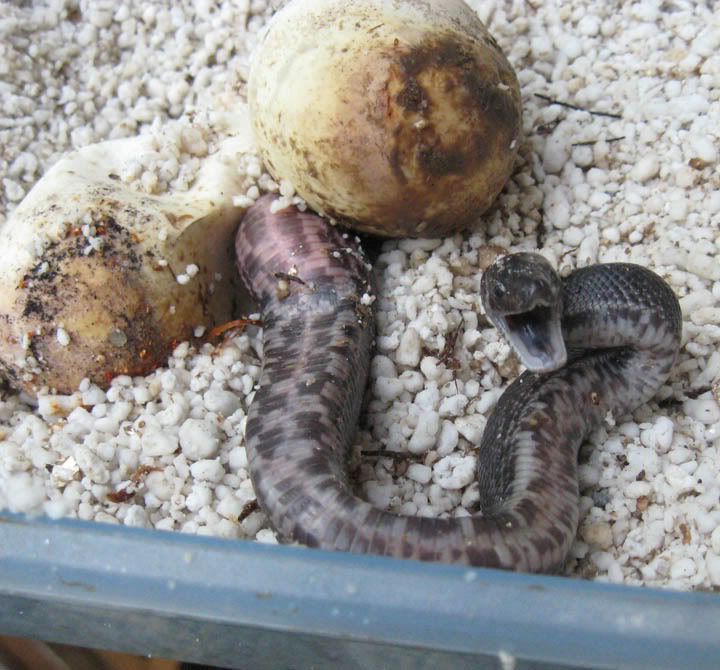
I only feed my pits rats from rat pinkies as babies to medium rats as adults. Let your snakes tell you when to feed them is the best method whether it's once a week or once every 3 weeks. Pits will usually crawl around quite a bit when they want to eat. You don't want to stuff them with food,because if they start regurging it's bad times! Heres a pic of a southern pine that is 42 inches long and only 9 months old at the time of the picture. Kevin

BBBruno
Jul 28, 2008 01:09 PM
In all the years I've kept and bred herps I've never power-fed my animals, and those I've known that did were usually seeking fast growth, fast breeding, and fast sale. I let the animals grow at their own pace, and for me the results have always been good; granted, I wasn't breeding and selling offspring at the same pace as several of my contemporaries, but that was never my intent anyway. Whatever money I gained from sales went right back into the collection for food, housing, bedding,heat, and books (Stull, state guides, etc.). As for longevity, I'd have to say that it has worked well for me over the years; Snowball will be 24 next month, and the Bowtie Snake will turn 20 two days later (I just put up 7 eggs from his latest breeding; smutty old dude!). I have a collection of mostly older animals at this point, very few under the age of 13, and I raised all from hathlings. I won't call myself an "anti" person with regards to power feeding, I just know what has worked for me, and after 30 years of this, I'd like to think my experience has at least some merit.
Bart
RJ Reptiles
Jul 28, 2008 04:55 PM
It has tons of merit buddy! John
Phil Peak
Jul 28, 2008 08:30 PM
You must be doing something right Bart. I think the part of the equation that is missing here is exactly what power feeding is by definition. I too oppose the "bring them up fast to get a quick return" mentality. You know what my commercial interest is - zero. My animals are large, healthy, reproduce and thrive. I feed them well, much like healthy populations of Pituophis in the wild feed well. I want the snakes that I keep in cages to reflect what I see in the field. When I go to the field I see robust healthy animals.
Phil
