how big do they get? what type of an enclosure do they need? how big an enclosure do they need? what are there temp/humidity/water requirements? what do they eat? what type of substrate do they need? what is their growth rate like? how much do they on average cost? what are their dispositions like? and is there any misc. info i should know?
Reptile & Amphibian Forums
Welcome to kingsnake.com's message board system. Here you may share and discuss information with others about your favorite reptile and amphibian related topics such as care and feeding, caging requirements, permits and licenses, and more. Launched in 1997, the kingsnake.com message board system is one of the oldest and largest systems on the internet.


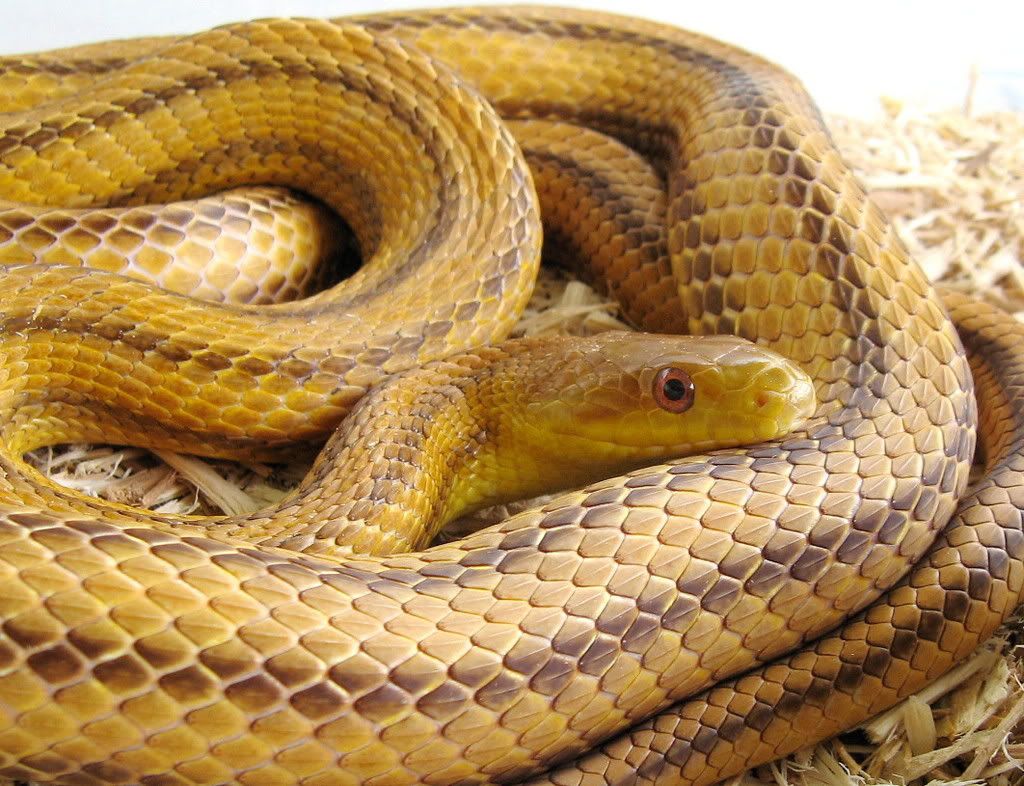
yellow/everglades rat snakes
banjobert
Aug 09, 2008 08:43 PM
Replies (18)
DMong
Aug 09, 2008 11:50 PM
What were the question again??,...could you repeat those please???..LOL!
Answers to all TEN of those questions are very easy to research if you really want information on them.
best regards, ~Doug
-----
"Better to be silent and thought a fool, than to open mouth and remove any doubt!"
Elaphefan
Aug 10, 2008 01:27 AM
Start with this link, and try Google to find answers before asking so many questions. (It makes you look stupid or lazy when you post such basic questions.)
Wild type N. American Rat Snakes can be had for a song ($15-25).
CBN Care Sheet, N.A. Rat Snakes
draybar
Aug 10, 2008 09:51 AM
>>how big do they get? what type of an enclosure do they need? how big an enclosure do they need? what are there temp/humidity/water requirements? what do they eat? what type of substrate do they need? what is their growth rate like? how much do they on average cost? what are their dispositions like? and is there any misc. info i should know?
Terry and Doug
I understand where you are coming from and definitely understand.. but at the same time, where better to do research then to ask the experts at a rat snake forum.
Isn't that part of why we come here?
especially if you do a google search on rat snakes and this site comes up....LOL
We've all had questions just not ALL the questions ALL at one time
Now for YOU poster. Tery and Doug are RIGHT...Do YOUR research, look for books about rat snakes, read care sheets, do google searches. Learn as much as possible.
how big do they get?
5 to 6 ft average maybe a few could get a little larger
what type of an enclosure do they need?
they can be kept in anything from rack type enclosures to natural vivariums...this is where more research will help you decide what will work best for you and the possible space you may have available
how big an enclosure do they need?
This can vary as well, but simply put, the larger the better.
For an adult yellow or everglades a rack "box" over 32 quarts or an aquarium at least 20 gallon long or larger. Once aain this is where deeper research and your own space and abilities will enter into the equation.
what are there temp/humidity/water requirements?
they are hardy snakes and can be forgiving but generally you would need to provide a temperature gradient between maybe mid 80's on the hot side to mid 70's on the cool. The snake's condition can be a good indicator of proper or improper humidity. Good sheds would help to indicate a decent humidity. Problem sheds would indicate otherwise. Make sure to have a water bowl large enough for the snake to fit in. This will allow the snake to soak if need be and this will also help keep humidity a little higher. And when using a screen top try covering half the top to help hold in humidity as well.
what do they eat?
now this one really bothers me....they are rat snakes..they eat rodents...rodents only
this question is actually an insult. To want to get snakes and not even have an idea what they eat before deciding on that species. Sorry but this one truly does speak of laziness.
what type of substrate do they need?
substrate can be paper towels, news paper, aspen shavings, carefresh bedding, cypris mulch or ground coconut.
I personally recommend aspen shavings because they are pretty much dust free, cheap, look pretty good in a natural environment, the snakes like to burrow under the aspen acting as another hide, easy to spot clean and are fairly inexpensive.
what is their growth rate like?
this varys from snake to snake. The snake's genetics, environment, food size, nutritional value of food and activity can all contribute to growth rate.
how much do they on average cost?
anywhere from $25.00 up. Just depends on the breeder, his stock, the morph and the age.
what are their dispositions like?
varys from snake to snake as well. Either way, hatchlings can be quite defensive. Everything is a threat to something that small.
I seriously believe that most, when acquired young and handled regularily, will tame down quite well, but there are a few that can remain temperamental and unpredictable throughout their lives. Like I said it varys snake to snake.
is there any misc. info i should know?
YES, you should know where to get the proper books (Amazon is a good start) you should know where to find good care sheets, ,check some of the sponsor sites and google, and you should learn to do thorough research to learn everything you can about any animals you plan to keep.
-----
Corn snakes and rat snakes..No one can have just one.
"Resistance is futile"
Jimmy Johnson
(Draybar)
Draybars Snakes
_____
draybar
Aug 10, 2008 10:06 AM
but at the same time, where better to do research then to ask the experts at a rat snake forum.
by the way...with the above statement I was NOT trying to imply that I was one of those experts.
I meant people like you Doug and you Terry and Dusty and the other members I would consider experts. Sorry for those whos names I did not mention. There are several.
Not me.
I am far from an expert.
I am just a hobbyist willing to learn.

-----
Corn snakes and rat snakes..No one can have just one.
"Resistance is futile"
Jimmy Johnson
(Draybar)
Draybars Snakes
_____
draybar
Aug 10, 2008 10:19 AM
You know what...I kept thinking about it and thinking about and I really don't know why I thought your name was Terry, Elaphefan.
To be one hundred percent honest I can't remember ever seeing your real name. If it is not Terry I am truly sorry.
If it is...cool. But either way, what I said in the above posts still stands
by the way a ouple more I would consider experts that frequent this forum are Tim Spuckler and the "other" Terry "ratsnakehaven"
and more but anyway my point has been made and my stupidity hopely corrected or ammended.
-----
Corn snakes and rat snakes..No one can have just one.
"Resistance is futile"
Jimmy Johnson
(Draybar)
Draybars Snakes
_____
Elaphefan
Aug 10, 2008 11:06 AM
Jimmy,
You are much kinder with people who ask questions that have been answered a thousand times. The above poster, was able to go on line to ask all those basic questions, so they must have known how to use Google. I just did a serach on Google using "Yellow Rat Snake care" and found plenty of info like the person was looking for.
As for being an expert, I don't have a PHD like Terry Cox, but I do try to be a student of the subject like you.
If the above poster had asked if a Yellow would make a great pet that would never musk or bite, I would have been glad to tell the person that most captive born Yellows calm down quickly and make great pets, but not all. I have an amel Enory that has added two points to the value of J & J stock from all the bites she has put on my hands and arms. I also have two Texas Rats that are just as nice as can be.
BTW, how many Baird pups did you get this year? What camera are you using to take your photos? I have a nice Canon, but it never seems to do that well with the close shots. If I remember correctly, you were using a Nikon a few years back.
Take care,
Rick

draybar
Aug 10, 2008 12:15 PM
>>Jimmy,
>>
>>You are much kinder with people who ask questions that have been answered a thousand times. The above poster, was able to go on line to ask all those basic questions, so they must have known how to use Google. I just did a serach on Google using "Yellow Rat Snake care" and found plenty of info like the person was looking for.
>>
>>As for being an expert, I don't have a PHD like Terry Cox, but I do try to be a student of the subject like you.
>>
>>If the above poster had asked if a Yellow would make a great pet that would never musk or bite, I would have been glad to tell the person that most captive born Yellows calm down quickly and make great pets, but not all. I have an amel Enory that has added two points to the value of J & J stock from all the bites she has put on my hands and arms. I also have two Texas Rats that are just as nice as can be.
>>
>>BTW, how many Baird pups did you get this year? What camera are you using to take your photos? I have a nice Canon, but it never seems to do that well with the close shots. If I remember correctly, you were using a Nikon a few years back.
>>
>>Take care,
>>
>>Rick
>>
Rick,
First let me apologise for getting your name wrong. My bad.
now, honestly I am not nearly as patient as it may seem in the above post.
It can really bug the hell out of me.
BUT I look at it two ways...first, I personally need to be more patient so that was good practice and I just don't want us to get a negative reputation. Traffic can get slow here and I sure would hate to run any possible members off. I understand 100% where you are coming from, I really do..BUT someone else new to the forum or new to snakes may see a post like that and get the wrong idea about the true willingness of the members here to help.
All the respect in the world to you and Doug...just don't want to run people off
Bairdis...
I ended up with 17 bairdi "pups"
Rosie and Sam gave me 7 and Laura and Elrond, 10.
I used to use a little Nikon CoolPix 3.2 and I now use a Nikon CoolPix 7.6
The 7.6 has a slightly slow shutter speed but it takes pretty good pictures. For the price, under $175.00 for a 7.5 mega pixel camera with 3 X optical and 4 X digital zoom was pretty reasonable when I got it.

-----
Corn snakes and rat snakes..No one can have just one.
"Resistance is futile"
Jimmy Johnson
(Draybar)
Draybars Snakes
_____
DMong
Aug 10, 2008 04:19 PM
Yeah, I know Jimmy,.....I didn't really want to come across as being short with the poster, as I purposly tried NOT to,.....I just basically thought it was a little much there with the short slew of extremely basic questions all in such short succession, and threw in a a touch of sarcasm.
I don't like the idea of being mean to folks on the forums for asking some questions either, and I am usually quite willing to go in deep detail most of the time.
take care!, ~Doug
-----
"Better to be silent and thought a fool, than to open mouth and remove any doubt!"
banjobert
Aug 10, 2008 05:09 PM
the only reason i ask what they eat is beacause not every snake will take rats/mice for example roasy boas mainly eat rodents but some individuals will only take lizards. and also about what type of enclosure they need i meant arboreal or terrestrial due to the fact that they can have arboreal tendencies
draybar
Aug 10, 2008 05:21 PM
>>the only reason i ask what they eat is beacause not every snake will take rats/mice for example roasy boas mainly eat rodents but some individuals will only take lizards. and also about what type of enclosure they need i meant arboreal or terrestrial due to the fact that they can have arboreal tendencies
You can go either way with yellows or everglades.
I personally would go with limbs for climbing for a yellow but maybe not for an everglades. I could be way off base but it seems to me that yellows are more arborial then everglades. I know my yellow utilized limbs but I never saw my everglades on his limbs once.
-----
Corn snakes and rat snakes..No one can have just one.
"Resistance is futile"
Jimmy Johnson
(Draybar)
Draybars Snakes
_____
jhnscrg
Aug 10, 2008 07:39 PM
BTW, either type will work. But I'd personally go for terastrial with one or two climbing branches. And the basic hide box. I always added a few natural touches (leaves, rocks) and mine seemed content..
Matthew
banjobert
Aug 10, 2008 08:30 PM
are there any arboreal rat snakes?
Elaphefan
Aug 11, 2008 08:06 PM
Black, Gray, and yellow all seem to love to climb. If you are willing to pay the shipping, I will send you a well started Black Rat pup feeding on f/t mice for FREE.
How big of a tank/cage do you have to keep the snake in? American Rats (E. obsoleta spp.) can grow to over 6 feet. A snake that large will need to be given rats as it gets larger.
Yes, and you still need to do more reading on the subject.
Take care,
Rick

banjobert
Aug 11, 2008 10:12 PM
i'm not sure if i can say yes to that, but how big is it?
banjobert
Aug 12, 2008 10:02 AM
it is still not a definite yes but how much is shipping? also is it healthy, does it have any infections, syndroms, disieases or any other conditions i should know? how big is it? what is the gender? the last one does not really matter but i would like to know if possible. if theres any other info about the snake i should know please tell me
banjobert
Aug 12, 2008 05:42 PM
please disregard all those questions i have decided not not to take you up on the offer but thank you though
antelope
Aug 12, 2008 02:36 PM
with some of the best damn bairdi out there!!!
-----
Todd Hughes
jhnscrg
Aug 10, 2008 07:33 PM
Easy questions, if a lot! LOL.
Same as for corns, except they get quite a bit longer when fully grown. I'm thinking 30-40 gallon terrariums will do. Everything is basic ratsnake. I mean really basic LOL. One non-tippable water bowl, newspapper or mulch substrate, under tank heat tape, basic humidity for mine (when I had them) was about 40-50%. Actually, florida room temp & humidity did quite nicely. Mine ate one medium rat about once a week when adult.
Hope that helps,
Matthew
