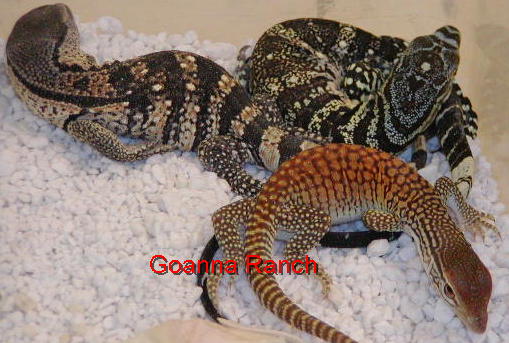
From what Bob has to say is, I have been keeping all the species he has, and many more for more then a decade longer and I do not have problems with groups, In fact, much the opposite. I experience superior results in all areas of captive success, with groups.
But without question, I agree with Bob. Use common sense.
There are many common sense sayings, like, When in doubt, Charley out. Which means, if its not A and its not B, it must be C(charley)
In this case, keeping monitors in groups, it works or doesn't work, and it works or doesn't work keeping them apart. There are indeed problems either way. So its not A(in groups) or B(keeping them solitary) So it must be C.
So what the heck is C?
Lets talk about husbandry, its a learned and applied science. Which means, we all have different aspects and different experiences and different approaches and more importantly different resources. So expecting a simple answer like YES or NO, is more then naive, its stupid. Its stupid because we already know monitors are a bit complicated compared to other behaviorally simple reptiles.
So what I am saying is, varanids are NOT behaviorally simple. They are complicated. That means, we keepers must learn more and more about the subject, not simply stick to the first rule that makes sense to you.
So as a new keeper, you want the odds on your side, your want to make sure you cover your very own ignorance. Start with a young pair and keep them together. That has the best odds of succeeding if reproduction is part of your goals.
After that it becomes more and more complicated. Keeping them solitary has its own set of complications and keeping them in larger groups also offers up a huge set of complications for the new keeper. Depending on species, it complicates any level of keeper.
In my experience, there is nothing better then a bonded pair or a good working group. Its a thing of beauty. Also in my experience and OPINION, there is nothing worse then a single animal in a cage. Of course, that has nothing to do with science. I think animals, NEED a reason to live. And keeping an animal in solitary offers nothing other then food to live for. GIVE THEM SOMETHING TO LIVE FOR.
We find that monitors love to live. They love to feed, they love to reproduce, they love to fight, yes, to fight. To fight is part of their lives. Again, common sense says, do not let them kill eachother, just let them do what they do naturally.
So yes, we let them fight if they want. I learned early on, theres a difference between casual fighting and attempting to kill eachother. A monitor can kill another monitor is less then a minute. So if you have monitors bickering forth and back, then that has nothing to do with wanting to kill or eliminate the combatants. I have to say, mice bicker, birds bicker(boy howdy) dogs, cats, all manner of animals that live in groups BICKER. Yet, monitor keepers think monitors are NOT suppose to bicker. WELL SIRS, they do bicker. That is how they maintain a GROUP.
Our job as keepers it to offer our captives a full life(as full as we can) not offer a life of solitary confinement. Then place animals together according to OUR AGENDA. I let them create there own groups and go by their own agenda. Actually thats how I learn and what keeps me interested.
If I kept them seperate and only placed them together for breeding purposes, I would suspect I would only do that for money. But I keep monitors for the joy of learning, so I do not follow that approach. I let them teach me.
Your task as a keeper is not to be told what works or doesn't work. But to figure out how to reach your goals and your animals goals. NEVER forget the animals have their own goals and agendas. Just because you(all of U's) do not understand them, does not mean they do not exsist.
SO what is C, its you, your C. You must learn how to keep them in groups or solitary for that matter. Each area has lots of things you must learn. So I guess Bob has some learnin to do. hahahahahahahahaha. Because without question, monitors can indeed work well in groups. In fact work in a superior way. Cheers