I have some six day old hatchlings. Should I wait until they shed to offer the first meal?

Reptile & Amphibian Forums
Welcome to kingsnake.com's message board system. Here you may share and discuss information with others about your favorite reptile and amphibian related topics such as care and feeding, caging requirements, permits and licenses, and more. Launched in 1997, the kingsnake.com message board system is one of the oldest and largest systems on the internet.


When to feed the first meal
Dave15run
Aug 16, 2008 11:29 AM
Replies (10)
Dave15run
Aug 16, 2008 11:31 AM
Do these look like some kind of morph? Is it too early to tell?
Dave
DMong
Aug 16, 2008 11:42 AM
Hatchling snakes usually have an ample supply of yolk in their bellies to help give them a "head-start" in nature until they can come upon prey and develope a feeding response. It is very normal for them to refuse prey until after they shed, although some will occasionally feed before they shed. In any case, I never bother even trying to feed them until after they shed, and they have time to get hungry.
From just looking at them, they appear to be normal wild-type young. I can see a pinkish cast to the grayish background coloration. this will intensify as they age. What types were the parents?....and do you know if they were were recessive gene carriers(het) for any trait(s)?
~Doug
-----
"Better to be silent and thought a fool, than to open mouth and remove any doubt!"
Dave15run
Aug 16, 2008 12:02 PM
I got the mom from a reptile breeder. I guess I'm not supposed to say the name. The mom was an everglades corn. There is no telling about the dad. The breeder was willing to sell her as a gravid female for a bonus. She laid 22 eggs and 21 were good. I got my money's worth.
Dave
tspuckler
Aug 16, 2008 12:18 PM
All the offspring will be normal in appearance. When morph traits are bred to a normal (and non-het) corn the offspring will be normal looking.
Morphs are RECESSIVE, meaning when bred to a normal the traits RECEDE, causing the offspring normal in appearance, but het for whatever traits the morph bred to the normal has.
Tim
Third Eye
Dave15run
Aug 16, 2008 12:37 PM
Thanks. That was the best and more simple explaination I have heard for recessive. As a teacher I know its hard to be simple.
Dave
DMong
Aug 16, 2008 12:53 PM
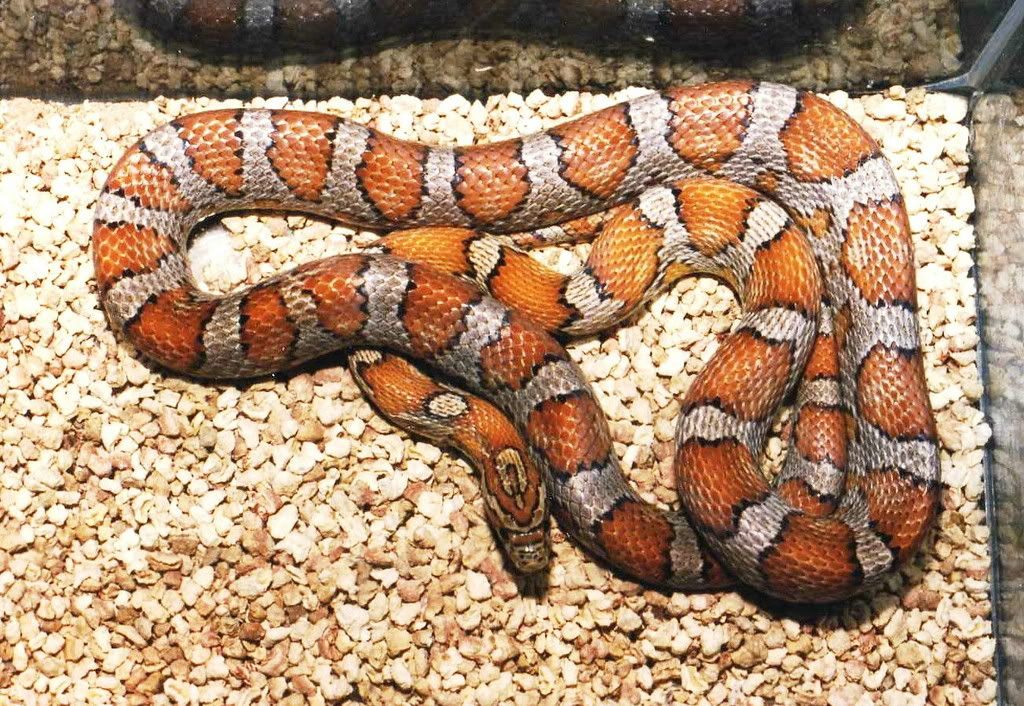
When you say the mom was an "everglades", there is a possibility that she was what is known in the hobby as a "Miami" phase cornsnake. These are a natural variant of cornsnake that tend to have a more grayish background coloration as opposed to a more red or orange background, also the saddle blotching can be red or orange, or intermediate between the two.
Below is an exceptional example of a "Miami" corn that a good friend of mine captured just north of Miami/Dade County years ago.
Of course since you don't know what the male looked like, it certainly doesn't mean the hatchlings are Miami types, as the "Miami" look is a natural co-dominant variation, and since the male is "unknown" the young could be intermediate between the two types as well.
Can you post a pic of the female just for kicks?
thanks, ~Doug
-----
"Better to be silent and thought a fool, than to open mouth and remove any doubt!"
Dave15run
Aug 16, 2008 02:22 PM
Here is a picture of what the breeder called an everglades corn. Since they are all normals the picture will not help much with the babies. Thanks for your help. It took me a while to to upload the picture.
Dave

Dave15run
Aug 16, 2008 02:23 PM
Sorry, I choose the wrong picture.

DMong
Aug 16, 2008 03:19 PM
Ah!,..okay, Thanks for posting the pic of the mother. That is helpful in determining things here. That snake is a wild-type that was very likely captured in the everglades area. The remnant longitudinal striping is very typical of many wild populations as well.
It's a safe bet that the male parent was similar looking too, so the hatchlings will probably also look close to the one you posted. They would certainly be considered normal corns.
Good luck with the youngsters!
~Doug
-----
"Better to be silent and thought a fool, than to open mouth and remove any doubt!"
kyleherp
Aug 17, 2008 11:45 AM
Yeah, too early to tell, but to me they look like normal anarys. I feed all of my babies the day after the first shed. That does not mean that they will not eat unless they shed first. It is just better to wait so that if they still are digesting their yolk you did not just waist a mouse on a snake that is not hungry yet.
Kyle with ALL ABOUT REPTILES
www.freewebs.com/kyleherp/
