What's this I hear about white-sided brooksi being hybrids between ratsnakes? Is there truth and proof to this?
Reptile & Amphibian Forums
Welcome to kingsnake.com's message board system. Here you may share and discuss information with others about your favorite reptile and amphibian related topics such as care and feeding, caging requirements, permits and licenses, and more. Launched in 1997, the kingsnake.com message board system is one of the oldest and largest systems on the internet.



White-sided Brooksi, HYBRID???
davidtobler
Sep 14, 2008 06:41 PM
Replies (47)
ZFelicien
Sep 14, 2008 08:56 PM
The history behind the White-Sided Floridana/Brooksi is sketchy at best. but everything i've heard/read concerning them being hybrids is 100% speculation and there isn't PROOF that they are.
i have questioned them myself, some of the normal white-sides look really weird others look like the real deal, honestly it's all about your gut. if you don't feel confident in working with them i say don't. personally i've got them in my collection... i like them all.
White-sided (Paradox)
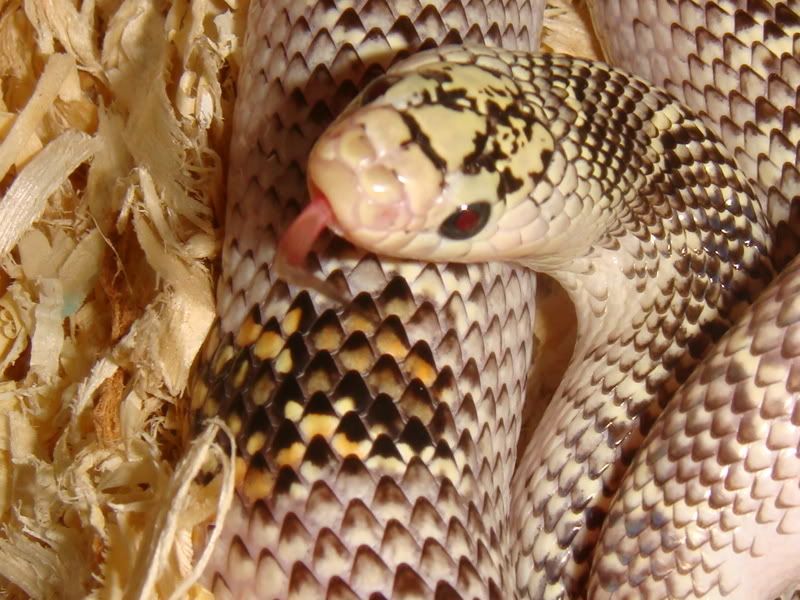
Axanthic-WS

Lavender-WS

Hypo-WS coming soon...
~ZF
CrimsonKing
Sep 15, 2008 02:04 PM
Zenny, I asked Christopher below and I have no w/s myself...So would you do a scale count and post it here? I think that could help a bit and may be interesting, I dunno...
:Mark
-----
Surrender Dorothy!
ZFelicien
Sep 15, 2008 02:30 PM
On the Normal WS i got approx. 245, when i got closer to the vent she got testy. but the count is close to accurate.
(This female is Directly from Ricks Line. Parents aquired from T. Trick and are 100% het for Axanthic)
On the Axanthic WS. i only got to about 165 before he coiled around my arm and disrupted the count but i was probably 3/5 midbody by then so i assume his belly scales are similar to the normal-WS
the Lavender-ws isn't having it at all... so no count there.
CrimsonKing
Sep 15, 2008 05:38 PM
Thanks!
Not belly scales (though that is some news), the scale count across the dorsum is what I was interested in.
:Mark
-----
Surrender Dorothy!
CrimsonKing
Sep 15, 2008 05:49 PM
..it's much easier to use a shed skin to count the scales across the dorsum.. Skins don't wiggle around much!
:Mark
-----
Surrender Dorothy!
ZFelicien
Sep 15, 2008 06:05 PM
ahhh ok! excuse my ignorance... i made reference to your post to ChrisD before i replied so i assumed you were referring to the ventral scales.
Well for the Axanthic-WS it's btwn 21 and 22
the Normal WS was 21.
That being said... IF the WS gene is a result of "gene migration" (in all fairness) i think this would be a hard call. Hybrids tend to fall inbtwn (i.e express traits intermediately). back breeding to the desired Parent snake would essentially eliminate the "undesired" traits. resulting in a good "camouflage" (for a lack of a better word).
~Z
CrimsonKing
Sep 15, 2008 09:13 PM
FL kings usually would be 23 and rats like black rats are 27....
:Mark
-----
Surrender Dorothy!
foxturtle
Sep 15, 2008 03:47 PM
the number of rows at mid body. Florida kings should have 23 scale rows at mid body, but can also have 21.
ChristopherD
Sep 15, 2008 04:26 PM
I noticed you used odd numbers so i asumme its radial from belly scute to belly scute mid -section
FR
Sep 14, 2008 09:09 PM
You have a mutation of a locality and you worry about it being a hybrid, how odd.
Its actually very simple, once they are not normal, they are mutations for captive use only. So who cares if they are hybrid mutations or simplye mutations. In these cases, none are pure. God I hate that word, pure, hahahahahahahahahaha. Ok, they are not naturally occuring. Cheers
RossCA
Sep 14, 2008 11:20 PM
I think that sums it up quite well.
Lazarus
Sep 15, 2008 02:25 AM
So how do we, as herpetoculturists, work towards purity? Of course not considering natural intergrades and such that may be perpetuated in captivity. What would you suggest?
Joe Forks
Sep 15, 2008 07:36 AM
>>So how do we, as herpetoculturists, work towards purity? Of course not considering natural intergrades and such that may be perpetuated in captivity. What would you suggest?
Frank's point is that every captive generation takes you another step away from "wild blood" (substituting wild blood for pure). You can start with wild blood, and you then work away from it. You can breed wild blood back into a project, but that does not invalidate Frank's point.
-----
Herp Conservation Unlimited
Mexicana Group Directory
Photography by Joseph E. Forks
Tony D
Sep 15, 2008 07:14 AM
While I tend to agree that the concept of a "pure" morph is a bit dubious there is a distinction between animals that have been misrepresented and those that have not.
Please note, I'm not saying that white-sided brooks have been misrepresented!
IMHO a new morph is worth more, at least for a time, than one where the mutation was migrated over from another genus. If most didn't feel this way, there would be no incentive to misrepresent. Just my two cents.
-----
Darwin Rocks!
FR
Sep 15, 2008 09:25 AM
Again please do not take this personal. But your talking about people, they are the ones that may or may not represent their goods accurately. No different then representing a used car, or any other object to be bought and sold.
So to me, you are more concerned with people and their honesty, then the actual subject of this forum, kingsnakes.
So I say to you, this area is no different then any other area in our lifes, there are indeed honest and dishonest people. Even down to misrepresenting localities accurately to make a buck. I have seen that many times and with "pure" animals.
You would be better off if you stepped back and looked at the animals. You know, the actual animals.
Nature creates pure animals. These animals are from a wide genotype(genetic possibilities) and are narrowed down to a phenotype(genotype after the effects of natural selection) normal phenotypic expression.
Even to a point that mutations are always occuring in nature, in an attempt to improve the chances of survival. But mutations rarely survive.
So what is pure is, the average color/pattern that occurs in a local. So when you talk local specific, thats exactly what your talking about, what is average in a certain local. All locals have extremes and exceptions.
But is that what is in our collections????? In a few cases yes, but in most cases, people keep the extremes and mutations of any pure phenotype(average for a local) They do so because they are people and we get tired of normal. Of course, not all people are alike, hahahahahahahahahahahaha.
So what I question is, how and why does anyone call ANY mutation, pure or normal? Any unsuccessful mutation is a failure, not matter if its caused by hybridizing or a simple recessive genetic memory.
Of course there are pattern mutations that are situational. An example would be striped cal kings. The vast majority of cal kings are banded. But in certain enviornmental conditions, striping is successful. In the case of cal kings, striping seems to be raparian or mesic and banding Xeric or arid.
In other species, melanism is a successful mutation, like with some getula, mexicana, hognose, coachwhips or gardersnakes(etc). In these cases there are indeed successful populations that include a percentage of All black individuals.
So to keep mutations such as albinos and whitesided and a vast number of oddities, and call them pure is very very odd. And in fact is a huge misrepresentation of what is pure or normal. A failed mutation is a failed mutation, whether its a hybrid or not, its simply a natural failure.
And yes, your welcome to like them and keep them, but that choice is about you being human and nothing to do with the natural wild phenotypes(pure). So in this case, you calling mutations pure is a huge misrepresentation. Sir, they are not pure or normal. They are a failed attempt, as with hybrids and other failed attempts. You see, all these attempts had to have already occurred in nature or you would not see them expressed in captivity. As genes are a record of what has already occurred. Cheers
charleshanklin
Sep 15, 2008 09:54 AM
Do all the sifting you want with this one, all your gonna get is smelly! lol
DMong
Sep 15, 2008 10:20 AM
Since the original poster didn't ask for all the additional "dancing" around the specific question with all the so-called philosophy.
For example,...if a given species, subspecies of snake has a trait for amelanism, it DOES NOT make it any less a species or subspecies than it would have normally been otherwise, it still remains exactly whatever species, ssp. it was prior to that, only it is simply amelanistic. But a turbo x bubblegum x imperial x corduran sure the hell DOES change things.
Unless of course one prefers to "twist" things all around and insist the snake is a pure form of turbo x bubblegum x imperial x cornduran...hahahaha!....GEEEESH!
~Doug
-----
"Better to be silent and thought a fool, than to open mouth and remove any doubt!"
FR
Sep 15, 2008 11:13 AM
Only there are no wild populations of albinos(amelanism). I read about albino Japanese rat snakes living free in temples, but not in nature. So yes, albinos are a unsuccessful mutation that is buried in the genetic memory of normal wild populations. So again, its a mutant.
As I mentioned, melanisum is(can be) a successful wild occurring mutation. Therefore it can and does represent something natural("pure" from the influence of man)
As are the rest of what you mentioned, bubblegum etc, those have nothing to do with a local or pure snake, nor do they represent a pure or local specific snake of any species.
Just because they are not a product of a hybrid crossing does not make them any more successful in nature or any different then any other mutant(unsuccessful mutation)
All those mutations including albinism are products for captivity, their value is in captivity, not nature, therefore they are not PURE or natural, or normal. They have little to no value in nature, but are or can be very valuable in captivity.
The problem I see is, many here confuse or use nature as a guide or source of a species or type, then confuse nature with captivity. The reality is, an albino or a bubblegum het for three other mutations, or possible het for a triple alele vanishing strawberry whipcream faded breakaway barker line striping, are nothing more or less then captive products and have not a thing to do with nature.
Its the same as a local specific animals that do not look like the local its suppose to come from. Its very simple, if an animal does not look like its local brothers, then its not.
I guess in scientific terms, we keepers KEEP genotypes, but do not mimic or breed for phenotypes. There is not natural selection. There is captive commerical selection. Cheers
charleshanklin
Sep 15, 2008 11:28 AM
Nature made these genetic reaks so we can profit off of them. It is nature's way of giving a little and in return it would like to be saved. There is np way nature could possible have any albino's or other mutation's thriving with the way we take them from it so you are absolutely correct.
Genetic mutation's do not thrive in the wild because......help me out here. Why don't they? We are getting new mutations all the time from Africa so how come there aren't any here? Maybe we should all live in huts and not over populate the world to see if mutations would make or better yet I think we all should just ask them.It is about the snakes and what they tell us.
Once snakes are in captivity they do not look like they do in the wild either. We will have to put ticks and afew scars if you really want something authentic.
Just because nature makes albinos and aneries does not by any means make them naturally occuring and they are all now hybrids and failures. We do like them though.
Nothing like spending a monday dancing with FR. Which by the way could actually be helpful but would rather babble. Nothing taken perdonal juast an opinion.
Toodles
jlassiter
Sep 15, 2008 12:56 PM
>> I guess in scientific terms, we keepers KEEP genotypes, but do not mimic or breed for phenotypes. There is not natural selection. There is captive commerical selection. Cheers
Selective Propagation instead of Natural selection......
-----
John Lassiter
"Poor planning and procrastination on your part does not constitute an emergency on my part....."
Tony D
Sep 15, 2008 01:29 PM
that you find it odd that I largely agree with your basic premise that captive snakes are a far cry from their wild relatives.
I also find it odd that you repeatedly miss that people are part of the mix in discussions relating to captive snakes. I've looked this at a couple of angles and I really don't see captive-bred snakes existing without PEOPLE!
-----
Darwin Rocks!
FR
Sep 15, 2008 10:43 PM
Wow we actually agree, captive animals are all about the people that keep them.
Its comparing them back to nature that confuses me. You know, the use of the term "pure", etc, when applied to a mutation is what I do not understand. Or in this case, a mutation like white sided, then being worried whether its a hybrid or not. Heck, is one mutation worse then another????? So a hybrid mutation is worse then a non hybrid mutation?????
Or as I already mentioned, if a local specific captive hatched individual, does not look like(represent) the local it comes from, then is it really a local specific individual? You see, local is a appearance thing. Its suppose to look like where it comes from. But if the keepers breed away from what that local is suppose to look like, then what does that mean? Cheers
tricolorbrian
Sep 18, 2008 01:12 AM
Apostle, I have a problem with a couple things you said. Maybe you can enlighten me...
For one thing, locale is spelled with an "e" on the end.
For another, a locale specific animal is simply an animal that directly descends from or was taken at, a specific locale. It has nothing to do with what most of the snakes look like at that locale. If the animal was produced in captivity, it cannot have any other blood lines in it but the ones that originated at the locale. Period.
Let me give an example: If snake A was collected at site B, along with snake C, and A and C bred, then offspring would be pure to locale B. If either A or C is bred to a snake from site D, then the offspring are not pure to locale B.
"Show me a college student, and I'll show you a person who goes to college."
tspuckler
Sep 15, 2008 08:23 AM
There's a big difference between a color phase (mutation) and a hybrid. Mutations occur in nature, there are natually occurring populations of anery corn snakes. So they are "pure."
Frank, you continually try to "sell" the idea that every snake in captivity is a hybrid with your misleading remarks, (e.g. implying that mutations and hybrids are the same thing). This simply isn't true.
Tim
FR
Sep 15, 2008 11:33 AM
Snakes do hybridize in nature as well and its not so uncommon.
If you would bother to do some research on that subject, you would be surprised how many natural occuring hybrids are found and published. I recently read an articule in a naturalists mag, I think Western naturalist or something similar, on a canebrake/atrox cross, using scale structure as a defining method, As Dna often does not work, without the dna of the founders. This articule listed a number of other rattlesnake hybrid papers(on many species). This basically included most if not all the larger rattlesnakes, and a few of the smaller ones.
This articule made a bold statement on how and why this may be occurring, MORE COMMONLY. Loosely put, species are evolved to a "certain" habitat, but now with mans envolvement, there is lots of neutral habitat where several species can occur without the restraits of their intended habitat.
Mate selection is a specific "behavior" and behavior is loose when compared to physical structure. It inferred that without natural behavioral restraits, hybridization will become more and more common.
Also, If you actually did more research, you would find that natural hybridization is now being atributed for the creation of many species of reptiles. That is, through the use of Dna, many exsisting species are proving(if dna is proof) to be successful hybrids.
So yes, hybridization may be as common as mutations in nature. And yes, neither are common, but both occur on a regular basis, but they are not normal. It just seems very funny to me that here many people think they are qualified to judge one more normal then the other. When in fact, neither are normal(pure). Thanks for your ear, Cheers
tspuckler
Sep 15, 2008 12:02 PM
"Snakes do hybridize in nature as well and its not so uncommon."
I never said they didn't.
"If you would bother to do some research on that subject, you would be surprised how many natural occuring hybrids are found and published."
Perhaps. But that doesn't change that fact that you didn't tell the truth in indicating that morphs and hybrids are the same thing - they're not.
"So yes, hybridization may be as common as mutations in nature."
Indeed. But that does not make them the same thing. Ants and sparrows are common in nature - but they're not the same thing (although maybe you think they are).
"And yes, neither are common, but both occur on a regular basis..."
Gee, Frank that seems to bee a contradiction in terms.
"It just seems very funny to me that here many people think they are qualified to judge one more normal then the other."
It does. But it seems even funnier when people try to pass off the idea that morphs and hybrids are the same thing and expect people to believe them because they're a self-proclaimed "pioneer."
Hahahahahaha
Tim
FR
Sep 16, 2008 09:24 AM
Both are normally unfit to exsist in nature. And both are very fit and popular in captivity.
Both can have a much higher value in captivity. You see, it really depends how you look at it.
Many here love morphs, because they do have a captive value. Also many here value hybrids for the same reasons. Those reasons include monitary value, different colors and patterns, different combinations of behavioral traits, precieved rarity etc. Which are valid reasons to like them in captivity. But has nothing to do with nature.
In nature both hybrids and mutations are attempts to increase the ability to survive. If they fail, which is most likely, they disappear, if they survive, they become a named by man specie/s. All these species are only temperarily a species, on the way to evolving to a different species or disappear.
The reality is, the line between morphs and hybrids is very unclear and is based on the current naming that man applies. All man has to do is, change the genus names and hybrids are no longer hybrids and intergrades become hybrids.
Just think what will happen when some taxo fella decides that colubrids are to closely related to be so many different genus????? After all, they can and do interbreed successfully. And their differences do appear superficial.
oh and I do apologise for causing you to think outside your bubble. Cheers
thomas davis
Sep 16, 2008 09:31 AM
thank you for trying to reel reality in to our lil group ,,,,,,,,thomas davis
-----
Morphs... just like baseball cards BUT ALIVE, how cool is that???
my website www.barmollysplace.com
tspuckler
Sep 16, 2008 09:23 PM
Taken from the "Glossary of Commonly Used Terms" in the "Features" section of this website (www.kingsnake.com):
Hybrid: to herpers, the progeny from a breeding between two species of the same genus or between two genera...
Morph: usually refers to the different colorations and patterns produced by one mutation or a combination of mutations in a particular species...
A hybrid and a morph are not the same, Frank, and you know it. As I said earlier, you are continually trying to present the false idea that every snake bred in captivity is a hybrid and that idea is untrue.
Tim
FR
Sep 17, 2008 01:34 PM
The difinitions on this site are about and for captivity. Not about nature.
My concern/confusion is, people here tend to revert back to what is what in nature. As with the term, pure, or a pure species, etc. When is nature, that is not so clear. And in nature, morphs and hybrids become very much the same thing. An attempt to increase success. And in nature, they are both 99.999% failures.
Take Cal kings, there are a number of color and pattern mutations that are successful, such things as melanism, striping, black&whites(desert), abberants, etc, have populations or percentages of populations. But white sided, albinos, paradox, etc, do not. They are unsuccessful mutations, as are hybrids.
Natural unsuccessful mutations, including hybrids, are supported in captivity for the various reasons I have already mentioned. And they are not supported in nature for very different reasons, they are unfit to exsist at this current time.
I fully understand that I must be old, as I do not get it. I go to this local reptile shop and they have a cage full of baby corns. yet, not a single one looks like a cornsnake. Some look like bairds, and yellow rats, and others look like no wild snake I have ever seen, YET, they are still called cornsnakes. They weirdos are as different from a cornsnake as any hybrid. So explain how they are not hybrids please. I mean, they are not produced from a locality type, they are produced from breeding all manner of corns from totally different locals(which soon will be hybrids)(ask if you want).
This is true for Fla. kings as well. And in the near future, Eastern kings will have a zillion morphs that do not appear in nature.
So yes, I do wonder why folks love morphs, but hate hybrids. Particularly when soon, as DNA taxonomy will make all distint populations(lacking geneflow) their own species. And the vast majority of these morphs will be hybrids.
When all we are talking about is manmade names, yes it confuses me. In nature, the names we give them mean absolutely nothing. In fact, less then nothing, its what they are and what they do, that is meaningful. Its their place in the ecosystem thats important, not their names. A successful hybrid in nature becomes a pure species. An unsuccessful species, disappears and is replaced by something else. Nothing stays the same, its all about evolution of a animal.
So please pardon me, as a field herper first, I am confused about comparing wild animals with captive morphs and hybrids. Captive morphs and hybrids are indeed part of the wild genotype of wild snakes, but not part of the successful phenotype. At least not yet.
Also, its odd to me that many here say I am wrong, but fail to express a right. To allow me to understand, you must include an explination that allows me to see another point of view. As least something to support another view. But I do not get that. Mostly I get name calling and such.
You must also understand, my views are mine and do not have to be anyone elses. You do not have to agree. I am merely bringing up points to keep a discussion alive.
So I ask again, why is a morph that is nothing like anything that exsists in nature, different from a hybrid that does not resemble anything in nature either?
I can tell you this, I have hybrids are are much closer to looking pure, then many morphs. They have at least some qualities of a pure species, characters of two pure species, yet many morphs do not resemble a pure species or local at all. So from that point of view, hybrids are much closer to something pure(naturally occuring) then many extreme morphs. Cheers and back to the bush I go.
FR
Sep 17, 2008 01:35 PM
I could go back and fix the many errors in my post. Cheers
tspuckler
Sep 17, 2008 01:48 PM
Frank,
A morph is not a hybrid. It does not matter if it's in the wild or in captivity. A morph is a color phase of a pure species. A hybrid is the crossing of two species.
You have presented false information and there's no getting around it. What you said is untrue.
Tim
FR
Sep 17, 2008 02:47 PM
Do some real research. Like research turtle and lizard species that are wild products of hybrization, they do exsist.
You are also missing most of the points I make. Instead, you repeat what you read on a forum. A morph is this and a hybrid is that. What you fail to think about is, what is a species.
Particularly at this time when species names are changing at a very rapid pace and will continue to do so. As I mentioned, in the future, many of these current morphs, will be hybrids. As their parent species are redifined. Anyway, good luck with your herps. Cheers
tspuckler
Sep 17, 2008 02:53 PM
I don't need to Frank.
"Hybrid" and "Morph" have definations associated to them.
They are not the same thing.
No additional research is needed.
You made a false statement.
Tim
FR
Sep 17, 2008 08:21 PM
Well I guess that is that. Thankfully, you really defined your stance and your understanding. Cheers
markg
Sep 17, 2008 02:11 PM
This baffles me too, how snakes bred in captivity for many generations from animals with various locales which would not have a chance to mix in nature and with various mutations which would not have a chance to mix in nature or survive in large numbers are called "pure."
-----
Mark
FR
Sep 17, 2008 02:43 PM
They can be called beautiful, or wonderful, or amazing, but they are not pure if pure is what is in nature.
I guess its a human thing that people want what they want, then make rationalizations to support that.
oh well, its all about discussion and thinking. Cheers
tspuckler
Sep 17, 2008 02:59 PM
Here's one way to look at it. Florida Box Turtles live in Florida. They may intergrade with other subspecies in the Eastern Box Turtle complex, but they don't hybridize with Western Box Turles. The two races are seperated by quite some distance.
Now let's say someone finds a wild Florida Box Turtle that happens to be an albino. Is it a morph? Yes. Is it a hybrid? No.
Morphs and hybrids aren't the same thing. Hybrid breeders love try to rationalize their hobby by suggesting that mixing locales is "impure." But there's a specific definition for a hybrid and that's the crossing of two different species.
Tim
FR
Sep 17, 2008 02:57 PM
No Tim, I never said "every? anything. That is totally in your head, not mine.
Try looking into how a species is named and all the different non argreeing approachs that make that up. Like Cladist, taxo, systematics, utility, etc etc. These are more have valid approaches to what a species is, but they do not agree with eachother. Then if you take DNA, that is another ball of wax altogether.
Yet, you simply read a book or a list in features and say what you say. Cool I say, try broadening your information base.
And please give me a tiny bit of credit. I have watched this occur from the very begining and in fact was part of it. I was the first breeder of many many captive species and captive morphs. And yes, some crosses and hybrids as well. I also spend lots of time in the field and doing field research. So I have a little idea as to what is currently being confused.
All in all, its not about right or wrong, its simply about discussing the many different approaches(views) of what this forum is about. We do not have to agree, and really we shouldn't. But no, I am not making things up, I am simply offerring you things you do not/have not considered. Cheers
tspuckler
Sep 17, 2008 03:24 PM
Nice try, Frank.
By saying that morphs and hybrids are the same thing, "every" is implied. You made a false statement and then posted multiple times trying to support that false statement and now it looks like you're backing off from it.
Ever consider just telling the truth?
Tim
DMong
Sep 17, 2008 03:44 PM
Frank,....granted, anyone that has the slightest concept of how wild animals actually evolve, also knows(like you are saying)they are a giant composite result of MANY, MANY past breedings(which obviously they are), can also figure out that(for example) just because a defective gene for amelanism is expressed in a given animal, does NOT instantly make it a hybrid when that took place in the egg, and if so, it would STILL be a hybrid WITHOUT the gene for amelanism,....simple as that. A mutant color and/or pattern gene that simply pops up out of nowhere and is expressed does NOT constitute a hybrid, unless of course the amel gene was introduced from a totally foreign source to begin with.....period!
I think I know what you are "trying" to say with this, but it only applies here and there to certain situations, certainly not all.
This thing is getting WWWAAAAYYYYY over-dramatized and exaggerated for any practical purpose. I don't see the need to try and re-invent the wheel here.
~Doug
-----
"Better to be silent and thought a fool, than to open mouth and remove any doubt!"
davidtobler
Sep 15, 2008 01:08 PM
Hang on Frank, don't jump to conclusions. I'm just asking a question, I do NOT own any freak mutations. In fact I don't keep anything at all...haha. I just wanted to know, because it got brought recently in two seperate conversatons.
ChristopherD
Sep 15, 2008 06:30 AM
I have bred alot and seen alot but have nver seen any with rat snake trademarks, such as head shape or the flat sharp angled tree climbing belly of the ratsnake.
And Tim Ricks i believe to be the originator told me they were not...They are still too cool!!!

CrimsonKing
Sep 15, 2008 01:56 PM
Nice white belly on that one!
Is that a white sided "brook's"?
Would you do a scale count and post it here?
Thanks!
:Mark
-----
Surrender Dorothy!
charleshanklin
Sep 15, 2008 01:59 PM
>>Nice white belly on that one!
>> Is that a white sided "brook's"?
>> Would you do a scale count and post it here?
Too funny. Did you make to the show this past saturday?
CrimsonKing
Sep 15, 2008 05:39 PM
Wasn't trying to be funny really.
Yes I was at WPB.
:Mark
-----
Surrender Dorothy!
charleshanklin
Sep 15, 2008 05:56 PM
>>Wasn't trying to be funny really.
My bad it is tough to tell by reading it online.
>> Yes I was at WPB.
I must have missed you then. I had a table but it was so slow I left a buddy of mine there to watch as I bs'd in the heat.
