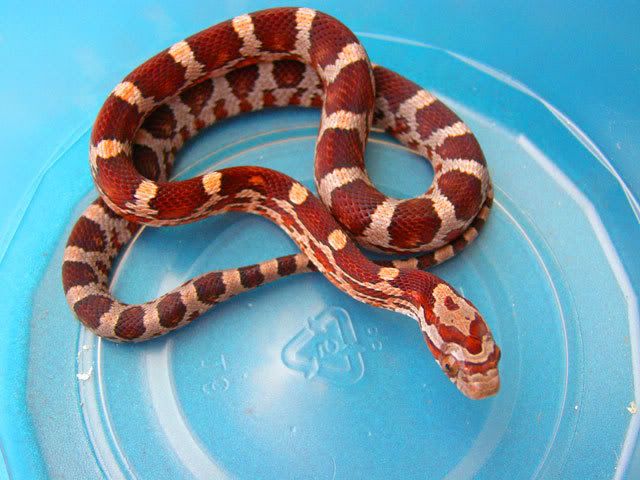
so from what i gather blood reds are not a morph but they are a naturally occuring phase, where did this phase originate? also i was curious if anybody has infused Okeetees with the blood red gene to get a richer colored snake, so called natural snake. and since the bloodred isnt a morph would the snake be consited het?
hope thats makes sense
Adam
-----
Reptile & Amphibian Forums
Welcome to kingsnake.com's message board system. Here you may share and discuss information with others about your favorite reptile and amphibian related topics such as care and feeding, caging requirements, permits and licenses, and more. Launched in 1997, the kingsnake.com message board system is one of the oldest and largest systems on the internet.



Question about blood reds
APLAXAR
Sep 16, 2008 09:31 AM
Replies (5)
Paul Hollander
Sep 16, 2008 09:54 AM
Blood reds were selected for darker red coloration and relatively diffuse blotching, starting with northern Florida stock. The coloration seems to be a result of selection, but the diffuse blotching seems to be the result of a mutant gene.
Blood reds have been extensively outbred from the original line. They have probably been bred to Okeetees at some time or other, but such crossbreeding has not been extensive (as far as I know) because the Okeetee look should include bold dorsal blotches rather than diffuse blotches.
Paul Hollander
APLAXAR
Sep 16, 2008 10:58 AM
Hey Paul, that makes sense about the difusing of the blotches were it would be almost counter productive, thanks for the reply
-----
HerpZillA
Sep 16, 2008 08:56 PM
Bloods were a WC phenotype. Out crossed and bred back for the look, but stronger OVER ALL genetics.
Now, the episkiastism (diffused) gene was said to be recessive. Now I read it's co dom? There is certainly a difference from recessive and co-dom/incomplete dom. I wish I had 20 snakes to test it for me to see.
But there is a diffused gene. The rest of the genetics aare basically the same to me as an okeetee. Although a good bloodred look is far harder to get than a "lookatee" I forgot who coined that term in here? But 2 bits for royalties. Also you will need corns with teh genes for the red color. Whether multi allelic, multi genetic or a combo.
But to me the bloodred is "NOT hetable". I coined that one. Simple example is if you breed a nice bloodred to a nice Miami, you should be able to breed those babies together and get 25% bloodreds. But what you get are snakes that could look Miami, somewhat normal and somewhat blood. That why they had to line breed it back after outcrossing. That right there is the answer.
NOW, before I get hammered. I know people call some snakes het bloodred. But all those hets, carry some genes, (which is important to breed back to that bloodred look) but can vary in look greatly. It is NOT the same as a het amel. Maybe "het bloodreds should have a percentage to show how close they look like bloodred? That would be impossble. Especially as babies.
As far as episkiastism being co dom now? I spent a lot of time talking to people in bio/genetics, such as instructors and herp guys on IRC work toward their masters or PH.Ds. The entire topic of co dom vs incomplete dom is stupid. WHY? Because co dom, by definition can act like incomplete dom, and vise verse. Not to mention it is acceptable for one group of people like boids to use the terms one way and a group standard for colubrid to mean something else. This info lead me back to my genetics Prof., and she said YUP. I was at a loss for words. Scientific use of words and they can mean different things to different people. Not to mention genes can be effected by genes near them. Add in multi allelic and multi genetic, and I punt.
Bloods are just a great snake, and the diffused gene may be understood at this point. But the rest is just unknown why exactly.
BUT, that's what make it so much fun.

-----
Thanks for reading.
Big Tom
APLAXAR
Sep 16, 2008 09:53 PM
thanks for that post Tom.
Adam
-----
guyergenetics
Sep 17, 2008 11:34 PM
I'm fortunate enough that I do have 20 snakes to compare.
I have bred my bloodred female to a different male of a different morph every year since 2006 creating outcrossed bloodreds that are each in effect the first step of a two generation process of creating morphs such as sulphurs, avalanches, peppers, fires, etc.
It seems more like the bloodred genetics work through an incomplete dominancy in where some of the 'blood red' bleeds through onto the outcrossed hatchling. No matter what I breed my bloodred to I have ended up with high red normals with many showing some diffusion along their sides and a good number of them with a reduced belly pattern. The bellies will have pattern along the sides but it looks like someone took an eraser right down the middle of the belly leaving the middle strip of belly patternless.
This year I bred my bloodred to a butter motley and have the reddest outcrosses I have seen yet. The snake pictured is one of those babies and for the outcrossing I've done, this one has a rather extreme amount of red in it.
From what I have observed through my own breeding the bloodred genetics are not simple recessive....there is no het bloodred, only outcrosses, and they are not codominant either, but incomplete dominant with the some of the 'bloodred' bleeding out onto the first generation hatchlings.