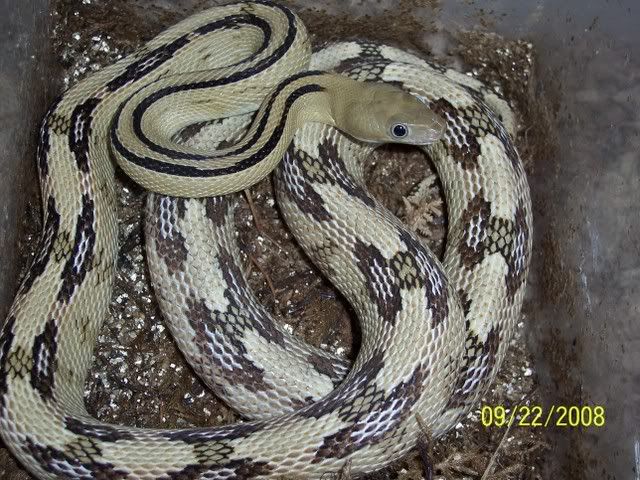
Here is the female from the project I have explained before and explained on my website.
She may prove out sooner than I thought. Looks pretty gravid right now.... stopped eating 3 weeks ago and hasnt lost and weight and just shed prolly 12 days ago...better late than never right  My fingers are crossed
Thanks
CHRIS FLOWERS
Reptile & Amphibian Forums
Welcome to kingsnake.com's message board system. Here you may share and discuss information with others about your favorite reptile and amphibian related topics such as care and feeding, caging requirements, permits and licenses, and more. Launched in 1997, the kingsnake.com message board system is one of the oldest and largest systems on the internet.


Female from my special project
cflowers
Sep 22, 2008 07:20 PM
Replies (8)
RandyWhittington
Sep 22, 2008 09:38 PM
Good luck Chris. I hope you get a nice fat clutch from her.
-----
Randy Whittington
CFlowers
Sep 22, 2008 09:55 PM
thanks Randy. me too. im sure they will sell fast. But im keeping a 1.1 forsure and we all know subocs have a small cultch the way it is 
DMong
Sep 23, 2008 12:37 AM
Very nice!,....certainly looks like eggs in the oven to me!..LOL!
~Doug
-----
"Better to be silent and thought a fool, than to open mouth and remove any doubt!"
dustyrhoads
Sep 23, 2008 10:28 AM
Congrats, Chris. First, let me say that whatever they are, I want some! A Black Gap color phase would be sweet!
Second, we were recently discussing this on another forum and Aaron shared this photo of the yearling that's turning Gray with age. As I shared with Aaron, to ontogenetically "turn gray" is an earmark of a polygenic Gray phase. So, I have considerable doubt that these are anything but a polygenic Gray phase suboc, which have been found at the Gap before. In other words, I highly doubt this is a simple recessive mode of inheritance of a single allele.
Also, to my knowledge, no other snake species has an axanthic or anerythristic morph that are born normal and turn into that with age. Some people might say Blue Chondros, but blue chondros aren't completely Axanthic, that's a polygenic morph -- in other words, many genes additively playing on one physical trait.
Just looking at the picture that Aaron shared of the yearling (top) compared with a true Axanthic of the same age (bottom), you can easily see the difference between Gray and Silver.


Anyway, not trying to stir anything up, but just giving my opinion as to what I think is going on with this morph. I could be wrong, but I think I'm guessing right.
Regards,
Dusty Rhoads
Suboc.com
Chris_Harper2
Sep 24, 2008 12:07 AM
Second, we were recently discussing this on another forum and Aaron shared this photo of the yearling that's turning Gray with age. As I shared with Aaron, to ontogenetically "turn gray" is an earmark of a polygenic Gray phase. So, I have considerable doubt that these are anything but a polygenic Gray phase suboc, which have been found at the Gap before. In other words, I highly doubt this is a simple recessive mode of inheritance of a single allele.
Is there any evidence that this phase is an example of phenotypic polymorphism (i.e. like what one sees in Variable Kingsnakes, Eyelash Vipers or G. oxycephalum)?
I am not aware of this discussion on another forum so sorry for stepping in here, but I do want to clarify that polygenetic traits are not necessarily mutually excluse from single gene recessive or dominant traits. Your quote above seems to suggest that but you may have just been summarizing this other thread.
I can't think of a great example parallel to this in snakes, unfortunately. One possible example is Calico Reticulated Pythons that go through a ontonogenic color change but the actual expression of the trait appears to be single gene recessive or dominant. I do not follow Reticulated Python morphs much so maybe this is a known fact now, I'm not sure.
But the general idea is the same. There could be some sort of polygenic trait that includes an ontonogenic color change that is expressed in a single gene manner. Multiple loci that form the trait but the one loci that either switches it on or off.
Just thinking out loud...
-----
Currently keeping:
6.10 Gonyosoma oxycephalum (Javan, mixed colors)
1.1 Philodryas baroni
1.1 Lampropeltis triangulum multistriata
1.0 Rhodesian Ridgeback
Chris_Harper2
Sep 24, 2008 09:56 AM
I have received a couple of emails about this post and thought I should clarify something.
Polymorphism as I mentioned is generally considered a type of polygenic inheritance. I did not mean to imply that the two terms are synonymous. It's more like polymorphism is one type of polygenism.
So both polygenic and polymorphic traits are thought to be controlled by multiple gene loci. The difference is that variation in a polygenic traits tend to occur along a continuum where polymorphic traits tend to have two or more discreet phenotypes that do not blend.
And both can show Mendelian patterns of inheritance if there is some sort of epistatic gene at work.
-----
Currently keeping:
6.10 Gonyosoma oxycephalum (Javan, mixed colors)
1.1 Philodryas baroni
1.1 Lampropeltis triangulum multistriata
1.0 Rhodesian Ridgeback
dustyrhoads
Sep 26, 2008 04:34 PM
I've got a calculus test coming up, and I'm trying to limit my time on the comp...
>>Polymorphism as I mentioned is generally considered a type of polygenic inheritance. I did not mean to imply that the two terms are synonymous. It's more like polymorphism is one type of polygenism.
Looks like we're getting into the realms of quantitative genetics...
I don't believe that polymorphism (e.g. as is seen w/ the variation of several traits of leonis kings, alterna and blairs phase of alterna, and the many appearances of Sonora sp. Ground Snakes) are good examples of the type of polygenic inheritance I believe Gray phase subocularis to be. I believe it to be, rather, an example of additive gene action, where several loci affect a single trait, and the alleles at these loci show no dominance, so the effects of the alleles on the phenotype are purely additive.
A better-documented example is that of kernel color in wheat, where a plant w/ dark red kernels is bred to a plant w/ white kernels...all of the F1s are an intermediate color (very light red); the F1s are then self-crossed, and all of the F2s show a gradient of phenotypes (some seven different shades) from white, to light pink, all the way to dark red.
Gray phase is a naturally-occuring color variety, much like Miami phase or Okeetee phase Corns. Gray phase often occur where the substrate is grayish. I've bred Orange phase, another naturally occurring color, to a yellow Blonde and got an intermediate-looking F1 generation. I haven't bred the F1s to count out how many alleles are governing the orange color (a very hard thing to do with a species that doesn't produce large numbers of offspring, quickly and repeatedly -- like wheat, for example). I believe the Gray phase is governed by the same type of polygenic inheritance, that is, additive gene action.
It could be an example of incomplete dominance, but I doubt it...it would seem that any locus that affects "Gray color" would be selected for in a species that needs to be cryptic, as they're both predator and prey. So, I think multiple genes are at play here.
Dusty Rhoads
Suboc.com
Chris_Harper2
Sep 30, 2008 09:04 AM
Sorry for my late reply as well. I have been out of town for a few days. Hope your calculus test went well.
I don't keep B. subocularis and have never seen one of these adults in person, so I'm only commenting based on my background in genetics.
But my understanding is that when it comes to adult phenotypes, we are not seeing any intermediate forms between silver & normal, whether in captive bred populations or in wild populations known to have Silver specimens.
If so, this makes me doubt additive genetic effects.
Of course one can have additive genetic effects and still have discreet phenotypes (i.e. non-continous variation) but this is thought to be less common. Can't think of an example off the top of my head.
So again, are you saying that there are intermediate forms between silver and gray B. subocularis specimens?
If so...
Is this in the wild?
Is this is captive populations?
Again, my understanding is that in captivity Black Gap specimens have either been silver or normal, with no intermediate forms. At least when comparing adult phenotypes.
And given the random nature that silver babies have showed up in captive breedings my gut reaction made me think some sort of polymorphism.
Thanks for any information. I have no vested interest in this discussion but am curious as to what is going on.
-----
Currently keeping:
6.10 Gonyosoma oxycephalum (Javan, mixed colors)
1.1 Philodryas baroni
1.1 Lampropeltis triangulum multistriata
1.0 Rhodesian Ridgeback
