

Reptile & Amphibian Forums

Welcome to kingsnake.com's message board system. Here you may share and discuss information with others about your favorite reptile and amphibian related topics such as care and feeding, caging requirements, permits and licenses, and more. Launched in 1997, the kingsnake.com message board system is one of the oldest and largest systems on the internet.

Click here to visit Classifieds
https://www.crepnw.com/
Click for 65% off Shipping with Reptiles 2 You

Here are some rare pics of Fl. Key

herpsltd Sep 26, 2008 02:45 PM

Eastern Diamondback Rattlesnakes. These live in disjunct colonies in the lower Keys and are very different than the mainland form. Earlier a friend of mine collected 3 neonates for me as I'm currently trying to aquire them for a breeding project. Needless to say I'm very pleased. On the way down we saw Rosy Rats, Giant Day Geckos, and a few nice Mangrove Water Snakes. I'll try to post more pics later....TC

Replies (16)

CrimsonKing Sep 26, 2008 03:13 PM

Nice. Keep us posted on their progress.
:Mark
-----
Surrender Dorothy!

crimsonking.piczo.com/

Upscale Sep 26, 2008 10:34 PM

Could you share with us exactly what makes these diamondbacks very different from the mainland form? Are there little marsh rabbits down there? Are these rat eaters? Thanks!

herpsltd Sep 27, 2008 05:02 AM

As they mature adults tend to be more gey and black in color with little or no gold or yellow. The dispostion is remarkably calm acting similar to a C. ruber and they tell me the D.N.A. look has shown a very different snake than the mainland form. An adult looks similar to an anerythristic snake. Even the babies have the very black mask on the front of the face similar to a C. molossus that is more pronounced with age. Have you not seen lots of E.D.B.'S to be able to look and see the subtle difference's in the neonate;s, poor pic as it is?.....TC

Upscale Sep 27, 2008 09:12 AM

I really don’t see anything from the pictures, that’s why I was wondering what the differences were. The DNA difference would be fascinating to explore with those, very interesting. I have experience keeping EDB I collected from just south of the Alley, west of 29 back in the day (we use to call that “the blocks” out there) so I was curious what the differences would be with that lower Keys population. Actually, there’s an ad in classifieds right now for some little cb diamondbacks with pictures that look like what you are describing, a really gray looking snake.

herpsltd Sep 27, 2008 01:18 PM

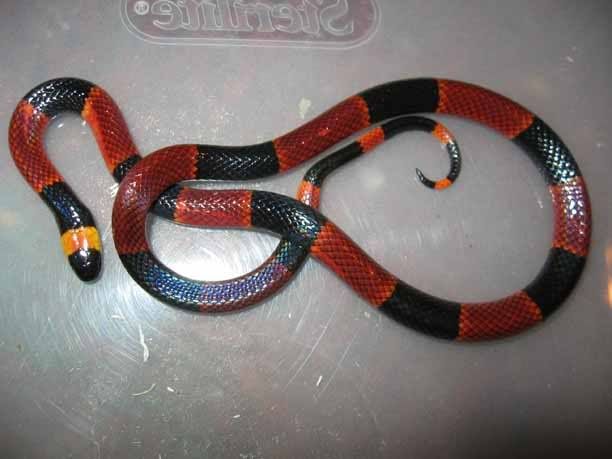
I'm very familiar with the Blocks in extreme S.W. Fl. I've seen many an E.D.B. and Indigos there as well. The E.D.B.'S in the Lower Keys actually look quite different than the mainland population particularly if you see them side by side. It's a bad pic but check out how many of the diamonds have light colored centers. They also have a lot more white and grey color rather that black and gold. It's a shame because other than areas in the Key Deer National Wildlife Refuge all their habitat is doomed to development. Fortunately some Keys that are uninhabited and can only be reached by boat have small populations of snakes. It's unfortunate that no Conservation Org. is surveying, studying, or paying any attention to these snakes that have been isolated from other populations for thousands of years. Like the Coral Snake in the Keys there very different and most people aren't aware or even care for that matter. I'm enclosing a pic of a Key's Coral Snake that was collected last year. Ditmar's called them Micrurus f. barbouri but I'm not sure today its considered valid..Thanks....TC

herpsltd Sep 27, 2008 01:26 PM

By the way The Blocks is now part of Picayune Strand National Forest due to a buy out because of the Fl. Panthers living there. So thats a BIG plus.....TC

Upscale Sep 27, 2008 03:54 PM

The blocks will always be very dear to me, it was the proverbial “zoo without bars” at one time. At the southern end where the canals all merge there was a particular woodsy area that you could walk through with a very open floor under a canopy of trees that we use to call the Garden of Eden. Very serene sorta spooky area. Very cool. I hope that area will always be protected. Here’s the only pictures I have from my many trips out there, just to bring back some memories, since you will practically recognize these locations…


herpsltd Sep 27, 2008 04:30 PM

I have had the pleaure of traveling to 5 of the 7 continents but the Everglades Wilderness Area remains my FAVORITE place to visit and feel the prescence of God....TC

herpsltd Sep 27, 2008 04:33 PM

Awesome pics and The Blocks shall now forever be the wild place you knew and loved.....TC

herpdoc133 Sep 29, 2008 10:19 PM

I rarely post...prefer to read and observe...but couldn't resist when the subject of the "blocks" came up. This area is dear to me for many reasons. 1st is I collected my first EDB back in '74. 2nd...I spent 33 days camping in the "blocks" in November '78. The animals found and the experience I had is still with me today. I have found many herps in this area, from EDB's, Indigo's, E. Hog's, Unique looking corn's, Coral's, the largest Cottonmouth, (just over 6')I've ever found, & "brooksi" kings. I've seen more Panthers there than anywhere else in Fl.
I'm glad to read the area is being protected. This part of Fl is the Garden of Eden.
Bob

Upscale Sep 29, 2008 10:28 PM

I also caught hognose there, which I believe is out of range in the field guides. Here's a couple of more pictures from out there, I meant to paste these with the others but I didn't "cut" them all in the other post. I wish I had carried a camera back then. We were spoiled, eh?


jhnscrg Sep 27, 2008 06:51 PM

The diamonds are more rounded than usual, for some reason they remind me of a Mojave, C. scutulatus..

Matthew

justinian2120 Sep 28, 2008 10:54 AM

not trying to start anything but i can't help but wonder how much those 3's dna may have contributed to the continued survival of that isolated population that is apparently quite unique,as you just stated yourself......was this taken into consideration at all?

i mean when you get right down to it,no two are exactly alike anyway,are they?adamanteus needs all the help they can get,esp. in florida......also much of the keys is nwr and park land,in which taking these would be illegal.
-----
"with head raised regally,and gazing at me with lidless eyes,he seemed to question with flicks of his long forked tongue my right to trespass on his territory" Carl Kauffeld

herpsltd Sep 28, 2008 11:17 AM

You're not starting anything and you're right. These 3 were collected close to Key West in an area being bulldozed. Two others were killed yesterday the same size and probably siblings by workers before my friend could get there. Within a year where these snakes came from there will be NO habitat left and NO snakes. It is now and always has been a major problem where a square foot of land is worth more than most folks make annually development will continue. The Key Deer areas are Big Pine and No Name Key but only on No Name does undisturbed habitat remain. In all the Keys south with the exception of small areas on some of the Torch Keys the snakes are doomed long term. Unfortunately some of these populations will be extirpated within a decade or so. That is a fact of life and very unfortunate. Also like most Rattlesnakes they are killed on sight even in protected areas. There's so many roads thru the Key Deer area on Big Pine it's likely roadkill will over time destroy the population there as well. The Big Pine Key Deer Area has tons of bisecting roads with tons of traffic both tourists looking for the deer and locals and any herp trying to cross is doomed. One only has to go to the Keys once to understand what I mean....TC

jhnscrg Sep 28, 2008 07:13 PM

I love the Keys, esp. as a diver. But you are right & its so depressing..

Matthew

jodscovry Oct 08, 2008 06:45 PM

The EDB does not stand a chance in the flat portion of the state nor do any other large snakes like the indigo and pinesnake, no chance at all. and the protections that are in place by the FWC are only assuring that populations will continue to decline till they only excist in zoos and collections like Tom's.

Site Tools
