I posted some awesome pics a few days ago and for some reason I couldnt get a decent discussion going on the color phases of the eastern milk. I guess some couldnt view my pics(I post the same here as I do in the classifieds), but I think I got help and some should be up now. I will rephrase the question:what makes BROWN in an eastern milk? I think its more than simple melanin...

Reptile & Amphibian Forums
Welcome to kingsnake.com's message board system. Here you may share and discuss information with others about your favorite reptile and amphibian related topics such as care and feeding, caging requirements, permits and licenses, and more. Launched in 1997, the kingsnake.com message board system is one of the oldest and largest systems on the internet.



I gotta ask.....
Jeff Schofield
Oct 09, 2008 05:18 PM
Replies (37)
jyohe
Oct 09, 2008 06:32 PM
genetics
time
sunlight...?
......PA has all colors of easterns....most would be grey and brown-ish colored...some are redish or orangish....top and bottom....
.captive raise them and they stay prettier...
-----
......
dekaybrown
Oct 09, 2008 06:57 PM
I cannot answer the melanin question, They are very beautiful in their own right.
Some of the really bright milks either look somewhat clownish or induce migraines.

-----
Regards,
Wayne A. Harvey

1.0.0 Ball Python - Python regius "Cane" Rescue
0.1.9 Eastern MilkSnake WC "Carmella" adult super sweet temperment (Eggs all hatched!)
1.3.13 Storeria dekayi Casper, Xena, Athena, Sharon & Kids
0.2.0 Thamnophis cyrtopsis Easter Black Neck Garter
1.1.0. Thamnophis elegans vagrans Wandering Garter
2.2.0 Thamnophis Sirtalis - Florida Blue stripe Garter
2.1.0 Thamnophis sirtalis - eastern Garters
0.0.1 Thamnophis HybridAlbino Checkered Normal eastern
2.0.0 Thamnophis sirtalis - eastern Garters (xtreme orange phase)
1.1.0 Thamnophis RADIX - Snow Hets
0.1.0 Thamnophis RADIX - Christmas Albino
0.0.1 Thamnophis sirtalis - Red Phase Eastern Garter red and white stripes
0.0.1 Thamnophis butleriButler's Garter Snake
0.0.4 Thamnophis proximus orariusCoastal Ribbons
0.0.16 Thamnophis sirtalis - newborn Eastern Garter babies 7/11/08
0.0.17 Thamnophis sirtalis parietalis HET Anerythristic Scott Felzer stock.
0.1.0 Thamnophis sirtalis Eastern Snow "Snowflake"
0.0.1 Thamnophis sirtalis infernalis California Red Sided (R.I.P. little guy)
1.2.0 Thamnophis pickeringi - Puget Sound Garter "Sky" (adult, Sky blue) 2 females recently aquired.
0.0.1 Nerodia sipedon - Water Snake - "Aqua" adult WC Pink eater!
0.1.0 Storeria occipitomaculata - Red Belly snake (Her children were raised & released)
0.0.1 Amelanistic Corn Snake "CY" Sub-adult CB
1.0.0. Pueblan Milk snake "Oreo" adult CB
1.0.0. ASIAN GREEN SNAKE 3' WC Cyclophiops major"Limon"
0.0.1. Savannah Monitor "CHOMPER" Growing fast!
1.1.3. Green Anole "Crystal" & "Chris" WC dropping eggs fast!
1.0.0. K9 "ACE" Black Cockapoo
0.2.0. Feline"Felix"(R.I.P. 4/27/08) "Kaja" & "Silver"
2.1.0. calico RATS
2.4.?? Mice - Feeder farm - Crickets / fish
More herps than I could ever list out back on the land. 
Jeff Schofield
Oct 09, 2008 06:57 PM
Genetics--yes but I was trying to have an intelligent arguement.
Sunlight--???? No
Time--????What do you mean by this?
I know milks are variable not just in PA but everywhere. My effort here is to try and talk about the causes of that variability. Does population size have anything to do with variability? Does proximity to the next locale have anything to do with gene flow? Obviously predator avoidance is key, but what would cause babies to exhibit such increased red? Why arent baby easterns hatched out brown??
jyohe
Oct 11, 2008 03:37 PM
last week there was a baby brown one shown in here...
Genetics--yes but I was trying to have an intelligent arguement.
Sunlight--???? No
Time--????What do you mean by this?
......genetics....that's why they all vary...how much intelligent conversation can you get from that....it is the cause...period...end of conversation about it......IF you mean genetics due to crossbreeding with reds,scarlets,or coastals???...no...easterns are easterns usually and the other subspecies don't influence them..
sunlight...YES...one of the major reasons they turn brown and grey...
time....how old they are....2 year olds are still better looking than 22 year old ones.....
-----
......
Jeff Schofield
Oct 13, 2008 12:24 PM
......genetics....that's why they all vary...how much intelligent conversation can you get from that....it is the cause...period...end of conversation about it......IF you mean genetics due to crossbreeding with reds,scarlets,or coastals???...no...easterns are easterns usually and the other subspecies don't influence them..
sunlight...YES...one of the major reasons they turn brown and grey...
time....how old they are....2 year olds are still better looking than 22 year old ones.....
We can have intelligent conversations about genetics. Not sure where you got "Reds, scarlets or coastals". Sunlight has absolutely NOTHING to do with color change as milks are subterranean 95% of the time. Nothing of your post makes any sense.
jyohe
Oct 13, 2008 06:56 PM
sunlight has nothing to do with it?
then it would all be genetic....
......again....I live in Pa and catch no milks except babies when I was a kid.....
but I do know a couple that caught as many easterns as they could from 2 farms one year.....like 35....and the colors were all over the place all from the one farm.....some you would all want ....orange tint to it all over...no white...orange..top and bottom.....some were normal dried brownish blood color....some were normal grey tinted all over....real dark, real light greys....all the wild colors you can see in easterns....and even greens......none were monsters I don't think.....most were just 3 footers....
they also hatched like 40 eggs from these wild ones....sold them all.....all 75 in one year....
none were caught below ground....
...different guy different county...3 1/2 foot female and a 4 foot plus male.....crossing the road , middle of summer...not the same day....
......at this point I am lost and forget the first question.....
......????
-----
......
jyohe
Oct 13, 2008 07:01 PM
ok....you asked what makes brown
the red turns to brown....
......think of blood....it is red and turns brown...
does red paint turn brown?.....I know it can fade to white in sun...guess it depends on type of pigment is in the paint...
so....red scales in babies....fade to brown....I would think the pigment turns that color....fades out....ask Dave Barker....
..but not from sunlight???.....
........
-----
......
jeff schofield
Oct 13, 2008 09:25 PM
When we talk genetics many times we talk about how the biochemistry of certain genes manipulate the phores that affect pigment. You refer to red paint turning brown, but you dont take into account what actually AFFECTS that paint to turn it brown. While true with paint because paint air time = pigment change..... this is a biochemcial process. The cells within a animals are not contacting the air, and they are only affected by time in their replication phase. Totally different.
To say the color changes without asking why is on line with the moon being made of green cheese......
jyohe
Oct 14, 2008 05:23 PM
don't tall me the moon ISN'T made of green cheese????.....
.......I hope it's not just rotten.....
...anyways......(and he says keep it simple )...
..you think they are anery...
.
they may be
if they are born with NO red....good...keep it...and mix it with amel.....snow easterns will be as boring as snow hondos???...and snow Egyptian sand boas.....
.....the amel screams....I love amel everything....
....it is odd....it may be genetic to the point of making cool stuff.......it's an eastern.....most states with easterns can't own , sell, breed easterns....sooo....$$$ goes down ....? faster
.....I was just talking, thinking , and making pints as to blood and paint and pigment thoughts.....like a fresh shed milk is redder and after awhile dulls again till te next shed...yet you say sun and air don't do it???......something does....you say air doesn't touch the pigment....cover the scales in clear coat and tell me about air not being need in the skin...ask Buddy Ebsen about skin breathing ((* ask me I'll tell you IF you don't get this ))anyone get this?...
......all thoughts....Google the word pigment....Google anything related...I didn';t have time yet......340 snakes and thousands of rodents is too much...plus 10 hour real job days....I get cranky all the time....and just type and spew...like this....)..
....and as always ...like I say......ask Dave Barker....really ...email him...if he don't know.........
.....why does pigemnt change color?
does air or light matter?
does red change for what reason? in all milks and even boas etc etc...
have fun.............time to move on.........
and I hope I find a green one real soon......
-----
......
Jeff Schofield
Oct 14, 2008 10:40 PM
Well, you gotta be tired to be spelling like that,lol. My last post didnt "look" the same as I typed because the PLUS and EQUALS buttons dont work on the forum....so what I meant was:
red paint oxidizes when exposed to air, air contains all different kinds of chemicals. The chemicals in the paint, the air and the exposure to light will fade or change the color paint, but that is not even close to what happens in animals.
Scales are the hard dermal layer made of keratin(same as finger nails). There is skin between the scales. There are no photoreceptors in the scales, they dont react at all to light.
What we see as a change in color is actually a biochemical change as the snake ages. Red does NOT turn into brown, the red exists and something is ADDED to it to turn it brown. This is NOT the same process as say a brown burmese python......they are born with all their color. You say you dont like SNOW animals, I am with you til I'm not...meaning that I think at some point there could be an animal with enough OTHER colors(yellow/green)that wouldnt be eliminated by amelanism/anerythrism. The only way to figure this out is to take a snake such as an eastern....and strip away one color at a time to expose the processes that make it LOOK LIKE the snake is changing color.
If you like easterns, and you like breeding, and you like morphs, and you like locality milks....then you should like these milks.
jyohe
Oct 15, 2008 05:27 PM
PA...no wild for sale, permit to keep more than one if grandfathered in from like 2 years ago......I got one...basically couldn't release a female adult that kids caught in town ,in late fall 2 years ago....wanna know what I'll breed her to? wanna know what I'll do with the kids?....(you actually don't wanna know )...(I know wanna isn't a word)...
...spelling is ok...typing suxx.....and I don't care...so I don't proofread...
...my thought...the whole "locale thing" is overrated....except in very few subspecies (temporalis ) actually can't think of another one....
.......you know what color morph I was first to produce? what other 2 I helped establish? what other one or two I produce now and sell none? and there are actually none for sale anywhere I can find?............no, you don't,,,,I don't advertise....and noone cares,,,,not even me....HA!....I am not in it for the glory,the fame and the friendship....the more people you know the longer it takes to walk around a show / expo...ask my friends....they go around like 6 to my 1....suxx....
so have fun.......
....zzzzzzzzzzzzzzzzzzzz.
-----
......
Sunherp
Oct 09, 2008 07:10 PM
Melanin and erythrin together make what we see as brown. Varying amounts of each color create the different shades and depths of brown on a given individual.
The last photo you posted in the previous thread is the best photo I've seen you put up. Make more like that if you want to grab people's attention. They're nice animals, it's up to you to take photos that represent them.
-Cole
Jeff Schofield
Oct 09, 2008 08:00 PM
Cole, erythrin produces red right? Baby easterns have alot of red in them that eventually turns brown. But I am suggesting it is NOT melanin. My contention is that GREEN comes in as the snake ages and its the red and green together which produces brown. If it were melanin it would make sense that the whole snake darkened, not just the blotches.Right?
Now you could argue that erythrin levels change....but again, there is no reason for it. So I am going forward with my theory....asking what would produce GREEN?? Now having snakes that start out typically anerythristic(lacking erythrin), the purple gives way to another color...and its not caused by melanin...so I ask what would Bechtel's book suggest? Opinions??
Amelanism is the lack of melanism. The albino that Joe has, you are suggesting, wont change color as it ages. I am thinking that it is going to fade to a nice orange as he ages....red + yellow= orange.
Now another question, what would a snake look like that lacked this gene that produces yellow?? My theory would say that adults retaining the red/maroon color may lack that gene. Opinions?
I
LamproPolice
Oct 09, 2008 11:21 PM
Now having snakes that start out typically anerythristic(lacking erythrin), the purple gives way to another color...and its not caused by melanin...so I ask what would Bechtel's book suggest? Opinions??
>> Amelanism is the lack of melanism. The albino that Joe has, you are suggesting, wont change color as it ages. I am thinking that it is going to fade to a nice orange as he ages....red yellow= orange.
>> Now another question, what would a snake look like that lacked this gene that produces yellow?? My theory would say that adults retaining the red/maroon color may lack that gene. Opinions?
>> I
>>
cole is right, it's the melanin. these things aren't producing "green" pigments. melanin synthesis can be up or down regulated. also, because synthesis occurs at the cellular level, pigments may only be produced in a localized area such as a blotch.
Sunherp
Oct 10, 2008 09:40 AM
Yep, I agree.
-Cole
Jeff Schofield
Oct 10, 2008 11:19 AM
There is no red to turn the green to brown. SIMPLE.
Sunherp
Oct 10, 2008 09:39 AM
Technically, your idea is a hypothesis... not to be a stickler, but...
The three pigment producing cells present (for the most part) in snakes are melanophores (black and brown, and some reds) and xanthophores (yellow and red). Xanthophores which produce large ammounts of red and orange (carotenoids) are referred to as erythrophores. Iridophores, another "pigment" cell, play a role in light absorption and reflection, causing us to see other colors, like purple, from the interplay of the above pigments.
Why would I not expect the coloration on Joe's snake to change? Increases and decreases in yellows, reds, and oranges are expected to happen ontogenically. I expect the red blotches to lighten and the background to gain a wash of orange or yellow, but we've seen so few amelanistic nominate triangulum that who knows?
-Cole
Jeff Schofield
Oct 10, 2008 10:37 AM
Cole, I know what you are saying but I was trying to keep it a bit simpler in an effort to get more people involved in the discussion. I really think that there are at least 3(if not more)factors making the brown color that we see. I was suggesting that to write it off as simply melanin wont incorporate these other factors. While I may agree that melanin is the most prominant factor, these genetic morphs will be great tools in lifting the curtain to see what is behind color schemes. I am suggesting they may be different than what we might want to think they are.

Jeff Schofield
Oct 10, 2008 10:40 AM
I was attempting to explain how GREEN could be the prominant color. If melanin is black/brown what makes GREEN?

Sunherp
Oct 10, 2008 10:53 AM
The Tyndall Effect uses guanine crystals in iridophores to break up light; like a prism. This can make green or blue, although those pigments DO exist in nature, too. I believe we'd be seeing a stronger green color if that's all that was going on. In my opinion, we're seeing an interplay between melanin, erythrin, xanthin, and the iridophoric twist on the light. Melanin typically produces brown and black, although reds are seen too. Check out the link that the kind Dr. Lynch has posted below (I know Wikipedia can be weak, but this page actaully looks pretty good!).
-Cole
Sunherp
Oct 10, 2008 10:59 AM
Jeff,
I know you were trying to keep it simple to involve more people. Unfortunately, to discuss the biochemistry of pigmentation at any meaningful level, it's difficult in lay-persont's language.
-Cole
vjl4
Oct 10, 2008 10:42 AM
So, I dont know whats happening but you can get green color or blue or whatever with out pigments. Think of bluebirds, that color blue is called Tyndall blue and is not produced by a pigment but by how light is scattered when it hits crystals. Similar things can make green.
The wiki page is pretty good..........
http://en.wikipedia.org/wiki/Chromatophore#Xanthophores_and_erythrophores
Best,
Vinnny
-----
“There is a grandeur in this view of life, with its several powers, having been originally breathed into a few forms or into one; and that whilst this planet has gone on cycling according to the fixed laws of gravity, from so simple a beginning endless forms most beautiful and most wonderful have been, and are being, evolved.” -C. Darwin, 1859
Sunherp
Oct 10, 2008 10:47 AM
Exactly! Iridophores and the magical guanine!
-Cole
vjl4
Oct 10, 2008 10:56 AM
LOL, I dunno about magical but pretty cool....
Witness the magical color producing powers of guanine!

(from: http://www.laserfocusworld.com/display_article/318544/12/none/none/NBrea/Photonic-crystals-get-fishy)
-----
“There is a grandeur in this view of life, with its several powers, having been originally breathed into a few forms or into one; and that whilst this planet has gone on cycling according to the fixed laws of gravity, from so simple a beginning endless forms most beautiful and most wonderful have been, and are being, evolved.” -C. Darwin, 1859
Sunherp
Oct 10, 2008 11:00 AM
Aaaaaaaah! LOL
-Cole
vjl4
Oct 10, 2008 11:07 AM
n/p
-----
“There is a grandeur in this view of life, with its several powers, having been originally breathed into a few forms or into one; and that whilst this planet has gone on cycling according to the fixed laws of gravity, from so simple a beginning endless forms most beautiful and most wonderful have been, and are being, evolved.” -C. Darwin, 1859
Sunherp
Oct 10, 2008 11:11 AM
Supposed to be... I've got a report draft due at the end of the the day. But, hey: it's Friday, it's snowing like a mo fo here, and I doubt those at the unspecified govt. agencies I work with will be around to read it anyway.
-Cole
Jeff Schofield
Oct 10, 2008 10:55 AM
My point wasnt so much what WAS producing the green(though it would be nice to figure out), but suggesting that it was not melanin. There have been others who have argued that these are "simply" variation of existing genes rather than genetic anomaly. I will aknowledge bad pics, but the difference in person is so much more obvious. I have just tried to draw lines of correlation from the baby anerys from this locale to the green adults that exist there. All the facts arent in, but they werent in years ago when I contested the EXTREME HYPO hondo line either. We can take sides and argue points as these evolve...we can even BET on outcomes,lol. It makes it more interesting for us does it not?? 

vjl4
Oct 10, 2008 11:05 AM
Sure it still can be genetic, but there is probably a lot of onotogenic changes too.
Its the genes that set up the whole way the system develops. So, if you have variation in how those genes assemble the system (big guanine crystals or little ones, spaced close together or far away) or variation in how, when, where they produce the various pigments you can get to different colors along the spectrum.
But, pigments are really just chemicals. And chemicals can be modified, like oxidized. Think of that nice white freshly cut apple turing brown, the same thing happens to pigments in animals. They oxidize and change color over the life of the animal (maybe they are partly replenished before a shed and thats why snakes look so nice right after, the pigments are still "fresh". So the color change over the course of an animals life can be the natural outcome of aging pigments.
It can also be related to how well pigments and color producing cells are made over the lifetime of an animal. Could be some are made better when young than old and visa versa. Could also be in what they are eating (probably more so in the wild).
Its all pretty complicated, so much so I am not I dont have to think about it too often Does make for some pretty cool variation though, I like a nice maroon colored eastern myself.
Vinny
-----
“There is a grandeur in this view of life, with its several powers, having been originally breathed into a few forms or into one; and that whilst this planet has gone on cycling according to the fixed laws of gravity, from so simple a beginning endless forms most beautiful and most wonderful have been, and are being, evolved.” -C. Darwin, 1859
Jeff Schofield
Oct 10, 2008 11:43 AM
Vinny, I have documented anerys coming from this locale. If you accept that anerys are there....and then you see these green ones I look for the simplest explanation....Brown MINUS red (anery)would produce something that could look green.
Sunherp
Oct 10, 2008 11:46 AM
No dispute, there. I'm not claiming your animals aren't anerythristic, Jeff. Some of them sure look like they could be.
-Cole
Joe_M
Oct 09, 2008 08:35 PM
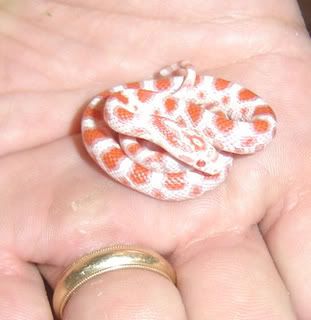
Based on my experience with captive easterns, I have also noticed that this color change not only occurs from neonate to adult, but also occurs throughout each individual shed cycle. The brightest reds are immediately following a shed, and they gradually fade to brown (light red/orangish in the case of the albino) the closer they get to shedding.
I'm guessing that the same changes occur throughout the life cycle (and shed cycles) of other NA milks as well?
Jeff, I think you may be right about the albino fading to an orangish color over time, but I am not sure about the reasoning behind the change.
I wish I had photo documented a little better, but these three photos show the progression over about a year's time. The lighting conditions are a little different for each photo so it may not be an accurate depiction, but it's definitely lightening up a little bit over time. Hopefully we'll get some nice current photos this weekend.


-----
Joe
Jeff Schofield
Oct 09, 2008 09:08 PM
Joe, snakes' skin inreases in thickness.... that builds up and shed off so it makes sense that the brightest colors would be just after a shed. But I havent seen pics of your snake in a while and its interesting to me to think its not a decrease in RED but an increase in YELLOW that is causing these changes. Look at other areas of the snake for color changes...white to cream etc...
Many times I have had people tell me they had a corn snake they found in their backyard...only to find a eastern milk. With all the different colors available now in corns its going to be fun to have lots of different lines established to breed these different genes into.
There should be some nice pics to come!
jyohe
Oct 11, 2008 03:47 PM
ok......made me think
they shed and are pretty...then after awhile get darker...all snakes do...could be light on the new skin looks good and after awhile the light screws up the color cells...till the next shed...
as for amel...maybe the light over time makes the color fade out...
..light makes skin turn brown yet makes bluejeans turn white....etc etc etc...
......
it all is based on genetics.....
and....
I never saw a green eastern.....my eyes and my mind have seen what it thinks is shades of greenish tints...but easterns aren't green....
..........(grey pigeons flash green and purple color )...different layers of pigment or color within the same colored pigment .......ummm...yea.....
...
-----
......
Jeff Schofield
Oct 12, 2008 10:04 PM
Side by side with "normals" the difference is more obvious. It is different regardless of shed cycle...green/gray instead of brown/cream. Joe took some pics with a much better camera, hope to show the differences as the 08 baby grows and sheds. I understand this is a process and I have trying to piece together a explanation that would incorporate what my eyes see.
Tony D
Oct 10, 2008 10:56 AM
Red, Blue and Yellow are the three primary colors. Green, Purple and Orange are secondary colors. Brown would be a tertiary color in that it is achieved by mixing a primary color (red) with a secondary color (green or yellow & blue). In essence it takes all three primary colors to make brown but I'm not sure of how this all balances out.
I tend to think that we oversimplify the various morph colorations but for brown blotches to become or appear green it would seem to me that red pigmentation would need to be absent or reduced.
-----
Darwin Rocks!
Jeff Schofield
Oct 10, 2008 11:33 AM
I tend to think that we oversimplify the various morph colorations but for brown blotches to become or appear green it would seem to me that red pigmentation would need to be absent or reduced.--Thanks Tony
In hunting this spot over the last 15 years I have found baby-immature milks that were 100% anerythristic as we all define it. I have also found several of these GREEN milks at the same locale. I havent kept individuals long enough(2 generations=6-8yrs) to see them go through this process so this is all anecdotal......But for us herptoculturists who USE genes rather than define them I am telling you that these are indeed anerys. Further, if other Green milks are found and bred out its my hypothesis that they are likely be a recessive morph rather than simple variability. I am sure Green milks have been found before and I doubt anyone would have thought them to be a form of anerythrism. Keep it simple, thanks again Tony, Jeff
