

Reptile & Amphibian Forums

Welcome to kingsnake.com's message board system. Here you may share and discuss information with others about your favorite reptile and amphibian related topics such as care and feeding, caging requirements, permits and licenses, and more. Launched in 1997, the kingsnake.com message board system is one of the oldest and largest systems on the internet.

Click for 65% off Shipping with Reptiles 2 You
Click for ZooMed
Click for 65% off Shipping with Reptiles 2 You

Eastern box shell question...

xxxanity Oct 12, 2008 10:03 PM

I posted this in turtle health but didn't get any responses, so I thought I'd try here too.

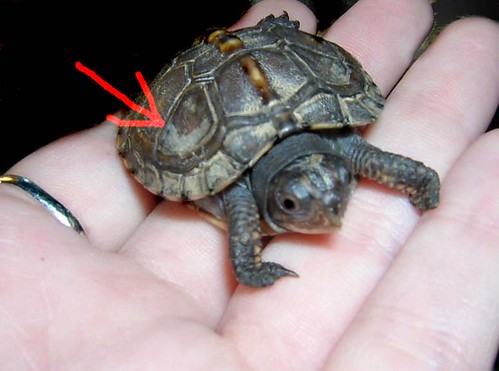
I have an eastern box turtle who is still pretty young, about a year and a half old. I've had her (as well as I can tell she's a girl) since she was a hatchling and I'm a little concerned that some of the front part of her shell is concave. It isn't that uniform smoothness of adult box turtles I've seen, but then I've never seen another turtle in person at this age. Her shell almost seems more like an aquatic turtle's.

She's been like this since I got her (rescued with injured feet, she's still missing claws) but I was concerned that maybe there's a problem with her diet causing this. The picture I'm putting in here is old, she's grown quite a bit. Excuse the mud and the fact that you can't see the indentations I'm talking about really. It's more to show you the area that is dipped inwards. The corresponding shell area in the back also dips in.

Should I be concerned? Are there any supplements or products other than regular calcium supplements that are specifically made for shell health?

Image

Replies (7)

golfdiva Oct 14, 2008 11:17 PM

What is her diet? (BTW it is difficult/impossible to sex a boxie until they are about 5 years old.)
-----
0.1.0 ornate box turtle
2.2.0 eastern box turtles
1.0.0 Yellow belly slider
0.1.0 Red belly cooter
0.1.0 Australian shepard
1.9.0 chickens
1.0.0 Dutch(rabbit)
3.2.0 adult children
1.0.0 husband

xxxanity Oct 15, 2008 04:56 PM

Box turtle food (I believe this is it in the link) that I soak and add a little fruit/veggie to and then run through a food processor, roll into sticks, and freeze until I need it. The occasional mealworm as a treat, and seasonal things. Mulberries. It loves sweet corn but I try to limit that. Cucumber and cantaloupe if we have it in the house. I've never had much luck getting it to eat greens, but I was going to try and collect some and try to sneak some in with other food. I usually try to get it to eat whatever vegetable we have around the house, sometimes it will take a bite, sometimes it doesn't want it.

I believe I have mislaid the package of food (since I have some in the freezer I wasn't horribly concerned) so I was going to pick up some new this weekend, and order some of the freeze dried meals when I get the chance and try to re-vamp the diet. Any advice is welcome. I will be back home and able to take some pictures of what I'm talking about this weekend, which I'm sure will help.

I read that incubation issues can cause shell deformity. So far all I've found online is pyramiding and severe malformation to compare it to.

These are those food cups I've been planning on ordering.
www.reptilesupply.com/product.php?products_id=2222

This is the food I have...

mj3151 Oct 15, 2008 06:25 PM

If you're using that prepared vegetarian mix and tortoise pellets as staple food for a box turtle, he's not getting enough animal protein. Wild baby box turtles are largely carnivorous and need a diet that includes things like earthworms, slugs, snails, crickets, and other small insects-things that they find crawling around among the leaf litter on the forest floor where they spend all of their time the first five years or so of their lives. If you're going to use a pelleted food, use Reptomin or something made specifically for box turtles that includes a good portion of animal protein. Tortoises are vegetarian and have very different requirements than box turtles. His shell doesn't look too bad, but he'll do much better with some animal protein added to his diet.

Woodnative Oct 15, 2008 06:27 PM

If your husbandry conditions and diet are the best possible, any new growth will be the best possible. Since it (too young for he or she) is small, live foods like freshly caught earthworms, pillbugs, small crickets etc. are great. You can add fruits and veggies, but for the time being it will be mostly carnivorous. By using freshly caught items, you are also making sure the food item is healthy, and the turtle will benefit from the soil and plant matter in the gut of the food item.

Make sure its living environment is humid, I like moist peat moss, with access to water for soaking at all times. Hatchlings dry out easily. Good luck with the little guy/girl.

xxxanity Oct 16, 2008 07:52 PM

Hi, thanks. I do try to get as many fresh insects as possible, but I'm living in a dorm and my turtle is still at home, unfortunately, and I'm kind of limited since I try to make sure that the foods that I have are portioned and and not hard for my dad to obtain. I keep a container on mealworms on hand, which I know probably aren't the best but are nice in case of emergency. I really would like to get some earthworms, but I can't ever seem to find enough to last more than a meal or two and all that I've found in stores are meant for bait and don't look very good.

His/her (Yeah, I already knew about the sexing thing but it just seems weird to call it an it so I randomly assign a gender.) diet used to be a lot higher in protein, and I actually tried to add more plants to see if that was the problem. And the pelleted food I have is for box turtles, perhaps I put the wrong one in the link. Most of the foods I find in stores are labeled as being tortoise/box turtle both, hopefully I will find something different when I'm out this weekend.

Oh, and I do use a mix of peat moss and a little spagham.

PHBoxTurtle Oct 25, 2008 03:22 PM

As the others have already suggested-it is a combination of humidity and nutrition that contributes to shell growth or mis-growth. Dad needs to commit to this turtle and learn a little about box turtle hatchling care if you want the turtle to get the best care. It cannot be done haphazardly if you want the turtle to have good care and good growth. Please invite him to join this group. He can get a good start by going to my website at www.boxturtlesite.info and reading the chapter on hatchling care on my online book.

You can make you very own box turtle food that can be frozen and defrosted as needed. Many people do this-here's one used by Martha Ann Messinger and George Patton when they had hatchlings. There are other versions --just search for them on the web.

Cook 1 pound of lean ground meat (beef, chicken or turkey)drain off any fat.

Put these vegetables in a food processor and chop fine:
16 oz. frozen green beans
16 oz. frozen vegetable, like green peas, or broccoli
1 pound package of fresh, peeled baby carrots

Make 2 cups of oat brand (real thick) and add all the ingedients together.

Place as many 1 tablespoons of the mixture as you can onto wax paper and freeze. Once frozen you can place them all into plastic freezer bags and dad can defrost one or 2 tablespoons as needed. He should sprinkle a bit of calcium powder made for omnivores reptiles onto the meal each time.

As much as possible you should be giving the turtle live insects. They can be purchased online, at pet stores and bait shops.
-----
Tess Cook
www.boxturtlesite.info

critterz Oct 28, 2008 03:26 PM

you are using a uva/uvb light right?
and a dry basking light
what size tank or what its in?

Site Tools