Reptile & Amphibian Forums

Welcome to kingsnake.com's message board system. Here you may share and discuss information with others about your favorite reptile and amphibian related topics such as care and feeding, caging requirements, permits and licenses, and more. Launched in 1997, the kingsnake.com message board system is one of the oldest and largest systems on the internet.

Click here for Dragon Serpents
Southwestern Center for Herpetological Research
Click for 65% off Shipping with Reptiles 2 You

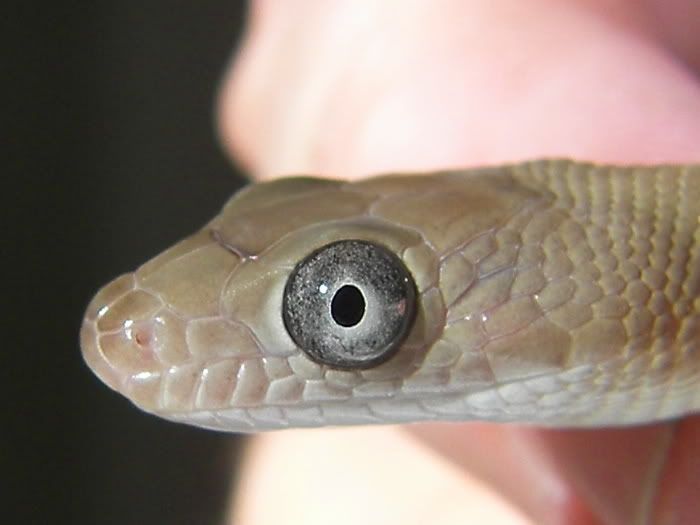
Bug-eyes in TPRSs, an evolutionary trait

dustyrhoads Oct 17, 2008 10:03 PM

This doesn't happen often, but sometimes I talk to people who are laboring under the myth that "bug-eyes" in Trans-Pecos Ratsnakes is a result of captive inbreeding. This is well-documented for leucistic Pantherophis obsoletus lindheimeri, but for Bogertophis, nothing could be further from the truth.

Trans-Pecos Ratsnakes are fossorial during the day and 100% nocturnal otherwise. In other words, they're constantly in complete darkness -- in fact, in the wild, they absolutely shun light. "Bug-eyes" is an evolutionary adaptation to this lifestyle. And bug-eyes is not only seen in TPRSs -- it, as a physical trait, has convergently evolved in many unrelated taxa of animals with similar nocturnal habits. Owls, Leaf-tailed Geckos of the genus Uroplatus (among many other gekkonids), tarsiers, Red-eyed Tree Frogs, and the list goes on and on. Another example of "bug-eyes" in completely nocturnal snakes is Gray-banded Kingsnakes. Their lifestyle is much more fossorial and nocturnal than most Lampropeltis, and so they have those bulging eyes, which is a disharmonic trait for a kingsnake species.

And there is no deleterious allele in subocs that causes extra or excessive "bug-eyedness" when subocs are inbred. In fact, of the 115 subocs in my facility, some of the most bug-eyed are from parents that were caught hundreds of miles apart -- the furthest thing from inbreeding.

So, in conclusion, though "no bug eyes" might be a selling point for leucistic Texas Rats, it's not desirable, healthy, or normal to have a TPRS without them! I mean, can you imagine someone selling a tarsier on the "selling point" that it has "NO bug eyes!"?

Have a great weekend, all.

Dusty Rhoads
Suboc.com

Replies (4)

JL1981 Oct 17, 2008 10:09 PM

"Trans-Pecos Ratsnakes are fossorial during the day and 100% nocturnal otherwise. In other words, they're constantly in complete darkness -- in fact, in the wild, they absolutely shun light."

I guess that trait has been bred out of my TPRS lol. He is happy anytime he has some company in the room, especially when he gets taken out of his cage and handled.

dustyrhoads Oct 17, 2008 10:23 PM

Yeah, though you can't ignore evolution when it's staring you in the face, many captive subocs become partially diurnal. And it certainly appears that they "like" being handled and are interested in their keepers.

At the very least, they certainly associate me with food, water, and a clean living environment. But that's okay, I'll just pretend that they love me.

My niece, when she was a toddler, used to kiss my wife on the lips repeatedly. My wife thought that she was being very sweet until she saw her niece glancing in the mirror behind her after every kiss to see if my wife's lipstick had rubbed off on her. I'm sure captive subocs see our "relationship" in a similar light...a big giant friend with benefits.

Dusty Rhoads
Suboc.com

BillMcgElaphe Oct 18, 2008 04:17 PM

"the myth that "bug-eyes" in Trans-Pecos Ratsnakes is a result of captive inbreeding."
.
Glad you mention this, Dusty, because at least twice at separate CB Shows, I've overheard a conversation where folks were saying the TPRS "bug eye" was from in-breeding.
I smiled and moved on.
To these folks who believe this, I'd recommend they visit these animals in the wild. Observe young as well as older specimens.
IMHO The naturally occurring “bugeyedness” of this animal adds strongly to why they are so endearing!.
.
.
River Road Wild Suboc:
,

.
.
.
Davis Mountains Wild Suboc:
.

.
.
.
North Davis Mountains Wild Suboc:
.

.
.
.
Here's an animal that has a life style very similar to Suboc from the Yucatan Peninsula, MX. These Yucatan Ratsnakes (Pseudelaphe flavirufus phaescens) shun the light and spend the day underground in the porous limestone.
In real life the eyes are quick to catch your attention.
.

.

-----
Regards, Bill McGighan

Bogey22 Oct 19, 2008 12:38 PM

115, thats alot of subocs

Site Tools