Reptile & Amphibian Forums

Welcome to kingsnake.com's message board system. Here you may share and discuss information with others about your favorite reptile and amphibian related topics such as care and feeding, caging requirements, permits and licenses, and more. Launched in 1997, the kingsnake.com message board system is one of the oldest and largest systems on the internet.

Click for 65% off Shipping with Reptiles 2 You
Southwestern Center for Herpetological Research
Click for 65% off Shipping with Reptiles 2 You

Not Rat Snakes; They are Tree Snakes

Ameron Oct 28, 2008 11:36 PM

After all, there are at least 14 common names for these creatures, all of which are based on ignorance. (Like the naming of Corn & Milk snakes, neither of which eat corn nor milk! Night Lizards are similarly misnamed; they are active during the day.)

For years, they were known as Pilot Snakes, based on the misconception that they piloted other snakes to hibernation dens. Actually, they are often the first species to leave dens in spring, and the last species to return in fall.

Shall we base the name on common diet? That would make them Mice & Bird Snakes, since a 1993 study of stomach contents of over two dozen snakes in VA showed that the most common food for these highly opportunistic snakes is:

mice & birds (over 32%, the highest percentage)
squirrels & chipmunks
all other rodents
lizards & frogs

Rats were not even specifically mentioned!

The scientific community has changed the scientific name at least twice since the 1800s, and still are not in agreement over the Elaphe vs. Pantherophis dispute. A further proposal in 2005 would name them based on regions - which I think if foolish.

They are Tree Snakes! They are the most arboreal of all North American snakes.

Are we Sushi People, just because a small portion of OUR diet is sushi?? Not! Any more than burgers & fries are the primary diet of Americans. We feed on grains and other meats more often.

I'd like to see less tolerance for Stupidity & Ignorance. We should halt repeating naming schemes based on ignorance.

What say FR, and other forum enthusiasts?

Ameron in Portland/Vancouver
1.0 Sonoran Black Kingsnake
0.1 Black Rat (Tree) Snake

Replies (23)

Evil_Hybrid Oct 29, 2008 10:10 AM

So.... Ratsnakes feed mostly on trees?

And what if the arboreal versus terrestial ratio varies depending on criteria such as season or geographical latitude?

And what if there are no trees?

Ameron Oct 29, 2008 10:41 AM

Remember, most animals are not named based on their food:

elephant
giraffe
camel
cat
dog

Sea snakes are named based on where they are found; in the sea.

I've made my point, using logic, reason & specific examples.

Although these snakes are also found on the ground, and in buildings, they exhibit a strong tendency to climb. (Humans are sometimes found diving, and flying, which is outside THIER normal habitat ranges.)

They are always found near trees & woods, whether or not they are actually in a tree. Often, they are found in dense woods, one of the few snakes which are. They also frequently hibernate in recesses in trees, or up in barns or attics.

Logically, I think that Tree Snake is the most accurate name.

I appreciate your feedback & time.

Elaphefan Oct 29, 2008 06:39 PM

In many areas, North Arerican "Rat Snakes" don't live in trees. Just because Va. Black Rats live in wooded areas, doesn't mean that they live in trees. Yes, they can climb. But much of the time they are not in trees. There was a study done of Black Rat Snakes using raido tracking devices, that would argue against your point.

Many types of N.A. Rat Snakes are found in areas where trees are few and far between. I think you are making much to do about nothing.
Spatial Ecology of Black Rat Snakes on Remington Farms, Maryland, by George M. Durner and J. Edward

draybar Oct 29, 2008 07:50 PM

>>Remember, most animals are not named based on their food:

YOU are the one that said it is stupid to name them rat snakes because they do not eat rats, obviously suggesting diet and name should somehow be relative

>>
>>Sea snakes are named based on where they are found; in the sea.

ever heard of a Beaked seasnake (Enhydrina schistosa)? just for one example....where is beak?
>>
>>I've made my point, using logic, reason & specific examples.

I'm sorry but I beg to differ. I have pointed out some of the flaws in logic and will probably find more as I go.
>>
>>Although these snakes are also found on the ground, and in buildings, they exhibit a strong tendency to climb. (Humans are sometimes found diving, and flying, which is outside THIER normal habitat ranges.)

But in this case it would be "sometimes" found in trees they are not a truly arborial species. you need to look up the definition.
>>

>>They are always found near trees & woods, whether or not they are actually in a tree. Often, they are found in dense woods, one of the few snakes which are. They also frequently hibernate in recesses in trees, or up in barns or attics.

this statement is just wierd. but lets just say it is factual.
How many other species of snakes are found near woods or trees. Should all of them be called tree snakes? By your logic there would be no other choice. But wait a minute, I see they are also in barns and attics...hmm do we no break them up into sub-species? The tree snake with the barn snake and the attic snake being sub-species?

>>Logically, I think that Tree Snake is the most accurate name.
>>
>>I appreciate your feedback & time.

I'm sorry but I just don't see the logic
I doubt you will appreciate my feedback but there it is.
-----
Corn snakes and rat snakes..No one can have just one.
"Resistance is futile"
Jimmy Johnson
(Draybar)
Draybars Snakes

_____

Evil_Hybrid Oct 30, 2008 04:49 AM

"Remember, most animals are not named based on their food:

elephant
giraffe
camel
cat
dog

Sea snakes are named based on where they are found; in the sea.

I've made my point, using logic, reason & specific examples."

That one remark ("So..." etc) was just a joke. I thought it was pretty obvious.

"Although these snakes are also found on the ground, and in buildings, they exhibit a strong tendency to climb. (Humans are sometimes found diving, and flying, which is outside THIER normal habitat ranges.)

They are always found near trees & woods, whether or not they are actually in a tree. Often, they are found in dense woods, one of the few snakes which are. They also frequently hibernate in recesses in trees, or up in barns or attics.

Logically, I think that Tree Snake is the most accurate name."

Yes, Pantherophis obsoletus is often found in trees. But not all the time, nor even most of the time. Besides, the name "Ratsnake" also refers to a group of colubrids closely related to this species, of wich many are not arboreal at all.

"I appreciate your feedback & time."

You're welcome.

Trolligans Oct 30, 2008 09:45 AM

what about ratsnakes found in rocky regions like the intermontane? would that be a rock snake? I've found texas rats in marshlands. are those actually marsh snakes? sure they climb in trees, but so do garters and ribbon snakes. I've seen moccasins in trees. EVERY green snake I've seen was in a tree or a bush. are they also tree snakes?

There's a texas rat that lives in the building where I work, eating the rats that have moved in. The closest tree is hundreds of yards from the parking lot. Is he a ratsnake, or a printing company warehouse snake?
-----
1.0.0 Great Plains Ratsnake
1.0.0 Corn, Lavender Aztec het for Amel
0.1.0 Black Ratsnake
0.0.1 Texas Rat (tame)
1.0.0 Broad Banded Water Snake, Hypo
1.0.0 Black Bassador Retriever
2.1.0 Godchildren, 1 Evil, 2 possible hets

jyohe Oct 29, 2008 08:33 PM

in trees
in bird houses
in bushes
under tin and wood
under cardboard
in rock crevices
in tree crevices
in barns
in basements
on roads
on RR traxx
on trails
along creeks
behind shutters and siding
under porches

..........find them all over the place.......least;ly for me has been IN the trees actually........

usually near or on the ground........

.I get what you are saying....don't know why it started.....

I still say Elaphe.......screw it...that's the way i learned them all...........

good luck
-----
......
..........
two digit morphs...who woulda thunk it.......

jyohe Oct 29, 2008 08:48 PM

age would help.....

black rats (and all) remember where to get food......the older they are the better they can achieve this..and they can remember what to eat at what times of the year.....and they remember in th spring especially.it is easier to go up into high bushes and trees and find bird nestlings....you figure...baby birds.(and eggs) usually more than one per nest and usually certain areas are high in bird density.....they know this and remember where to go.....and eat as many as they can....they digest fast and there is no need to actually go and rest to digest...just find them and eat eat eat.....

I know they remember......Nixon Park ranger....lady said the black rats there at times have to be removed due to the fact that they are seen going from bird house to bird house and when taken away to the park extremes they find their way back and still go from box to box....she says ...of course the park likes snakes and actually has reptile displays and reptile weekends every year...they also have a duty to the birds...so from time to time certain ratsnakes must be removed...to help the birds....(this was a story she told )....

(as another story...she also says that every year alot of people bring in snakes...dead and alive and ask about the copperhead they found,....and not once has anyone actually brought in a copperhead)......just another note for kicks....

>...ratsnakes...because they are one of the only snakes big enough to actually eat an adult rat?......(in the east)....

...
-----
......
..........
two digit morphs...who woulda thunk it.......

jhnscrg Oct 30, 2008 07:14 PM

Elaphe WAS most accurate until the evil Taxonimists decided to sow confusion among the faithul, yea verily! LOl

Matthew

tbrock Oct 29, 2008 09:47 PM

Sorry, but I think you have asked for trouble with this... First, I'd like to say I would like to see MORE tolerance for whatever people want to call things, as long as the audience which said name is aimed at, knows what is meant by it.

I have found "obsoletus" (which is obviously the species you are referring to) in trees, but not as often as on roads, in old sheds, and under a/c. They are semi-arboreal, and nest raiders which raid the nests of both birds and rodents, as adults. "All other rodents" includes rats of various species, as well as mice, and large obsoletus are known to take down squirrels too. Having said this, I have found more rough green snakes (Opheodrys aestivus) and racers (Coluber constrictor - now there's an inappropriately named snake) in trees than I have rat snakes, but I would not consider them to be arboreal either.

Aside from the obsoletus group (which I sometimes think of as the "forest rat snakes" ) the other species/subspecies of NA rat snakes can be found far from the vicinity of trees/heavily wooded areas, and which are not arboreal. For example, Great Plains rat snakes and southwestern rat snakes (Pantherophis [Elaphe] emoryi) are not arboreal, and frequently found far from trees. They are terrestrial and might be considered semi-fossorial, so should we call them rodent-hole snakes? Kingsnakes, milksnakes, and bull/gopher snakes also occupy rodent holes, at times... Speaking of kingsnakes - what are they king of? I would put money on a large indigo snake winning a battle with a kingsnake of almost any size. In addition, there are the other rat snakes of the desert southwest, Bogertophis subocularis and Senticolis triaspis, which I have never heard of being found in trees.

Anyway... I don't think you are going to get many rat snake enthusiasts behind you on this, as I think most of us like the name "rat snake". I could go on, but I'm tired of this now...

-Toby

-----
Southwestern Center for Herpetological Research

Ameron Oct 30, 2008 01:26 PM

You defend your assertions with logic, reason and specific examples.

I appreciate your tolerance for new ideas and for opinions which may inflame others.

I defer; for now it's best to call them Rat Snakes.

dustyrhoads Oct 29, 2008 11:03 PM

Bottom line...common names are not scientific names...and common names are often not invented by herpetologists who understand the animals' habits etc. That's why we have binomial nomenclature.

And the surname ratsnake refers more to a Colubrid's body shape and size than it does a diet. Or a phylogenetic tree, for that matter...

And Toby, both Bogertophis and Senticolis have been found in trees, bushes, and in stuff like acacia. But, you're right -- it isn't very common (and usually there isn't a tree in sight where subocs are found anyway). If they were named for their habits, Bogeys would be called Desert Rock-dwelling Snakes and Green Rats would be called Beneath-Boulder Snakes.

DR
Suboc.com

tbrock Oct 30, 2008 06:55 AM

>>And Toby, both Bogertophis and Senticolis have been found in trees, bushes, and in stuff like acacia. But, you're right -- it isn't very common (and usually there isn't a tree in sight where subocs are found anyway). If they were named for their habits, Bogeys would be called Desert Rock-dwelling Snakes and Green Rats would be called Beneath-Boulder Snakes.
>>
>>DR
>>Suboc.com

Actually Dusty, I figured that subocs and greens had been found in trees before - but did not think of this until after I posted my response (should've checked my books before making that statement). And, having herped the Trans-Pecos region, I can say that there are plenty of trees and bushes there. I would imagine that greens and subocs would climb trees to find food, just as the other lampropeltini will. Mostly, I think we herpers find snakes where it is most convenient for us - on the road or under a/c, etc.

-Toby
-----
Southwestern Center for Herpetological Research

dustyrhoads Oct 29, 2008 11:13 PM

>>After all, there are at least 14 common names for these creatures, all of which are based on ignorance. (Like the naming of Corn & Milk snakes, neither of which eat corn nor milk! Night Lizards are similarly misnamed; they are active during the day.)

I think the two schools of thought for naming Corns has nothing to do with what people thought they ate...but the checker pattern on the belly that looks like Indian Corn or the fact that Corns were often found near corn cribs in the early American pioneer days, catching and eating mice.

Whether ignorance comes into play or not when considering common names...I think the history of common names is neat! Common names are often a legacy of amateur naturalists and others who lived long before us, and it's cool to learn of the associations they made with animals and their habits.

Ameron Oct 30, 2008 01:28 PM

Thanks!

tspuckler Oct 30, 2008 08:33 AM

Rat snakes don't spend anywhere near the amount of time in trees that Green Tree Pythons do.

Tim

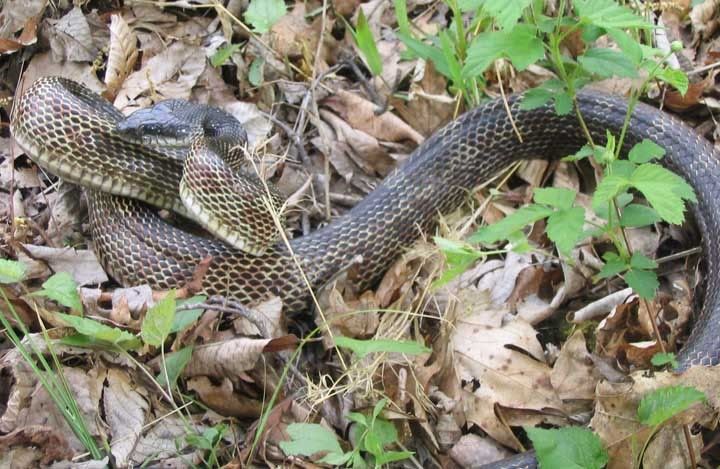
Wild Black Rat Snake found on the ground in Central Ohio:
Third Eye
Third Eye

jhnscrg Oct 30, 2008 07:10 PM

Nah, Ratsnakes is fine with me.
BTW, Cornsnake refers to a) Color pattern & b) Locality ( cornbins, barns, etc.) where said snakes were often found.
But Milksnake is just plain dumb! LOL

Matthew

guttersnacks Oct 31, 2008 12:12 AM

100 % of the snakes I caught have been on the ground. I would estimate I've caught maybe......80-100 snakes in my time spent herping the past 10 years or so.

So, all snakes should be called ground snakes.

Never once have I ever ever caught a lizard on a fence either.
-----
Tom

"The more people I meet, the more I like my snakes"

Ameron Nov 01, 2008 11:48 AM

Just to be scientific, based on your prior comments, how often had you been herping in trees - that you would have captured them there?

Don't you normally walk & herp on the ground??

How many tree cavities had you searched during this process?

draybar Nov 01, 2008 02:18 PM

>>Just to be scientific, based on your prior comments, how often had you been herping in trees - that you would have captured them there?
>>
>>Don't you normally walk & herp on the ground??
>>
>>How many tree cavities had you searched during this process?

you just don't get it.
First you say they should not be called rat snakes because that one article did not specify rats as their diet.
Then you said that food shouldn't be a factor but where they live should be the determination.
YOU are the one who said they should be called tree snakes because they are found in trees. The simple fact is....More times then not they are found anywhere but trees.
How can you still defend your reasoning to call them tree snakes.
You used one article as your basis that they do not eat rats and this article was based on a whopping twelve specimen survey.
Now that is one "extreme" survey group.
You have been given numerous examples of rat snakes that are not found in snakes. According to your reasoning of location equal naming they should be called anything but tree snakes.
You said they should not be called rat snakes because they do not eat rats then you cave a list of animals mentioned in that one expansive twelve snake survey. By the other side of your logic should they be called birdsquirrelchipmunklizardmousefrog snakes?
Or, flipping back to the "other" logic again... they are found on the ground, in barns, attics, rocks and on roadways.
Should they be called rock snakes, road snakes, attic snakes, barn snakes or ground snakes. Should all other snakes found in similar habitats be called the same thing?
The only thing you did say that made sense is the the naming of milk snakes...that one is crazy. a non=founded belief that they were "stealing" milk from cows in the field.
Your mention of corn snakes has been touched upon several times now. You should understand now that they were not named corn snakes because they eat corn. The patterning on their bellies was comparable to indian corn and there were instances of them being found in corn cribs eating the mice feeding on the corn or other possible grains stored there.
I have seen rat snakes eat rats, never seen one eat a tree. I have found over a hundred rat snakes in my life and only two in trees. How do those numbers warrent calling a rat snake a treee snake.
Like someone mentioned in a previous responce, I have found quite a few green snakes and these were always in bushes or low hanging trees, never on the ground. Should they be called tree snakes even though green snakes is a pretty good descriptive?
I have seen more water snakes in trees then any other species in my area. I can travel down the river or creek, while fishing, and see them drop from low hanging limbs into the water. Which should they be, water snakes or tree snakes?
you also mentioned that all sea snakes are called sea snakes because they are in the sea. Well if snakes are not found in the sea,well that would generaly mean they would have to found on land. Should all non sea snakes be called land snakes, then?

by the way...my original response was deleted for some reason. Once again I know it did not violate the TOS but....we will see what happens here.

a non tree dwelling "tree snake"

-----
Corn snakes and rat snakes..No one can have just one.
"Resistance is futile"
Jimmy Johnson
(Draybar)
Draybars Snakes

_____

draybar Nov 01, 2008 02:20 PM

>>You have been given numerous examples of rat snakes that are not found in (snakes. THIS SHOULD READ TREES NOT SNAKES) According to your reasoning of location equal naming they should be called anything but tree snakes.
>>You said they should not be called rat snakes because they do not eat rats then you cave a list of animals mentioned in that one expansive twelve snake survey. By the other side of your logic should they be called birdsquirrelchipmunklizardmousefrog snakes?
-----
Corn snakes and rat snakes..No one can have just one.
"Resistance is futile"
Jimmy Johnson
(Draybar)
Draybars Snakes

_____

garweft Nov 02, 2008 02:40 PM

A name common is a common name, who cares where it really comes from. Common names aren't used in scientific publications because many species have multiple common names and many species share common names. Are Kingsnakes really kings? Are they married to Queensnakes? And who exactly are Racers racing?

A better question is why are racers C. constrictor when they rarely if ever constrict prey.

orangudan Nov 24, 2008 09:54 PM

I have heard it proposed that milk snakes were so named because of their likelyhood of being found near dairies (of course alot of snakes can be found near agricultural settings as well).

Site Tools