Reptile & Amphibian Forums

Welcome to kingsnake.com's message board system. Here you may share and discuss information with others about your favorite reptile and amphibian related topics such as care and feeding, caging requirements, permits and licenses, and more. Launched in 1997, the kingsnake.com message board system is one of the oldest and largest systems on the internet.

Click here to visit Classifieds
Click for ZooMed
Click for 65% off Shipping with Reptiles 2 You

HH -- your cage design overhead heat?

knottydread Nov 04, 2008 11:22 AM

Hi HH,

I was going to reply to the thread in the cage design section, but thought you might see it here first.

What kind of overhead heat are you going to use for your enclosure? I am looking to build a few cages and was going to try heat tape with a thermostat, but am open to other substitutes. Is overhead heating just heat lamps?

I was planning on using the cabinet plymood or melamine and then putting heat tape down and maybe finding some plastic material or laminate to go over the heat tape, possibly even a piece of plexiglass or something (might make cleaning easier).

Thoughts? Suggestions? I love the cage you made man...
-----
1.0 Het Albino Burm
0.1 Normal Ball Python
1.0 Albino Ball Python
1.1 Pastel Ball Pythons
0.1 Spider Ball Python
0.2 Het Albino Ball Pythons
0.1 Lavender Albino Retic

Seeking bigger cages for the family

Replies (13)

HappyHillbilly Nov 04, 2008 08:14 PM

Hey there!

"What kind of overhead heat are you going to use for your enclosure? I am looking to build a few cages and was going to try heat tape with a thermostat, but am open to other substitutes. Is overhead heating just heat lamps?"

I'm going to use 2 - 150-watt ceramic heat emitters to start out with. They'll both be on the hot end, spaced apart within the width/depth of the cage.

Since my cage is stackable the CHEs will be on the inside with a safety guard around them. For cages that won't have other cages stacked on top of them it's much better, simpler, safer, to cut a hole the size of the dome housing the CHE or light bulb and just place it on top of the cage.

CHEs (ceramic heat emitters) are infrared devices. The rays penetrate the snake's body for better heating versus the heating of the snake's skin where light rays stop. Lights left on 24/7 can stress snakes and in some cases, if that's the only source of heat, what can you do? Of course, they make the night-light bulbs but they generally don't produce enough heat for the average Burmese Python cage. Sometimes they do, sometimes they don't. Plus, if you can get one to last you 3 months or more please tell me how you did it. CHE's cost 3 times as much but last 20 times longer.

With that said, I'm still considering radiant heat panels. For one or two cages I wouldn't hesitate to use them. But given that I've got to build at least 8 of those big cages it comes to about $1000 difference. That's a lot of cuzin Luke's white ligtnin'. (Just kidding, of course.)

Heat tape is good and inexpensive. Those that use it say it's effective, too. I use it in a hatchling rack but no cages. Yet, at least. The thing about using heat tape is the cage modifications that need to be done. Specifically the routing out of the area the heat tape will fit into. And sometimes it could mean reinforcing the bottom of the cage somehow or another.

Randy (Art In Scales) can fill you in quite well on heat tape. He's built some nice setups with it.

"I was planning on using the cabinet plymood or melamine and then putting heat tape down and maybe finding some plastic material or laminate to go over the heat tape, possibly even a piece of plexiglass or something (might make cleaning easier)."

Choosing the type of material was probably my hardest decision. There are soooo many factors to it all.

I love wood grain, and a fairly light, not dark, color. That limited my options to plywood or high-end melamine. I don't remember what the exact cost of the cabinet grade pine plywood I used, but it was $15 for a 4 x 8 sheet or less. The melamine was $45 for a 4 x 8 sheet. Like I said earlier, building one or two cages, a lil' more money's not much of a deal. But with 8 cages, it becomes quite a big deal.

If woodgrain's not important & a plain ol' colored cage wii do, I'd probably go with 3/4-inch MDF or plywood, put several coats of high quality indoor paint on it, seal all corners, and be done with it. It'll last longer than the average keeper will ever need it for.

I don't know how well putting plexiglass over the heat tape will work. It may work just fine, I'm just saying I don't know because I'm not that familiar with using heat tape. Now, as for protecting the inside of the cage from humidity damage, you can laminate it with formica, cover the insides with pllexiglass, vinyl flooring, and many other things other than a water-based polyurethane like I used. I'm considering trying epoxy resin (fiberglass, without the cloth strips) in my next cage.

The first rule in cage building - K.I.S.S. (Keep It Simple, Stupid) That's not directed at anyone but me. I have to constantly tell myself that.

Let me know if you've got any other questions. Hopefully someone else will chime in here soon. Thanks for the compliments on my cage. Due to lack of time & a fe mishaps on my part it's still not quite finished. I hope to get the last coat of poly on it tomorrow (Wed) and then take it to get sliding glass door tracks & glass installed by end of the week. Weather permitting, that is.

Take care!
Mike
-----
Due to political correctness run amuck,
this ol' hillbilly is now referred to as an:
Appalachian American


www.natures-signature.com

knottydread Nov 05, 2008 11:16 AM

Thanks for the advice...

After some research yesterday it might be easier/more efficient for me to use a radiant heat panel for the burm cage..

I'm only going to build one cage for now, but have to build a stack or large rack for the ball pythons so that might come in a few months and I can use heat tape for that...

Can you use radiant heat panels as belly heat or does it need to be overhead?

If Randy can chime in with some setup help that would also be helpful..

Thanks again!
-----
1.0 Het Albino Burm
0.1 Normal Ball Python
1.0 Albino Ball Python
1.1 Pastel Ball Pythons
0.1 Spider Ball Python
0.2 Het Albino Ball Pythons
0.1 Lavender Albino Retic

Seeking bigger cages for the family

VinnyButch Nov 05, 2008 12:45 PM

As long as the thread is about heating Burm cages, I thought I might try to pick a few brains myself.

With either overhead heating or belly heat, how would one use a thermostat to keep the temperatures at optimum levels? Specifically, how would you position the heat sensing probe? If you put it on the floor of the cage (on the hot side, of course), the snake would shield it from the overhead heat, thus causing the temps to rise. If it's belly heat, the snake laying on top of the probe would trap heat in between the tape and it's belly, causing another mis-read and having the temps drop too low. At least that's the way it works (or doesn't work) in my head.

Do you just adjust the heat output from outside the cage until it reaches a satisfactory level, then hope things stay within range when a snake takes up residence?

Vinny

HappyHillbilly Nov 06, 2008 01:07 AM

"With either overhead heating or belly heat, how would one use a thermostat to keep the temperatures at optimum levels?"

Put the probe in an optimum location, silly. Ha! Ha! I'm just pickin' at ya, Vinny. Sorry, couldn't resist.

"Specifically, how would you position the heat sensing probe? If you put it on the floor of the cage (on the hot side, of course), the snake would shield it from the overhead heat, thus causing the temps to rise."

With overhead heat I tape my probes to a small block of wood that's aproximately 1-inch square, with the sensor being on the top of the block. I place the block on the outer limits of the basking area. With a 12ft snake coiled up in the basking area the sensor is within 1 - 2 degrees of the temperature in the dead center of the basking area. That's plenty close enough.

Easy way - Observe your snake coiled in the basking area and note where you can place the probe/sensor, just outside of its coils. Attach it to a scrap piece of wood or something to hold it off the floor. This will also make it a bit uncomfortable for the snake to lay on it. Having the basking area just slightly away from the end wall instead of right up against it gives a little leeway.

"If it's belly heat, the snake laying on top of the probe would trap heat in between the tape and it's belly, causing another mis-read and having the temps drop too low. At least that's the way it works (or doesn't work) in my head."

Bear with me as this reply could get a bit long-winded. There are several different ways used by various people to measure & controll belly heat temperatures. I'll tell you a few of those ways and let you decide which one to use.

First off, we should have a basking area larger than our snake's coiled area so the sensor could/should be placed just outside of the snake's general coiled area. Just like with the overhead heating placement I mentioned earlier. Any misreadings due to the snake laying on the sensor are usually quickly adjusted by either the snake getting out of the heat or it's body catching up to the desired temperature setting.

Some people place the sensor on the heat source itself and make micro-adjusments to the thermostat settings. This usually requires setting the thermostat to a temperature higher than the actual in-cage temperature. This is a fairly common practice in racks using heat tape, flexwatt, with people placing the sensor directly on the surface of the heat tape. The probe isn't usually placed in the same location that the snake will actually be laying, it may be several feet away but still on the same piece of heat tape.

I'm more particular. I want to know what the temperature is inside the cage, where my snake will be basking. That's why I'll place the probe outside of the snake's general coil position but still on the actual heated surface.

For my rack I set up a tub just like the ones my snakes are in, complete with the same number of layers of paper towels or newspaper, and I tape my sensor to the top of those paper towels or newspaper. The paper towels are also taped to the bottom of the tub or weighted down, just as if the weight of a snake were pushing them down. Every now & then I'll swap places with the sensor tub and one of the snake's tubs, giving me various reading points to ensure accuracy.

I'm not saying that they're the perfect & only way, but those are the things that have worked for me. I hope this helps.

Catch ya later!
HH
-----
Due to political correctness run amuck,
this ol' hillbilly is now referred to as an:
Appalachian American


www.natures-signature.com

laurarfl Nov 05, 2008 01:38 PM

RHP's are installed on the inside of the cage and mine get pretty darn hot to the touch!

knottydread Nov 05, 2008 03:39 PM

Inside overhead, on the side or on the bottom?
-----
1.0 Het Albino Burm
0.1 Normal Ball Python
1.0 Albino Ball Python
1.1 Pastel Ball Pythons
0.1 Spider Ball Python
0.2 Het Albino Ball Pythons
0.1 Lavender Albino Retic

Seeking bigger cages for the family

HappyHillbilly Nov 05, 2008 11:42 PM

They're typically mounted to the ceiling. Some state that they can be mounted vertically (on the wall) but they're not designed for floor installations on the inside ot a cage.

Now, whether or not one could be mounted underneath a cage to heat the cage bottom, I don't know, but I think you'd lose a lot of its effectiveness.

Catch ya later!
HH
-----
Due to political correctness run amuck,
this ol' hillbilly is now referred to as an:
Appalachian American


www.natures-signature.com

ArtInScales Nov 06, 2008 01:09 AM

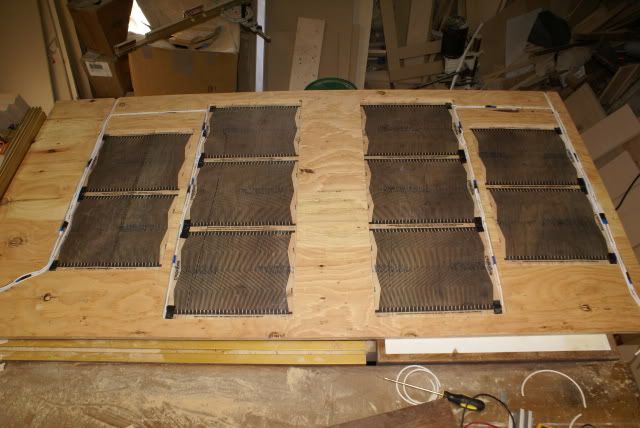
Here are some pics of the cages we're working on. I'm not finished building cages yet. There will be 2 more cages next to the TV and 6 more above, 2 rows of 3 cages. The bottom cages are roughly 6 feet by 3 feet.

These are made with maple melamine top, back and sides. The front is maple plywood, door frames are solid maple and the floor is plywood with maple laminate glued on with contact cement.

I used flexwatt under the floor by routing a space 3/8 deep so the heat doesn't have to go all the way through the 3/4 plywood. Then I stapled the flexwatt in the recess. I put the probe for the thermostat in a small recess between the floor and the flexwatt. These cages are in our living room, so I was concerned about controlling the ambient heat. Five of the panels are for the hot spot and five of the panels are for the ambient heat. Cages that we have built in our snake rooms only get flexwatt for a hot spot since we control the temps of the room with a space heater and a thermostat.

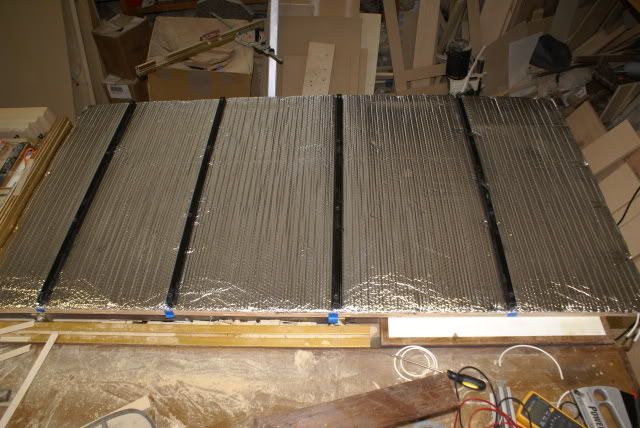
Once all the wiring is done I covered the whole thing with Reflectix to help force the heat up into the cage and not over heat the cage below. Since I removed so much material from the 3/4 plywood I reinforced the floor with 3/4 square steel.

All the cages will be controlled with 2 Herpstat Pro's. One Herpstat will control all the ambient heat and the other will control all the hot spots. That way if something happens to one of the Herpstats all the cages will still have some kind of heat.

We have use this set up on several other cages we have built and it works quit well. It take a few hours for the cage to reach it full temps because it has to heat the plywood, but once it's up and running the temps stay pretty steady and I don't have to worry about a snake burning themselves on their heat source.
-----
Randy and Michelle
Art In Scales
(719) 439-4199
info@artinscales.com

Carmichael Nov 05, 2008 09:05 PM

....for big constrictors are Pro Product Radiant Heat Panels. I've been using them at my facility for many years and love them. They provide an excellent thermal gradiant and for big snakes, they are fantastic as they provide a large, evenly distributed basking area. They are easily mounted to the inside ceiling of the cage and they never become overly hot to the touch. You ought to consider this option.

Rob Carmichael, Curator
The Wildlife Discovery Center

>>Hi HH,
>>
>>I was going to reply to the thread in the cage design section, but thought you might see it here first.
>>
>>What kind of overhead heat are you going to use for your enclosure? I am looking to build a few cages and was going to try heat tape with a thermostat, but am open to other substitutes. Is overhead heating just heat lamps?
>>
>>I was planning on using the cabinet plymood or melamine and then putting heat tape down and maybe finding some plastic material or laminate to go over the heat tape, possibly even a piece of plexiglass or something (might make cleaning easier).
>>
>>Thoughts? Suggestions? I love the cage you made man...
>>-----
>>1.0 Het Albino Burm
>>0.1 Normal Ball Python
>>1.0 Albino Ball Python
>>1.1 Pastel Ball Pythons
>>0.1 Spider Ball Python
>>0.2 Het Albino Ball Pythons
>>0.1 Lavender Albino Retic
>>
>>Seeking bigger cages for the family
-----
Rob Carmichael, Curator
The Wildlife Discovery Center at Elawa Farm
Lake Forest, IL

HappyHillbilly Nov 05, 2008 11:33 PM

Rob,
I've been meaning to contact the fella over at Pro Products for some time but haven't yet. Perhaps you could answer a question for me if you don't mind.

For 14ft, 16ft-plus snakes do they make a single unit big enough or does it require two units? The other heat panels I've seen listed for sale at other places only have sizes that look like I would need two units to cover the basking area of a large snake.

Thanks, and have a good one!
Mike
-----
Due to political correctness run amuck,
this ol' hillbilly is now referred to as an:
Appalachian American


www.natures-signature.com

Carmichael Nov 08, 2008 05:58 PM

Absolutely, we have some panels that are 4' x 2' and cover a lot of space. Our burms LOVE 'em.

>>Rob,
>>I've been meaning to contact the fella over at Pro Products for some time but haven't yet. Perhaps you could answer a question for me if you don't mind.
>>
>>For 14ft, 16ft-plus snakes do they make a single unit big enough or does it require two units? The other heat panels I've seen listed for sale at other places only have sizes that look like I would need two units to cover the basking area of a large snake.
>>
>>Thanks, and have a good one!
>>Mike
>>-----
>>Due to political correctness run amuck,
>>this ol' hillbilly is now referred to as an:
>>Appalachian American
>>
>>
>>www.natures-signature.com
-----
Rob Carmichael, Curator
The Wildlife Discovery Center at Elawa Farm
Lake Forest, IL

HappyHillbilly Nov 09, 2008 01:19 AM

Thank you, Rob! - (no post)
-----
Due to political correctness run amuck,
this ol' hillbilly is now referred to as an:
Appalachian American


www.natures-signature.com

bcwildman Nov 09, 2008 09:43 PM

Hey just curious what the 1.0 and 0.1 and 0.2 mean when you list your snakes at the bottom of a post. Thanks

Site Tools