Reptile & Amphibian Forums

Welcome to kingsnake.com's message board system. Here you may share and discuss information with others about your favorite reptile and amphibian related topics such as care and feeding, caging requirements, permits and licenses, and more. Launched in 1997, the kingsnake.com message board system is one of the oldest and largest systems on the internet.

Click here to visit Classifieds
Click for ZooMed
Click here for Dragon Serpents

Planning a new herp home

cpsinatl Nov 08, 2008 09:59 AM

As the title goes I am planning on making some new homes for my herps in the coming year. Right now I have 1 BP, 2 leo geckos, and plan on getting one colubrid. As such I figure I have two possible paths, the first is making a rack the other is making a custom enclosure that looks more like furniture.

My concern about the more "furniture" style, as in all wood construction, hinged and see through front etc, is heating. I want to avoid heat lamps because they take up a lot more space, produce a lot of waste heat and subsequently use a lot more energy. So what I am stuck with is how to provide heat from a UTH. I could of course go with the radiant heat panels but at their price vs FW I don't see that as a reasonable option. For the heat source I had some ideas related to using floor tiles in the enclosure to affix the FW to, to give the warmth. The question that comes up with that is cleaning of course, unless someone has had luck with warming an enclosure through wood or some other readily available material.

The other option is to make a rack. I'd like to keep it right around 4' (48" tall. For tubs for the snakes I am planning on using CB110 at 19 7/8"W x 39"L x 6 1/4"H (referencing tubs by volume seems silly to me...) and not sure what to use for the leos (as I can't find a dimension that is both half of one dimension of CB110 and equal in another) so it is clean. With that height I have room for a little future expansion if I so choose. Not a lot but some. Regardless I am wondering about the heating. My plan is to either use one 11" strip of FW or two 3" or 4" strips per shelf. I like the idea of using two strips to heat the warm side because if one fails there is a redundancy. Any opinions?

To protect against failure I am going to put a fuse on each FW individually (as I mentioned in a different sticky thread).

Regarding material, I figure there are two options. One being plywood and the other being melamine coated particle board. The melamine stuff weighs a ton so I'm not a fan. I'm also not worried about having the stuff pre-cut as I can take care of that myself at home. What would be awesome if there was that PVC stuff available. Can one get that at a home supply mega-store? Or is one stuck with the above?

Basically the necessity is I don't want a room full of fish tanks...

Replies (3)

ArtInScales Nov 09, 2008 10:57 PM

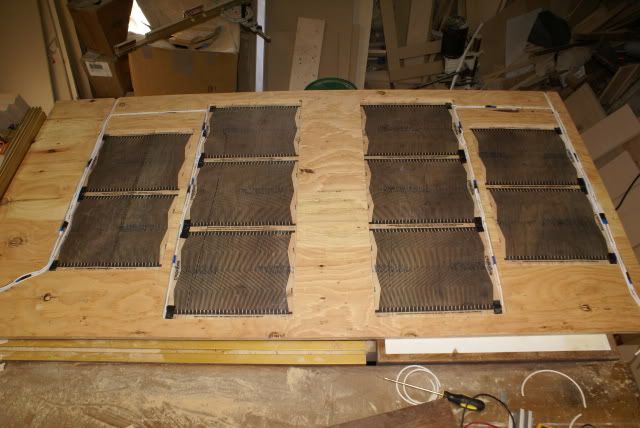
Here is one option if you are building a rack. This is 11" flexwatt, but we just built a rack for 28 qt sterilites that used 2 strips of 3".

I route a recess about 1/8th inch deep so the tubs don't rub on the flexwatt. I put the probe for the thermostat under the flexwatt and monitor the temps inside the tub.

If you are building a cage you could use plywood for the bottom. We put laminate, like counter tops are made of, on the plywood for easy cleaning.

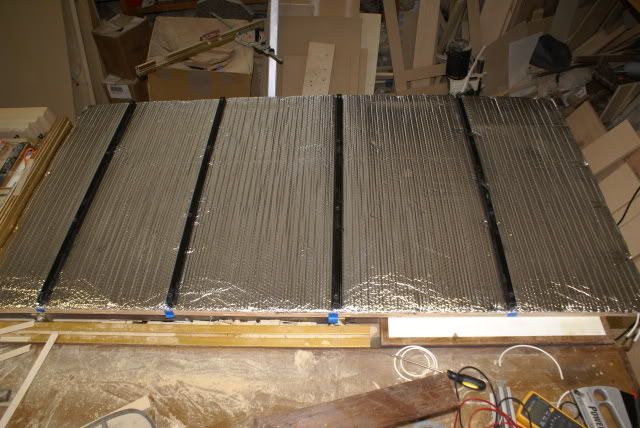
We routed a recess on the underside of the floor about 3/8ths inches and again put the thermostat probe between the flexwatt and the floor. If you go this route you may want to reinforce the floor. We used reflectix as insulation, then screwed 3/4 inch square steel to the floor to stiffen it up.

We aren't done with all the cages yet, but here's what we have so far and the floors and heat are working great.


-----
Randy and Michelle
Art In Scales
(719) 439-4199
info@artinscales.com

cpsinatl Nov 10, 2008 05:21 AM

wow thanks. so you are heating the ply directly with the FW? That was my #1 issue if that was possible or not.

Chris_Harper2 Nov 10, 2008 10:18 AM

As far as racks vs. cages, I say make what you want. Racks make maintenace so easy for even a small collection and honestly a lot of species seem to do better in them. But on the other hand, a nice display cage can be a very enjoyable way of keeping animals. Again, do what you want.

I think RHP's are the way to go. There are some cheaper options, including under-desk heaters that are often very cheap on Ebay or Amazon. You can even make your own RHP's with a UTH or Flexwatt but I won't give any tips on how to do that.

To use an UTH underneath a furniture like cage, there are two general methods I recommend and have used.

First is to cut a square out of the cage floor that is about 2" longer and wider than the size of heater you'll be using.

Keep this cutout far enough away from the walls of the cage as to avoid any screws or nails in the wood and to maintain the structure of the cage floor.

Route a shallow groove from the cutout to the side or back of the cage. This is where the power supply cord will run.

Now cover the entire floor with a 1/4" thick piece of Sintra or other plastic that is able to conduct and transmit heat.

Use aluminum foil tape to attach your heat tape to the underside of the floor, inside of the cutout area.

I like this method because it provides an air space for the heat source and makes the cage floor more durable and easier to clean.

My next method is one that people don't seem to like, but I can tell you I've seen it done on 8' cages. Just build the cage with no solid floor at all and use staples and silicone to attach a plastic floor directly to the cage walls. Then the heat source just rests between two stacked cages, or whatever the cage is placed on.

People seem scared by this approach but it does save on wood, meaning you can build a bigger cage or have leftover for the next one. As far as strength, a lot of book cases have just a thin sheet of hardboard tacked on the back and no solid back. Book cases are bigger and hold a heck of a lot more weight than most cages so it's a strong design if executed properly.

If you go with either design make sure to have your plastic purchased and cut first so you can make sure the cage is designed around it.

With the first design the floor needs to fit inside of the cage so it can be smaller.

With the second design the floor has to be the same size as the perimeter of the cage so it has to be larger. 1.5" wider and longer than the fist design, assuming both cages are built from 3/4" thick material.

So make sure to design your cages around the plastic as it tends to be the most expensive part of the cage. One guy I recommended this design to did not factor this in and instead of getting four cage floors from a piece of material he was only able to get two and was left with one large piece of not very useful scrap.

-----
Currently keeping:

6.10 Gonyosoma oxycephalum (Javan, mixed colors)

1.1 Philodryas baroni

1.1 Lampropeltis triangulum multistriata

1.0 Rhodesian Ridgeback

Site Tools