


Reptile & Amphibian Forums

Welcome to kingsnake.com's message board system. Here you may share and discuss information with others about your favorite reptile and amphibian related topics such as care and feeding, caging requirements, permits and licenses, and more. Launched in 1997, the kingsnake.com message board system is one of the oldest and largest systems on the internet.

Click here for Dragon Serpents

Green Rat Keepers....

ratsnakehaven Nov 18, 2008 01:19 PM

I'm interested in getting some opinions from those keeping and breeding the Northern green ratsnake, Senticolis triaspis intermedia; especially about how they are kept in regards to the humidity/moisture levels in their cages, types of furnishings, etc.

Last year I collected a pair of yearling green rats in a mtn. range in southern AZ. I want to work with this species from a definite locality and wanted young snakes that I could observe maturing. Several adults were passed up.

From the beginning things have gone very well. Both snakes started eating f/t pinky mice right away. They seemed to adapt to their enclosures too, although I kept them in shoe boxes at first and didn't observe much. Sometime during the late summer I transferred them to ten gallon tanks with a water jug, a dry hide, a small hide with moist sphagnum, and in the case of the male, a gallon jug set up to provide a layered moist hide for burrowing. The rest of the cage is layered with aspen shavings and paper towell.

Room temps are usually in the low 70's, but can get up to the high 70's during the day. Now that it's cooled off a lot, it sometimes gets down to about 68*F. at night. I put a heat pad under one end of the tank.

Here's what I've seen so far. The female seems to hide almost all the time in her dry hide. She does spend a lot of time in the moist sphagnum hide when she's in the shed cycle, or about to shed. Neither snake seems to have any trouble digesting and don't seem to need extra heat to digest. They occasionally lie near the heat pad (under tank.) The male cruises around the cage a lot. He uses all the hides in turns when he's not cruising. Neither snake soaks in the water, so I assume they find humidity in other ways in the wild.

One other point I'd like to make is that green ratsnakes have a thin skin compared to other North American ratsnakes. I think they would have a lot of difficulty shedding if they didn't have moist hides.

Here's my questions....
1. What requirements do you think these snakes have as far as humidity/moisture goes?
2. What do you do in their cage set ups to help provide for their humidity requirements, or other, such as security issues?
3. Do you think this species can be maintained in captivity in a healthy environment w/o there being major problems down the line?

Thanks for any and all help and discussion of this wonderful species. I believe several breeders have also had success reproducing green rats in captivity and it might be interesting to hear from some of them.

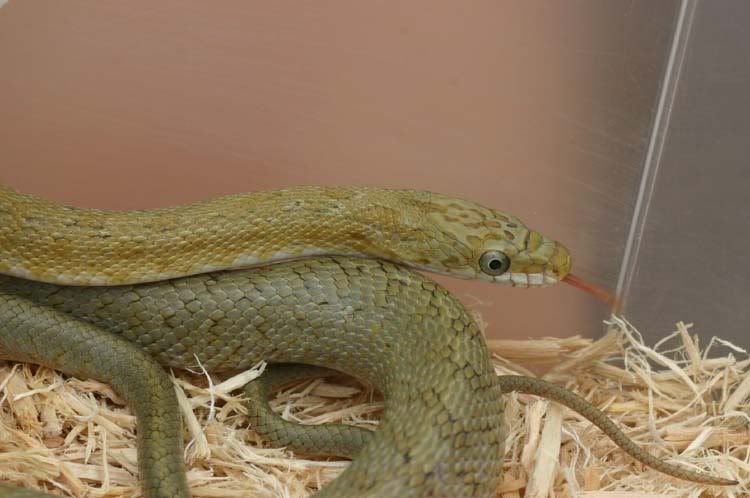
Here's a series of photos I took of the male last spring, while he still had some traces of juvenile pattern. Now that they are two year olds, they have both turned a uniform greenish color...


Regards...Terry Cox
Ratsnake Haven

-----
Conserve reptiles by helping protect habitat.

Replies (13)

monklet Nov 19, 2008 09:41 AM

Hi Terry, wish I could help out with your query but all I can do is say thanks for all the detailed information and great pix. Best of luck with your project!

Brad

ratsnakehaven Nov 19, 2008 11:07 AM

>>Hi Terry, wish I could help out with your query but all I can do is say thanks for all the detailed information and great pix. Best of luck with your project!
>>
>>Brad

Thanks, Brad...

We're getting into the cool down part of their life cycle and I think this is the toughest part of keeping this species. There's a lot to learn, and it would be cool to have a group putting their heads together. I'm not sure this is the right forum for that, however.

The green rats have some obvious differences from other North American ratsnakes. Asamof, they remind me more of Old World ratsnakes. Their need for humidity/moisture seems to be more critical, so I'm back to designing habitat. I'm also working with desert kings, Lampropeltis getula, which are also demanding as far as semi-moist burrowing medium, etc.

PS: I didn't expect much response, because green rats are pretty challenging. I don't think there are too many enthusiasts out there keeping them...

Later...Terry

-----
Conserve reptiles by helping protect habitat.
monklet Nov 20, 2008 09:47 AM

Not to digress but, funny about the Desert King bit, I have a CB '07 which is very hearty but doesn't seem at all inclined to burrow in her substrate (she's in shredded aspen currently but was originally in reptibark). I don't wet the substrate unless she's in her shed cycle and she's always had perfect sheds. I live on the coast though where humidity levels are generally moderate.

I'd really like to have some green in my collection and very much have my eye on triaspis in the future once they become more established in the hobby (something tells me that's on the way

Best of luck and please update.

Cheers,
Brad

ratsnakehaven Nov 30, 2008 08:14 AM

>>Not to digress but, funny about the Desert King bit, I have a CB '07 which is very hearty but doesn't seem at all inclined to burrow in her substrate (she's in shredded aspen currently but was originally in reptibark). I don't wet the substrate unless she's in her shed cycle and she's always had perfect sheds. I live on the coast though where humidity levels are generally moderate.
>>
>>I'd really like to have some green in my collection and very much have my eye on triaspis in the future once they become more established in the hobby (something tells me that's on the way
>>
>>Best of luck and please update.
>>
>>Cheers,
>>Brad

Brad, I think the big difference about our desert kings is that mine are all wild caught. I haven't started breeding them, yet, but have plans for next year.

I think the desert kings spend a huge amount of time underground in cool, moist environments. In the wild they are used to burrowing and I believe the wild caught ones are very shy. I also think we need to be careful about dehydration. Here in AZ the humidity can get very low, as you know.

Thanks for the good thoughts about the green rats. They are a very cool species, but I would say somewhat trickier than Emory's rats. Emoryi is the main species I work with and they are usually a piece of cake. I end up comparing all my other ratsnakes to Emory's.

So far the moist hides are working pretty well. The greenies seem to use them at least part of the time. Interesting that I never see them going into the water jugs, so I have removed the large water jug in favor of another hide, and I'm just keeping a small water jug in the cage that I don't have to worry about very much, as far as defecation, etc.

Later...Terry

-----
Conserve reptiles by helping protect habitat.

tbrock Nov 20, 2008 01:30 AM

Hey Terry,

I wish I could help somehow, as I find these fascinating, from a distance - for now anyway. Great photos of a great looking snake BTW. Have you tried talking to Gerold Merker? I know that he works with this specie, and has had success with them. It sounds like you have done well with them, and that they have acclimated to captivity okay. It really seems good that they eat well for you, and don't seem to have digestion issues, as I have heard that w/c specimens can be heavily parasitized.

Sincerely - Best of luck,
-Toby
-----
Southwestern Center for Herpetological Research

viborero Nov 20, 2008 01:45 PM

Well, well...the gang's all here! Terry, I have only been keeping them since this spring, so I don't have a lot of experience to add to the conversation. Both were W/C from the same locality (practically your backyard! ) this year. They were both treated for parasites and have acclimated nicely. The male took off like a champ, eating f/t on the first try, but the female took over a month to eat and even though she eats 2-3 times a week, she will only take live hopper mice to this day.

As far as keeping them, I follow a simplistic approach. I keep both of them on newspaper, with one dry hide and one damp sphagnum moss filled humid hide each. At first, I tried to provide a warm spot (85-90), but they avoided it like the plague, so they are just at room temp now (76-80).

My friend Oscar actually bred his Pajaritos pair this year. Let me know if you want me to put you in touch with him for the details.


-----
Diego

SWCHR

tbrock Nov 21, 2008 07:24 AM

Great looking Green Rat, Diego! Good info, as well.

-Toby
-----
Southwestern Center for Herpetological Research

viborero Nov 21, 2008 01:37 PM

Thanks, bud. That's the female we've been discussing. She should be ready to go in 2010, I believe. She's probably big enough to handle a 2-3 egg clutch this coming spring, but I'd give her one more year of good, solid growth.
-----
Diego

SWCHR

tbrock Nov 21, 2008 03:43 PM

Sounds great! I'm with you on that - I don't rush any of mine either, and have no problem waiting until they put on size and weight.

-Toby
-----
Southwestern Center for Herpetological Research

ratsnakehaven Nov 23, 2008 12:02 AM

>>Well, well...the gang's all here! Terry, I have only been keeping them since this spring, so I don't have a lot of experience to add to the conversation. Both were W/C from the same locality (practically your backyard! ) this year. They were both treated for parasites and have acclimated nicely. The male took off like a champ, eating f/t on the first try, but the female took over a month to eat and even though she eats 2-3 times a week, she will only take live hopper mice to this day.
>>
>>As far as keeping them, I follow a simplistic approach. I keep both of them on newspaper, with one dry hide and one damp sphagnum moss filled humid hide each. At first, I tried to provide a warm spot (85-90), but they avoided it like the plague, so they are just at room temp now (76-80).
>>

Hi, Diego. Thanks for the info.

My room temps are now getting down to about 68*F at night. During the day the room only gets up to about 76*F, but it also depends on the outside temps. The under tank heat pads provide some extra warmth, but to tell the truth I don't think the green rats need it.

My two yr old female (somewhat smaller than yours) is eating large pinks and small fuzzies. I really haven't tried anything larger.

I'm thinking about providing more moisture in some form, but they have done pretty well so far with just a humid hide with sphagnum. I'm just thinking their nature environment is more humid than the cage set up.

I'm sure we'll find out more in the coming year.

-----
Conserve reptiles by helping protect habitat.

ratsnakehaven Nov 30, 2008 08:40 AM

>>Well, well...the gang's all here! Terry, I have only been keeping them since this spring, so I don't have a lot of experience to add to the conversation. Both were W/C from the same locality (practically your backyard! ) this year. They were both treated for parasites and have acclimated nicely. The male took off like a champ, eating f/t on the first try, but the female took over a month to eat and even though she eats 2-3 times a week, she will only take live hopper mice to this day.
>>
>>As far as keeping them, I follow a simplistic approach. I keep both of them on newspaper, with one dry hide and one damp sphagnum moss filled humid hide each. At first, I tried to provide a warm spot (85-90), but they avoided it like the plague, so they are just at room temp now (76-80).
>>
>>My friend Oscar actually bred his Pajaritos pair this year. Let me know if you want me to put you in touch with him for the details.
>>
>>
>>-----
>>Diego

Hi, Diego.

Wanted to make a comment about parasites.

I thought this would be an issue at first, as my pair of green rats are wild caught also. But I put them in treated cages when I first got them as I do for any new snakes I bring in and I've never seen any mites. Also, I've been watching for any signs of internal parasites and have seen none. The snakes look very healthy.

One theory that I have is that it's better to start with young snakes. It might be better because they might not have contacted any of the bad parasites, yet, and it might be better because behaviorally they are still learning and will become accustomed to your captive environment more easily, imho.

Another note is that my snakes were both yearlings when I found them. I didn't find any 'last year's' babies my first year here. I'm not sure why, but I'll check it out better this coming year, and hopefully it won't make a difference with the pair I'm working with. BTW, for those who aren't familiar with AZ law, we are allowed to keep four green ratsnakes, or two pairs. We are not allowed to sell any, but we can gift them to someone.

Regards...Terry

-----
Conserve reptiles by helping protect habitat.

ratsnakehaven Nov 22, 2008 11:53 PM

>>Hey Terry,
>>
>>I wish I could help somehow, as I find these fascinating, from a distance - for now anyway. Great photos of a great looking snake BTW. Have you tried talking to Gerold Merker? I know that he works with this specie, and has had success with them. It sounds like you have done well with them, and that they have acclimated to captivity okay. It really seems good that they eat well for you, and don't seem to have digestion issues, as I have heard that w/c specimens can be heavily parasitized.
>>
>>Sincerely - Best of luck,
>>-Toby

Thanks, Toby.

I have talked to Gerald before. I'm about to try a new method for adding moisture to the captive environment. Also, I haven't observed any parasites, yet. They seem very healthy.

I'll let ya's know what happens.

- Terry

-----
Conserve reptiles by helping protect habitat.

jhnscrg Nov 20, 2008 07:04 PM

Nice pics Terry! Greenest Green Rat pictures I've seen to date..

Matthew

Site Tools