


Reptile & Amphibian Forums

Welcome to kingsnake.com's message board system. Here you may share and discuss information with others about your favorite reptile and amphibian related topics such as care and feeding, caging requirements, permits and licenses, and more. Launched in 1997, the kingsnake.com message board system is one of the oldest and largest systems on the internet.

Click here to visit Classifieds
Click for ZooMed
Click here to visit Classifieds

Death Adders are Elapids... WHY?

yasin1 Nov 23, 2008 09:44 PM

Hello,

I am a geneticist and even though my work is mostly bacterial and human genetics, I am extremely interested in snake genetics as well.

I have been getting more and more interested in Death Adders recently. I almost bought a couple but could not get the necessary import permit so I couldn't. But I am still interested. I have been reading a lot about them and everybody says that they are the result of convergent evolution.

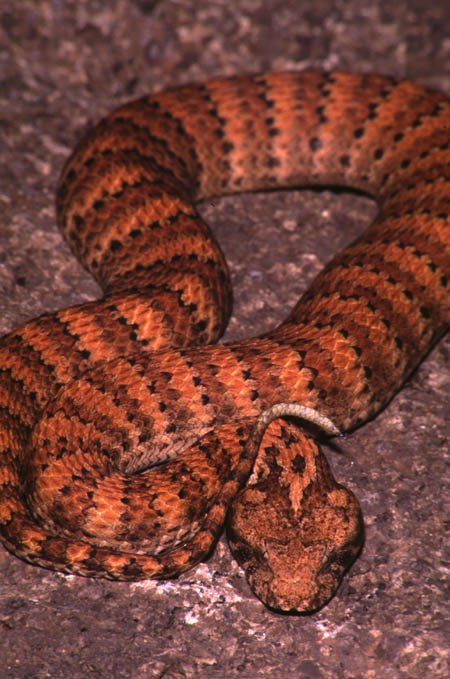
I have to be honest here. When I look at them, I see vipers. Ambush hunting, tail luring, vertical pupils, triangular head shape, short/stout body shape etc. But they are classifieds as Elapids by taxonomists. Why?

From what I have been reading in the scientific literature, their strike kinematics are somewhat elapid like, their venom is completely neurotoxic like most elapids and there are no vipers in Australia so we are classifying Death Adders as elapids. But I haven't seen any genetics data. (I have looked but not throughly).

I am neither an herpetologist nor a taxonomist but I understand the concepts somewhat due to my interest. However, as a geneticist, I would classify them vipers if there are no genetics data like ribosomal RNA sequencing etc. that ties them to Elapids. If we are classifying these beasts as elapids just to prove an evolutionary point, I think we are doing wrong. They may as well be a remnant of the old world vipers before the continents got divided.

So please enlighten me... Why do we call them Elapids? Is it only the venom (which would be HIGHLY idiotic), is it the fact that there are no other vipers in Australia or do we have genetics data? This has been bugging me for a while and I had to say something.

Thanks,
Yasin

-----
We are the best GALATASARAY

Replies (22)

lep1pic1 Nov 23, 2008 10:26 PM

FIXED FRONT FANGS NOT HINGED LIKE A VIPER
-----
http://www.simply-sober.com/him.html

http://simply-sober.com/blog1/

yasin1 Nov 23, 2008 10:51 PM

I am sorry but their fangs are longer and much more mobile than any other """"""elapid""""".
-----
We are the best GALATASARAY

LarryF Nov 24, 2008 02:12 AM

First of all, many elapids have very mobile fangs. They are often described as "fixed", but this is an oversimplification that has led to many bites. I've had a few cobras I was holding behind the head get uncomfortably close with a fang swinging wildly out of the side of their mouth.

Death adders may have the longest and most mobile fangs of the elapids, but not by as wide a margin as a quick read may lead you to expect.

The way a viper's fangs work is fundamentally different. There is at least one extra bone involved in the "hinge" that does not appear in the death adder.

It also would be one of a very small handful of vipers that lay eggs.

I'm sure there are many other anatomical keys that I'm missing, and I would be VERY surprised if the death adder hasn't been studied genetically because of these very questions.

You might try contacting Dr, Fry at: www.venomdoc.com

If he hasn't been directly involved in sequencing them, I bet he can tell you who has.

-----
What goes up must come down...unless it exceeds escape velocity.

indictment Nov 24, 2008 07:58 AM

I think I've read somewhere that Mmost Elapids are distinguished by their scalation also...............does the Death Adder pertian to the typical Elapid scalation(if there is one)?
-----
1.3.0 Leopard Geckos
0.1.0 California Kingsnake
0.1.0 Copperhead
1.1.0 Eastern Box Tutles

yoyoing Nov 24, 2008 08:14 AM

I am completely ignorant in this are but:
The observations so far could just as easily be a viper becoming more elapid-like as an elapid becoming more viper-like.

yasin1 Nov 24, 2008 09:47 AM

Death Adders have viper-like small subocular scales.

Do not get me wrong people. I don't have the education to classify them as vipers, I just don't understand why they are classified as elapids. 'Cos if there are no genetics info, they pretty damn look like vipers to me.

I think we need WW's help here...
-----
We are the best GALATASARAY

yasin1 Nov 24, 2008 09:43 AM

Death adders are viviparous (live bearing). They don't lay eggs so it wouldn't make them one of the rare "vipers" that do. I was going to write this too as a point but then there are egg laying vipers anyway so I didn't.

As for fangs, I think "evolving" rotatable fangs would be much easier than "evolving" vertical pupils but again who knows .
-----
We are the best GALATASARAY

choppergreg74 Nov 24, 2008 10:13 AM

Some elapids like Rinkhals, give birth live. This is a question to ask Wolfgang Wuster to grt the most acurate answer.

LarryF Nov 24, 2008 12:49 PM

>>Death adders are viviparous (live bearing).

Oops. My bad. That's what I get for posting when I'm half asleep.
-----
What goes up must come down...unless it exceeds escape velocity.

conserve Nov 24, 2008 11:10 AM

I'm sorry to be blunt, but if you truely are a educated, professional geneticist, you should realize that you are offering a fairly uneducated argument. Morphological characters can be extremely plastic, and are only one part of the puzzle when looking at phylogeny. I'm guessing that you don't work with phylogentic analysis.

I'll cut you some slack since you said you have not thoroughly research the topic, but to make wild statements that a certain animal should be classified differently based on purely superficial observations is a bit hasty. I don't know much about death adders, I'm merely making a comment on your argument.

Some posters mentioned things like fixed front fangs and egg laying. Again, these are only part of the whole picture, and they are not black-and-white examples (there are a number of pit vipers that are egg layers). Morphology, genetics, behavior all come together to give a more complete picture.

The genetic data is pretty clear, at least as far as calling them elapids. Most evidence shows the Australian elapids to have diversified from an Asian elapid origin.

For some light bedtime reading see:
http://www.anu.edu.au/BoZo/Scott/PDF Files/1998.Keogh.ElapidWorld.pdf

http://biology.bangor.ac.uk/~bss166/Publications/2004_OzElapids_MPE.pdf

yasin1 Nov 24, 2008 11:46 AM

No need to be sorry.

However, when there is a phenotype, there is a genotype behind it. And here we see a lot of phenotypes of vipers in a so called elapid. Again it is not a single trait but multiple traits that resembles vipers here.

Also, I have been expressing my desire to find some kind of a genetics analysis on Death Adders because that can be the only reason of placing these buggers in elapidae except for the fact that they live amongst elapids. Thanks for sharing those links with us. They weren't as helpful as I would have wished for them to be but I found an article from the references section of one of your articles that can be helpful.

http://www.anu.edu.au/BoZo/Scott/PDF Files/1998.Keogh.ElapidOz.pdf

It looks like there is some 16S RNA studies done on Death Adders but they were used to compare them to other Australian Elapids. The phylogenetic trees were then constructed with the assumption that Death Adders are Elapids and branched from a common Elapid ancestor.

This is not what I am looking for. For example, if I assume that people and rattlesnakes share a close common ancestor, I can build a phylogenetic tree showing this. However that assumption would be idiotic, won't it?

What I am looking for is a comparison of a Death Adder's 16S RNA analysis with an asiatic elapid's and an asiatic viper's 16S RNA analysis to see, which are more closely related. I hope I am more about this than I was before.

AND AGAIN

I am not saying that Death Adders are vipers. I am probably just missing something crucial here that would clear my doubts but according to what I have seen and read SO FAR, they resemble vipers much more than elapids.
-----
We are the best GALATASARAY

LarryF Nov 24, 2008 01:05 PM

We're certainly out of my realm of expertise here, but a "quick read" suggests that 16S RNA is only used for classifying bacteria?

My limited understanding is that mtDNA is generally used to classify higher organisms and that it not only gives enough information to build a tree, but allows for an estimate of how long ago two organisms diverged. So if you compared a human to a rattlesnake it would be obvious that they had no recent common ancestor.

I could also be completely wrong again...
-----
What goes up must come down...unless it exceeds escape velocity.

yasin1 Nov 24, 2008 01:17 PM

My bad, I meant to say 18S ribosomal RNA. Indeed 16S is for bacteria.

As for my rattlesnake example:

I wanted to say that if you ASSUME humans and rattlesnakes share a CLOSE common ancestor, you can build a phylogenetic tree, based on 18S rRNA comparison, and put them on the same tree.

So again ,if you assume Death Adders are elapids, when you compare 18S rRNA, you can put them on the same tree as other elapids. What I want to see is a comparison of Death Adder 18S rRNA, an asiatic elapid 18S rRNA and an asiatic viper 18S rRNA so that we can see which is more closely related. Comparing compelete genomes and looking for homology would be much better but it is also much harder.

I am not aware of a study like this but it may be due to my ignorance.
-----
We are the best GALATASARAY

jhnscrg Nov 24, 2008 06:57 PM

Actually, I believe genetic studies indicate Aussie Elapids are closely related to Seasnakes, more than any other snake family.
Anyway, vipers did not make it to Australia.

Matthew

WW Nov 27, 2008 07:35 AM

First, an important concept is that organisms are classified on the basis of evolutionary relationships, not based on similarity. So the fact that death adders are covergently similar to vipers in some charcaters is neither here nor there. What matters is what they share the most recent common ancestors with.

With regards to the latter, there have been a considerable number of studies of elapid phylogeny (based on mitochondrial and nuclear DNA as well as morphology), all of which have recovered Acanthophis as nested deep within the Elapidae, specifically within the Australian/marine elapid radiation. Furthermore, there have been a large numbers of snake phylogenies that have recovered the elapids as a monophyletic group, and, moreover, very distant from the vipers. Although I can't recall seeing any tree that features Acanthophis as well as vpers in the same tree, you really don't need that - all the available evidence places them firmly within the elapids. Since there is very little evidence questioning the monophyly of the elapids, that settles the question of whether they are vipers or not quite nicely.

Cheers,

WW
-----
WW Home

yasin1 Nov 27, 2008 11:36 AM

Thanks a lot for helping me out!

So you are saying that:

a-Death Adder genetics were compared with marine and terrestrial Australian elapids and found to be very similar.

b-Elapids and Vipers are distinct groups.

c-Due to a and b and due to the fact that vipers never made into Australia, evolutionary speaking, death adders can not be Vipers.

Did I get it right?
-----
We are the best GALATASARAY

WW Nov 27, 2008 12:56 PM

>>Thanks a lot for helping me out!
>>
>>So you are saying that:
>>
>>a-Death Adder genetics were compared with marine and terrestrial Australian elapids and found to be very similar.

Nothing to do with similarity, everything to do with history of descent. All the evidence, genetic and morphological, places the death adders deep within the elapid radiation.

>>b-Elapids and Vipers are distinct groups.

Very much so.

>>c-Due to a and b and due to the fact that vipers never made into Australia, evolutionary speaking, death adders can not be Vipers.

Nothing to do with whether vipers made it to Aus - if death adders were vipers, then obviously that statement would be wrong anyway. But a and b together clearly indicate that death adders are elapids, not vipers.

To use an analogy: my home village is Holm, in the state of Schleswig Holstein, which is in Germany, which in turn is in Europe.

The fact that Holm does not feature on a wall map of the world does not mean that I now need to worry about whether it might be in Africa after all.

Cheers,

WW
-----
WW Home

yasin1 Nov 27, 2008 02:28 PM

How does morphological evidence places Death Adders in Elapidae?

How do you know genetics evidence will place Death Adders in Elapidae if you do not compare it with anything else but Elapidae?

Yasin
-----
We are the best GALATASARAY

WW Nov 27, 2008 04:16 PM

>>How does morphological evidence places Death Adders in Elapidae?
>>
>>How do you know genetics evidence will place Death Adders in Elapidae if you do not compare it with anything else but Elapidae?

As per the analogy in the previous post. If Acanthophis were anything other than an elapid, that would pretty rapidly become obvious in phylogenetic analyses, as Acanthophis would then obstinately fail to group within the elapids. It's not exactly a subtle nuance.

See some of the following:

Greer, A. 1997. The Biology and Evolution of Australian Snakes.
Surrey Beatty & Sons, Sydney.

Heise, P.J., Maxson, L.R., Dowling, H.G., Hedges, S.B., 1995. Higher level snake
phylogeny inferred from mitochondrial DNA sequences of 12S rRNA and 16S
rRNA genes. Mol. Biol. Evol. 12, 259–265.

Kelly, C.M.R., Barker, N.P., Villet, M.H., 2003. Phylogenetics of advanced snakes
(Caenophidia) based on four mitochondrial genes. Syst. Biol. 52, 439–459.

Keogh, J.S., Shine, R. & Donnellan, S. 1998. Phylogenetic
relationships of terrestrial Australo-Papuan elapid snakes
(Subfamily Hydrophiinae) based on cytochrome b and 16S
rRNA sequences. Mol. Phylogenet. Evol. 10: 67–81.

Lawson, R., Slowinski, J.B., Crother, B.I., Brubrink, F.T., 2005. Phylogeny of the
Colubroidea (Serpentes): new evidence from mitochondrial and nuclear genes.
Mol. Phylogenet. Evol. 37, 581–601.

Mengden, G.A. 1985. Australian elapid phylogeny: a summary
of the chromosomal and electrophoretic data. In: The Biology of
Australasian Frogs and Reptiles (G. Grigg, R. Shine & H. Ehmann,
eds), pp. 185–192. Royal Zoological Society of NSW, Sydney.

K. L. SANDERS, M. S. Y. LEE, R. LEYS, R. FOSTER* & J. SCOTT KEOGH (2008) Molecular phylogeny and divergence dates for Australasian elapids and sea snakes (hydrophiinae): evidence from seven genes for rapid evolutionary radiations. Molecular Phylogenetics and Evolution

Scanlon, J.D. & Lee, M.S.Y. 2004. Phylogeny of Australasian
venomous snakes (Colubroidea, Elapidae, Hydrophiinae)
based on phenotypic and molecular evidence. Zool. Scr. 33:
335–366.

Schwaner, T.D., Baverstock, P.R., Dessauer, H.C. & Mengden,
G.A. 1985. Immunological evidence for the phylogenetic
relationships of Australian elapid snakes. In: The Biology of
Australasian Frogs and Reptiles (G. Grigg, R. Shine & H. Ehmann,
eds), pp. 177–184. Royal Zoological Society of NSW, Sydney.

Slowinski, J.B. & Keogh, J.S. 2000. Phylogenetic relationships of
elapid snakes based on cytochrome b mtDNA sequences. Mol.
Phylogenet. Evol. 15: 157–164.

Vidal, N., Delmas, A.-S., David, P., Cruaud, C., Couloux, A., Hedges, S.B., 2007. The
phylogeny and classification of caenophidian snakes inferred from seven
nuclear protein-coding genes. CR Biol. 330, 182–187.

Wallach, V. 1985. A cladistic analysis of the terrestrial Australian
Elapidae. In: The Biology of Australasian Frogs and Reptiles
(G. Grigg, R. Shine & H. Ehmann, eds), pp. 223–253. Royal
Zoological Society of NSW, Sydney.

-----
WW Home

yasin1 Nov 27, 2008 05:23 PM

I will read all when I have time.

But help me out with my previous question please.

How does morphological evidence places Death Adders in Elapidae? I mean what "morphological" evidence precisely?
-----
We are the best GALATASARAY

lep1pic1 Nov 27, 2008 06:02 PM

GET OVER IT THERE NOT VIPERS.
-----
http://www.simply-sober.com/him.html

http://simply-sober.com/blog1/

yasin1 Nov 27, 2008 07:23 PM

LMAO

We are trying to have an intelligent conversation here mate. If you don't wanna join in, do not cast a shadow please.
-----
We are the best GALATASARAY

Site Tools
