Reptile & Amphibian Forums

Welcome to kingsnake.com's message board system. Here you may share and discuss information with others about your favorite reptile and amphibian related topics such as care and feeding, caging requirements, permits and licenses, and more. Launched in 1997, the kingsnake.com message board system is one of the oldest and largest systems on the internet.

Click here to visit Classifieds
https://www.crepnw.com/
Click for 65% off Shipping with Reptiles 2 You

falling in love with corns

jsschrei Dec 16, 2008 11:55 PM

Hi,
These are the two corns I goton Saturday. I am a ball python person, but am loving my corns more each day! They are so cute! Their names are Pike (M) and Sumatra (F)-we are Starbucks junkies

I am learning more each day while reading about them. I am having trouble with the types of "normals". I guess they are designanted by region? Can anyone clarify "normal" for me? For example, are there different normals, like Okeetee vs. ????

Pike- boy anery

Sumatra- girl "normal"

Hope you enjoyed the photos!
Cheers
-----
Jessica
0.2 Pastel jungle
1.1 Spiders
1.0 Het pied
0.2 Pied
1.0 VPI axanthic poss het snow
0.1 Het VPI axanthic
1.1 Het clown
1.0 DH Jolliff snow
0.1 Albino het Jolliff snow
1.0 Albino
1.0 Black pastel
1.0 Lesser Platinum
0.1 Lemon Blast
0.1 Mojave poss. het pied
0.1 Poss. het albino
1.0 Caramel
0.1 Het Caramel
0.1 "Lace" Blackback (het red ax.)
1.0 Anerythristic Corn
0.1 Normal Corn

Replies (2)

HerpZillA Dec 17, 2008 08:51 AM

Welcome to the club. As a kid I had 100's of herps, up to a 7' 4" water monitor and 10-12 other loose in a room all over 3' and many over 5' and 6'. I never liked corns as a kid. I liked BIG herps and SW USA desert stuff. I pretty much got out of herps for close to 20 years. I was always around the scene though, so I saw and handled new stuff but just was to busy with life for then I guess. Back in 2002 I started helping my friend at his shop, the same one I worked at as a kid in 1972-1980. I got into chameleon as I'm really a lizard herp guy. But we had this 1 corn that would not sell for $125 (photo below). A rather large all red corn. Long story short I bought her. Sadly I lost her after her first clutch.

BUT, I was hooked on corns? Of all things common corns? I had Bengal monitors, at the shop we had san estaban chuckwallas, draco volan, 16' retic, I had a 2 year old 14' burmese, and so much really "cool stuff". How on earth can i like common corns?

Well, these days I find myself on the other side of the coin. When I tell people I like corns, I have to defend that with some. Some people with herps, have to change what they have periodically. I call it "the reptile rotation". I'm one. I admit it. But I still have a few corns. I've learned to enjoy the WC/classic/normal look too. But you have so many options with the corn. And normal is the wild caught phase. And there are many looks based on locality, the okeetee just being one.

Bottom line is the corn is a great snake. Good size for most people, huge variation in color and pattern to choose from, generally a great temperament, easy to care for (last year I lost my female triaspis, and no idea why, but they are like that, so I hear), easy to breed, unlimited genetics to play with, gee need I go on?

As the guru of corns says, they are spankin'

Sorry so long.
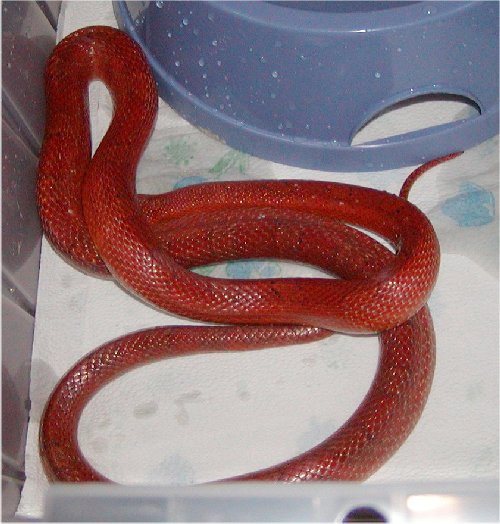
Image
-----
Thanks for reading.
Big Tom

www.HerpZillA.com

KevinM Dec 19, 2008 11:13 AM

Hi Jessica,

Yes there is variation in "normal" corns from various regions. For example, the "miami" phase is a normal variant orginally found in Dade County, Florida and the "Okeetee" phase is a normal variant orginally found in South Carolina around the Okeetee Hunt Club area. "Lower Keys" corns are found in the lower keys of Florida. The "miami" variant typically displays a more grey background with orange blotches (very nice contrast), while the "okeetee" variant obviously is the classic vibrant orange and red with thick black borders many desire. "Lower Keys" normal corns are typically more muted and hypomelanistic looking naturally. Even blood red corns were developed from normal wild corns that were captured in (I believe) the north part of Florida that exhibited reduced black and more diffusion of the blotches and background color (I think it was called the "hastings" phase normal corn at one time). Of course, breeders have line-bred many of these "normal" types to produce "best of the best" examples of what these types should look like. Some don't even have blood lines from where the original normal phase was captured in the past (okeetee phased corns are a good example).

I know this post is a bit long, but I hope it clarifies some of the "normal" phase questions you have. A lot of the newer/younger herpers aren't exposed to where these "normal" phases were derived from in the wild. Below is a pic of normal wild caught male "Okeetee" corn captured in South Carolina that I acquired several years ago.

Site Tools


