

Am planning on posting this on my website so any thoughts, ideas, suggestions for change etc are most welcome......
I get asked how I breed my rodents from time to time so thought I'd document it for others to copy, modify, ignore or even laugh at. 
I breed my rats in a method I call cycle breeding. The females are introduced to a male to get impregnated and are removed to give birth and raise up surviving (not fed off) babies. This way I can control my weekly production better and not have larger fluctuations in my weekly numbers.
Bedding - I currently am using Equine Fresh pelleted pine bedding. In the smaller tubs I also add in a handful of pine shavings for nest material.
Food - I'm in a local co-op, we order food directly from some local feed mill "Roger's rodent diet" I guess originally "Roger" set up the mill with a formula and we have picked it up somewhere along the way. Minimum order is 4 tons. That's 160 50# bags or four pallets of 40 bags each. Hence the co-op! None of us individually could afford/store/use that much at one time. So, when it's time to order, we all meet up at the delivery location and split up the load. More or less 40 bags each but we do work with one another to adjust who gets how many so nobody runs out or gets overstocked.
Water - pressure regulated constant supply. No bottles, no buckets to fill - grins!!!
Each of my breeder female rats has her own history tag that follows her around the "factory". I keep many color varieties so I can get multiple animals in a single cage and still be able to tell them apart. Colors I have are...
Black, Tan, Blue, Brown (each in solid and hooded)
White and Siamese
That's a total of 10 colors so you can see that helps identify individuals in a group.
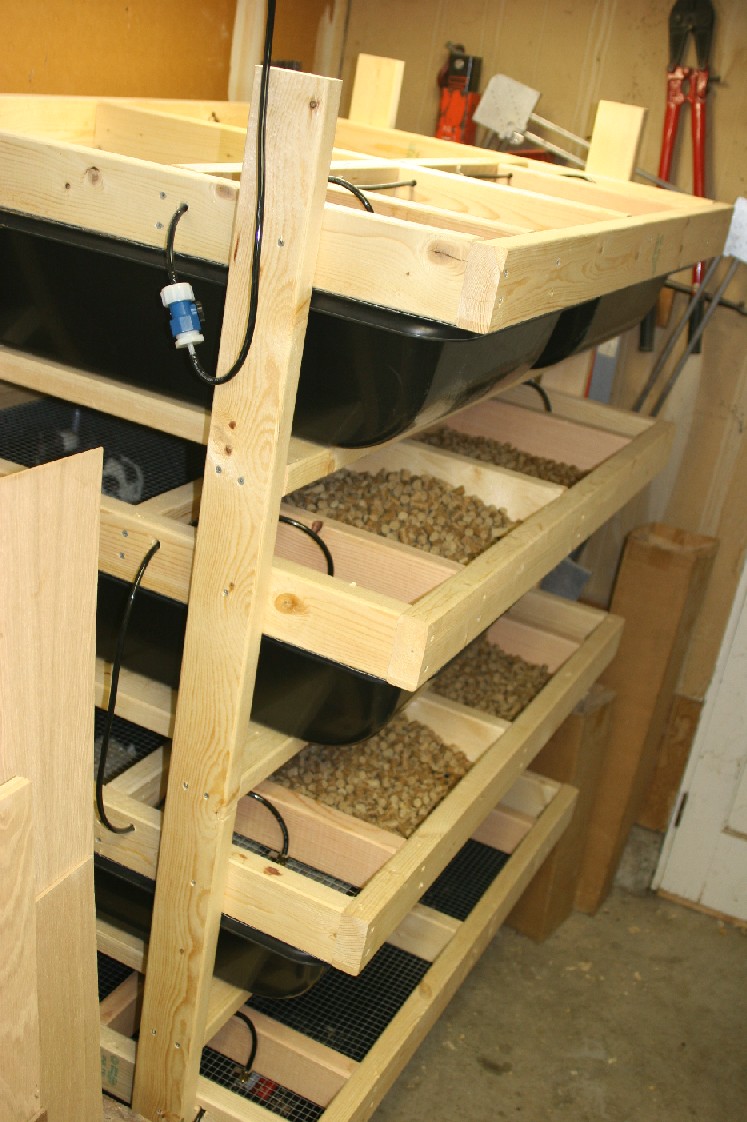
The "factory" is housed in three racks, two 24 tub cat litter pan racks I bought used and one 8 slot large mortar tub rack I made for growing up larger feeder rats.

The left hand cat litter tub rack is my rat "breeding" and mouse rack.
The right hand cat litter tub rack is my rat "birthing and raising" rack.
The mortar tub rack is for growing up larger rats to feed the larger snakes.
None of the tubs are actually numbered but for this document.... The cat litter tubs start with "1" in the upper right corner and serpentine down to the lower right corner so, by level it's...
4, 3, 2, 1.
5, 6, 7, 8.
12, 11, 10, 9.
13. 14, 15, 16.
20, 19, 18, 17,
21, 22, 23 & 24
I know it seems odd but the "next" position in the rack is always one spot away and that's good with hoppers!!!
For the grow-out rack....
2, 1,
4, 3,
6, 5,
8, 7
The whole process hinges around cleaning day. But remember, by each cleaning day, I've fed off various sized feeders to my snake collection so many tubs are not full.
I start by cleaning the grow-out rack, one tub at a time. Starting with the largest rodents and working my way down moving individual rats up as necessary to keep tubs full to capacity.
Tub #1, my largest males. 16 each
Tub #2, next largest males 16 - 20 depending on size
Tub #4, third largest males 16 - 30 depending on size
Tub #6, fourth largest males 16 - 30 depending on size
Tub #3, future breeder females 16 - 20 depending on size
Tub #5, surplus females 16 - 30 depending on size
Tub #7, weaned and unsexed. Typically 30 - 40
Tub #8, weanlings with breeder moms - anywhere from 2 - 6 litters
(tubs 4 - 8 have extended, protected, water line holders so smaller rats can reach nipple without getting at water line)
When all is said and done tub # 8 is usually empty and I have those breeder females set aside to be bred again.
Next to clean is rack #2 - rat birthing and raising.
Starting at tub #1, the "oldest" babies, Typically 2 ½ - 3 weeks old. I take those and any of the next tubs in sequence that are the same(ish) age, and move those to grow-out rack tub #8 along with enough breeder females to support them. Remember, all tubs are no longer full so some of those breeder females are not needed and again set aside for breeding again. I pick out a group of females that are different colors so I can tell them apart next week when they go to the breeding tubs.
Note: in the rat birthing and raising rack, once babies are born, two females along with 24ish babies are combined into one tub.
After removing the almost weanlings to the grow-out rack, that leaves empty spaces at the top. I clean and cycle the next in line babies up to the last available tub slot. Keeping two females and 24ish babies in each tub. My female rats are extremely good at fostering babies. Not just caring for their own. So each cleaning day, I'm breaking up groups and moving babies around so I get the two females and 24ish babies (the same age within a few days) in any given tub. Sometimes I end up with 12ish babies and one female in a tub. Once all the already born babies are done, now in 2/24ish qty per tub, there are usually some leftover females....
1) Preggo ones get a cleaned tub in the lower area of the rack.
2) Ones that gave birth and had all babies taken are grouped in tubs with others to be bred again.
3) Non-preggo ones either get bred again (only if I'm short on females or is a good reason they did not get pregnant) or surplused into a snakes belly.
By this time the rat birthing/raising rack is all clean and there is about half of it empty. Again, several females set aside in the lower area ready to be bred again.
Next is the rat breeding / mouse rack. The last 14 tub slots hold 13 tubs. Each with a breeder male and his current harem. The 14th slot is so I can move the rats to stay in the breeding rack to the adjacent empty slot.
Each breeding tub contains it's breeder male and up to three breeding females. On the front are the females record tags. The right hand tag has been there three weeks, the middle tag has been there two weeks and the left hand tag only one week.
So, depending on which way the breeding tubs are currently, I place a clean tub in either the first or last slot and move the adjacent tub male and the two least amount of time females to the clean tub. I also move their tags and at the same time move them one position to the right. The middle tag will now be the right hand tag and the left hand tag will now be in the middle of the tub leaving the left hand position open for a new female to be added.
The remaining female, matching the right hand card, is moved to a clean individual tub in the birthing rack along with her tag, placed on the left side so I know to check her for babies. Once born and recorded, the tag is moved to the right.
Now there is a new empty slot in the breeding rack, repeat process for each breeding tub.
Two or three times as I go, I will add in a new breeder female to each cleaned breeding tub. Watching colors so I don't get two of the same color females in the same tub. Of course if I don't want to "start" 13 litters, I don't add in 13 females. That is just about maximum production.
Last on the cleaning list is the 10 mouse tubs on top. Those are pull the tub, replace with a clean one and add back in the mice and babies. I only use them to produce mouse hoppers and even that, not enough
Phew, sounds complicated as I write it all down but really is just several steps repeated many times each week. I like the cycle process because I can closely control my production levels. Yes, some will crap out so I don't always get 13 litters. And not all litters are exactly 12 babies. Still, all in all I get a pretty consistent weekly volume of babies born and the "rat factory" is working for me!
-----
Thanks,
Dave Colling

www.rainbows-r-us-reptiles.com
0.1 Wife (WC and still very fiesty)
0.2 kids (CBB, a big part of our selective breeding program)
LOL, to many snakes to list, last count:
26.49 BRB
20.21 BCI
And those are only the breeders 
lots.lots.lots feeder mice and rats 
